

Grand Blanc Senior Joins Officials 'Legacy'
February 15, 2017
By Lisa Paine
Swartz Creek View
HARTLAND – Michigan, not unlike most other states across the nation, is struggling with a shortage of officials for junior high and high school sports. Steve Tannar, the Kensington Lakes Activities Association assigner, says locally that Michigan High School Athletic Association registered officials are down by one third.
Looking to stem the tide, the MHSAA is reaching out to high school juniors and seniors through its Legacy Officials Program.
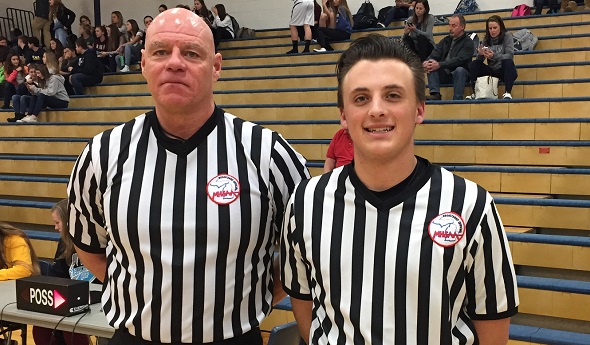
Jason Caine, a Grand Blanc senior, is working with his veteran partner, Shawn Waterman. Caine said he came across the program through an online application and “just wanted to give it a try.”
“I attended a clinic at Goodrich High, just the basics, and it just took off after that,” said Caine. “After the clinic I attended Rules School and the Genesee County Officials Association (GCOA). Through that, I got partnered with Shawn Waterman (a veteran MHSAA official). They mentor us and show us the basics.”
Caine is also being mentored by eight-year MHSAA official and former coach Brian Morley of Grand Blanc. Caine, who played freshman and junior varsity baseball at Grand Blanc, said he’s not a typical multi-sport athlete.
“I’m a DECA Officer at Grand Blanc,” explained Caine. “It’s a business club that presents their businesses to potential investors. Officiating is a side hobby that I want to pursue. Next year I plan on attending college and with officiating, I can take that with me wherever I go.”
Tannar said the ultimate goal of the Legacy program is to get the word out to recruit more teens like Caine.
“The main reason we are looking to grow our officials program is because we have such an officiating shortage all over the country,” said Tannar. “Not many of us are under the age of 40. The average age of our officials is mid to upper 50s. If we don’t recruit and get them working now, we’re going to be faced with a shortage of officials.”
“It really began when they switched girls basketball (to winter) and everyone tries to play triple headers on Tuesday and Friday,” explained Tannar. “I need 42 officials in one night to fill the six schools I assign for the KLAA.”
Tannar noted that in 2012 the GCOA qualified 125 officials to work in MHSAA tournaments. This year that number dropped to 84.
“Mentoring the rookie officials such as Caine is a big responsibility," said Morley, who is one of three officiating trainers in the area. He’s been officiating in the Saginaw Valley League, Flint Metro League, Genesee Area Conference and KLAA.
“This year we were in an ad for the MHSAA, and Jason was one that responded. He was looking for something other than working at McDonald’s. I told him the MHSAA has a program in place to train officials,” said Morley, who found his own path to the MHSAA officials program as an adult.
Morley also spoke to the number of officials needed.
“We figured for the Saginaw Valley plus the Thumb area and into where Steve is (KLAA), somewhere between 300 and 400 officials are needed on a given Tuesday or Friday,” Morley said.
 Officiating isn’t easy, as it’s about more than just calling the games, noted Tannar.
“The number one reason for quitting officiating is the fans and their reactions, not the coaches or players,” Tannar said.
Mark Uyl, assistant director for the MHSAA and its coordinator for officials, echoed that. He’s seen the profession take its hits over the past five years.
“The biggest challenge in officiating is it’s a thankless job,” Uyl said. “We are expected to be perfect on our first day. But you can’t play without officials, so our culture needs to rethink how we are acting as fans in the athletic arena. We are in an angrier society right now and until that trend reverses itself, we face that challenge.”
“So much of officiating is handling people, managing emotions. If we can keep getting people of all ages interested in our officiating program, we can continue to put quality officials at all levels of games – youth sports, junior high through high school and into the college games,” Uyl said.
The fans were one of Caine’s first concerns.
“It was a little nervy at first, but when I got up there, Shawn was a great partner and assured me everything was OK no matter what the outcome,” said Caine. “My background at the clinics and Rules School gave me the confidence.”
Morley explained the importance of teaming up rookies with veterans.
“That’s why this training is so important. If Jason and these others didn’t have us to learn from, lean on, fans can be brutal. Part of our training is how to combat or ignore the angry fans and block that out and do what we need to do in these games. Our job is protect our rookies in their first couple of years to help everyone handle the heat of the moment. We can’t lose someone because of the ugliness that often goes on around us,” said Morley.
The money isn’t bad either. Morley and Uyl said refs can pick up anywhere from $35 to $65 on any given night.
"Many don’t realize how good the money is in officiating,” said Uyl. “After school jobs are $9-10 dollars an hour. (Officiating), they can make $35 in one game.
Tannar said the plan is to turn up recruiting another couple of notches into the next year.
“Next year we want to get into the schools and do a presentation to an all-level program at every school. If I can get one or two kids, that gets us 40 new officials.”
Uyl is grandfathering in Legacy Official students for free, saving them money on the typical registration fees.
More clinics are planned for the Legacy Officials program in the spring and fall of 2017.
This story originally appeared in the Dec. 29, 2016, edition of the Swartz Creek View and is reprinted with permission.
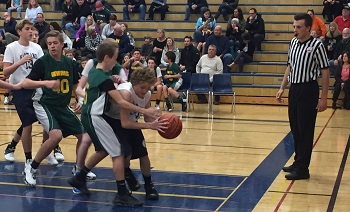
PHOTOS: (Top) Veteran official Shawn Waterman (left) stands with Grand Blanc senior Jason Caine during Caine's first game as an MHSAA referee Nov. 30. (Middle) Caine monitors the action during the junior high game in Hartland. (Photos courtesy of Steve Tannar.)
Sontag Inspires Amid 'Miracle' Cancer Fight
January 3, 2020
By Doug Donnelly
Special for Second Half
PINCKNEY – Dave Sontag could tell something was wrong.
 The gymnasium at Petersburg-Summerfield High School is bigger than most in Monroe County. But when Sontag, a veteran official, was running up and down the floor, he felt unusually tired and began feeling pain in his back.
“I knew something was wrong,” Sontag said. “During a timeout, I told one of the other officials who was in the stands watching that he might have to finish the game.”
Sontag, however, pushed through and made it.
“That’s when it all began,” he said.
A few weeks later, as the Saline varsity baseball coach, Sontag was hitting fly balls to the Hornets’ outfielders.
“I was struggling,” he said. “I called the players in and told them something was wrong. I had to stop.”
Still trying to fight through whatever was wrong, Sontag was coaching third base during a Saline intra-squad scrimmage a short time later.
“I started to see white,” he said.
He had another member of the Saline coaching staff call his wife, Michelle, who came and picked him up and took him to the hospital in Chelsea.
“My blood counts were trash, just trash,” he said. “The doctors said I need to have a blood transfusion.”
He was rushed to a Detroit-area hospital for the transfusion. After tests, Sontag was diagnosed with acute lymphoblastic leukemia, an extremely vigorous, aggressive cancer. That was May 15, 2018.
During the 18 months since, Sontag has gone through chemotherapy and radiation treatments. He’s watched multiple communities respond with fundraisers and benefits and amazing support. He’s had more than one bone marrow transplant. He’s heard from countless friends and ex-players who have continued to lift his spirits day after day via e-mails and text messages. He’s been counted out more than once.
Yet, he’s survived.
“Every day has been a challenge,” he said.
***
Sports and Sontag have gone together from the beginning.
He is a Monroe County native who was The Monroe Evening News Player of the Year in baseball in 1978 and went on to play at the University of Toledo. He taught journalism and English at his alma mater, Monroe Jefferson, before becoming a counselor for another 12 years. He was also the Jefferson director of athletics and recreation for a time.
 He coached baseball for the Bears, leading the team to nearly 400 victories and the Division 2 championship in 2002. He stepped down from coaching to follow his kids, who were playing at higher levels; Ryan Sontag played at Arizona State University and in the Chicago Cubs organization. Susan played softball at Bowling Green State University, and Brendan played ball at Indiana Tech University.
Still, the desire to coach never left their dad.
“After my kids were done playing, I coached freshman baseball at Jefferson,” he said. “I missed it and still wanted to be part of it.”
With his wife a principal in the Saline district, Sontag was asked by Scott Theisen, Saline’s head coach, to join his staff in 2015. He was with the Hornets when they captured the Division 1 championship in 2017, then was named head coach before the 2018 season started.
“That was the year I got sick,” he said. “I didn’t even finish the year.”
Sontag also has been a basketball official for years, getting his start in the early 1980s. He’s been a registered MHSAA high school basketball official for 40 years and has trained officials for the Monroe County Basketball Officials’ Association. He’s called four MHSAA Finals championship games.
“My first varsity game ever was when I was 21,” Sontag said. “I refereed a game at Whiteford.”
***
Sontag previously battled non-Hodgkin’s lymphoma in 1995-1996, beating that disease after a nine-month battle.
Although this cancer battle began as he was new to the Saline community, they embraced his fight, selling “Team Tags” T-shirts and painting the youth baseball diamond with a big ribbon. His son, Ryan, was invited to throw out the first pitch before the youth baseball season started in Dave’s honor.
Back home, in Monroe County, Sontag’s school held similar fundraisers and blood drives.
“I had so much support,” he said. “It was quite amazing to see.”
He tried all sorts of treatments, ultimately boarding an airplane and heading to Seattle for a clinical trial. It didn’t work.
“At that point, I didn’t think I was going to live,” Sontag said. “They told me there was nothing more they could do. They just were giving me something to take the pain away. I was miserable.”
Still, Sontag said, he held out hope.
“I felt it wasn’t time yet,” he said. “I have three grandkids. There are things I want to do. There’s so much I haven’t accomplished yet. In Seattle, they didn’t count on me living.”
But, for a still-unexplained reason, a combination of the medicine he was given to “take the pain away,” on his flight home and a different medicine he received when he returned to Michigan, started to change the way he felt. His blood counts started getting better.
“The side effects were lousy, but, for some reason, it threw me into remission. They checked for leukemia and it was not there.
“We called it a miracle.”
***
Sontag, who lives in Pinckney now, is still dealing with the side effects of nearly two years of treatments. He has a tingling sensation in his arms and legs – the feeling people get when their hands or feet ‘fall asleep’ – and he has a weak immune system.
 But he gets a little better every day.
“Every day is a blessing,” he said.
In addition to the community support and constant praying, he credits his wife with guiding him through this process.
“Michelle has been a rock through all of this,” he said. “She’s been by my side every single day. Without her, I don’t know if I would have made it.”
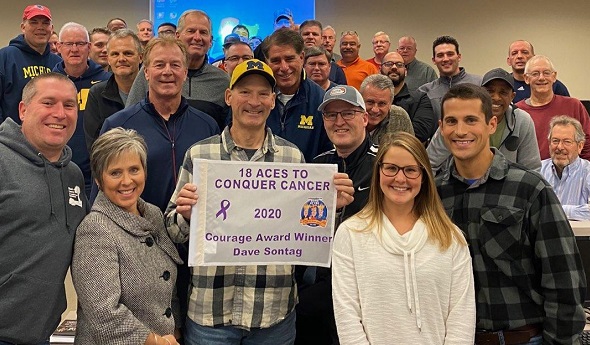
Recently, the Monroe County Officials’ Association held a banquet during which Sontag was presented with a “Courage Award.” He isn’t sure if he’ll be able to referee again anytime soon.
“I told them that night that I’d like to do it again, somewhere,” he said. “I don’t care of it’s a seventh-grade game. I just want to get out there again.”
In addition to the outpouring of love from multiple communities, family and friends, Sontag said sports has kept him alive.
“Sports is part of my fabric,” he said. “Baseball and officiating basketball games has given me that motivation I’ve needed to fight through this. I don’t know if I will coach again or referee again. I’m definitely not going to jump into the same schedule. But there are things I would like to do.
“Will I become a head coach again? Probably not. The task of being a head coach is probably too big right now. But I’d like to be involved. I’d still like to run camps and clinics. I’d still like to officiate too. I want to be a part of it. It’s something that’s in my blood.”
His son Ryan lives in Saline and has three children. Ryan coaches his son in a youth baseball league.
“He called me the other day and asked if I’d help him out,” Dave Sontag said. “I told him I think he will get me out there at some point.”
 Doug Donnelly has served as a sports and news reporter and city editor over 25 years, writing for the Daily Chief-Union in Upper Sandusky, Ohio from 1992-1995, the Monroe Evening News from 1995-2012 and the Adrian Daily Telegram since 2013. He's also written a book on high school basketball in Monroe County and compiles record books for various schools in southeast Michigan. E-mail him at [email protected] with story ideas for Jackson, Washtenaw, Hillsdale, Lenawee and Monroe counties.
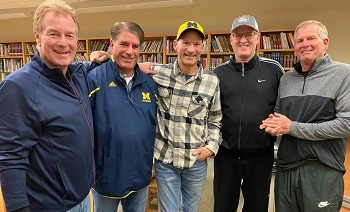
PHOTOS: Longtime official and coach Dave Sontag – standing in front row with wife Michelle, daughter-in-law Amy and son Brendan – is presented a “Courage Award” by the Monroe County Officials Association. (Middle) Sontag, formerly baseball coach at Monroe Jefferson and Saline, mans his spot on the baseline. (Below) Sontag with officials, from left, Mike Gaynier, Mike Bitz, Mike Knabusch and Dan Jukuri. (Top and below photos courtesy of Knabusch; middle photo courtesy of the Monroe News.)