

The Official View: The Couple That Officiates Together
By
Brent Rice
MHSAA Assistant Director
October 8, 2018
By Brent Rice
MHSAA Assistant Director
This key to a long and happy marriage is officiating school sports.
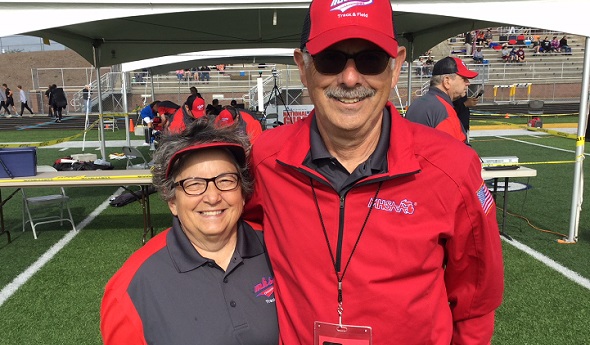
Richard and Christine Lee from Brown City are proof. Richard has been officiating with the MHSAA for 42 years, and Christine has been an MHSAA official for 23 years. And this spring they celebrated their 45th wedding anniversary!
Of course, they celebrated in part by working a meet together, as seen in the photo above.
It’s Official!
Rules Meetings: With winter sports just around the corner, many of you already have begun getting into officiating shape and studying up on rules and mechanics in preparation of another great MHSAA season. Don’t forget to tend to the administrative requirements for postseason tournament consideration. The first Winter Online Rules Meetings become available starting today.
Here is the schedule for this year:
Oct. 8 – Basketball, Ice Hockey, Competitive Cheer and Wrestling
Oct. 15 – Gymnastics and Swimming
All Online Rules Meetings will close Dec. 13 at 11:59 pm. Don’t miss out on postseason opportunities because you put off (then forget) these requirements.
Rule of the Week
CROSS COUNTRY As A1 reaches the 3,000-meter mark, the umpire notices that the runner has multi-color compression shorts with a manufacturer’s logo that extends beneath the runner’s shorts but above her knees.
Ruling: There is no violation and no warning should be given. New NFHS cross country rule 4-3-1 provides that any visible garment(s) worn underneath the uniform top and/or bottom are considered a foundation garment. A foundation garment is any item worn under the uniform top and/or bottom and is not subject to logo/trademark/reference or color restrictions.
It’s Your Call
FOOTBALL On this play, the right guard pulls as the running back receives the handoff. The play results in a half-yard loss, but is there more to this play? What’s the call?
Last Week’s IYC Ruling: In order for the first contact to be considered a “block,” some part of the player’s hands must extend higher than the top of the net. This is a very close call as to whether her hands meet this – probably too close to consider them “below.” (Click to see the video from last week.)
The more pertinent aspect that applies to this play is whether she is still a blocker based on her playing action. One thing we should look at to determine whether this is a defensive or offensive play is arm swing. When the player in the clip takes a swing at the ball, this becomes an attack. As a result, the second contact by the front row member of Team R should be called a double hit violation.
Be the Referee: Sideline Management
December 5, 2014
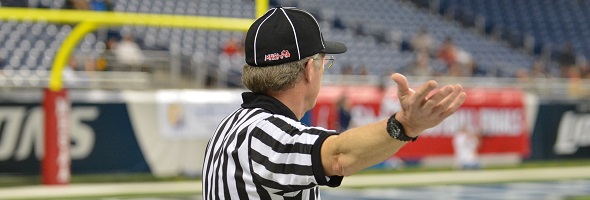
This week, MHSAA assistant director Mark Uyl dicusses how the sideline rule helps to keep the adults working in football, including coaches and officials, safe during football games.
"Be the Referee" is designed to help educate people on the rules of different sports, to help them better understand the art of officiating and to recruit officials. The segment can be heard on Mondays, Wednesdays and Fridays during the school year on The Drive With Jack Ebling on WVFN-AM, East Lansing.
Below is this week's segment - Sideline Management - Listen
The hottest topic right now in the sport of football deals with safety. We have talked a great deal over the fall about some new rules that have improved player safety. Today we’re going to focus on the adults - specifically coaches and officials that work at the sideline area just in front of the team box.
The rules require that from the time just before the snap until the end of the play, all coaches and team personnel must be completely out of the 6-foot safety zone located in front of the team box at each sideline. This then gives the official plenty of room to work unimpeded in either direction.
Now as soon as the play ends, coaches can move into this area to instruct their players or send in the next play and then move back prior to the next snap.
Past editions
Nov. 19 - 7-Person Mechanics - Listen
Nov. 12 - Blocking Below the Waist - Listen
Nov. 5 - Tournament Selection - Listen
Oct. 29 - Uncatchable Pass - Listen
Oct. 22 - Preparation for Officials - Listen
Oct. 15 - Automatic First Downs - Listen
Oct. 8 - Officials & Injuries - Listen
Oct. 1 - Overtime - Listen
Sept. 25 - Field Goals - Listen
Sept. 18 - Tackle Box - Listen
Sept. 11 - Pass Interference - Listen
Aug. 25 - Targeting - Listen