

The Official View: Winter Wonderland

By Brent Rice
MHSAA Assistant Director

November 12, 2018

By Brent Rice
MHSAA Assistant Director

In this week’s “Official View” we explain the important of insurance and offer a brief primer on how the MHSAA helps officials stay covered.

We also work through some rule scenarios in football, volleyball and swimming and take a look at a few of the wintery scenes braved not only by teams on the field and fans in the stands but officials in stripes as well.

It’s Official!

Most officials will go their entire lives without needing to utilize insurance coverage for something that occurred while officiating. In the often rough-and-tough world of school sports, though, the need for officials to protect themselves on and off the field has never been greater. While officiating is not considered a dangerous avocation, officials should prepare themselves for those one-in-a-million situations.

There are a variety of coverage options out there for officials, ranging from medical and loss of income coverage due to injuries sustained while officiating to liability coverage and legal fees. Officials, individually and through their associations, can purchase increased coverages that suit their needs.

The MHSAA continues to look out for the best interests of our registered officials in this area and in other ways. When officials annually register with the MHSAA, they are included in both a comprehensive liability plan and catastrophic medical coverage for incidents that occur during MHSAA contests. Major injuries due to officiating are rare, but it is nice to have the security that you’re covered in the event of some tragic event. Though the few lawsuits that officials are a party to are often summarily dismissed, the MHSAA’s liability coverage kicks in at dollar one, including any legal fees or attorney retainers.

We will be seeking your feedback in how we can best serve these interests as they pertain to increased insurance coverage, training and development and providing additional useful resources. We thank you for your input and continued commitment and dedication to the MHSAA and the Officials Program.

Rule of the Week

FOOTBALL It’s 4th-and-8 on Team K’s 35-yard line. R1 signals for a fair catch at Team R’s 40-yard line. R1 muffs the punt, and the ball is picked up by K5 at Team R’s 35. With no one else around, K5 runs into his end zone for an apparent touchdown.

Ruling: The ball is dead at the moment the muffed kick is possessed by Team K. The ball cannot be advanced. It will be 1st-and-10 for Team K on R’s 35.

It’s Your Call

VOLLEYBALL This week’s clip shows a back row player for Team S making a back row attack and then landing on the attack line. What’s the call?

Last Week’s IYC Ruling: Last week’s video shows a swimmer drifting into the lane divider before ultimately finishing first in the meet. This incidental contact with the lane divider is legal since she did not grab ahold or otherwise use the divider to pull herself through the water. (Click to see last week's video.)

Official View: Reffing in a Winter Wonderland

The first day of winter is scheduled for Dec. 21, but you wouldn’t know that by the weather from this past weekend’s football games.
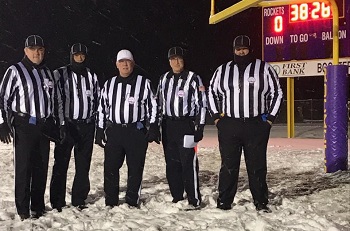
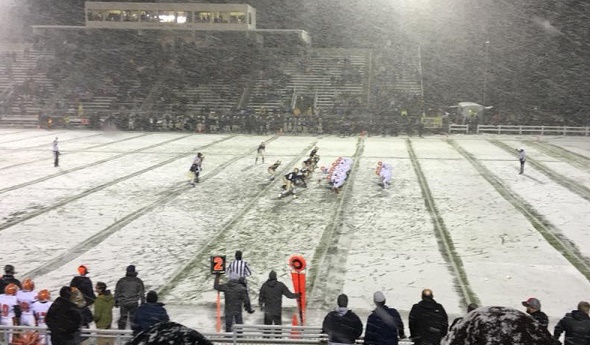
Snow covered most of the state Friday and Saturday, even causing some teams to play in a couple of inches of the falling white stuff. Just like our teams, the officials braved the cold and flurries to ensure another great week of MHSAA football.

The top photo shows Thirlby Field during the Division 6 Regional Final between Traverse City St. Francis and Kingley.

The photo above and to the right is from the 8-Player Semifinal between host Rapid River and Cedarville. The crew, from left: Joel Mitrzyk, Mark Pieniozek, Jan Viliquette, Paul Binder and David Paananen.

Sontag Inspires Amid 'Miracle' Cancer Fight

January 3, 2020

By Doug Donnelly
Special for Second Half

PINCKNEY – Dave Sontag could tell something was wrong.

The gymnasium at Petersburg-Summerfield High School is bigger than most in Monroe County. But when Sontag, a veteran official, was running up and down the floor, he felt unusually tired and began feeling pain in his back.

“I knew something was wrong,” Sontag said. “During a timeout, I told one of the other officials who was in the stands watching that he might have to finish the game.”

Sontag, however, pushed through and made it.

“That’s when it all began,” he said.

A few weeks later, as the Saline varsity baseball coach, Sontag was hitting fly balls to the Hornets’ outfielders.

“I was struggling,” he said. “I called the players in and told them something was wrong. I had to stop.”

Still trying to fight through whatever was wrong, Sontag was coaching third base during a Saline intra-squad scrimmage a short time later.

“I started to see white,” he said.

He had another member of the Saline coaching staff call his wife, Michelle, who came and picked him up and took him to the hospital in Chelsea.

“My blood counts were trash, just trash,” he said. “The doctors said I need to have a blood transfusion.”

He was rushed to a Detroit-area hospital for the transfusion. After tests, Sontag was diagnosed with acute lymphoblastic leukemia, an extremely vigorous, aggressive cancer. That was May 15, 2018.

During the 18 months since, Sontag has gone through chemotherapy and radiation treatments. He’s watched multiple communities respond with fundraisers and benefits and amazing support. He’s had more than one bone marrow transplant. He’s heard from countless friends and ex-players who have continued to lift his spirits day after day via e-mails and text messages. He’s been counted out more than once.

Yet, he’s survived.

“Every day has been a challenge,” he said.

***

Sports and Sontag have gone together from the beginning.

He is a Monroe County native who was The Monroe Evening News Player of the Year in baseball in 1978 and went on to play at the University of Toledo. He taught journalism and English at his alma mater, Monroe Jefferson, before becoming a counselor for another 12 years. He was also the Jefferson director of athletics and recreation for a time.

He coached baseball for the Bears, leading the team to nearly 400 victories and the Division 2 championship in 2002. He stepped down from coaching to follow his kids, who were playing at higher levels; Ryan Sontag played at Arizona State University and in the Chicago Cubs organization. Susan played softball at Bowling Green State University, and Brendan played ball at Indiana Tech University.

Still, the desire to coach never left their dad.

“After my kids were done playing, I coached freshman baseball at Jefferson,” he said. “I missed it and still wanted to be part of it.”

With his wife a principal in the Saline district, Sontag was asked by Scott Theisen, Saline’s head coach, to join his staff in 2015. He was with the Hornets when they captured the Division 1 championship in 2017, then was named head coach before the 2018 season started.

“That was the year I got sick,” he said. “I didn’t even finish the year.”

Sontag also has been a basketball official for years, getting his start in the early 1980s. He’s been a registered MHSAA high school basketball official for 40 years and has trained officials for the Monroe County Basketball Officials’ Association. He’s called four MHSAA Finals championship games.

“My first varsity game ever was when I was 21,” Sontag said. “I refereed a game at Whiteford.”

***

Sontag previously battled non-Hodgkin’s lymphoma in 1995-1996, beating that disease after a nine-month battle.

Although this cancer battle began as he was new to the Saline community, they embraced his fight, selling “Team Tags” T-shirts and painting the youth baseball diamond with a big ribbon. His son, Ryan, was invited to throw out the first pitch before the youth baseball season started in Dave’s honor.

Back home, in Monroe County, Sontag’s school held similar fundraisers and blood drives.

“I had so much support,” he said. “It was quite amazing to see.”

He tried all sorts of treatments, ultimately boarding an airplane and heading to Seattle for a clinical trial. It didn’t work.

“At that point, I didn’t think I was going to live,” Sontag said. “They told me there was nothing more they could do. They just were giving me something to take the pain away. I was miserable.”

Still, Sontag said, he held out hope.

“I felt it wasn’t time yet,” he said. “I have three grandkids. There are things I want to do. There’s so much I haven’t accomplished yet. In Seattle, they didn’t count on me living.”

But, for a still-unexplained reason, a combination of the medicine he was given to “take the pain away,” on his flight home and a different medicine he received when he returned to Michigan, started to change the way he felt. His blood counts started getting better.

“The side effects were lousy, but, for some reason, it threw me into remission. They checked for leukemia and it was not there.

“We called it a miracle.”

***

Sontag, who lives in Pinckney now, is still dealing with the side effects of nearly two years of treatments. He has a tingling sensation in his arms and legs – the feeling people get when their hands or feet ‘fall asleep’ – and he has a weak immune system.

But he gets a little better every day.

“Every day is a blessing,” he said.

In addition to the community support and constant praying, he credits his wife with guiding him through this process.

“Michelle has been a rock through all of this,” he said. “She’s been by my side every single day. Without her, I don’t know if I would have made it.”

Recently, the Monroe County Officials’ Association held a banquet during which Sontag was presented with a “Courage Award.” He isn’t sure if he’ll be able to referee again anytime soon.

“I told them that night that I’d like to do it again, somewhere,” he said. “I don’t care of it’s a seventh-grade game. I just want to get out there again.”

In addition to the outpouring of love from multiple communities, family and friends, Sontag said sports has kept him alive.

“Sports is part of my fabric,” he said. “Baseball and officiating basketball games has given me that motivation I’ve needed to fight through this. I don’t know if I will coach again or referee again. I’m definitely not going to jump into the same schedule. But there are things I would like to do.

“Will I become a head coach again? Probably not. The task of being a head coach is probably too big right now. But I’d like to be involved. I’d still like to run camps and clinics. I’d still like to officiate too. I want to be a part of it. It’s something that’s in my blood.”

His son Ryan lives in Saline and has three children. Ryan coaches his son in a youth baseball league.

“He called me the other day and asked if I’d help him out,” Dave Sontag said. “I told him I think he will get me out there at some point.”

Doug Donnelly has served as a sports and news reporter and city editor over 25 years, writing for the Daily Chief-Union in Upper Sandusky, Ohio from 1992-1995, the Monroe Evening News from 1995-2012 and the Adrian Daily Telegram since 2013. He's also written a book on high school basketball in Monroe County and compiles record books for various schools in southeast Michigan. E-mail him at [email protected] with story ideas for Jackson, Washtenaw, Hillsdale, Lenawee and Monroe counties.

PHOTOS: Longtime official and coach Dave Sontag – standing in front row with wife Michelle, daughter-in-law Amy and son Brendan – is presented a “Courage Award” by the Monroe County Officials Association. (Middle) Sontag, formerly baseball coach at Monroe Jefferson and Saline, mans his spot on the baseline. (Below) Sontag with officials, from left, Mike Gaynier, Mike Bitz, Mike Knabusch and Dan Jukuri. (Top and below photos courtesy of Knabusch; middle photo courtesy of the Monroe News.)