

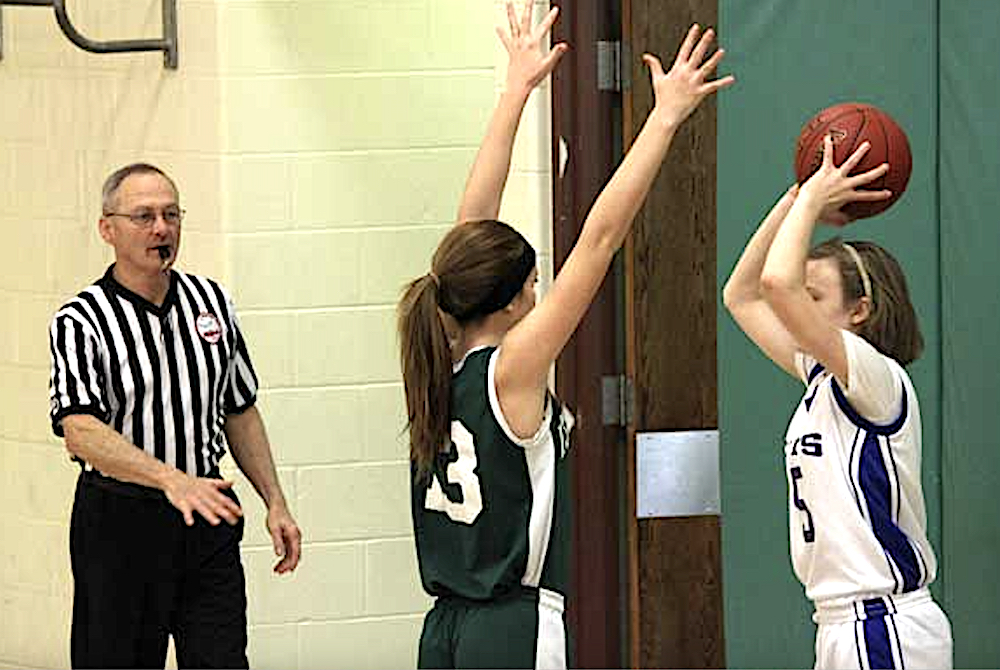
Reeb, Officiating Crew Dedicated to Helping Make Island Games Go
By
Tom Spencer
Special for MHSAA.com
January 8, 2022
High school sports officials are quite familiar with the phrase, “They can’t play the game without you.”
 Athletic Directors are even more familiar with it. They live it. They believe it. Covering the multitude of interscholastic contests is quite daunting for mainland Michigan ADs.
School officials on Mackinac Island and Beaver Island have an even bigger task.
That’s where Dave Reeb comes in. He’s been officiating volleyball and basketball for as long as folks can remember.
Without Reeb, 73 years young, and his partners, the island athletes simply wouldn’t be able to play the game.
“For many years Dave has organized getting refs over to the Island for our volleyball and basketball programs,” said Kerry Smith, Beaver Island AD. “He always makes sure we have someone here.
“Especially at a time when refs are hard to find, he always comes through for us.”
Reeb would have been at Mackinac Island this weekend with Glen McIntyre to officiate a boys basketball Northern Lights Conference game between the Lakers and Munising Baptist. COVID-19 challenges caused the visitors to cancel the Friday evening and Saturday morning contests.
McIntyre is currently registered for basketball, volleyball and softball with MHSAA. He began officiating in 1979. He got into volleyball a few years ago He’s scheduled to go with Reeb to Mackinac Island again Feb. 11 and to Beaver Island Feb. 18.
In the meantime, Reeb will take advantage of the weekend off and travel to Perry with his wife, Linda, to watch one of his grandsons play middle school basketball. It should be easy traveling as compared with journeying to Mackinac and Beaver.
 Boat, airline and sometimes snowmobiles are offered by the schools to get Reeb and his partners over from the mainland and to the school. Reeb lives in the Inland Lakes area, as do many of his partners.
During his early days of going to the islands, Reeb flew out of Petoskey with his former referee partner Randy Sagante in a private plane actually piloted by Sagante. The two of them were dubbed “The Flying Referees” by a local reporter.
Chartered flights have been the most common mode Reeb and other referees have used to get to both islands.
“With Mackinac, you never know,” said Reeb, a 30-year volleyball and 20-year basketball veteran. “When you go over there on the ice crusher … it’s been fun too.”
Reeb’s next island game is at Beaver Island on Jan. 14. Steve Hines, formerly the longtime girls basketball coach at East Jordan, will be taking his first trip to officiate the Islanders with Reeb. They are scheduled to fly out of the Charlevoix Airport.
Hines has officiated volleyball with Reeb and has been to Mackinac Island once for volleyball. They’ve done basketball games together previously on the mainland.
“When I exited coaching, I decided to give officiating a shot,” Hines said. “I am looking forward to going with Dave.”
Hines is a shiny example of what school administrators love about Reeb. He always comes through with a partner so kids can play the game
“Every time, yep,” Hines said of Reeb.
Amy Peterson, who is now in her second year as superintendent, principal and athletic director for Mackinac Island, is glad she met Reeb shortly after starting on the Lake Huron island. She had been involved in athletics in her previous job at Houghton Lake but only as a parent of school athletes.
Reeb had been coming to Mackinac Island long before she arrived.
“I got to know Dave last year right when I got here,” Peterson said. “One thing about Dave is he is either here himself to help or he knows a whole lot of people who can.
“Being new to this area and the athletic part, he was really helpful.”
Another example of getting officials to the islands is Reeb’s grandson, Jacob. He went to Beaver Island in 2018 and 2019 to referee both volleyball and basketball with his grandfather.
 “After we’d get done, he’d stick around and shoot baskets with the teams,” Reeb said. “They got to know him.
“It was fun for him. It was a connection for him too.”
It isn’t just his just his abilities to get officials nor his officiating skills that stand out for Reeb on the Lake Michigan island though.
“Dave is not only a ref but a friend to our community,” Smith said. “He genuinely cares about the kids and community here.
“He is an amazing asset to our school and the other schools he serves all over Northern Michigan,” Smith continued. “Dave is one of a kind, and we truly appreciate his commitment and dedication to BICS.”
Smith noted Reeb has had a significant impact on student-athletes over the years.
“The kids and parents know him well,” she said. “He goes out of his way to help kids improve skills as well as help new coaches.
“He always has a smile and a kind of easy-going demeanor,” she continued. “Everyone knows Dave, and we will keep him coming back to the island for as long as he wants to ref.”
Reeb has enjoyed the relationships, too, just as he did during his career as an educator with the Inland Lake schools.
“It is great to see the students progress year to year,” he said. “Now I am seeing some of their kids coming through, just like I did at Inland Lakes.
“Some of the fans have been enjoyable … you see them again and again,” he added. “I have really, really enjoyed it, and it helps the schools.”
Retired Beaver Island volleyball coach Connie Boyle indicated Reed was much more than a referee. She was impressed with Reeb’s commitment and saw him as a mentor, coach and a friend to many of the visiting coaches, as well as visiting and island athletes.
“When you ref on the island, it is a huge time commitment because you need to be at Island Airways in Charlevoix for your flight by 4:30 and you will ref basketball and volleyball games that night, as well as first thing in the morning, which means you won't leave the island until 1 o’clock the next day,” she said. “You can always count on Dave to do an impeccable job during the game.”
 Boyle is one of many who noted the specialness and frequency of which Reeb and his wife Linda made quilts and presented them as gifts.
“Occasionally he gifts a senior one of his very special quilts, which are truly amazing and cherished by the girls,” Boyle said. “Because if Dave Reeb thinks you're a special player and person, you stand even a little taller.”
Boyle’ s daughter Caitlin, who died last year after battling a brain tumor, received a quilt from the Reebs. She was part of the Islanders Class of 2009.
Tom Frick, now retired, was a teacher at Mackinac Island and Inland Lake schools. He refereed volleyball and basketball for nine years. He was yet another example of Reeb finding referees to help.
“One day we were talking and he said, ‘Get your stuff, and we’ll do it’ - so I did,” Frick recalled. “We went over there four or five years.
“He was very committed to the those people on the islands,” Frick continued. “They really enjoyed him.”
Weather often interferes with getting on and off the islands. Reeb has never taken the two-hour ferry ride from Charlevoix to Beaver, counting on the plane ride. He has been on the much shorter ferry ride to Mackinac.
For the most part, the flights to the islands have been fine, the officials noted. Only once on each Island did Reeb get “stranded” while refereeing the Lakers and Islanders. He and his partner had to spend another night waiting for the weather to clear for a flight back to the mainland.
 Tom Spencer is a longtime MHSAA-registered basketball and soccer official, and former softball and baseball official, and he also has coached in the northern Lower Peninsula area. He previously has written for the Saginaw News, Bay County Sports Page and Midland Daily News. He can be reached at [email protected] with story ideas for Manistee, Wexford, Missaukee, Roscommon, Ogemaw, Iosco, Alcona, Oscoda, Crawford, Kalkaska, Grand Traverse, Benzie, Leelanau, Antrim, Otsego, Montmorency, Alpena, Presque Isle, Cheboygan, Charlevoix and Emmet counties.
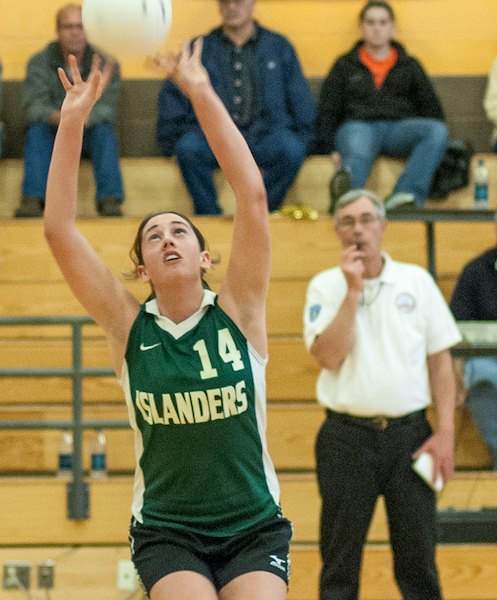
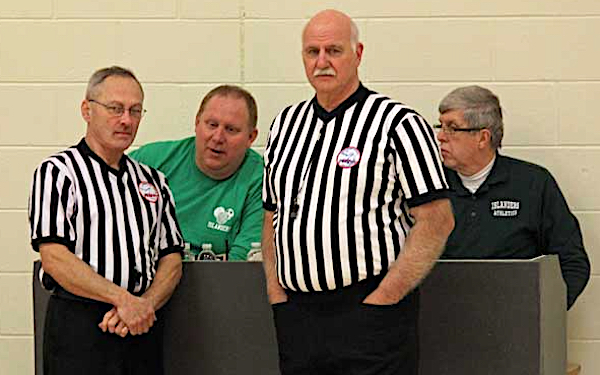
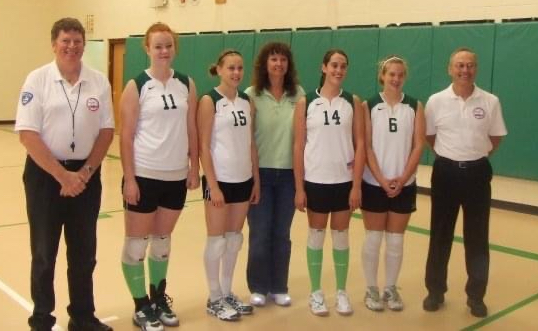
PHOTOS (Top) Official Dave Reeb counts off an inbound during a basketball game at Beaver Island. (2) Former longtime official Morris Porter monitors the action as Caitlin Boyle sets during a 2008 match. (3) From left, Reeb, Gerald LaFreniere, referee Jerry Cook and Rick Speck talk things over at the scorer’s table. (4). From left, former official Randy Sagante with Beaver Island athletes Heather McDonough (11), Deven Cook (15), former volleyball coach Connie Boyle, Caitlin Boyle (14), Maeve Green (6) and Reeb. The four athletes were seniors in 2008-09. (Basketball photos courtesy of Beaver Island News on the ‘Net; volleyball photos courtesy of Frank Solle.)
Norris Winner Jewell an Officiating Gem
By
Geoff Kimmerly
MHSAA.com senior editor
April 8, 2014
When Hugh Jewell looks at the list of past Vern L. Norris Award winners, his eyes are drawn to 1992 honoree Ted Wilson of East Detroit and Redford’s Bob Williams, who earned the Michigan High School Athletic Association officials accolade in 2011.
Both rank highly among those who have mentored Jewell, a 40-year MHSAA official who has worked a combined eight Boys Basketball and Football Finals.
Wilson and Williams also are the only past winners from the Detroit area. And that makes Jewell even more honored to become the third.
 A member of Halls of Fame for both the Detroit Public School and Detroit Catholic High School Leagues, Jewell will receive this year’s Norris Award at the Officials’ Awards & Alumni Banquet on May 3 at the Kellogg Center in East Lansing.
Receiving the call to accept this year’s Norris Award led Jewell to recall many who have helped him along the way – and make a day’s worth of phone calls thanking them for the opportunities and knowledge.
“I’ll never forget certain people who saw something in me even back then, in the 1970s and early 80s, when I was getting on my feet,” Jewell said. “Especially as you get older in this, you have to take on the mentality that whatever it is you learned over the years, there’s reason to give back and pass it to younger (officials).
“Now, reaching the point that I have, I think that’s why a lot of younger guys look forward to games (with me). They see my name, and they know I’m going to give them something to take home with them, even if it’s nothing more than a little bit of advice.”
The Norris Award is presented annually to a veteran official who has been active in a local officials association, has mentored other officials, and has been involved in officials’ education. It is named for Vern L. Norris, who served as executive director of the MHSAA from 1978-86 and was well-respected by officials on the state and national levels.
Jewell, 65, has worked mostly in football, boys and girls basketball, and also a few seasons of volleyball and softball. He also officiated college basketball for more than 20 years, reaching the Division II level.
Jewell officiated MHSAA Boys Basketball Finals in 1986, 1989, 1990 and 1997, and Football Finals in 1991, 1995, 2000 and 2006 in addition to a number of Semifinals and earlier-round tournament games.
Not only have his Finals come in three decades, but Jewell believes he is the only official to work MHSAA Basketball Finals at Crisler Arena, The Palace of Auburn Hills and the Breslin Center. He also began his championship weekend run with a 1986 Class A Semifinal at Jenison Field House.
“He has taken advantage of every opportunity to improve himself in his field,” wrote Alvin Ward, a longtime Detroit teacher, coach and administrator and the PSL’s executive director of athletics, in his nomination of Jewell for the Norris Award. “His always positive personality and strong leadership skills have enabled him to become the respected mentor to all who came in contact with him during his prestigious career.”
Jewell graduated from Highland Park High School in 1966 and was decorated with the Combat Infantryman Badge, Bronze Star with Valor Award, Air Medal Award and Vietnam Campaign Ribbon while serving in the U.S. Army from 1968-70.
Jewell then served as a Highland Park police officer from 1970-78, receiving numerous unit and individual citations, and continued as a police/liaison and security officer at the high school and adjoining community college and adult education center.
Jewell earned a bachelor’s degree in secondary education from Wayne State University in 1979 and took his dedication into the classroom two decades later after earning a teaching certificate in social studies in 2001. He taught from 2001-04 at Highland Park Alternative High School, 2004-06 at the Wayne County Juvenile Detention Center’s Ben Carson Academy and from 2006-10 at the Life Skills Center of Metro Detroit.
He has mentored countless sports officials, students and coaches at Detroit area community and neighborhood centers, and taught volunteer officiating classes at Highland Park Community College from 1980-88.
“Hugh Jewell is renowned not only as a top official who has worked a number of Finals events, but also as a positive influence in the officiating community, “ MHSAA Executive Director John E. “Jack” Roberts said. “He’s passed on his expertise to countless colleagues, students and coaches as a clinician and mentor for more than three decades. We are pleased to recognize Hugh Jewell with the Vern L. Norris Award.”
Jewell also is a member of the Basketball Coaches Association of Michigan and Highland Park Community High School Halls of Fame, and has been an active member of his church and the Highland Park Men’s Forum. In addition to multiple Detroit area officials organizations including the Metro Detroit Officials Association, Jewell is a member of the NAACP and American Federation of Teachers.
He also has served as deputy director of the city of Highland Park’s Parks and Recreation Department, deputy superintendent of the city’s Water & Public Works Department and as a substitute teacher/security specialist for Southfield Public Schools.
In addition to passing along his knowledge of games, Jewell had made sure to create a comfort zone for newer officials – remembering when another veteran did the same for him.
Before tip-off of that 1986 Semifinal at Jenison, official Stan Kemp told his young partner, “Don’t worry about a thing. We’ve got this,” Jewell recalled, and Jewell still appreciates how that put him at ease. (Jewell also remembers Kemp mentioning that will a little luck Kemp might be in the NFL someday – and then turning on a game that fall and seeing him wearing the white hat.)
Other best memories include packed Quarterfinals at the University of Detroit Mercy’s Calihan Hall and Ferndale High School – which over the last 30 years have often hosted matchups of the best Class A teams from the Detroit area as they made bids to reach the MHSAA championship-deciding weekend.
Jewell has helped a number of officials prepare for their first “big games.” He delighted in watching one, Lamont Simpson, work an NCAA Tournament game just a few weeks ago. It’s those relationships, part of an incredible legacy, and the opportunities to pass on lessons learned, that have made officiating a giant part of his life’s work.
“Whether it’s in the pregame conference or postgame chit-chat, I have that responsibility to pass those things on,” Jewell said. “I love hearing (from those officials). That why we stay doing this 30 or 40 years.”
Previous recipients of the Norris Award
1992 – Ted Wilson, East Detroit
1993 – Fred Briggs, Burton
1994 – Joe Brodie, Flat Rock
1995 – Jim Massar, Flint
1996 – Jim Lamoreaux, St. Ignace
1997 – Ken Myllyla, Escanaba
1998 – Blake Hagman, Kalamazoo
1999 – Richard Kalahar, Jackson
2000 – Barb Beckett, Traverse City; Karl Newingham, Bay City
2001 – Herb Lipschultz, Kalamazoo
2002 – Robert Scholie, Hancock
2003 – Ron Nagy, Hazel Park
2004 – Carl Van Heck, Grand Rapids
2005 – Bruce Moss, Alma
2006 – Jeanne Skinner, Grand Rapids
2007 – Terry Wakeley, Grayling
2008 – Will Lynch, Honor
2009 – James Danhoff, Richland
2010 – John Juday Sr., Petoskey
2011 – Robert Williams, Redford
2012 – Lyle Berry, Rockford
2013 – Tom Minter, Okemos
High school game officials with 20, 30, 40, 45 and 50 years of service also will be honored at the Officials’ Awards & Alumni Banquet on May 3. Eight officials with 50 or more years of service will be honored, along with 14 officials with 45 years. A 40-year award will be presented to 74 officials. In addition, 92 officials with 30 years and 183 officials with 20 years of experience will be honored. With the induction of this year’s group of 371, the honor roll of officials who have aided young student-athletes grows to 9,416 since the inception of the banquet in 1980. Click to see the full list of this year’s honorees.
Tickets for the banquet are available to the public and priced at $20. They will not be sold at the door. Tickets can be ordered by calling the MHSAA office at (517) 332-5046 or by sending the order form available at this link.
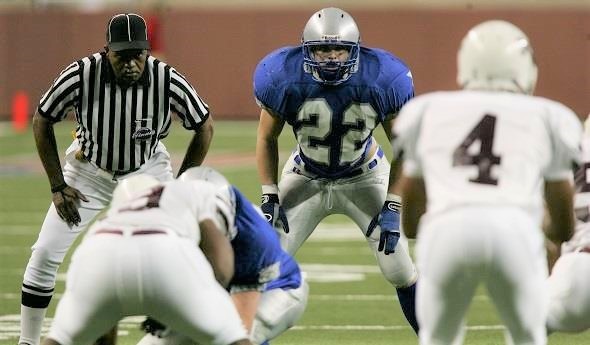
PHOTO: Hugh Jewell officiates the 2006 MHSAA Division 6 Football Final between Inkster and Saginaw Nouvel at Ford Field. VIDEO: Jewell, in 1988, speaks about officiating while working an MHSAA camp.