


The Sports Officiating Challenge
July 30, 2013
Last Saturday, the MHSAA hosted the largest gathering of sports officials ever assembled in this state at one time and place: 1,248 under the same roof.
The occasion was “Officiate Michigan Day” that preceded the 31st Sports Officiating Summit conducted by the National Association of Sports Officials (NASO) in Grand Rapids. The summit began Sunday and concludes this evening in Grand Rapids.
On Sunday afternoon, nearly 300 of Michigan’s officiating leaders – local association officials and trainers and registered assignors – went through three hours of training which the MHSAA requires face to face every other year.
All this comes at a challenging time for our officiating program which is most dramatically demonstrated by this fact: the number of MHSAA registered officials has declined by 1,895 - 17.5 percent – over the past four years!
We know of course that our registration totals were temporarily inflated by two outside factors after 2007. First, after the court-ordered change in sports seasons for girls basketball and volleyball, the MHSAA allowed officials to add those sports to their registration free of charge in 2007-08 through 2010-11. And second, as is always the case, the recession pushed many new people into officiating; but again, just temporarily – we’ve lost many of them as the economy has slowly improved.
I do believe the MHSAA and its member schools and the local officials associations that serve school sports are up to the challenge we face. The same community that just rallied to provide record attendance in Grand Rapids has the ability to reverse the trend that could weaken school-based sports: fewer officials.
We will get there with three E’s: (1) encouraging officials; (2) equipping officials; and, most of all, (3) providing officials an environment in which to thrive – that’s one that is safe, sane and sportsmanlike.
I’ll have more to say on all three E’s over the course of the next few months. In the meantime, I invite you to learn more about officiating in Michigan here at MHSAA.com.
Officate Michigan Day Recap: Photo Gallery | Story
The Official View: The Couple That Officiates Together
By
Brent Rice
MHSAA Assistant Director
October 8, 2018
By Brent Rice
MHSAA Assistant Director
This key to a long and happy marriage is officiating school sports.
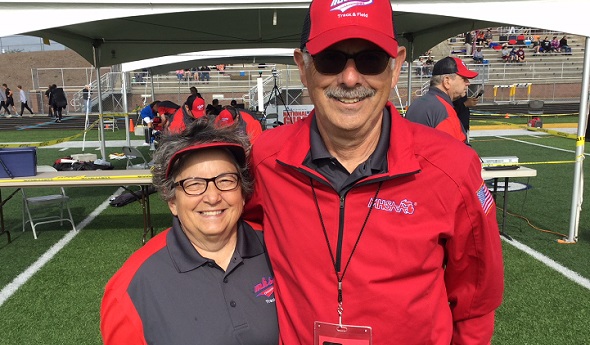
Richard and Christine Lee from Brown City are proof. Richard has been officiating with the MHSAA for 42 years, and Christine has been an MHSAA official for 23 years. And this spring they celebrated their 45th wedding anniversary!
Of course, they celebrated in part by working a meet together, as seen in the photo above.
It’s Official!
Rules Meetings: With winter sports just around the corner, many of you already have begun getting into officiating shape and studying up on rules and mechanics in preparation of another great MHSAA season. Don’t forget to tend to the administrative requirements for postseason tournament consideration. The first Winter Online Rules Meetings become available starting today.
Here is the schedule for this year:
Oct. 8 – Basketball, Ice Hockey, Competitive Cheer and Wrestling
Oct. 15 – Gymnastics and Swimming
All Online Rules Meetings will close Dec. 13 at 11:59 pm. Don’t miss out on postseason opportunities because you put off (then forget) these requirements.
Rule of the Week
CROSS COUNTRY As A1 reaches the 3,000-meter mark, the umpire notices that the runner has multi-color compression shorts with a manufacturer’s logo that extends beneath the runner’s shorts but above her knees.
Ruling: There is no violation and no warning should be given. New NFHS cross country rule 4-3-1 provides that any visible garment(s) worn underneath the uniform top and/or bottom are considered a foundation garment. A foundation garment is any item worn under the uniform top and/or bottom and is not subject to logo/trademark/reference or color restrictions.
It’s Your Call
FOOTBALL On this play, the right guard pulls as the running back receives the handoff. The play results in a half-yard loss, but is there more to this play? What’s the call?
Last Week’s IYC Ruling: In order for the first contact to be considered a “block,” some part of the player’s hands must extend higher than the top of the net. This is a very close call as to whether her hands meet this – probably too close to consider them “below.” (Click to see the video from last week.)
The more pertinent aspect that applies to this play is whether she is still a blocker based on her playing action. One thing we should look at to determine whether this is a defensive or offensive play is arm swing. When the player in the clip takes a swing at the ball, this becomes an attack. As a result, the second contact by the front row member of Team R should be called a double hit violation.