


The Sports Officiating Challenge
July 30, 2013
Last Saturday, the MHSAA hosted the largest gathering of sports officials ever assembled in this state at one time and place: 1,248 under the same roof.
The occasion was “Officiate Michigan Day” that preceded the 31st Sports Officiating Summit conducted by the National Association of Sports Officials (NASO) in Grand Rapids. The summit began Sunday and concludes this evening in Grand Rapids.
On Sunday afternoon, nearly 300 of Michigan’s officiating leaders – local association officials and trainers and registered assignors – went through three hours of training which the MHSAA requires face to face every other year.
All this comes at a challenging time for our officiating program which is most dramatically demonstrated by this fact: the number of MHSAA registered officials has declined by 1,895 - 17.5 percent – over the past four years!
We know of course that our registration totals were temporarily inflated by two outside factors after 2007. First, after the court-ordered change in sports seasons for girls basketball and volleyball, the MHSAA allowed officials to add those sports to their registration free of charge in 2007-08 through 2010-11. And second, as is always the case, the recession pushed many new people into officiating; but again, just temporarily – we’ve lost many of them as the economy has slowly improved.
I do believe the MHSAA and its member schools and the local officials associations that serve school sports are up to the challenge we face. The same community that just rallied to provide record attendance in Grand Rapids has the ability to reverse the trend that could weaken school-based sports: fewer officials.
We will get there with three E’s: (1) encouraging officials; (2) equipping officials; and, most of all, (3) providing officials an environment in which to thrive – that’s one that is safe, sane and sportsmanlike.
I’ll have more to say on all three E’s over the course of the next few months. In the meantime, I invite you to learn more about officiating in Michigan here at MHSAA.com.
Officate Michigan Day Recap: Photo Gallery | Story
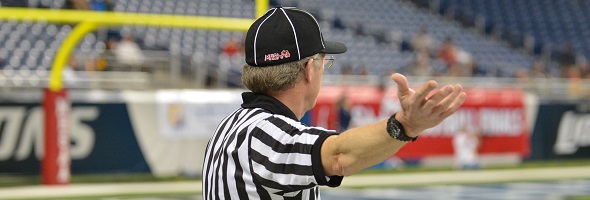
Be the Referee: Covering Knees
September 8, 2016
This week, MHSAA assistant director Mark Uyl explains the increased focus on making sure knee padding is worn correctly in football.
Be The Referee is a series of short messages designed to help educate people on the rules of different sports, to help them better understand the art of officiating, and to recruit officials.
Below is this week's segment – Equipment Covering the Knees - Listen
Everything in the game of football, from a rules-making perspective, starts and ends with an increased focus on player safety.
One big point of emphasis for the 2016 season centers on equipment being worn properly by all players. Too often we see college and pro players, especially those at the skill positions, wearing football pants that come nowhere close to covering the knee area.
With a continued focus on all high school players to lower the target zone when hitting an opponent to keep the head out of football, kids must wear pants with knee pads which completely cover the knee area to avoid those types of injuries.
Past editions
Sept. 1: Play Clock Experiment - Listen
Aug. 25: Clipping in the Free Blocking Zone - Listen