

Umpire's Heart Healed, Back in the Game
April 4, 2017
By Mike Spencer
Special for Second Half
Ken Allen can’t wait to say the words “Play Ball!’ today.
Weather permitting, the Traverse City softball umpire is expected to be behind the plate at Kingsley this afternoon after missing all of the spring season last year due to a heart double by-pass surgery.
“I’m sure It’s going to be exciting,” said Allen, a 32-year MHSAA umpire, basketball and football referee. “Especially after taking a year off from softball.
“But once the game gets started and you make that first call, it’s going to be right back to the old business.”
Allen, who has hardly missed a game since Dick Simon recruited him to officiate in 1985, was glad he went to his primary care physician after he noticed he was slowing down at the end of the 2015-16 boys and girls basketball season.
Allen’s doctor did an EKG and referred him to a heart surgeon, where he underwent a cardiac catheterization. Before the visit with the heart specialist was over, Allen was wheeled up to the second floor for heart surgery.
“It changed things, but I keep telling everybody that the man above gave me a second chance and I’m going to take full advantage of it,” said Allen, who was told he’d need at least three months to recuperate. “It was hard to be idle.”
“Ken is an ‘old school’ die hard,” said Barb Beckett, a charter member of the Northern Sports Officials Association, former officiating partner and assignor. “He is an assignor’s dream because he will go anywhere, work any level, and anytime.
“It was tough on him missing the last part of the basketball season and entire softball season. He makes a difference every time he steps on the court or the field."
Allen, who has officiated two MHSAA Finals in softball and another in football, never thought about retiring after his double by-pass on March 3, 2016.
“I never had a thought about quitting, and I don’t have a plan to retire,” Allen said. “I’m going to go as long as I can.
 “When I can’t give the kids a full 100 percent, it’ll be time to get out.”
Allen had a clean bill of health to officiate football last fall, but he missed two weeks of the season after having his gall bladder removed. He then went on to work the entire boys and girls basketball season, which ended last month.
“Ken has always been a very hard-working official, and it’s no surprise to anyone that he has worked so hard to get back on the field and court,” said MHSAA assistant director Mark Uyl, the association’s coordinator of officiating. “Ken always had a true passion for officiating, and this passion has helped him recover and has been a source of motivation to get healthy and rehab so he can return to the competitive arena.”
Uyl said life-threatening illnesses and injuries often send veteran officials into early retirement.
“For many other officials, what Ken endured would have meant retirement or the end of their career, certainly in a sport like basketball,” Uyl said. “It shows how important working with the kids and schools is to Ken that he’s persevered so hard to get back.”
Allen also officiated baseball until the day he lost a coin flip and had to leave his softball game because no one showed up at the baseball field. His softball partner Tom Post tooted his horn departing after two quick softball games and Allen was still in the bottom half of his opener.
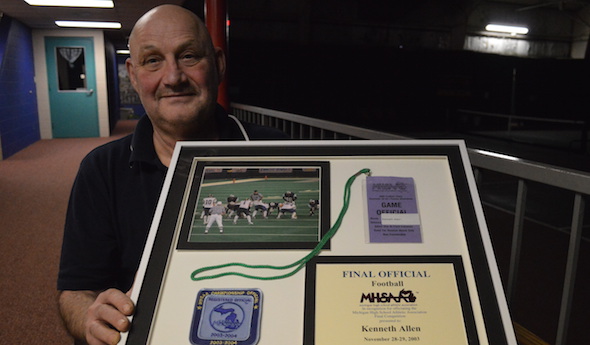
Although Allen has officiated two MHSAA softball championship games, football is his No. 1 sport. He worked a 2003 MHSAA Final as the umpire.
“When I first started out, I was on the chains,” said Allen, who played freshman football at Clio High and ran track and cross country. “Then I decided that I wanted to get in the middle where the action is. I really love it.”
Allen’s taken a few knocks in the middle of the football field, even suffered a couple of concussions. But until the heart double by-pass, he was always able to get back up on his feet without hardly missing a down.
“Ken is a great official because he’s got such good people skills,” Uyl said. “The officiating business is a ‘people business’ first and foremost, and this is why this has been such a great fit for Ken for the past 30-plus years. The MHSAA and all member schools are thrilled to have Ken back!”
Author Mike Spencer is a MHSAA registered official in boys and girls basketball and soccer. He spent more than three decades as a newspaperman before becoming a marketing communications specialist two years ago.
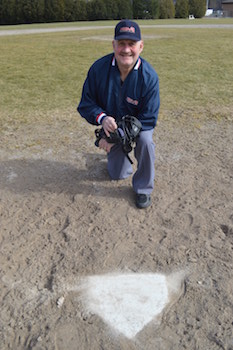
PHOTOS: (Top) Ken Allen, a 32-year veteran official from Traverse City, shows off his most memorable moment in high school officiating with photos and items he received after doing a 2003 MHSAA Finals assignment. (Middle) Allen kneels behind the plate; today he’ll return to action for the first time after heart surgery.
Be the Referee: Bat Safety
June 1, 2015
This week, MHSAA assistant director Mark Uyl explains how bats have been altered the last few seasons to make baseball safer for pitchers and infielders.
Be The Referee is a series of short messages designed to help educate people on the rules of different sports, to help them better understand the art of officiating, and to recruit officials.
Below is this week's segment - Bat Safety - Listen
The biggest change in the world of amateur baseball over the last five years has been the new standards for non-wood, or what most of us refer to as aluminum, bats.
Prior to these changes, it was quite common to see high school and college baseball scores in double digits on a regular basis.
The new bat standards first sought to address player safety. And now these new aluminum bats match the ball exit speed ratio – or in other words, the speed that the ball comes off the bat – for a non-wood bat with what it would be coming off a wood bat; making the amateur game safer for pitchers and infielders.
Past editions
May 25 - Balks - Listen
May 18 - Baseball Pace of Play - Listen
May 11 - Fair or Foul Ball? - Listen
May 4 - Non-Glare Helmets - Listen
April 27 - Vern L. Norris Award - Listen
March 23 - Deciding the Game - Listen
March 16 - Block/Charge Call - Listen
March 9 - Dive on the Floor - Listen
March 2 - Primary Areas - Listen
Feb. 23 - Too Much TV - Listen
Feb. 16 - Video Clip Library - Listen
Feb. 9 - Cheer Safety - Listen
Feb. 2 - Basketball PA Announcers - Listen
Jan. 26 - Wrestling Health Concerns - Listen
Jan. 19 - Basketball Physical Contact - Listen
Jan. 12 - Video Review Part 2 - Listen
Dec. 29 - Video Review Part 1 - Listen
Dec. 17 - Registration Part 2 - Listen
Dec. 10 - Registration Part 1 - Listen
Dec. 3 - Legacy Program - Listen
Nov. 26 - Sideline Management - Listen
Nov. 19 - 7-Person Mechanics - Listen
Nov. 12 - Blocking Below the Waist - Listen
Nov. 5 - Tournament Selection - Listen
Oct. 29 - Uncatchable Pass - Listen
Oct. 22 - Preparation for Officials - Listen
Oct. 15 - Automatic First Downs - Listen
Oct. 8 - Officials & Injuries - Listen
Oct. 1 - Overtime - Listen
Sept. 25 - Field Goals - Listen
Sept. 18 - Tackle Box - Listen
Sept. 11 - Pass Interference - Listen
Aug. 25 - Targeting - Listen