

What's My Why: Official Mike VanLaan
May 20, 2026
Mike VanLaan, Alto
VanLaan is completing his eighth year as an MHSAA-registered official. He began with football in 2018-19 and added boys lacrosse the following year.
So in 2018 I decided to get started in officiating. I started with football because that was the sport that gave me the most opportunity when I was younger. I played a lot of football and just wanted to give back to the game.
I loved it so much that I decided I also wanted to add a spring sport. So a couple of years later I added boys lacrosse, and now I officiate high school football and high school boys lacrosse.
Things that drove me to add another sport – just fell in love with the camaraderie, working with other officials, good people. And then also, just realizing how important it is to stay active physically and mentally, and this allows me to do that.
“What’s My Why” is a weekly feature telling the stories of MHSAA-registered officials in their own words. If you’re an MHSAA official and would like to share your reason why, please submit a 15 to 45-second video, taken horizontally, to director of officials Sam Davis at [email protected].
Don't miss Officiate Michigan Day 2026, July 25 in Grand Rapids! Check out MHSAA.com/OMD to register and learn more.
What's My Why
May 20: Clint Abbott, Newaygo - Watch
Be the Referee: You Make the Call
February 21, 2019
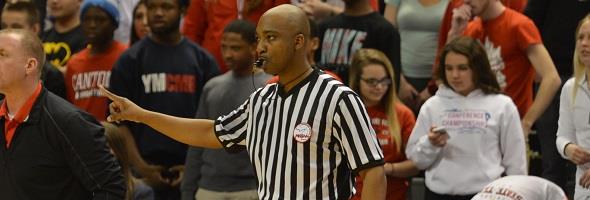
This week, MHSAA officials coordinator Sam Davis takes us through a "You Make the Call" scenario in basketball.
Be The Referee is a series of short messages designed to help educate people on the rules of different sports, to help them better understand the art of officiating, and to recruit officials.
Below is this week's segment – You Make the Call - Listen
Let’s test your rules knowledge with this basketball “you make the call.”
A player on the red team drives for the basket, and as he leaps into the air, a defender from the green team knocks the ball loose prior to the release of the shot. The red team player, still airborne, regains control of the loose ball, returns to the floor, starts to dribble again and scores.
You Make The Call – Do we have a traveling violation, a double dribble violation, or does play continue?
If you said play continues – you’re right. Under Rule 9-5 in the National Federation Basketball Rules Book, the loose ball created by the defender’s actions allows the offensive player to basically start a new possession. There is no violation, and the basket counts.
Past editions
February 14: Because They Love It - Listen
February 7: Coach/Official Communication - Listen
January 31: Backcourt Violation? - Listen
January 24: Required Hockey Equipment - Listen
January 17: You Make the Call: 10-Second Clock - Listen
January 10: Tripping in Hockey - Listen
January 3: Sliding in Basketball - Listen
December 27: Stalling in Wrestling - Listen
December 20: Basketball: You Make the Call - Listen
December 13: Basketball Uniform Safety - Listen
December 6: Coaching Box Expansion - Listen
November 29: Video Review, Part 2 - Listen
November 22: Video Review, Part 1 - Listen
November 15: You Make the Call - Sleeper Play - Listen
November 8: 7-Person Football Crews - Listen
November 1: Overtime Differences - Listen
October 25: Trickery & Communication - Listen
October 18: Punts & Missed Field Goals - Listen
October 11: What Officials Don't Do - Listen
October 4: Always 1st-and-Goal - Listen
September 27: Unique Kickoff Option - Listen
September 20: Uncatchable Pass - Listen
September 13: Soccer Rules Change - Listen
September 6: You Make the Call: Face Guarding - Listen
August 30: 40-Second Play Clock - Listen
August 23: Football Rules Changes - Listen