


Why They Don’t Officiate Anymore
December 16, 2016
Several years ago, the Michigan High School Athletic Association produced a series of radio and television spots in which MHSAA registered officials explain why they officiate. For the third time in the past 12 years (2004, 2012, 2016), the MHSAA conducted an extensive survey of former MHSAA officials to identify the reasons individuals have left the avocation of high school officiating.
From the 1,065 responses to the 2016 survey, it is demonstrated that career and job changes continue to be the top reason why individuals leave officiating. This has been the No. 1 reason in all three surveys.
Local association politics was again the No. 2 reason, which was the same second place reason in 2012. However, in the 2004 survey results, local association politics was sixth. This illuminates the reality that over the past 12 years there has been a significant shift from local schools hiring officials to using assigners in many, if not all, sports. The concerns are not so much with the association itself (training, recruiting, retaining) but with the assigning dynamic within the association or local area. Many recent MHSAA policy changes and most MHSAA in-service training have focused directly on assigners, and this survey confirms that this must continue and expand.
The next three most common reasons for leaving MHSAA officiating continue to be lack of sportsmanship by coaches, lack of sportsmanship by spectators, and low game compensation. The sportsmanship concerns from these adults must be continually addressed by all MHSAA constituent groups to improve the working conditions for officials.
The MHSAA increased tournament officiating fees at the start of the 2016-17 school year, and many local leagues and conferences have done the same. The reality is that many leagues and conferences are still playing “catch up” from the long fee freezes in the late 2000s and early 2010s when Michigan schools were in historically bad financial shape.
A significant reason to leave officiating seen in all three surveys is the official’s family situation. Many have indicated they left officiating due to time away from their spouse or children, or because of travel time or a family move. These reasons have been in the top 10 in all three surveys, and could have ranked higher had these individual questions been combined into one single category.
One troubling trend from the 2016 survey is that lack of sportsmanship by players was inside the top 10 (No. 7) for the first time since 2004. In 2012, this issue with students was No. 11. This may show that players are much more apt to argue, criticize or demonstratively disagree with calls than years ago.
(This posting was prepared with the assistance of MHSAA Assistant Director Mark Uyl.)
The Official View: Steps Away, Starts Anew
By
Brent Rice
MHSAA Assistant Director
October 29, 2018
By Brent Rice
MHSAA Assistant Director
As “Official View” returns this week, we say good-bye and a big thank you to a longtime football official – but only for the fall as he’ll be continuing to serve on basketball courts in southwestern Michigan.
 We also consider a few soccer scenarios and explain changes on the way at MHSAA.com designed in part to provide more resources for officials.
It’s Official!
The use of regular bulletins for officials in each sport was rolled out for this past fall season in football, soccer and volleyball. Each of these weekly bulletins provides readers with a few topical items (rules and mechanics) which includes common issues observed, points of emphasis or tips, and hints. It also provides a rules challenge and other tidbits of beneficial information in the specific sport. Full implementation of this tool will be started this winter in basketball, competitive cheer, gymnastics, hockey, swimming and wrestling.
Expect to see some changes in the coming weeks to the Officials page of the MHSAA website. The primary goal of this revamp is to reduce redundancy, separate and organize general officials information from sport-specific information and provide a new resource area for each sport’s officials to receive bulletins, approved rulings and interpretations and to access the new video rules library currently in development. If there are specific things you would like to see included, please let assistant director Brent Rice know.
Rule of the Week
SOCCER During A1’s throw-in, the ball first hits the touchline and then continues immediately out of play.
Ruling: This is a legal throw-in and Team B will be awarded a throw-in at the spot at which the ball left play.
It’s Your Call
SOCCER This week’s clip has the attacker in white and defender in blue racing to retrieve a ball headed near (but just outside) the penalty area. The goalkeeper charges and both he and the attacker attempt to make a play on the ball. What’s the call?
Last Week’s IYC Ruling: Last week we were presented with a prime example of how not to run the “Swinging Gate” formation from scrimmage. The play had a number of potential fouls – let’s run through them (click to see the video):
• Illegal formation – Snapper’s shoulders must be squared to the line of scrimmage.
• Illegal formation – It appears only the snapper is on the line of scrimmage. This leaves 10 in the backfield.
• Illegal shift – While the cluster of players are attempting to get set, the near receiver goes in motion. The ball is snapped without having all 11 set for at least one second.
• False start – The back that receives the snap starts to move before the snap.
Official View: A Step Back
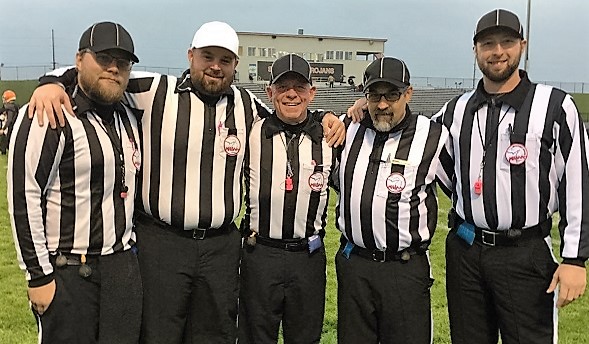
 For the last 42 years, Wayne Patterson has roamed the high school gridirons serving as a strong, hardworking and dependable official, crewmate and mentor to young officials. Patterson has decided that after years and years of fall Fridays blocked on the calendar, it’s time to spend more time with his family and allow other officials to take his place.
It’s not a step out though, only a step back. He will continue to officiate both boys and girls basketball in the winter, working alongside his daughter.
In the adjacent photo, Patterson sits with his regular crew for a postgame meal and discussion. The crew took the top photo together during his final career football game, at Sturgis High School. (Top photo, from left: Mitch Reynolds, Pete VanGeisen, Wayne Patterson, Tim Latta and Mike McKenzie).