


Why They Don’t Officiate Anymore
December 16, 2016
Several years ago, the Michigan High School Athletic Association produced a series of radio and television spots in which MHSAA registered officials explain why they officiate. For the third time in the past 12 years (2004, 2012, 2016), the MHSAA conducted an extensive survey of former MHSAA officials to identify the reasons individuals have left the avocation of high school officiating.
From the 1,065 responses to the 2016 survey, it is demonstrated that career and job changes continue to be the top reason why individuals leave officiating. This has been the No. 1 reason in all three surveys.
Local association politics was again the No. 2 reason, which was the same second place reason in 2012. However, in the 2004 survey results, local association politics was sixth. This illuminates the reality that over the past 12 years there has been a significant shift from local schools hiring officials to using assigners in many, if not all, sports. The concerns are not so much with the association itself (training, recruiting, retaining) but with the assigning dynamic within the association or local area. Many recent MHSAA policy changes and most MHSAA in-service training have focused directly on assigners, and this survey confirms that this must continue and expand.
The next three most common reasons for leaving MHSAA officiating continue to be lack of sportsmanship by coaches, lack of sportsmanship by spectators, and low game compensation. The sportsmanship concerns from these adults must be continually addressed by all MHSAA constituent groups to improve the working conditions for officials.
The MHSAA increased tournament officiating fees at the start of the 2016-17 school year, and many local leagues and conferences have done the same. The reality is that many leagues and conferences are still playing “catch up” from the long fee freezes in the late 2000s and early 2010s when Michigan schools were in historically bad financial shape.
A significant reason to leave officiating seen in all three surveys is the official’s family situation. Many have indicated they left officiating due to time away from their spouse or children, or because of travel time or a family move. These reasons have been in the top 10 in all three surveys, and could have ranked higher had these individual questions been combined into one single category.
One troubling trend from the 2016 survey is that lack of sportsmanship by players was inside the top 10 (No. 7) for the first time since 2004. In 2012, this issue with students was No. 11. This may show that players are much more apt to argue, criticize or demonstratively disagree with calls than years ago.
(This posting was prepared with the assistance of MHSAA Assistant Director Mark Uyl.)
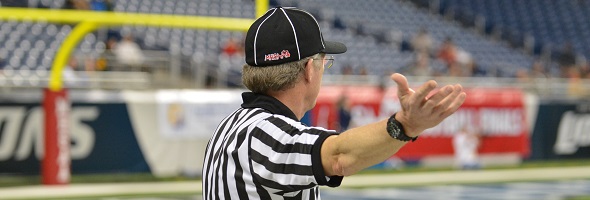
Be the Referee: Personal Fouls
November 5, 2015
This week, MHSAA assistant director Mark Uyl explains how personal fouls are penalized at the high school level.
Be The Referee is a series of short messages designed to help educate people on the rules of different sports, to help them better understand the art of officiating, and to recruit officials.
Below is this week's segment - Make the Call: Personal Fouls - Listen
Late in a key game that’s tied, it’s third down and goal from the 12-yard line after a sack has pushed the offense back. On the third-down play, the quarterback has scrambled and is pulled down again for an apparent sack, but he is pulled to the ground by his facemask.
The officials throw the flag and correctly rule it’s a personal foul facemask. What’s the next down? Under high school rules, personal fouls are NOT an automatic first down. On this play, the officials would walk off the yardage penalty of half-the-distance (to the goal line) and we would replay third down. The only fouls that give the offense an automatic first down are the roughing fouls … roughing the kicker, passer, holder and long snapper.
Past editions:
Oct. 29: Officials Demographics - Listen
Oct. 15: Make the Call: Intentional Grounding - Listen
Oct. 8: Playoff Selection - Listen
Oct. 1: Kick Returns - Listen
Sept. 24: Concussions - Listen
Sept. 17: Automatic First Downs - Listen
Sept. 10: Correcting a Down - Listen
Sept 3: Spearing - Listen
Aug. 27: Missed Field Goal - Listen