


Paying Tribute with Diamond Donation
May 14, 2014
By Geoff Kimmerly
Second Half editor
Rochester Adams and Bloomfield Hills Cranbrook-Kingswood baseball players and coaches both had loved ones on their minds when they took the field at Comerica Park earlier this month.
And they paid tribute to those loved ones over their hearts and across the backs of their jerseys.
 Together, the teams raised more than $3,500 for the Coaches vs. Cancer research initiative.
Instead of its usual brown and yellow, Adams wore jerseys of light blue with a green ribbon as the middle “A” in its name across the front in honor of those suffering with lymphoma, including 2011 graduate and former standout Matt Williams.
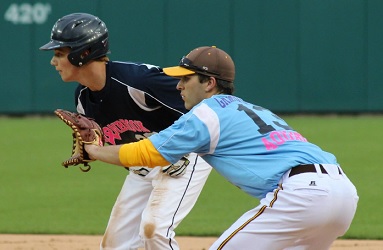 Cranbrook-Kingswood wore dark blue jerseys with a pink ribbon as the “A” in Cranbrook and with lime green writing on the back as the Cranes remembered longtime coach Jack Sanders, who died in 2012 after also battling lymphoma.
Sanders’ was among names adorning the backs of jerseys, along with other cancer victims the players and coaches knew.
Adams won the May 1 game, 18-3. Click to read more from the Oakland Press’ Keith Dunlap, who leading up to the game detailed both Williams’ fight and Sanders’ longtime contributions.
Net finder
Lake Fenton’s Jordan Newman will finish her high school soccer career later this spring as the top goal-scorer in MHSAA girls soccer history.
The Blue Devils’ senior forward broke the career record on April 28, scoring her 169th goal against Perry to pass the mark set by Newaygo’s Jaleen Dingledine from 2004-07. Newman also is a four-year varsity player.
Click to read more on her record run from the Flint Journal's Eric Woodyard.
5 K, 1 IP
The MHSAA doesn't keep a record for most strikeouts in an inning. But if it did, there’s a great chance Brighton’s Garrett Russell would top the list.
Against Ann Arbor Pioneer on April 5, Russell struck out five batters in an inning.
Yes, five.
Here’s how:
Russell struck out the first two batters of the inning swinging, leaving one out to get. He then struck out that third batter as well, but that batter reached first base because the third strike turned into a wild pitch.
The fourth batter of the inning was the only one to not strike out – he walked, putting runners on first and second base with two outs. Those runners advanced to second and third base, respectively, on a wild pitch thrown to the fifth batter of the inning.
That fifth batter then struck out swinging (which made it four strikeouts in the inning), but that third strike turned into a passed ball – and that batter ended up on first base, loading them for the sixth hitter of the inning.
But Russell found enough for one more K, striking out that sixth hitter swinging on a 2-2 pitch.
His line for the inning: 0 hits, 0 runs, 1 bases on balls, 5 strikeouts.
Brighton went on to sweep the doubleheader 12-4 and 11-1.
Family ties
Basketball clearly runs in a pair of families who have come through Corunna High School.
This winter, brothers M.J. and Mikhail Myles both scored their 1,000th career points – M.J., a senior, on Jan. 3 and Mikhail, a junior, in the team’s District Semifinal on March 5.
On Feb. 18, senior Payton Birchmeier became the fifth player in girls program history to score her 1,000th point – despite scoring only four points as a freshman before suffering a season-ending knee injury in her first high school game. She became the first Corunna girl to score 1,000 since her sister Megan finished accomplishing the feat in 2010.
Payton Birchmeier went on to play her final three seasons also on varsity, and M.J. Myles also was a four-year varsity player. Mykhail Myles has played three on varsity with next season still to play. The Myles' stepsister Klarissa Bell this winter finished an outstanding career at Michigan State University and won the Miss Basketball Award as a senior at East Lansing High School in 2010, and stepbrother Devlin Bell also was a Trojans standout.
PHOTOS: (Top) Rochester Adams players congratulate each other during their May 1 game at Comerica Park. (Middle) The Adams' first baseman and a Cranbrook-Kingswood base runner await the next pitch. (Photos courtesy of Rochester Adams baseball.)
Why Athletes Should See A Sport Psychologist
By
Elizabeth Swanson
Henry Ford Health
January 9, 2024
Whether at the professional or intramural level, there are so many benefits to being an athlete. Participating in a sport teaches communication skills, how to overcome adversity—and regular exercise has so many incredible health effects on the mind and body.
 But that’s not to say athletes don’t have their own set of challenges. Pressures to perform, physical injuries and intense schedules can take a toll on anyone’s mental health, which is where a sport psychologist comes in.
“It’s helpful that a sport psychologist knows the culture of athletics and the typical stressors that athletes face,” says Seth Swary, Ph.D., a sport psychology clinician at the Henry Ford Center for Athletic Medicine. “We’re familiar with the influence the world of athletics can have on someone and how it can affect their well-being.
“Athletes have a whole team around them to help them perform — athletic trainers, nutritionists, etc.— so why shouldn’t they have an expert who is dedicated to supporting their mental health? A sport psychologist acts as a strength-training coach for the mind.”
Mental Health Challenges That Athletes Face & How Sport Psychology Can Help
Athletes often have a built-in support system: teammates and coaches who know what they’re going through and trainers and physicians who can help manage aches and injuries. But still, it’s not always easy. Some of the difficulties that athletes face include:
- Increased attention on body image. Especially if you play a sport that requires revealing outfits — or a sport with increased focus on weight — it might be difficult to maintain a healthy body image. For some, this can lead to an increased risk of developing an eating disorder.
- The pressure to perform. “If you’re an athlete at the college or professional level and play badly during a game, you get roasted on Twitter,” says Dr. Swary. “But even if you’re not in the public eye, there is pressure to perform — from coaches, teammates, family members.”
- Navigating demanding schedules. “I work with many college athletes and their schedules are packed — practicing at least two hours a day, team meetings, traveling to and from games — and then they’re trying to keep up with school,” says Dr. Swary. “It can be stressful.”
- Debilitating physical injuries. The physical demand of sports can also bring about its own set of challenges — especially when injuries occur. “You’re not only dealing with surgery and rehabilitation, but you’re also out of the game for a while,” says Dr. Swary.
- Making career transitions. “I’ve worked with many athletes who are transitioning from one level of athletics to another (for example, middle school to high school, high school to college, college to professional) along with athletes who are transitioning out of their career,” says Dr. Swary. “They wonder how they can leave this sport they’ve been doing their whole lives — some since they were 3 or 4 years old. It can be a huge part of their identity and a tough transition to make. Even more so if it’s an injury that abruptly derails their career. We can provide them with ways to make a smooth, healthy transition.”
That said, nothing “bad” has to happen to benefit from sport psychology. As Dr. Swary says, you don’t see a personal trainer because you’re not strong, you see a personal trainer because you could benefit from being stronger. It’s the same with sport psychology — and it can help improve your performance.
“We have specific skills we work on for performance optimization,” says Dr. Swary. “How do we talk to ourselves? How do we respond in certain situations? How do we stay in the moment when we’re distracted?
“A high school athlete may have had a rough day at school; then they have to refocus and find energy at the end of the day for their game. It can be helpful for any athlete at any time.”
Reviewed by Seth Swary, Ph.D., a sport psychology clinician at the Henry Ford Center for Athletic Medicine.
To learn more about the sport psychology program at Henry Ford or to request an appointment, visit henryford.com/sportpsychology.