

Paying Tribute with Diamond Donation
May 14, 2014
By Geoff Kimmerly
Second Half editor
Rochester Adams and Bloomfield Hills Cranbrook-Kingswood baseball players and coaches both had loved ones on their minds when they took the field at Comerica Park earlier this month.
And they paid tribute to those loved ones over their hearts and across the backs of their jerseys.
 Together, the teams raised more than $3,500 for the Coaches vs. Cancer research initiative.
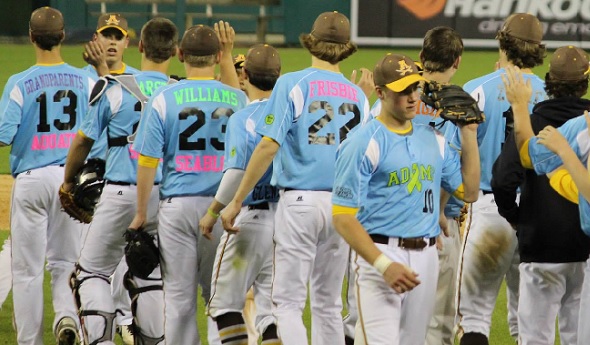
Instead of its usual brown and yellow, Adams wore jerseys of light blue with a green ribbon as the middle “A” in its name across the front in honor of those suffering with lymphoma, including 2011 graduate and former standout Matt Williams.
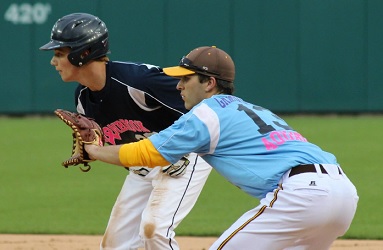 Cranbrook-Kingswood wore dark blue jerseys with a pink ribbon as the “A” in Cranbrook and with lime green writing on the back as the Cranes remembered longtime coach Jack Sanders, who died in 2012 after also battling lymphoma.
Sanders’ was among names adorning the backs of jerseys, along with other cancer victims the players and coaches knew.
Adams won the May 1 game, 18-3. Click to read more from the Oakland Press’ Keith Dunlap, who leading up to the game detailed both Williams’ fight and Sanders’ longtime contributions.
Net finder
Lake Fenton’s Jordan Newman will finish her high school soccer career later this spring as the top goal-scorer in MHSAA girls soccer history.
The Blue Devils’ senior forward broke the career record on April 28, scoring her 169th goal against Perry to pass the mark set by Newaygo’s Jaleen Dingledine from 2004-07. Newman also is a four-year varsity player.
Click to read more on her record run from the Flint Journal's Eric Woodyard.
5 K, 1 IP
The MHSAA doesn't keep a record for most strikeouts in an inning. But if it did, there’s a great chance Brighton’s Garrett Russell would top the list.
Against Ann Arbor Pioneer on April 5, Russell struck out five batters in an inning.
Yes, five.
Here’s how:
Russell struck out the first two batters of the inning swinging, leaving one out to get. He then struck out that third batter as well, but that batter reached first base because the third strike turned into a wild pitch.
The fourth batter of the inning was the only one to not strike out – he walked, putting runners on first and second base with two outs. Those runners advanced to second and third base, respectively, on a wild pitch thrown to the fifth batter of the inning.
That fifth batter then struck out swinging (which made it four strikeouts in the inning), but that third strike turned into a passed ball – and that batter ended up on first base, loading them for the sixth hitter of the inning.
But Russell found enough for one more K, striking out that sixth hitter swinging on a 2-2 pitch.
His line for the inning: 0 hits, 0 runs, 1 bases on balls, 5 strikeouts.
Brighton went on to sweep the doubleheader 12-4 and 11-1.
Family ties
Basketball clearly runs in a pair of families who have come through Corunna High School.
This winter, brothers M.J. and Mikhail Myles both scored their 1,000th career points – M.J., a senior, on Jan. 3 and Mikhail, a junior, in the team’s District Semifinal on March 5.
On Feb. 18, senior Payton Birchmeier became the fifth player in girls program history to score her 1,000th point – despite scoring only four points as a freshman before suffering a season-ending knee injury in her first high school game. She became the first Corunna girl to score 1,000 since her sister Megan finished accomplishing the feat in 2010.
Payton Birchmeier went on to play her final three seasons also on varsity, and M.J. Myles also was a four-year varsity player. Mykhail Myles has played three on varsity with next season still to play. The Myles' stepsister Klarissa Bell this winter finished an outstanding career at Michigan State University and won the Miss Basketball Award as a senior at East Lansing High School in 2010, and stepbrother Devlin Bell also was a Trojans standout.
PHOTOS: (Top) Rochester Adams players congratulate each other during their May 1 game at Comerica Park. (Middle) The Adams' first baseman and a Cranbrook-Kingswood base runner await the next pitch. (Photos courtesy of Rochester Adams baseball.)
How To Be Proactive About Concussions In Student Athletes
December 5, 2023
Most people have seen the headlines about concussions as a common sports injury—and it's natural that parents of athletes may have concerns. A large misconception in sports is that previous concussions are to be blamed for ongoing headaches, blurred vision and memory loss, among other symptoms.
 “It’s really important to think about concussions in tandem with overall brain health,” says Jake Carpenter-Thompson, M.D., Ph.D., a board-certified neurologist at the Henry Ford Kutcher Clinic for Concussion and Sports Neurology. “Concussions can be concerning, but they shouldn’t be looked at in a vacuum. It is important to understand an athlete’s overall brain health to help manage recovery after any impact.”
One way to do that is to consult with your child’s doctor or a sports neurologist for an annual evaluation. A sports neurologist focuses on managing sports-related brain and nervous system injuries and conditions in athletes, such as concussions, post-concussion syndrome, peripheral nerve injuries, migraines, epilepsy and more.
“Having an annual evaluation of your athlete’s brain health when they are at their baseline – and uninjured – can help diagnose and treat issues when they arise,” says Dr. Carpenter-Thompson.
A qualified healthcare professional can use the baseline evaluation results as an important comparison tool if an athlete develops a suspected concussion.
Best Practices For Keeping Athletes Safe
Dr. Carpenter-Thompson shares these tips to ensure you keep front of mind your child’s brain health and safety, not just their athletic performance:
- Get a brain health baseline test. This should include a personal and family neurological history, with a focus on current issues. It is important to note any neurological conditions that may influence concussion recovery, such as ADHD, depression, anxiety or migraine headaches.
- Encourage your children to listen to their body. There are risks to playing any sport. Encourage your child to listen to and be honest about how they’re feeling. It’s the best way to prevent and treat injuries.
- In the event of an injury, look for the signs. Within 24 hours after an injury, an athlete should be evaluated if they are experiencing: headaches, fatigue, dizziness and nausea, changes in sleep habits, trouble with memory, confusion, irritability and anxiety, or light sensitivity.
- Know that brain injuries don’t just occur with a blow to the head. They can also occur from falls, car accidents or even whiplash. If your child is experiencing any symptoms, consult your physician.
- Remember that brain health is more than just concussions. If your athlete is complaining of chronic headaches, migraines, dizziness, memory or mood issues, there may be an underlying issue.
“There is no magic number of concussions a brain can sustain. Each person is different,” says Dr. Carpenter-Thompson. “The severity of the impact and recovery time can vary greatly for numerous reasons. By getting a brain health assessment before the injury, we can provide more targeted care to improve an athlete's overall clinical course.”
To find a sports medicine doctor or athletic trainer at Henry Ford, visit henryford.com/athletes.