

Paying Tribute with Diamond Donation
May 14, 2014
By Geoff Kimmerly
Second Half editor
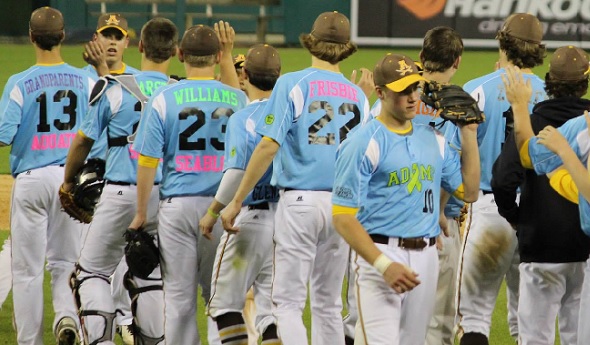
Rochester Adams and Bloomfield Hills Cranbrook-Kingswood baseball players and coaches both had loved ones on their minds when they took the field at Comerica Park earlier this month.
And they paid tribute to those loved ones over their hearts and across the backs of their jerseys.
 Together, the teams raised more than $3,500 for the Coaches vs. Cancer research initiative.
Instead of its usual brown and yellow, Adams wore jerseys of light blue with a green ribbon as the middle “A” in its name across the front in honor of those suffering with lymphoma, including 2011 graduate and former standout Matt Williams.
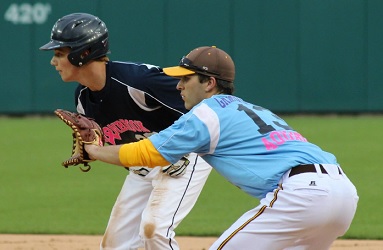 Cranbrook-Kingswood wore dark blue jerseys with a pink ribbon as the “A” in Cranbrook and with lime green writing on the back as the Cranes remembered longtime coach Jack Sanders, who died in 2012 after also battling lymphoma.
Sanders’ was among names adorning the backs of jerseys, along with other cancer victims the players and coaches knew.
Adams won the May 1 game, 18-3. Click to read more from the Oakland Press’ Keith Dunlap, who leading up to the game detailed both Williams’ fight and Sanders’ longtime contributions.
Net finder
Lake Fenton’s Jordan Newman will finish her high school soccer career later this spring as the top goal-scorer in MHSAA girls soccer history.
The Blue Devils’ senior forward broke the career record on April 28, scoring her 169th goal against Perry to pass the mark set by Newaygo’s Jaleen Dingledine from 2004-07. Newman also is a four-year varsity player.
Click to read more on her record run from the Flint Journal's Eric Woodyard.
5 K, 1 IP
The MHSAA doesn't keep a record for most strikeouts in an inning. But if it did, there’s a great chance Brighton’s Garrett Russell would top the list.
Against Ann Arbor Pioneer on April 5, Russell struck out five batters in an inning.
Yes, five.
Here’s how:
Russell struck out the first two batters of the inning swinging, leaving one out to get. He then struck out that third batter as well, but that batter reached first base because the third strike turned into a wild pitch.
The fourth batter of the inning was the only one to not strike out – he walked, putting runners on first and second base with two outs. Those runners advanced to second and third base, respectively, on a wild pitch thrown to the fifth batter of the inning.
That fifth batter then struck out swinging (which made it four strikeouts in the inning), but that third strike turned into a passed ball – and that batter ended up on first base, loading them for the sixth hitter of the inning.
But Russell found enough for one more K, striking out that sixth hitter swinging on a 2-2 pitch.
His line for the inning: 0 hits, 0 runs, 1 bases on balls, 5 strikeouts.
Brighton went on to sweep the doubleheader 12-4 and 11-1.
Family ties
Basketball clearly runs in a pair of families who have come through Corunna High School.
This winter, brothers M.J. and Mikhail Myles both scored their 1,000th career points – M.J., a senior, on Jan. 3 and Mikhail, a junior, in the team’s District Semifinal on March 5.
On Feb. 18, senior Payton Birchmeier became the fifth player in girls program history to score her 1,000th point – despite scoring only four points as a freshman before suffering a season-ending knee injury in her first high school game. She became the first Corunna girl to score 1,000 since her sister Megan finished accomplishing the feat in 2010.
Payton Birchmeier went on to play her final three seasons also on varsity, and M.J. Myles also was a four-year varsity player. Mykhail Myles has played three on varsity with next season still to play. The Myles' stepsister Klarissa Bell this winter finished an outstanding career at Michigan State University and won the Miss Basketball Award as a senior at East Lansing High School in 2010, and stepbrother Devlin Bell also was a Trojans standout.
PHOTOS: (Top) Rochester Adams players congratulate each other during their May 1 game at Comerica Park. (Middle) The Adams' first baseman and a Cranbrook-Kingswood base runner await the next pitch. (Photos courtesy of Rochester Adams baseball.)
Track Gaining Speed Toward Future with Electronic Starting Devices
By
Steve Vedder
Special for MHSAA.com
May 23, 2023
Aubrey Greenfield thinks it might be the perfect time to reevaluate 130 years of tradition.
For a number of reasons, from technical to personal, the Oxford senior sprinter believes it makes sense for the crack of a starting pistol to be eliminated from high school track meets.
Because track meets would benefit in various ways from lowering costs to easier setup at meets to the human factor of competitors not having to flinch at the crack of a pistol shot, Greenfield believes the sport has a chance to embrace new technology – electronic starting devices (ESD).
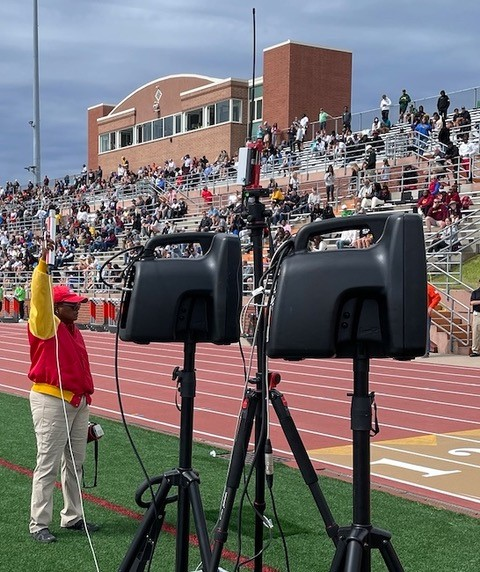
In essence, an ESD replaces the starting pistol with a light flash, tone sound or both to begin a race.
"High school sports should put the athlete first," Greenfield said. "We should promote sports, and eliminating starting pistols promotes health in terms of PTSD or trauma for athletes and spectators and that would be good. I would like to think people would say that's a good idea."
In fact, Greenfield would go as far as to say if there was not an implementation of electronic starting devices, many of her teammates would have considered giving up the sport.
"If it's something that helps us compete safely, we're all for it," she said.
Greenfield's opinion apparently is spreading. Michigan High School Athletic Association senior assistant director Cody Inglis said the use of ESD makes it both affordable for meet starters and sensible for athletes and fans to rethink the use of starting pistols. While the MHSAA is not mandating electronic starting devices, it does promote the use of what Inglis calls "emerging technology." He notes that ESD are becoming the norm for organizations such as USA Track & Field, the NCAA and an increasing number of high schools.
 "I think we have to embrace new technology, and we think this will be something that takes hold," Inglis said.
A key part of embracing ESD is the human element. The tragic Oxford High School shooting Nov. 30, 2021, that took the lives of four students while injuring seven others should not be relived even for a fleeting instance at a high school sporting event. Oxford athletic director Tony DeMare said the school began using ESD at every meet, including the MHSAA Lower Peninsula Division 1 Finals last June. He said that decision was embraced by virtually all schools Oxford encountered.
"We were very convinced that the alternative (of ESD) would promote a healthy attitude," DeMare said. "We were overwhelmed with the positive response. If a school was on the fence about it or might not be for it, I think we've started to see the tide turn in favor of people willing to listen and learn about electronic starting devices."
Inglis said the MHSAA is acutely aware of what the crack of a starting pistol can mean to athletes and fans.
"It's unimaginable what Oxford went through, and this is a small way we can help," he said. "We look at a (starting pistol) and think, ‘Could we do something else?’ It's a way of helping to solve a problem."
Over the last several years, the MHSAA has embraced finding an alternative to starting pistols. Inglis noted the discussion started with the cost and diminishing availability of 32-caliber ammunition that meet starters use. A box of ammunition, if it can be found, is around $75 a box.
In addition to cost, there is potential damage from excessive exposure to 150-plus decibels of sound generated by the traditional 32-caliber blanks. Medical studies show damage to ears caused by decibel levels above 120 dB.
The tragedy at Oxford accelerated the conversation.
Inglis said the cost of ESD can be likened to a school sinking money into artificial surfaces at football fields. Yes, there is a great cost at first, but over time money is ultimately saved. An ESD system itself ranges between $200 and $500. Speakers also may need to be purchased, but with ESD starting events like the 800 and 1,600-meter relays positioned near the outside lanes 8, 7, 6 and 5 would result in improved hearing by athletes at the start of a race.
There is one challenge with ESD that track administrators are working to overcome – lighting conditions that lessen the ability to see the ESD’s LED light or strobe when the button is pressed by a starter to begin a race. But that vision difficulty resulting from clear blue skies and backgrounds of setting suns can be substantially improved by incorporating a black background with an ESD – something as simple as a starter holding up black cardboard behind the lighting mechanism at the start of an event.
Inglis said when all factors are considered, the use of ESD makes sense.
 "With the climate we live in nowadays, no lookalike guns is good," he said. "We're not mandating this. But people are saying this is affordable."
While switching to ESD would break 130 years of tradition, the timing could be a step forward, said Jeff Hollobaugh, co-author of the book "The Fleet Feet of Spring: Michigan's High School State Championships in Track & Field." He said while no definitive answer is possible, it's likely starting pistols were used at the inaugural state meet at the Jackson Fairgounds in 1895. The meet, which included events like tossing a 16-pound shot put, bike races and a 100-meter sprint, was sponsored by the Michigan Interscholastic Athletic Association (a predecessor to the MHSAA) and comprised mostly of the state's larger schools.
Hollobaugh's sentiments echo what many involved in today's high school track & field believe in terms of making a transition from starting pistols to electronic starting devices.
"It's a change, not necessarily good or bad, just different," he said. "It's not a drastic change, but it will take some getting used to. But it is the future. In the end, we'll all be fine."
DeMare believes the future of high school track will definitely include ESD.
"Our desire is that the practicality and sensibility of this will overcome the alternative," he said. "I think we'll see the automation and electronics taking hold of certain elements in track, and people will embrace it."
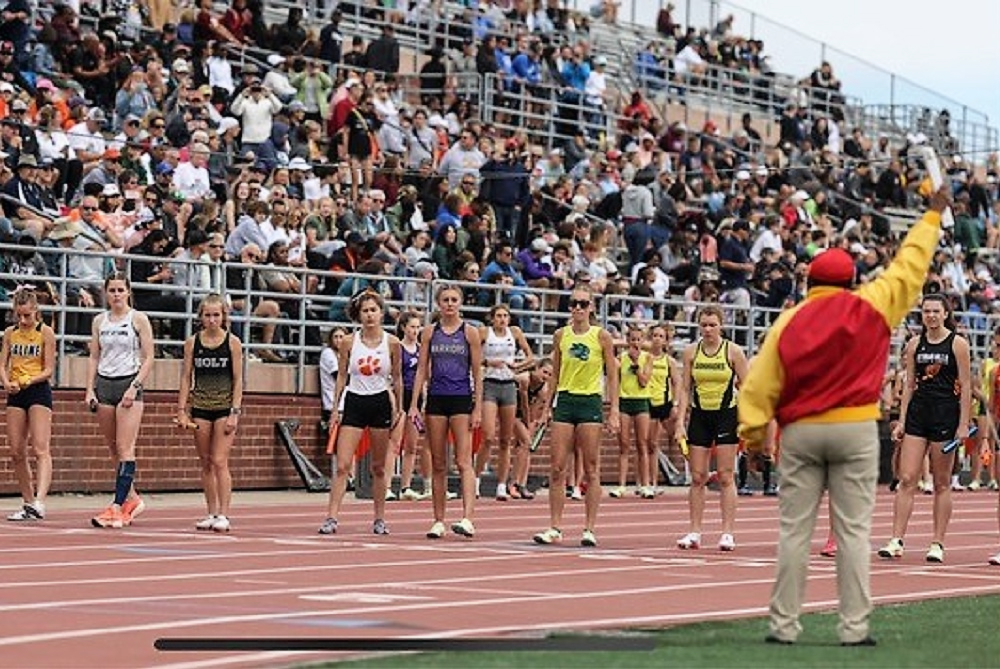
PHOTOS (Top) Runners watch official Bertha Smiley as they prepare to begin a race during last season's Lower Peninsula Division 1 Finals at Rockford. (Middle) An electronic starting device provided by VS Athletics was used to start those races. (Below) Smiley sets to begin an event. (Photos provided by David Kuderka/VS Athletics.)