

Powerful Voice for High School Sports
December 19, 2014
By Geoff Kimmerly
Second Half editor
Paul Carey was home from the U.S. Army only a few months and just shy of 25 years old when Beal City embarked on its first trip deep into the MHSAA boys basketball tournament.
On the call for local radio station WCEN from gyms at Saginaw Arthur Hill and Lansing Sexton, Carey served as the voice of the previously “laughable” Aggies as they reached the Class D Semifinals before falling just six points short of playing for the title.
“All of Beal City emptied out. They’d never had anything before,” Carey recalled during his annual Thanksgiving weekend visit to the MHSAA Football Finals at Ford Field. “When I got home, within the next two weeks I got a letter from every citizen of Beal City thanking me for broadcasting their games. That’s the kind of appreciation that meant so much.”
During 42 years on the airwaves, Carey was best known as a voice of the Detroit Tigers bounding out of transistor radios all over Michigan, thanks to WJR’s powerful signal.
But for the state’s high school sports community, his legacy is similarly memorable as the voice of the longtime football and basketball scoreboard show and a voter for various all-state teams and wire polls over the decades.
Now 86 and retired since 1991, Carey remains a regular during the first day of the Football Finals, taking in games he broadcast for the MHSAA during the late 1970s and that continue to hold his eye as they have for more than a half-century.
“It was a passion of mine. High school sports always has been,” Carey said. “I think because my dad was a high school coach, and teacher initially, and my brother was a high school coach and teacher, I just grew up in families that appreciated coaching and athletics. I was not a great athlete, but it kept my hand in following sports that way.”
Now, the scores
Carey partnered with Ernie Harwell for Tigers radio broadcasts from 1973-91, including during the march to the 1984 World Series championship. He was named Michigan Sportscaster of the Year six times and to the Michigan Sports Hall of Fame in 1992.
But Carey’s early career included sitting on top of a car, plugged into a phone pole, for a Sacred Heart football game at old Fancher Field just a few blocks from his family’s Mount Pleasant home. Among many more accolades are a Distinguished Service Award from the Michigan High School Coaches Association and a place in the Basketball Coaches Association of Michigan Hall of Fame.
In fact, the start of his weekly announcing of statewide football and basketball scores preceded his baseball career by 16 years and ended two months after he announced his final professional out.
The Michigan High School Scoreboard show was a staple of WJR’s late Friday nights from 1957-91. Carey would read every score he could collect from a variety of sources, often organized by league and with state rankings and context mixed in.
His idea came from something similar read by Len Colby for Kalamazoo’s WKZO. Carey’s brother Terry was coaching at Niles during the second half of the 1950s, and he and other coaches would get together to listen to the Friday night scores from the southwestern part of the state.
Carey, who left WKNX in Saginaw for WJR in 1956, explained to then-sports director Bob Reynolds that the station’s strong signal could provide for a truly statewide scoreboard experience.
Carey then connected with Edgar Hayes of the former Detroit Times, who gave the OK for Carey to call the paper on Friday nights to get scores from the Detroit metro area. For the rest, Carey relied on wire services – there were three at the time – who relied on newspapers from all over Michigan to call in scores over the course of an evening.
Before every Friday during high school football season – and later Tuesdays and Fridays during boys basketball season – Carey typed up lists of games based on schedules in the newspaper, with spaces to add scores. More than a few times, Carey raced down a back ramp at Tiger Stadium after a Friday night game, back to the WJR studio, with 15 minutes to prep for the show’s 11:30 p.m. start.
“If the Flint Journal, the Grand Rapids Press, the Traverse City paper didn’t call in scores to the AP, then I was out of luck too. And that happened all the time,” Carey said. “I would call back occasionally, say, ‘Did you get anything more?’ It was a rat race.”
The show originally was set for 10 minutes and then extended to 15. American Airlines sponsored a record show that followed, and Carey’s scoreboard show had a sponsor only once in 35 years. Finishing up on time was expected, even with more than 200 scores to read.
But Carey said he always went 20 minutes, sometimes 25.
“Because I wasn’t done. I just kept right on going,” Carey said. “Jay Roberts did the all-night show most of the time, and he was patient with me. He didn’t say too much on the air about ‘that guy ahead of me took all of my time.’”
Carey continued the “rat race” until his final scoreboard show, Dec. 20, 1991. He retired from WJR at the end of that calendar year. And it's important to note: Carey was never paid a dime extra for doing the program. .
“I think Paul is really just a sports fan, and that came across to the listener on his broadcasts,” MHSAA historian Ron Pesch said. “Paul would gather as much as possible off the wire. He'd interject if scores were missing from sections of the state. Press polls from the Free Press, News, AP and UPI were big, so he could point out close calls and upsets.
“He provided immediacy, or the closest thing to it in the days before cable TV and the Internet, and because of his scoreboard show, you could get the results before the morning paper. For listeners, he brought life to something as simple as game scores.”
First team all the way
Carey, who resides in Rochester, also served as the engineer on Tigers broadcasts for 16 years, through 1990. He broadcast Pistons games on the radio for six seasons and did the first broadcast of a Central Michigan University football game, in 1949.
Harry Atkins, covering Detroit’s teams while with The Associated Press for 29 years including the last 21 as its sports editor for Detroit, took note of his colleague's hard work – and especially that Carey was one of few broadcasters who was a journalist in addition to a voice.
That made Carey's other major role in high school sports a natural fit.
Atkins split The Associated Press all-state selection panels for football and basketball into 11 regions, and Carey represented the Detroit area for a number of years. He also was a longtime voter in those sports' weekly polls.
“Paul is just that kind of guy. He thought it was important and he made time in his busy schedule to do it,” Atkins said “And it had an impact on the other 10 voters on the All-State panels, too.
“Some of them were from small out-state newspapers or radio or TV stations. Yet every one of them knew who Paul Carey was. And when he spoke, of course, with what often is called "The Voice of God," those voters paid attention.”
And he still does, as well.
At the end of each fall, Carey still puts together a compilation of the three high school all-state football teams – Associated Press, Detroit Free Press and Detroit News – and files them with years of research and results.
“It’s important to me. Nobody sees it but me, but I get a certain kick,” Carey said. “Once in a while I’ll see a kid playing at Central, Western or (Michigan) State or Michigan, and they’ll say he came from Clawson. I’ll go into my all-state collections, say that would’ve been 2009 he played, and I find a name.”
In addition to the Football Finals on WJR, Carey was part of the Baseball Finals broadcasts into the early 1990s, continuing to contribute even after his retirement from his fulltime gig.
He spent high school games over the years sitting next to legends like the Free Press’ Hal Schram and remembers when current Free Press longtime scribe Mick McCabe was just a rookie. One of Carey's final broadcasts was a 1992 Baseball Final with his nephew Mike Carey, who continues to broadcast MHSAA championship games to this day.
“I am eternally grateful to Paul Carey. His contribution to high school sports in Michigan has been great and significant,” Atkins said.
“We are lucky to have him.”
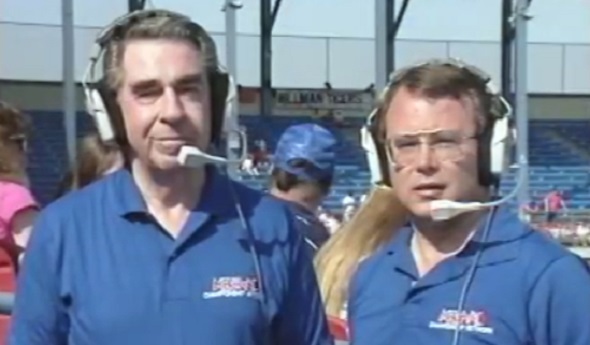
PHOTO: Paul Carey (left) and nephew Mike Carey broadcast the MHSAA 1992 Class D Baseball Final between Hillman and Athens for PASS.
Lessons from Multi-Sport Experience Guide Person in Leading New Team
By
Pam Shebest
Special for MHSAA.com
August 1, 2024
PARCHMENT — When Amanda Person was in sixth grade, her family hosted an international student from Japan.
 Until then, soccer was the main sport for her family – but that soon changed.
“Naoki wanted to play tennis,” Person said. “He started playing and then my sister (Marissa) started playing, and then I started playing.”
That passion for both sports only increased during her four years at Parchment High School.
“Soccer was really fun, but when I look back on my high school career, tennis was the most prominent thing I remember,” the 2008 grad said. “I think it’s because I played year-round: our regular tennis season and then our summer tennis program and winter tennis program.”
Although it has been 16 years since her glory days at Parchment ended, Person has no trouble recalling the best parts of her Panthers sports career.
In fact, coming up with memories from those days is no problem — she has a folder full of photos called “I Miss Team Sports” on her Facebook page.
Playing intramural soccer at Michigan State University, she graduated with a degree in social work, then stayed in the Big Ten. She is the campus tours and ambassador coordinator at Purdue University in West Lafayette, Ind., where she supervises 80 to 100 student tour guides who provide information for families considering the school.
Her ties to the Spartans sometime makes for interesting conversations with her colleagues.
“They give me a hard time,” she said with a quick laugh. “I say Michigan State will always be my No. 1. That’s my alma mater I spent four years of time, tears and money at Michigan State. But I really love Purdue, so I’ll root for the Boilermakers second.”
She is also working on her master’s degree in higher education at Purdue.
Her office in the welcome center shares space with the alumni association, leading to an unforgettable experience.
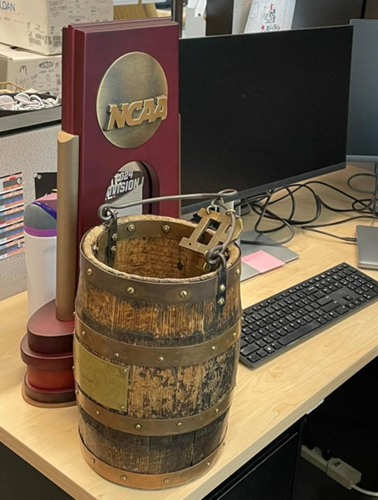
During a lunch break, she went home to let out her dog, Tessa. When she returned, a trophy and a bucket were sitting on her desk.
 Confused, she asked what they were doing there.
“The tour guides I was working with said (during an event) they had to put them somewhere before putting them out (to the public), so they just put them on my desk,” she said.
Turns out, one trophy was the NCAA Final Four runner-up men’s basketball trophy the Boilermakers took home last year after losing to Connecticut in the championship game.
The other was the Old Oaken Bucket, the trophy that goes to the winner between Purdue and Indiana University’s annual football grudge match.
“I didn’t know anything about the Old Oaken Bucket,” she said. “They were like, what do you mean ‘what is this?’ Then they told me the story behind it.”
Creating core memories
Recalling her years at Parchment, Person becomes animated, smiling and laughing at all the memories.
“The first thing I remember is that my sister was really, really good at soccer,” she said. "I was always trying to keep up with her a bit.”
Her dad, Dave Person, noted that “all of our kids (Adam, Marissa, Amanda) had some success in sports during high school while realizing that it was secondary to their education.
“My only input was that I insisted they treat officials, coaches and opponents with respect, which they did. I always thought that while Marissa did very well in tennis, she was a natural at soccer. Amanda, on the other hand, was very good at soccer, but was a natural at tennis.”
Amanda said her soccer memories come down to “we might not have won a lot, but it was still a lot of fun.”
She said while several on the team, including herself, had years of soccer experience, players also welcomed those who wanted to try the sport for the first time.
“Our team had a home for those people, too,” she said. “The games were always fun, but I feel like a lot of being on a team like that is the outside things you do together: the team dinners, the traveling on the bus, even practices.”
Her freshman year, the team advanced to the MHSAA Lower Peninsula Division 4 Girls Tennis Finals, finishing 19th.
Her senior year was a transition when several sports seasons were switched, putting girls soccer and tennis at the same time during the spring.
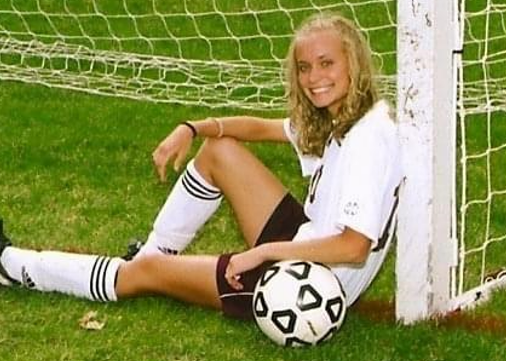 Person and the other three two-sport seniors juggled both.
“All of a sudden we were playing soccer and tennis in the spring,” she said. “Thankfully they let us do both, and our coaches were very good in terms (of) making sure nothing important overlapped.”
Person played doubles all four years and was at No. 1 with Kelly Drummond her final two seasons.
“If my memory serves me correctly, I believe we only lost two matches the whole (senior) year, so it was a good year for us,” she said.
It was a very good year.
She and Drummond won their Regional Final, but that ended her prep career since the team did not qualify for championship weekend.
Preparing for life
The best thing about high school tennis, she said, was that it was a combination team and individual sport.
“You can do really well individually and maybe the team doesn’t do well, or maybe the team does well and you don’t do well personally,” she said. “It has the aspect of wanting the entire team to do good.”
Competing in both sports prepared her for the “real” world, she said.
“Playing soccer and tennis and being part of a team helped me cheer other people on,” she said. “The world is a competitive place, so having that foundation of team sports is really good to teach a plethora of things you can use in the real world.
“Even at work, you have your individual job but you’re also part of a team. If one person isn’t doing well, then your whole team isn’t doing well. If someone else is having a hard time, helping them out is helping the team.”
She added that losing also teaches important lessons.
“You’re going to lose at things your entire life,” she said. “Being able to handle losing, handle rejection, is a good skill to have for anything in life. I’ve learned it’s not what happens to you but how you respond to it. That’s a huge lesson. There are a lot of life lessons you can get from playing team sports in high school.”
Her advice to high school athletes today: “Enjoy it, first of all. Don’t take it too seriously in wins and losses.
“When I look back, most of my core memories are being part of a team, having fun with the team, having fun playing the sport. Enjoy your time,” she said.
“Now I miss it.”
2024 Made In Michigan
July 30: After Successful 'Sequel,' Suttons Bay's Hursey Embarking on Next Chapter - Read
July 24: East Kentwood Run Part of Memorable Start on Knuble's Way to NHL, Olympics - Read
July 22: Monroe High Memories Remain Rich for Michigan's 1987 Mr. Baseball - Read
July 17: Record-Setting Viney Gained Lifelong Confidence at Marine City - Read
July 11: High School 'Hoop Squad' Close to Heart as Hughes Continues Coaching Climb - Read
July 10: Nightingale Embarking on 1st Season as College Football Head Coach - Read
June 28: E-TC's Witt Bulldozing Path from Small Town to Football's Biggest Stage - Read
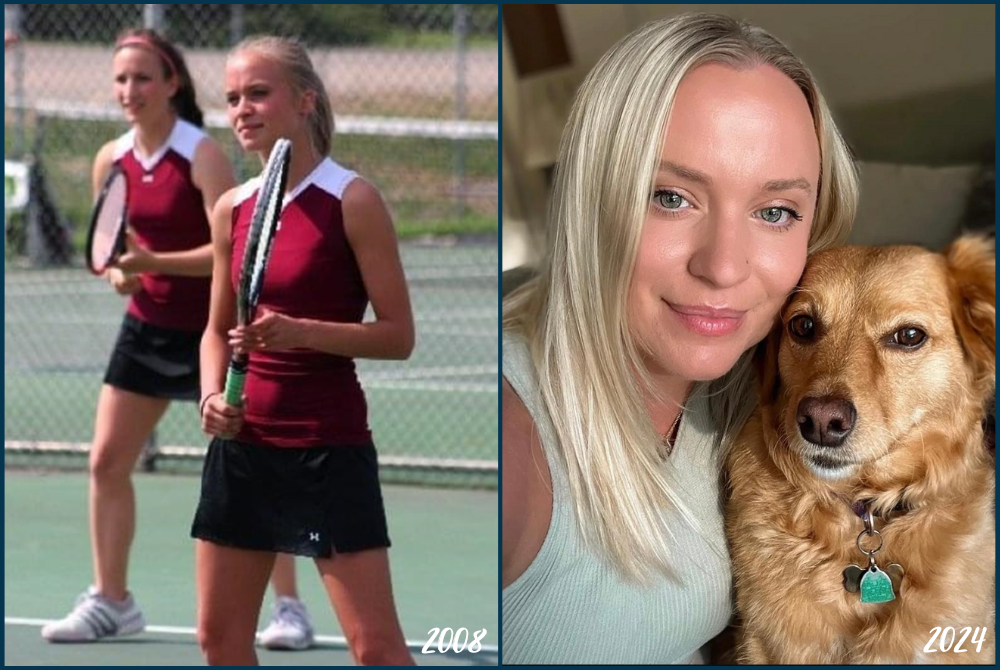
PHOTOS (Top) At left, Parchment’s Amanda Person plays a 2008 tennis match with doubles partner Kelly Drummond; at right, Person and her dog Tessa. (Middle) A pair of beloved trophies sit temporarily on Person’s desk at Purdue. (Below) Person also was a soccer standout at Parchment. (Photos courtesy of Amanda Person.)