

Powerful Voice for High School Sports
December 19, 2014
By Geoff Kimmerly
Second Half editor
Paul Carey was home from the U.S. Army only a few months and just shy of 25 years old when Beal City embarked on its first trip deep into the MHSAA boys basketball tournament.
On the call for local radio station WCEN from gyms at Saginaw Arthur Hill and Lansing Sexton, Carey served as the voice of the previously “laughable” Aggies as they reached the Class D Semifinals before falling just six points short of playing for the title.
“All of Beal City emptied out. They’d never had anything before,” Carey recalled during his annual Thanksgiving weekend visit to the MHSAA Football Finals at Ford Field. “When I got home, within the next two weeks I got a letter from every citizen of Beal City thanking me for broadcasting their games. That’s the kind of appreciation that meant so much.”
During 42 years on the airwaves, Carey was best known as a voice of the Detroit Tigers bounding out of transistor radios all over Michigan, thanks to WJR’s powerful signal.
But for the state’s high school sports community, his legacy is similarly memorable as the voice of the longtime football and basketball scoreboard show and a voter for various all-state teams and wire polls over the decades.
Now 86 and retired since 1991, Carey remains a regular during the first day of the Football Finals, taking in games he broadcast for the MHSAA during the late 1970s and that continue to hold his eye as they have for more than a half-century.
“It was a passion of mine. High school sports always has been,” Carey said. “I think because my dad was a high school coach, and teacher initially, and my brother was a high school coach and teacher, I just grew up in families that appreciated coaching and athletics. I was not a great athlete, but it kept my hand in following sports that way.”
Now, the scores
Carey partnered with Ernie Harwell for Tigers radio broadcasts from 1973-91, including during the march to the 1984 World Series championship. He was named Michigan Sportscaster of the Year six times and to the Michigan Sports Hall of Fame in 1992.
But Carey’s early career included sitting on top of a car, plugged into a phone pole, for a Sacred Heart football game at old Fancher Field just a few blocks from his family’s Mount Pleasant home. Among many more accolades are a Distinguished Service Award from the Michigan High School Coaches Association and a place in the Basketball Coaches Association of Michigan Hall of Fame.
In fact, the start of his weekly announcing of statewide football and basketball scores preceded his baseball career by 16 years and ended two months after he announced his final professional out.
The Michigan High School Scoreboard show was a staple of WJR’s late Friday nights from 1957-91. Carey would read every score he could collect from a variety of sources, often organized by league and with state rankings and context mixed in.
His idea came from something similar read by Len Colby for Kalamazoo’s WKZO. Carey’s brother Terry was coaching at Niles during the second half of the 1950s, and he and other coaches would get together to listen to the Friday night scores from the southwestern part of the state.
Carey, who left WKNX in Saginaw for WJR in 1956, explained to then-sports director Bob Reynolds that the station’s strong signal could provide for a truly statewide scoreboard experience.
Carey then connected with Edgar Hayes of the former Detroit Times, who gave the OK for Carey to call the paper on Friday nights to get scores from the Detroit metro area. For the rest, Carey relied on wire services – there were three at the time – who relied on newspapers from all over Michigan to call in scores over the course of an evening.
Before every Friday during high school football season – and later Tuesdays and Fridays during boys basketball season – Carey typed up lists of games based on schedules in the newspaper, with spaces to add scores. More than a few times, Carey raced down a back ramp at Tiger Stadium after a Friday night game, back to the WJR studio, with 15 minutes to prep for the show’s 11:30 p.m. start.
“If the Flint Journal, the Grand Rapids Press, the Traverse City paper didn’t call in scores to the AP, then I was out of luck too. And that happened all the time,” Carey said. “I would call back occasionally, say, ‘Did you get anything more?’ It was a rat race.”
The show originally was set for 10 minutes and then extended to 15. American Airlines sponsored a record show that followed, and Carey’s scoreboard show had a sponsor only once in 35 years. Finishing up on time was expected, even with more than 200 scores to read.
But Carey said he always went 20 minutes, sometimes 25.
“Because I wasn’t done. I just kept right on going,” Carey said. “Jay Roberts did the all-night show most of the time, and he was patient with me. He didn’t say too much on the air about ‘that guy ahead of me took all of my time.’”
Carey continued the “rat race” until his final scoreboard show, Dec. 20, 1991. He retired from WJR at the end of that calendar year. And it's important to note: Carey was never paid a dime extra for doing the program. .
“I think Paul is really just a sports fan, and that came across to the listener on his broadcasts,” MHSAA historian Ron Pesch said. “Paul would gather as much as possible off the wire. He'd interject if scores were missing from sections of the state. Press polls from the Free Press, News, AP and UPI were big, so he could point out close calls and upsets.
“He provided immediacy, or the closest thing to it in the days before cable TV and the Internet, and because of his scoreboard show, you could get the results before the morning paper. For listeners, he brought life to something as simple as game scores.”
First team all the way
Carey, who resides in Rochester, also served as the engineer on Tigers broadcasts for 16 years, through 1990. He broadcast Pistons games on the radio for six seasons and did the first broadcast of a Central Michigan University football game, in 1949.
Harry Atkins, covering Detroit’s teams while with The Associated Press for 29 years including the last 21 as its sports editor for Detroit, took note of his colleague's hard work – and especially that Carey was one of few broadcasters who was a journalist in addition to a voice.
That made Carey's other major role in high school sports a natural fit.
Atkins split The Associated Press all-state selection panels for football and basketball into 11 regions, and Carey represented the Detroit area for a number of years. He also was a longtime voter in those sports' weekly polls.
“Paul is just that kind of guy. He thought it was important and he made time in his busy schedule to do it,” Atkins said “And it had an impact on the other 10 voters on the All-State panels, too.
“Some of them were from small out-state newspapers or radio or TV stations. Yet every one of them knew who Paul Carey was. And when he spoke, of course, with what often is called "The Voice of God," those voters paid attention.”
And he still does, as well.
At the end of each fall, Carey still puts together a compilation of the three high school all-state football teams – Associated Press, Detroit Free Press and Detroit News – and files them with years of research and results.
“It’s important to me. Nobody sees it but me, but I get a certain kick,” Carey said. “Once in a while I’ll see a kid playing at Central, Western or (Michigan) State or Michigan, and they’ll say he came from Clawson. I’ll go into my all-state collections, say that would’ve been 2009 he played, and I find a name.”
In addition to the Football Finals on WJR, Carey was part of the Baseball Finals broadcasts into the early 1990s, continuing to contribute even after his retirement from his fulltime gig.
He spent high school games over the years sitting next to legends like the Free Press’ Hal Schram and remembers when current Free Press longtime scribe Mick McCabe was just a rookie. One of Carey's final broadcasts was a 1992 Baseball Final with his nephew Mike Carey, who continues to broadcast MHSAA championship games to this day.
“I am eternally grateful to Paul Carey. His contribution to high school sports in Michigan has been great and significant,” Atkins said.
“We are lucky to have him.”
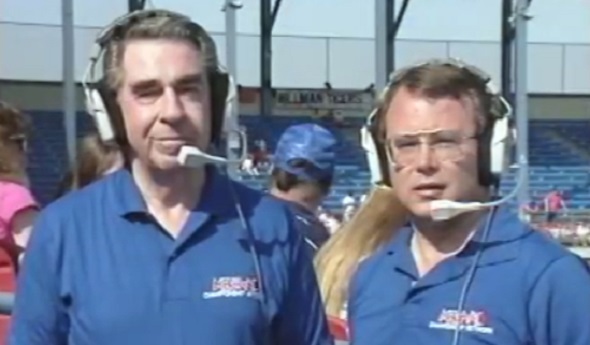
PHOTO: Paul Carey (left) and nephew Mike Carey broadcast the MHSAA 1992 Class D Baseball Final between Hillman and Athens for PASS.
We Will Always Remember Trojans, Lumberjacks as 114-Year-Old Rivalry Nears End
By
Ron Pesch
MHSAA historian
February 9, 2024
The MHSAA basketball record book still lacks a rivalries category. The state’s football record book offers clues to likely candidates, but without deep research, the participants and sequencing of such lists will remain unknown.
Certainly, among the candidates would be the annual boys basketball battles between Saginaw’s east side and west side – Saginaw High vs. Saginaw Arthur Hill. Come Friday, Feb. 16th, 2024, twilight falls on one of Michigan’s most intense. Because of its significance, the game will be hosted outside of a high school gymnasium.
Saginaw’s Dow Event Center will stage the final regular-season showdown between the Trojans and Lumberjacks. Titled the ‘Game of Legends,’ all 5,000 tickets for the celebration were snapped up in 20 minutes. After years of discussions, at the end of the school year, Saginaw High and Arthur Hill will combine to finalize the formation of Saginaw United High School.
Based on the research of Dave Slaggert, the series between schools began during the 1910-11 season at the Saginaw Manual Training School gymnasium. Head varsity boys basketball coach at Arthur Hill from 1996 through 2001, Slaggert spent five years compiling a book documenting the rivalry. Much of the manuscript has already been committed to paper. That includes a chapter penned by Michigan State University coaching legend Tom Izzo, who highlights the uniqueness of the crosstown rivalry, the crazy fans, and the talent that brought him regularly to town. Titled “Remember the Trojans & the Lumberjacks,” the concluding chapter awaits the results of the 2024 season.
The Beginnings
In 1889, Michigan’s State Legislature consolidated the cities of East Saginaw and Saginaw City into what we know today as Saginaw.
East Side High School opened in 1865. In 1901, West Side High School was renamed Arthur Hill, in honor of a former school board president and mayor of Saginaw City.
Football teams from Saginaw High (sometimes called Saginaw Eastern) and Arthur Hill High first met on the gridiron in 1894. In 1904, both joined Flint (Central) and two schools from Bay City to form the Saginaw Valley League. During the 1910-11 season, the boys squads from the Saginaw schools squared off on the basketball court for the first time.
 “Saginaw High easily defeated the Arthur Hill High school basketball players … in the first game of the interscholastic series,” stated the Saginaw Daily News, “the final score standing 60 to 17. … (Bill) Steckert contributed 12 field baskets for the winners. … (Leo) Vondette starred for the losers.”
Perhaps it was a typo – it’s impossible to know – but the final score differed in the 1911 Saginaw yearbook – “The Aurora” – when published in the spring. “Before a large crowd of enthusiastic fans, Arthur Hill was decisively defeated in the local gym, the final count being 69 to 17, with the East Siders on the heavy end.”
The author concluded with flair and flourish: “Steckert starred for Saginaw, getting 24 points to his credit, while Vondette was the celestial light for the vanquished quintet. Dancing was enjoyed after the game.”
A week later, the Saginaw girls basketball team opened its season against the west siders. According to the yearbook, “Saginaw out-played Arthur Hill and defeated them by the score of 41-4.” The newspaper credited Leona Buck as the leading scorer, with a phenomenal 29 points.
The Inevitable Finale
The doors open at 3 p.m. for the 2024 festivities at The Dow next Friday. Fittingly, the Saginaw girls team will tip off the action on the court at 5 o’clock. The girls programs already have consolidated, and the Phoenix of Saginaw United will face Flint Carman-Ainsworth – a school that consolidated in 1986. The Hill and High contest is scheduled for 7 p.m.
“It’s really going to be a big deal,” said Slaggert, thrilled by the prospect. “Saginaw’s going all out for this. They’re trying to do it up in style.”
The wrap-up comes a decade after what, initially, looked like the end.
On Feb. 15, 2014, Detroit Free Press sportswriter Mick McCabe wrote about the expected unification.
“Saginaw and Saginaw Arthur Hill likely met for the last time ever in the regular season Friday,” he wrote. Saginaw had just knocked off the Lumberjacks, the No. 2 team in McCabe’s weekly ranking of the state’s top teams.
“The Saginaw-Arthur Hill basketball rivalry is the best in the state, so you shouldn’t be surprised when the underdog wins. But Saginaw (11-6) was coming off consecutive losses to Midland and Midland Dow for maybe the first time ever.”
The school district was expected to announce the closure of Saginaw High that following Monday, merging its students into Arthur Hill. The move would mean a new school name, new school colors, and a new nickname.
Like many urban centers across the country, outbound migration of both jobs and people, combined with plunging birth rates, had altered the demographics of cities, and the education landscape.
“In just five decades, the city's population dropped from nearly 100,000 in the 1960s to fewer than 52,000 by the 2010 census,” stated the Saginaw News in 2014. “To say it another way, Saginaw lost 48 percent of its residents during the last 50 years.”
McCabe cut to what that meant to enrollment numbers at the two schools: “In 1987, Saginaw High had over 1,800 students; it is now down to about 600. Arthur Hill had 2,395 students in ’85; it now has 973.”
 Despite the defeat, McCabe predicted Arthur Hill to be among the final four Class A teams still standing that season when the annual MHSAA Tournament shifted to Michigan State’s Breslin Center. But in the craziness of March, the Trojans again took down Arthur Hill in the Districts, 53-51.
Adding to the madness, the expected consolidation didn’t happen. A recommendation by a Saginaw interim superintendent to close Saginaw High found no school board support.
With the potential consolidation still hovering, one year later sportswriter Bill Khan recalled other recent departures from Michigan’s classic basketball landscape in an article for the StateChamps! Sports Network:
“The Saginaw-Arthur Hill rivalry is at risk of going the way of other great urban rivalries – such as Flint Central-Flint Northern, Pontiac Central-Pontiac Northern, Lapeer East-Lapeer West, Detroit Cooley-Detroit Southwestern, Detroit Mackenzie-Detroit Redford, Detroit Kettering-Detroit Northeastern, Detroit Miller-Detroit Northern and Detroit Southeastern-Detroit Eastern, that have ended in years past due to school closures and consolidations.”
Arthur Hill downed the Trojans twice during the 2014-15 regular season league action, and again in postseason District play, before finishing the year as Class A runner-up, and the holding pattern of the planned school merger continued.
Enrollment numbers continued to drop at both schools and after much community and school board debate, construction on a brand-new five-story Saginaw United High School began in 2022.
A Celebration of Statistics
The state basketball tournament kicked off in 1917. Over 107 years, on only two occasions – in 1943 during World War II, and in 2020, due to COVID-19 – the tournament was not completed.
Slaggert breaks down the City of Saginaw School District’s incredible basketball history in a quick series of numbers.
“47-36-18-8,” said Slaggert, stressing a bullet point of a well-rehearsed pitch, breaking out the incredible success of the two schools come tournament time.
“During those 105 tournaments, 47 times, Saginaw High (starting in 1919) or Arthur Hill (beginning in 1930) made it into the state Quarterfinals – the final eight.
“That’s almost half of the 105 possible years. And in most cases throughout that rivalry, they would have played each other in the Districts. So how many more times would they have made it if they were coming in different brackets or different directions? “
To take that further, he noted, 36 times one of those teams made it into the final four. On 18 occasions, one of the two schools reached the state title game, and on eight occasions, they emerged as MHSAA state champions.
Six of those titles were won by Saginaw High (1942, 1962, 1996, 2007,2008, 2012). Arthur Hill’s championships were won in 1944 and 2006.
“That's a pretty incredible stat for two schools in the same town, don’t you think?” Slaggert asked.
 That history also points out another Slaggert challenge. As illustrated, come March the schools could, in theory, bump into each other one more time come the postseason. This year, the teams are in different Districts, and could potentially cross paths in an MHSAA Regional.
A Parade of All-Staters
Between 1938 and 2023, a combined total of 106 players from the two schools – 10 or more in each decade from the 1940s to the 2010s – have earned all-state basketball honors from The Associated Press and/or one or more of the Detroit newspapers: the Free Press, News or Times.
Since the introduction of Michigan’s Mr. Basketball award in 1981, honoring the best-of-the-best from the state’s top high school seniors, 10 players from the two schools have landed among the top five in voting: Eric Davis (AH –‘15), Maurice Jones (AH –‘10), Draymond Green (S –‘08), Dar Tucker (AH –‘07), Anthony Roberson (S –‘02), Eugene Seals (S –’00, and head coach of the United girls basketball team), Jason Richardson (AH-‘99), Jessie Drain (S –‘91) and Daryl Reed (S –‘87). Richardson won the award. Davis, Green, Tucker, Roberson, and Seals all finished second in the annual voting.
Tony Smith (S -‘74), Craig Dill (AH -‘63), Ernie Thompson (S -‘62), Webster Kirksey (S -‘51), Dick Rifenburg (AH -‘44), and Larry Savage (S -‘42) were all honored by the Basketball Coaches Association of Michigan with their Retro Mr. Basketball Award when the organization sought to honor the great seniors in Michigan high school basketball from the years 1920 through 1980. Seven others – James Koger (S -‘79), Lovell Humes (S – ’63), Bill Agre (AH -‘47), Gene Glick (AH -’46), Jack Mott (AH -’45), Eddie Johnson (S – ’43) and Stanley Paskiewicz (S -’38) – were among the candidates for that award.
Based on research by Orchard Lake St. Mary’s Robin Goddard, Saginaw High is likely the state’s winningest basketball program, trailed by Benton Harbor, Kalamazoo Central and Orchard Lake St. Mary’s.
Initially, Saginaw dominated the crosstown series with the Lumberjacks. But by the 1920s Arthur Hill overcame the deficit, and by the mid-1950s the Hill had opened a wide 25-game lead in wins versus losses. But by 1975, the gap had narrowed with the Trojans just six games back in the series. And yet, the exact status of the rivalry is still unknown, as the capture of game scores is spotty going forward.
The digging to capture those missing scores continues, as does the race to game day.
Slaggert has committed to printing 1,000 copies of his book. His challenge to date has been selling copies of something that does not yet, physically, exist. As it stands, currently there are 772 pages in the book. It includes a mind-blowing 800+ photos dating as far back as 1905. The sale price is fixed at $40. That currently means the production cost per copy exceeds the retail price, so Slaggert continues to chase sponsorships to defray the printing expense.
“It’s a non-profit effort,” he noted. “If there are any profits, they go to scholarships for the new high school. All money is run through the Saginaw Community Foundation,” which makes sponsorships tax-deductible.
His favorite memory from the series is his last victory as an Arthur Hill coach. It comes from 2001.
“Saginaw High defeated us 90-37 in the second game of that season and finished with a 17-5 season record that year,” he retold. “We had a modest 10-10 season record heading into the Districts but showed lots of improvement through the season. We met again in the District Finals. Saginaw High was led by Anthony Roberson, LaMarr Woodley, Michael Thomas and Tanoris Shepard and was ranked seventh in the state. In front of a sold-out Heritage High School crowd, our kids played their hearts out and, led by Devaundre Whitson, Omar Linder, and Freddy Jackson, pulled out a 68-66 overtime win! (It’s) my greatest thrill in coaching, and most of the old-timers say it’s the greatest upset in the rivalry.”
Slaggert retired from coaching after that season, and in the years to follow, found a desire to record the history of the series.
“I have nine living coaches from Saginaw and Arthur Hill that have written a chapter for me. I have eight others that I've written on Larry Laeding, Chuck Fowler, and different coaches that are deceased,” he said. “My intent is to give something back to my community. I didn’t do this for money. I wanted this story to be passed down to future generations – people 100 years from now about Jason Richardson, Draymond Green, Ernie Thompson, Craig Dill, and all the great ones.
“It’s a labor of love for me, I’ve really enjoyed it.”
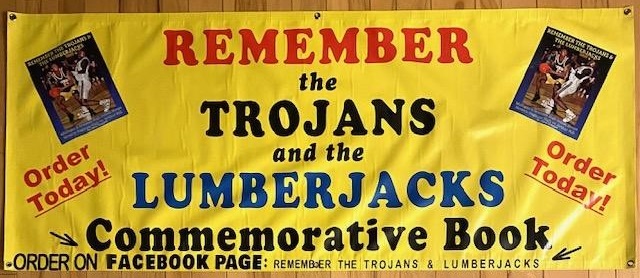 To order Slaggert's book, click for the Facebook link or visit the Saginaw Community Foundation website, click "Give Now" and select the book title as Fund. Cost is $40 with an option including shipping for $52.
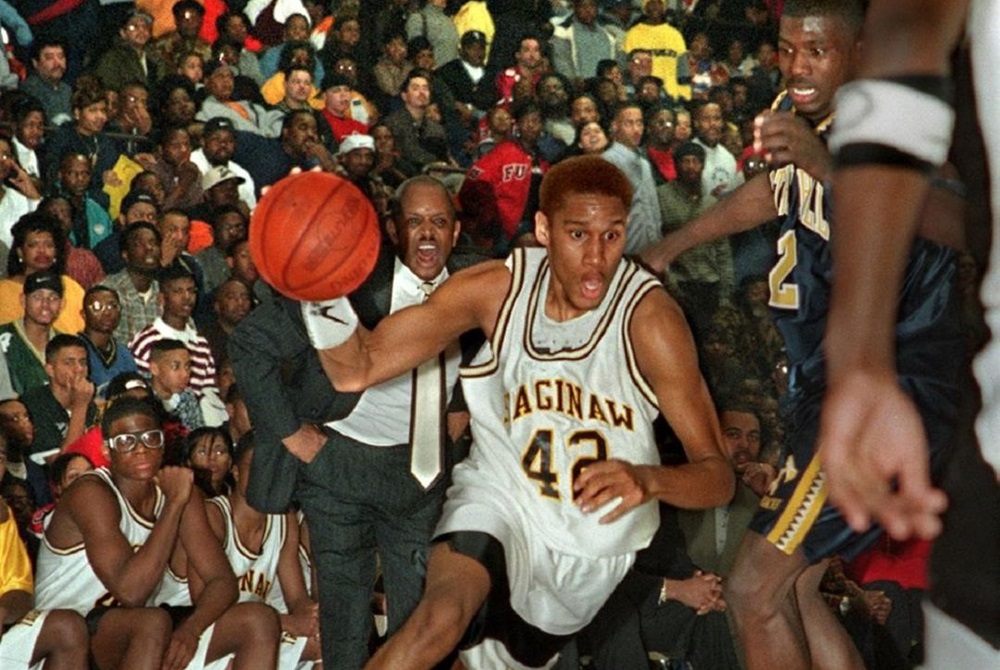
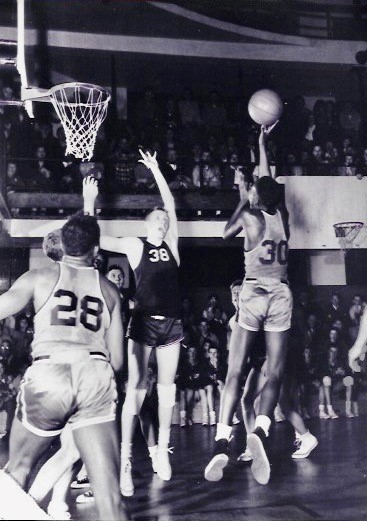
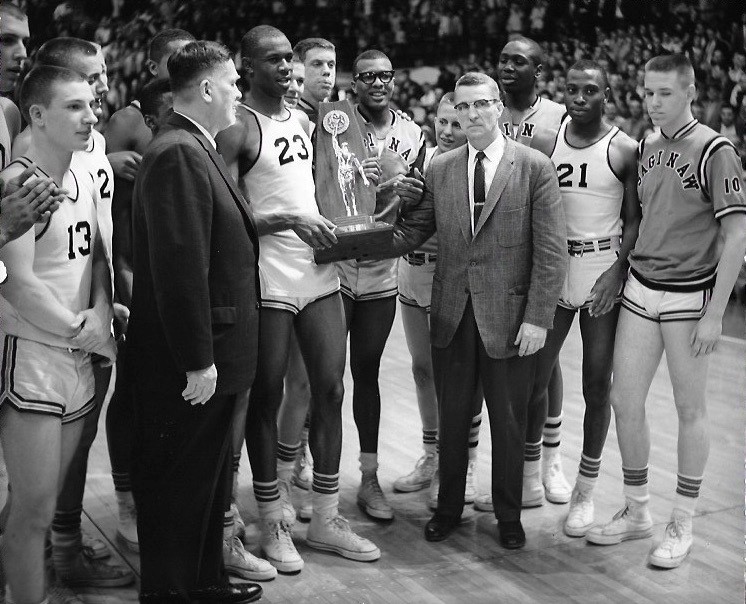
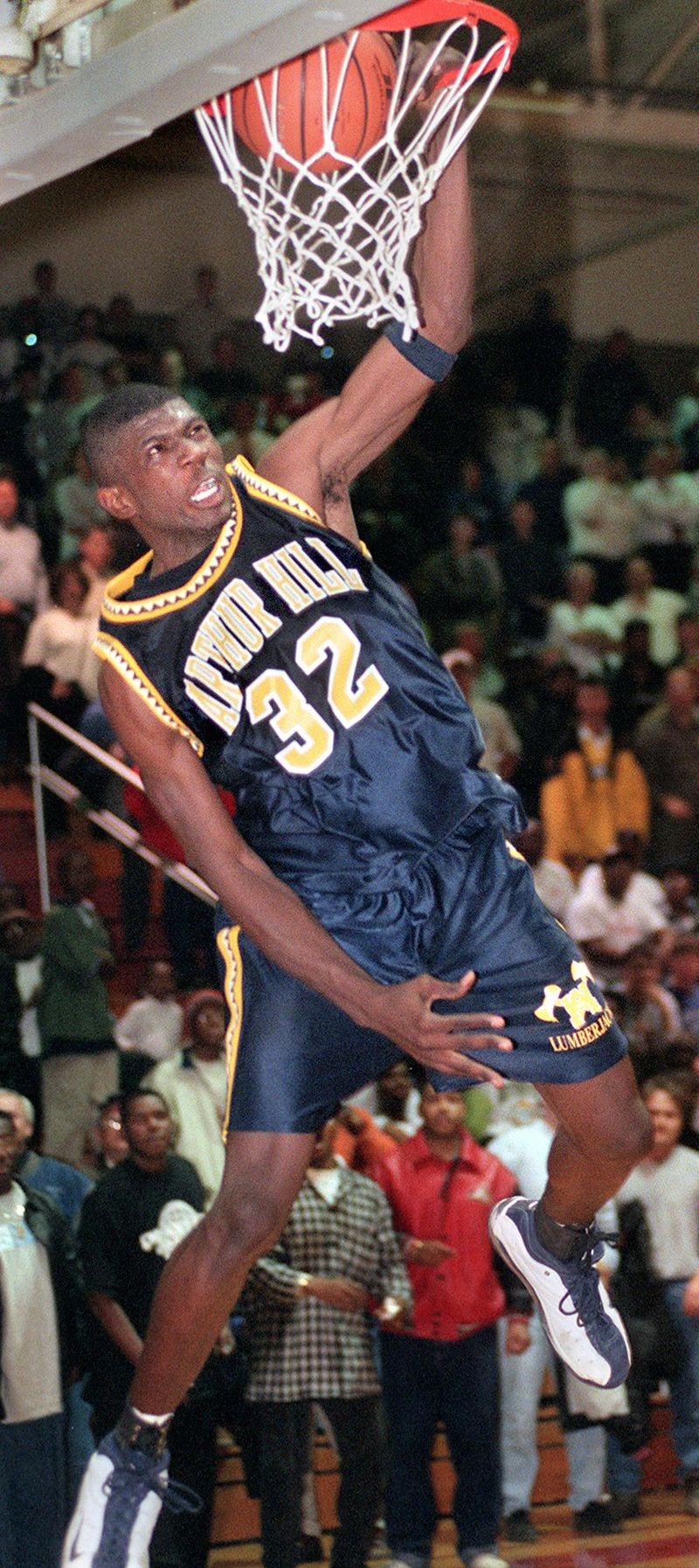
PHOTOS (Top) Saginaw Eugene Seals drives against Arthur Hill’s Jason Richardson – with coach Marshall Thomas in the background – during a sold-out 1999 game at the Saginaw Civic Center. (2) Arthur Hill’s Ernie Thompson and coach Larry Laeding accept the 1962 Class A championship trophy. (3) Saginaw High’s Webster Kirksey (30) puts up a shot; he graduated in 1951. (4) Richard dunks at the final buzzer as Arthur Hill downs top-ranked Flint Northwestern in a 1999 Class A Regional matchup. (Photos collected by Dave Slaggert. Top photo courtesy of Saginaw News/MLive.)