

Powerful Voice for High School Sports
December 19, 2014
By Geoff Kimmerly
Second Half editor
Paul Carey was home from the U.S. Army only a few months and just shy of 25 years old when Beal City embarked on its first trip deep into the MHSAA boys basketball tournament.
On the call for local radio station WCEN from gyms at Saginaw Arthur Hill and Lansing Sexton, Carey served as the voice of the previously “laughable” Aggies as they reached the Class D Semifinals before falling just six points short of playing for the title.
“All of Beal City emptied out. They’d never had anything before,” Carey recalled during his annual Thanksgiving weekend visit to the MHSAA Football Finals at Ford Field. “When I got home, within the next two weeks I got a letter from every citizen of Beal City thanking me for broadcasting their games. That’s the kind of appreciation that meant so much.”
During 42 years on the airwaves, Carey was best known as a voice of the Detroit Tigers bounding out of transistor radios all over Michigan, thanks to WJR’s powerful signal.
But for the state’s high school sports community, his legacy is similarly memorable as the voice of the longtime football and basketball scoreboard show and a voter for various all-state teams and wire polls over the decades.
Now 86 and retired since 1991, Carey remains a regular during the first day of the Football Finals, taking in games he broadcast for the MHSAA during the late 1970s and that continue to hold his eye as they have for more than a half-century.
“It was a passion of mine. High school sports always has been,” Carey said. “I think because my dad was a high school coach, and teacher initially, and my brother was a high school coach and teacher, I just grew up in families that appreciated coaching and athletics. I was not a great athlete, but it kept my hand in following sports that way.”
Now, the scores
Carey partnered with Ernie Harwell for Tigers radio broadcasts from 1973-91, including during the march to the 1984 World Series championship. He was named Michigan Sportscaster of the Year six times and to the Michigan Sports Hall of Fame in 1992.
But Carey’s early career included sitting on top of a car, plugged into a phone pole, for a Sacred Heart football game at old Fancher Field just a few blocks from his family’s Mount Pleasant home. Among many more accolades are a Distinguished Service Award from the Michigan High School Coaches Association and a place in the Basketball Coaches Association of Michigan Hall of Fame.
In fact, the start of his weekly announcing of statewide football and basketball scores preceded his baseball career by 16 years and ended two months after he announced his final professional out.
The Michigan High School Scoreboard show was a staple of WJR’s late Friday nights from 1957-91. Carey would read every score he could collect from a variety of sources, often organized by league and with state rankings and context mixed in.
His idea came from something similar read by Len Colby for Kalamazoo’s WKZO. Carey’s brother Terry was coaching at Niles during the second half of the 1950s, and he and other coaches would get together to listen to the Friday night scores from the southwestern part of the state.
Carey, who left WKNX in Saginaw for WJR in 1956, explained to then-sports director Bob Reynolds that the station’s strong signal could provide for a truly statewide scoreboard experience.
Carey then connected with Edgar Hayes of the former Detroit Times, who gave the OK for Carey to call the paper on Friday nights to get scores from the Detroit metro area. For the rest, Carey relied on wire services – there were three at the time – who relied on newspapers from all over Michigan to call in scores over the course of an evening.
Before every Friday during high school football season – and later Tuesdays and Fridays during boys basketball season – Carey typed up lists of games based on schedules in the newspaper, with spaces to add scores. More than a few times, Carey raced down a back ramp at Tiger Stadium after a Friday night game, back to the WJR studio, with 15 minutes to prep for the show’s 11:30 p.m. start.
“If the Flint Journal, the Grand Rapids Press, the Traverse City paper didn’t call in scores to the AP, then I was out of luck too. And that happened all the time,” Carey said. “I would call back occasionally, say, ‘Did you get anything more?’ It was a rat race.”
The show originally was set for 10 minutes and then extended to 15. American Airlines sponsored a record show that followed, and Carey’s scoreboard show had a sponsor only once in 35 years. Finishing up on time was expected, even with more than 200 scores to read.
But Carey said he always went 20 minutes, sometimes 25.
“Because I wasn’t done. I just kept right on going,” Carey said. “Jay Roberts did the all-night show most of the time, and he was patient with me. He didn’t say too much on the air about ‘that guy ahead of me took all of my time.’”
Carey continued the “rat race” until his final scoreboard show, Dec. 20, 1991. He retired from WJR at the end of that calendar year. And it's important to note: Carey was never paid a dime extra for doing the program. .
“I think Paul is really just a sports fan, and that came across to the listener on his broadcasts,” MHSAA historian Ron Pesch said. “Paul would gather as much as possible off the wire. He'd interject if scores were missing from sections of the state. Press polls from the Free Press, News, AP and UPI were big, so he could point out close calls and upsets.
“He provided immediacy, or the closest thing to it in the days before cable TV and the Internet, and because of his scoreboard show, you could get the results before the morning paper. For listeners, he brought life to something as simple as game scores.”
First team all the way
Carey, who resides in Rochester, also served as the engineer on Tigers broadcasts for 16 years, through 1990. He broadcast Pistons games on the radio for six seasons and did the first broadcast of a Central Michigan University football game, in 1949.
Harry Atkins, covering Detroit’s teams while with The Associated Press for 29 years including the last 21 as its sports editor for Detroit, took note of his colleague's hard work – and especially that Carey was one of few broadcasters who was a journalist in addition to a voice.
That made Carey's other major role in high school sports a natural fit.
Atkins split The Associated Press all-state selection panels for football and basketball into 11 regions, and Carey represented the Detroit area for a number of years. He also was a longtime voter in those sports' weekly polls.
“Paul is just that kind of guy. He thought it was important and he made time in his busy schedule to do it,” Atkins said “And it had an impact on the other 10 voters on the All-State panels, too.
“Some of them were from small out-state newspapers or radio or TV stations. Yet every one of them knew who Paul Carey was. And when he spoke, of course, with what often is called "The Voice of God," those voters paid attention.”
And he still does, as well.
At the end of each fall, Carey still puts together a compilation of the three high school all-state football teams – Associated Press, Detroit Free Press and Detroit News – and files them with years of research and results.
“It’s important to me. Nobody sees it but me, but I get a certain kick,” Carey said. “Once in a while I’ll see a kid playing at Central, Western or (Michigan) State or Michigan, and they’ll say he came from Clawson. I’ll go into my all-state collections, say that would’ve been 2009 he played, and I find a name.”
In addition to the Football Finals on WJR, Carey was part of the Baseball Finals broadcasts into the early 1990s, continuing to contribute even after his retirement from his fulltime gig.
He spent high school games over the years sitting next to legends like the Free Press’ Hal Schram and remembers when current Free Press longtime scribe Mick McCabe was just a rookie. One of Carey's final broadcasts was a 1992 Baseball Final with his nephew Mike Carey, who continues to broadcast MHSAA championship games to this day.
“I am eternally grateful to Paul Carey. His contribution to high school sports in Michigan has been great and significant,” Atkins said.
“We are lucky to have him.”
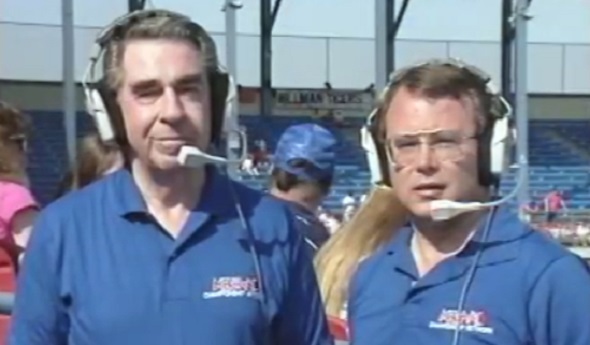
PHOTO: Paul Carey (left) and nephew Mike Carey broadcast the MHSAA 1992 Class D Baseball Final between Hillman and Athens for PASS.
Constantine Celebrates 100th Season, Renowned for Continuity & Signature Wing-T
By
Scott Hassinger
Special for MHSAA.com
September 6, 2023
CONSTANTINE – Bennett Vandenberg and Cohen McGee are just like any other high school football players.
 Both Constantine seniors have high aspirations of winning a fifth-straight Southwestern Athletic Conference Lakeshore title and reaching the postseason.
But Vandenberg and McGee, along with their Falcons teammates, will be celebrating more than victories and a potential playoff appearance this fall.
Constantine, a community located in southern St. Joseph County, is observing the 100th season of the school's football program.
The Falcons (1-1) will commemorate the occasion Saturday, Oct. 7, with a home game against SAC Lakeshore foe Kalamazoo United. Kickoff time from Sweetland Stadium is 1 p.m. The game will be followed by a community luncheon and program in the high school at which time past coaches, players and the program's biggest accomplishments will be recognized and celebrated.
Vandenberg, a starting fullback/tight end and outside linebacker, and McGee, an offensive lineman and linebacker, are both looking forward to the rest of the season and continuing Constantine's strong tradition on the gridiron.
"We have a huge football tradition here at Constantine. This year we're celebrating the 100th year, and we have some of the oldest living players coming back to help celebrate after that game with United,” said Vandenberg, a three-year starter and Finals placer his junior year in wrestling and track & field. “Our community is all about football. We know we have to go out there and represent our school and community the right way."
McGee is following in the footsteps of his older brother Carter.
"There are lots of things that people who follow Constantine football don't see, like the hours of dedication and work we put in during the offseason. That's where we make our strides and become better as a program," McGee said.
The football stadium at Constantine is named after Dr. George Sweetland, a physician in the community, who donated money for a football stadium to be built with a hill completely circling the facility.
 Sweetland, who moved to Constantine in 1916 to take over his brother's medical practice after the latter was killed in a car crash, reportedly allowed patients to work off their medical bills by helping with the stadium's construction.
Constantine, which played its first football game in 1924 and finished as county champs at 4-2 under coach Lew Lake, sports an all-time record of 481 wins and 221 losses with 11 ties. During that span, the Falcons have enjoyed 11 unbeaten seasons, including Robert Finlay's 1937 squad that went 8-0 and was unscored upon.
Coaching longevity is one of the biggest factors allowing Constantine to be as successful as it has been, especially during the program's modern era. The Falcons have had just four head coaches since 1964.
Mike Messner, a three-sport athlete and 1965 Constantine graduate, later served as the school's athletic director from 1992-2016.
Messner pointed to Meredith 'Spud' Huston, Constantine's football coach from 1958-1961, as one of the first individuals influential in setting the wheels in motion for the program's future success.
Huston guided the Falcons to their first league title in 1961.
Constantine's four winningest coaches – Dave Horn, Tim Baker, Ken Rimer and Shawn Griffith – are all honorary members of the Michigan High School Football Coaches Association's Hall of Fame.
Horn, who died earlier this summer, served two stints as Constantine's head coach from 1964-1981 and 1987-1989 while compiling a 116-65-4 record.
Baker (129-30) coached Constantine for 15 seasons and guided the Falcons to a record of 129-30. Under Baker, the Falcons were Division 6 champs in 2004 and Finals runners-up in 1994 (Class CC) and 2002 (Division 5).
"Dave (Horn) was a genuinely great person who coached 21 years. He could get upset at you on the field, but he was a very kind, storyteller and a thoughtful guy who really cared about others," Messner said.
 "In the modern coaching era, Tim (Baker) really believed in lifting weights, making kids stronger and developing kids into good football players. He was diligent, hardworking and put a lot of time into the program while missing a lot of family functions. He concentrated on doing the best job he could. Ken (Rimer) was right there in the same mode as Tim. When they started coaching together, they wanted a program that kids at Constantine could be proud of. Things started really happening, and ever since then the program has been strong. We have coaches who want Constantine to be successful on the field."
Rimer spent 28 years as an assistant coach under Baker and current head coach Shawn Griffith. Constantine compiled a win-loss mark of 242-70 with Rimer as an assistant.
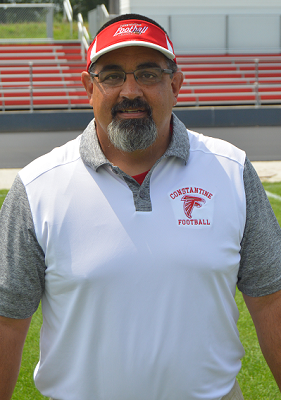
Griffith, who took over as Constantine's head coach in 2005, is the Falcons’ all-time winningest coach at 156-53. Under Griffith's tutelage, the Falcons have made 17 playoff appearances, with back-to-back Division 6 runners-up finishes in 2011 and 2012.
"The history of Constantine football kind've coincides with everything else here in the community. This is my 32nd year overall as a coach in this program. But I also have several memories from when I was in high school at Mendon as a player going up against Constantine," Griffith said.
"When you talk about any community our size, you immediately look at family names. We have another Stears (Lucas) on this year's team. Mike (Messner) told me there have been over 20 from the Stears family that have worn the Falcon uniform. It doesn't stop there. I look at the number of kids we have in the locker room this year, and I realize that I've coached many of their brothers, fathers and uncles. We look at the program as one big family. This program has helped to raise a lot of young men in the area these last few years. The community has been extremely supportive of the program as well."
Constantine won 19 league championships as a member of the St. Joseph Valley League from 1952-2007. That league consisted of Constantine, White Pigeon, Schoolcraft, Centreville, Colon, Climax-Scotts, Burr Oak and Mendon. Bronson and Battle Creek St. Philip became members later after Climax-Scotts and Burr Oak left to join the Southern Central Athletic Association. Eventually, the SJV disbanded due to conference realignment and declining enrollment among its smaller schools.
 At one time, Constantine played in one of the longest-running rivalries in state football history. The Falcons and archrival White Pigeon began playing one another in 1924 and Constantine held a 47-35-6 in the rivalry, with wins in the final 17 meetings before the series ended after the 2007 season.
Messner recalls the 1981 meeting between White Pigeon and Constantine as one of the most memorable. The game was played at the Sweetland Stadium in Constantine, and there were more than 5,000 people in attendance.
"White Pigeon came into that game unscored upon and ranked No. 1 in the state. We were undefeated, but nobody was saying anything about us, but they were really talking (White Pigeon) up," Messner said. "(White Pigeon) had brought over 1,000 balloons with them and hid them behind the bleachers. They were going to launch them every time they scored. They never scored, and we beat them 21-0. It was such a sad moment for both schools when they had to stop playing one another in football."
After the SJV dissolved, Constantine and Schoolcraft became members of the Kalamazoo Valley Athletic Association from 2008-2014 before leaving to join the Southwestern Athletic Conference for the 2015 season. Constantine begins its ninth season competing in the SAC Lakeshore against the likes of Watervliet, Allegan, Kalamazoo United, South Haven and Parchment.
Messner also lists several playoff games as big moments in Constantine's football history.
"Our first playoff team (1991) was a big year, and our first state finals appearance (1994) was another," Messner added.
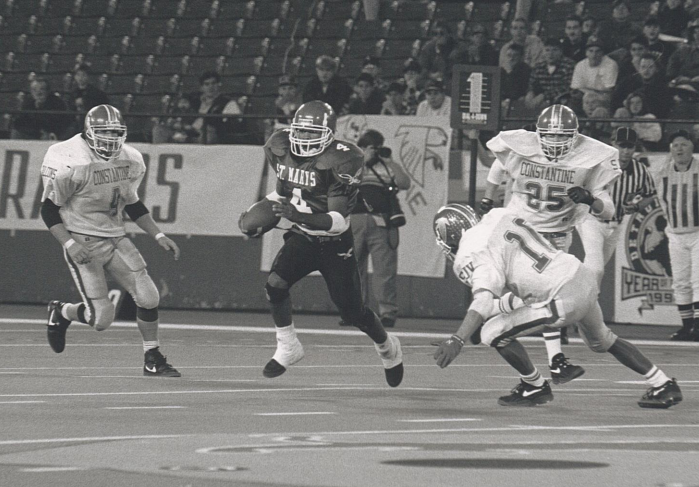
Constantine lost to Orchard Lake St. Mary's (35-7) in the 1994 Class CC Final, but knocked off heavily-favored Fennville (50-0) in their Pre-Regional and Whittemore-Prescott (54-6) in a Semifinal to get there.
"Both teams were considerably bigger than us up front on the line. Fennville had a really good quarterback (Frank Alfieri) and Whittemore-Prescott had a great tailback (Tom 'Touchdown' Tyson) that our much smaller guys managed to shut down," Messner said. "Then there was a 13-7 win we had in the 2002 Regional Finals over heavily-favored Muskegon Oakridge."
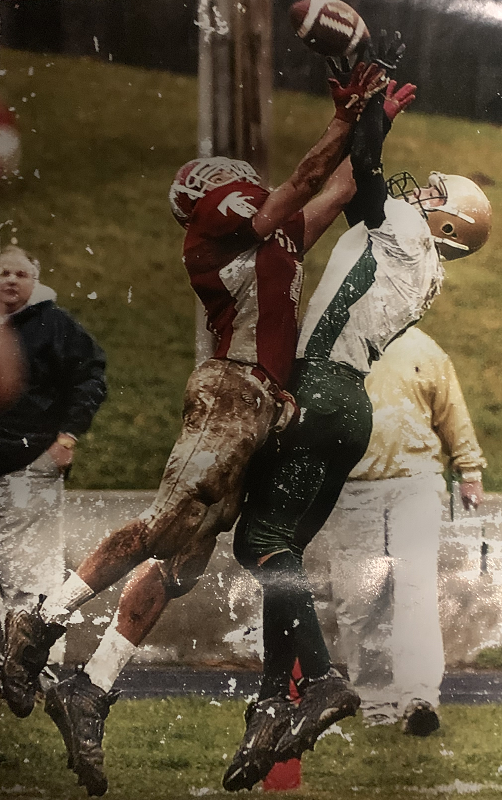
But perhaps the 2004 Semifinal deemed 'The Miracle in Marshall' will go down as the most memorable game in Constantine history. In that contest, Constantine trailed Monroe St. Mary Catholic Central 27-14 with a little more than six and a half minutes to go in the fourth quarter.
The Falcons scored twice during those last few minutes, including a last-second 32-yard TD pass from Aaron Baker to Sean Wolf caught in the end zone that tied the game at 27-27 with one second left. Jordan Williams booted the PAT as time expired, giving the Falcons a 28-27 win.
Constantine went on to defeat Suttons Bay 34-13 in the Division 6 Final the following week.
 From 1991-2015, Constantine attained at least seven wins for 25 consecutive years, which is a state record. The Falcons made 18 consecutive playoff appearances from 1999-2016 before suffering their most recent losing season in 2017, when they finished 3-6.
Constantine's overall playoff record stands at 49-25 with 26 total appearances.
It was Griffith, who played his high school football at Mendon for Class D championship-winning coach Roger Smith and his then-assistant John Schwartz (who would later lead the Hornets to 10 more Finals titles) who convinced Baker the Falcons should transition from the I-Formation to the Wing-T offense.
After much discussion and argument among the coaching staff, Baker reluctantly agreed to Griffith's idea.
"I joined the coaching staff in 1992 as offensive coordinator. As a coaching staff, we really came into our own and made our first run to the Finals in 1994. In the late ’90s we had some really good teams, but still didn't quite have a real identity. During that time we ran into some really good Wing-T football teams," Griffith said.
"We started noticing that we had a real hard time stopping these teams that ran the Wing-T like Muskegon Orchard View, Hopkins and Battle Creek Pennfield. So I came to Tim (Baker) after the 2001 season with the idea of changing the offense. We knew we had a tremendous group of running backs coming up through the program for the next seven or eight years. I approached him about running the Wing-T. He wasn't real receptive at first about running it. But after sitting down with other Wing-T coaches like John Shilito (Muskegon Orchard View) and Irv Sigler (Belding), he agreed to give it a try."
Constantine began running the Wing-T at the start of the 2002 season.
"Once you get known for running an offense like this, it kind've becomes your niche. I get emails from people all over the United States wanting me to come teach them this offense at camps. Here at Constantine, we've been fortunate to rack up quite a few wins since we installed this offense. Our kids can really talk the Wing-T game, and we didn't really have that before when we were running our I-formation and single-back stuff," Griffith said.
"The blocking schemes have become ingrained in our kids. They do a great job of knowing where they are supposed to be and who they are supposed to block. Another thing I really like about the Wing-T is it's a lineman's offense. Our linemen get a lot of credit, which they deserve. There is a certain toughness to this offense as well. It's allowed us to use kids who might be smaller and less athletic, but still allows us to be successful because they have developed a certain toughness."
Griffith credits a lot of that toughness to his players who compete on the Falcons' wrestling team during the winter sports season. Constantine’s wrestling program also has enjoyed a long run of success, including a Class C-D title in 1993 and Division 3 runner-up finish in 2002. The Falcons have won Team Regional titles three straight seasons.
 Scott Hassinger is a contributing sportswriter for Leader Publications and previously served as the sports editor for the Three Rivers Commercial-News from 1994-2022. He can be reached at [email protected] with story ideas for Berrien, Cass, St. Joseph and Branch counties.
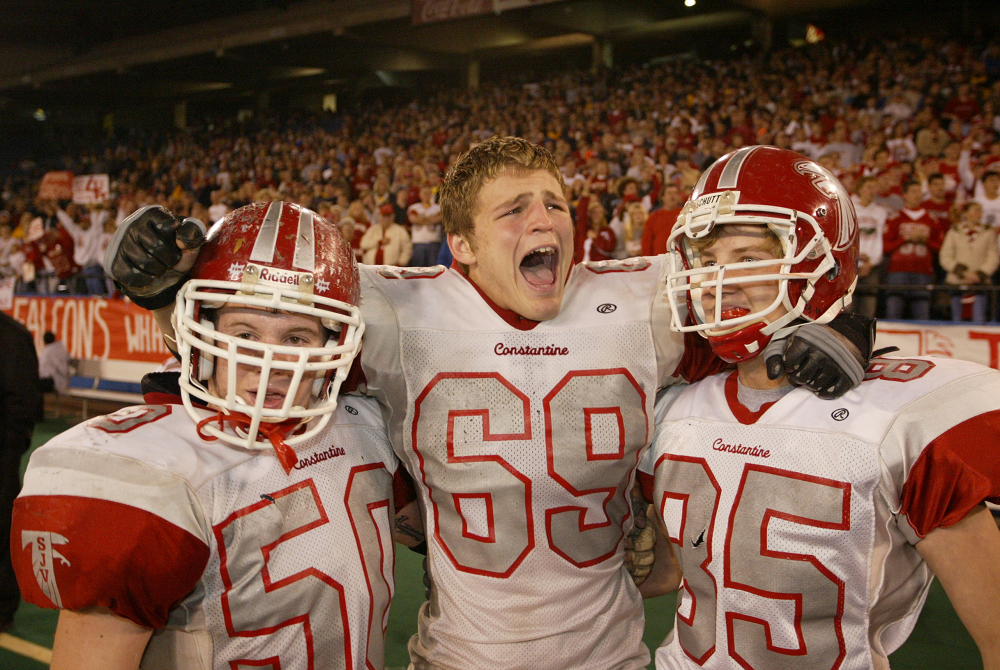
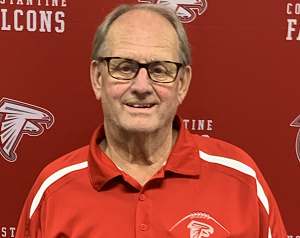
PHOTOS (Top) Constantine players celebrate near the end of their 2004 championship win at Pontiac Silverdome. (2) A trio of Constantine defenders pursue Orchard Lake St. Mary’s Phil Martin (4) during the 1994 Class CC Final. (3) Longtime Constantine athletic director Mike Messner. (4) Current Constantine head varsity coach Shawn Griffith. (5) The 2004 “Miracle in Marshall” remains one of the most memorable games in Constantine football history. (Finals photos from MHSAA archive. “Miracle in Marshall” photo by Dick Carter. Messner and Griffith photos gathered by Scott Hassinger.)