

Powerful Voice for High School Sports
December 19, 2014
By Geoff Kimmerly
Second Half editor
Paul Carey was home from the U.S. Army only a few months and just shy of 25 years old when Beal City embarked on its first trip deep into the MHSAA boys basketball tournament.
On the call for local radio station WCEN from gyms at Saginaw Arthur Hill and Lansing Sexton, Carey served as the voice of the previously “laughable” Aggies as they reached the Class D Semifinals before falling just six points short of playing for the title.
“All of Beal City emptied out. They’d never had anything before,” Carey recalled during his annual Thanksgiving weekend visit to the MHSAA Football Finals at Ford Field. “When I got home, within the next two weeks I got a letter from every citizen of Beal City thanking me for broadcasting their games. That’s the kind of appreciation that meant so much.”
During 42 years on the airwaves, Carey was best known as a voice of the Detroit Tigers bounding out of transistor radios all over Michigan, thanks to WJR’s powerful signal.
But for the state’s high school sports community, his legacy is similarly memorable as the voice of the longtime football and basketball scoreboard show and a voter for various all-state teams and wire polls over the decades.
Now 86 and retired since 1991, Carey remains a regular during the first day of the Football Finals, taking in games he broadcast for the MHSAA during the late 1970s and that continue to hold his eye as they have for more than a half-century.
“It was a passion of mine. High school sports always has been,” Carey said. “I think because my dad was a high school coach, and teacher initially, and my brother was a high school coach and teacher, I just grew up in families that appreciated coaching and athletics. I was not a great athlete, but it kept my hand in following sports that way.”
Now, the scores
Carey partnered with Ernie Harwell for Tigers radio broadcasts from 1973-91, including during the march to the 1984 World Series championship. He was named Michigan Sportscaster of the Year six times and to the Michigan Sports Hall of Fame in 1992.
But Carey’s early career included sitting on top of a car, plugged into a phone pole, for a Sacred Heart football game at old Fancher Field just a few blocks from his family’s Mount Pleasant home. Among many more accolades are a Distinguished Service Award from the Michigan High School Coaches Association and a place in the Basketball Coaches Association of Michigan Hall of Fame.
In fact, the start of his weekly announcing of statewide football and basketball scores preceded his baseball career by 16 years and ended two months after he announced his final professional out.
The Michigan High School Scoreboard show was a staple of WJR’s late Friday nights from 1957-91. Carey would read every score he could collect from a variety of sources, often organized by league and with state rankings and context mixed in.
His idea came from something similar read by Len Colby for Kalamazoo’s WKZO. Carey’s brother Terry was coaching at Niles during the second half of the 1950s, and he and other coaches would get together to listen to the Friday night scores from the southwestern part of the state.
Carey, who left WKNX in Saginaw for WJR in 1956, explained to then-sports director Bob Reynolds that the station’s strong signal could provide for a truly statewide scoreboard experience.
Carey then connected with Edgar Hayes of the former Detroit Times, who gave the OK for Carey to call the paper on Friday nights to get scores from the Detroit metro area. For the rest, Carey relied on wire services – there were three at the time – who relied on newspapers from all over Michigan to call in scores over the course of an evening.
Before every Friday during high school football season – and later Tuesdays and Fridays during boys basketball season – Carey typed up lists of games based on schedules in the newspaper, with spaces to add scores. More than a few times, Carey raced down a back ramp at Tiger Stadium after a Friday night game, back to the WJR studio, with 15 minutes to prep for the show’s 11:30 p.m. start.
“If the Flint Journal, the Grand Rapids Press, the Traverse City paper didn’t call in scores to the AP, then I was out of luck too. And that happened all the time,” Carey said. “I would call back occasionally, say, ‘Did you get anything more?’ It was a rat race.”
The show originally was set for 10 minutes and then extended to 15. American Airlines sponsored a record show that followed, and Carey’s scoreboard show had a sponsor only once in 35 years. Finishing up on time was expected, even with more than 200 scores to read.
But Carey said he always went 20 minutes, sometimes 25.
“Because I wasn’t done. I just kept right on going,” Carey said. “Jay Roberts did the all-night show most of the time, and he was patient with me. He didn’t say too much on the air about ‘that guy ahead of me took all of my time.’”
Carey continued the “rat race” until his final scoreboard show, Dec. 20, 1991. He retired from WJR at the end of that calendar year. And it's important to note: Carey was never paid a dime extra for doing the program. .
“I think Paul is really just a sports fan, and that came across to the listener on his broadcasts,” MHSAA historian Ron Pesch said. “Paul would gather as much as possible off the wire. He'd interject if scores were missing from sections of the state. Press polls from the Free Press, News, AP and UPI were big, so he could point out close calls and upsets.
“He provided immediacy, or the closest thing to it in the days before cable TV and the Internet, and because of his scoreboard show, you could get the results before the morning paper. For listeners, he brought life to something as simple as game scores.”
First team all the way
Carey, who resides in Rochester, also served as the engineer on Tigers broadcasts for 16 years, through 1990. He broadcast Pistons games on the radio for six seasons and did the first broadcast of a Central Michigan University football game, in 1949.
Harry Atkins, covering Detroit’s teams while with The Associated Press for 29 years including the last 21 as its sports editor for Detroit, took note of his colleague's hard work – and especially that Carey was one of few broadcasters who was a journalist in addition to a voice.
That made Carey's other major role in high school sports a natural fit.
Atkins split The Associated Press all-state selection panels for football and basketball into 11 regions, and Carey represented the Detroit area for a number of years. He also was a longtime voter in those sports' weekly polls.
“Paul is just that kind of guy. He thought it was important and he made time in his busy schedule to do it,” Atkins said “And it had an impact on the other 10 voters on the All-State panels, too.
“Some of them were from small out-state newspapers or radio or TV stations. Yet every one of them knew who Paul Carey was. And when he spoke, of course, with what often is called "The Voice of God," those voters paid attention.”
And he still does, as well.
At the end of each fall, Carey still puts together a compilation of the three high school all-state football teams – Associated Press, Detroit Free Press and Detroit News – and files them with years of research and results.
“It’s important to me. Nobody sees it but me, but I get a certain kick,” Carey said. “Once in a while I’ll see a kid playing at Central, Western or (Michigan) State or Michigan, and they’ll say he came from Clawson. I’ll go into my all-state collections, say that would’ve been 2009 he played, and I find a name.”
In addition to the Football Finals on WJR, Carey was part of the Baseball Finals broadcasts into the early 1990s, continuing to contribute even after his retirement from his fulltime gig.
He spent high school games over the years sitting next to legends like the Free Press’ Hal Schram and remembers when current Free Press longtime scribe Mick McCabe was just a rookie. One of Carey's final broadcasts was a 1992 Baseball Final with his nephew Mike Carey, who continues to broadcast MHSAA championship games to this day.
“I am eternally grateful to Paul Carey. His contribution to high school sports in Michigan has been great and significant,” Atkins said.
“We are lucky to have him.”
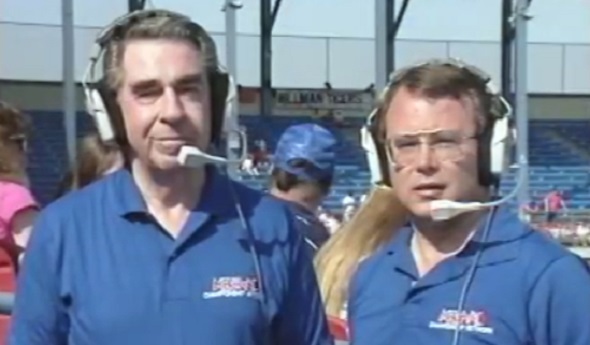
PHOTO: Paul Carey (left) and nephew Mike Carey broadcast the MHSAA 1992 Class D Baseball Final between Hillman and Athens for PASS.

Rep Council Adjusts, Expands Out-of-State Competition Opportunities at Spring Meeting
By
Geoff Kimmerly
MHSAA.com senior editor
May 12, 2023
Substantial changes to the rules governing out-of-state competition by Michigan High School Athletic Association member schools were among the most notable actions taken by the MHSAA’s Representative Council during its annual Spring Meeting, May 6-7 in Gaylord.
The Spring Meeting of the 19-member legislative body of the Association’s more than 1,500 member schools is generally the busiest of its sessions each year. The Council considered 31 committee proposals and dealt with a variety of eligibility rule, postseason tournament and operational issues.
The most far-reaching changes approved by the Council shifts the MHSAA rules regarding competitions against out-of-state opponents. Moving forward, MHSAA member schools may continue to compete against teams from Illinois, Indiana, Ohio, Minnesota, Wisconsin and Ontario – but also may compete against teams from elsewhere in the United States as long as those competitions take place in Michigan, one of those five contiguous states or Ontario. The Council voted to remove the allowance for MHSAA member schools to travel up to 300 miles to play an out-of-state opponent; MHSAA member schools still can compete against those opponents, but competition must take place in Michigan or one of the states/province listed above. Any event including schools from outside of Michigan or those contiguous states/province must receive approval by the MHSAA and each state high school association with a team involved in order for MHSAA member schools to be allowed to participate.
In an effort to strengthen the undue influence regulation, the Council approved a change making it a violation for coaches or their representatives to connect via social media with students from another high school or with a student prior to ninth grade who has not yet enrolled in a high school or participated in an athletic practice or competition as a high school student. Violations of this rule include connecting via social media with a “follow,” “friend request” or “direct message” to a student. The Council also expanded the portion of the undue influence regulation that doesn’t allow coaches and representatives to visit prospective athletes and their families at the families’ homes to not allow them to visit athletes and families at “other locations” as well.
The Council approved an expansion in the use of video to determine penalties when there is a bench-clearing situation or other incident where team members enter the area of competition during an altercation. MHSAA staff, based on video evidence, will be allowed to assess additional penalties including ejections and suspensions to team members, coaches and other staff who enter those areas to participate or engage in such an altercation.
Concerning specific sports, changes to three stand out from several adopted by the Council.
The Council approved three Bowling Committee recommendations affecting postseason competition in that sport. The first reorganizes Regional competition to eight sites, with each qualifying the top two teams and top seven singles for both girls and boys competitions to the Finals (instead of the previous six sites qualifying three teams and 10 singles for both girls and boys). The Council also approved a proposal to change the Team Finals match play to a head-to-head, best-of-five Baker game format. Finally, the Council approved a proposal to adopt the Phantom II oil pattern for all MHSAA Tournament competitions.
In girls volleyball, the Council approved a Volleyball Committee recommendation to begin seeding the top two teams in each District beginning with the 2024-25 school year. As is done currently with girls and boys basketball and girls and boys soccer, the top-two seeded teams in each District will be placed on opposite sides of the bracket, guaranteeing they will not play each other before the District Final. Seeding will be determined using the Michigan Power Rating (MPR) formula which takes into account regular-season success and strength of schedule. MPR is used to seed Districts in the same way in basketball and soccer.
In wrestling, the Council approved a Wrestling Committee recommendation adding two regular-season dual meets to the allowed number of wrestling contest dates. These must be dual meets and may not be converted into three-team (tri) or four-team (quad) meets. Teams and individuals now will be allowed 16 days of competition with no more than eight of those days allowed for tournament-type events where a wrestler competes more than twice.
Here is a summary of other notable actions taken by the Representative Council at the Spring Meeting, which will take effect during the 2023-24 school year unless noted:
Regulations
• The Council approved a classification-related change for the MHSAA’s smallest member schools, allowing them to request participation of eighth and seventh-grade students, based on the high school’s enrollment. Schools with fewer than 125 students (instead of the previous 100) may request an MHSAA Executive Committee waiver to use eighth-grade students in all sports except football, ice hockey and wrestling. Schools with fewer than 75 students (instead of the previous 50) may make the same request to use seventh and eighth-grade students in all sports except those three. Schools requesting a waiver must show cause and rationale for those students’ participation.
Sports Medicine
• The Council approved a Sports Medicine Advisory Committee proposal requiring middle school head coaches to have valid, current CPR certification. Similar to the high school requirements for head coaches at all levels, this addition at the middle school level will ensure each team has at least one coach at each level present who is CPR-certified. This requirement will take effect with the 2024-25 school year, and schools will attest to its completion by the established deadline for each season.
Officials
• The Council approved an Officials Review Committee recommendation adjusting the minimum requirements for postseason consideration in wrestling, competitive cheer and soccer. In wrestling, officials must receive 75 coaches ratings (instead of the previous 100) to be considered for working a postseason meet. In girls competitive cheer, judges must be members in good standing of a Local Approved Association. In soccer, officials must work a minimum of five regular-season games (down from the previous 10) to be considered for the postseason.
• The Council also approved a Committee recommendation increasing the amount paid when an official arrives on site prior to a competition before receiving notice that competition has been canceled due to an “act of God” including weather that results in unplayable conditions. In these situations, officials will receive one-half of the contract fee (instead of the previous one-third).
Sport Matters
• For baseball, the Council approved a change to when trophies will be awarded to Regional champions. Those trophies will be presented to both Regional champions after the Quarterfinal is concluded, as Regional Finals and the ensuing Quarterfinal are played at the same site on the same day and both Quarterfinal participants will have earned a Regional championship earlier that day.
• In addition to the Regional and Finals changes for bowling explained above, the Council also approved a Bowling Committee proposal seeking common start dates for practice and competition for Lower and Upper Peninsula teams. For the 2023-24 season, bowling teams in both peninsulas will begin practice Nov. 9 and competition Nov. 25. Previously, Upper Peninsula teams were allowed to begin their seasons slightly earlier – this past season four days sooner for practice and a week earlier for competition than their Lower Peninsula counterparts.
• The Council also approved a start date change in girls competitive cheer, proposed by the Competitive Cheer Committee, moving the practice start date to the second Monday before Thanksgiving. This shortens the season by one week, but also allows a more comfortable gap between the fall sideline cheer and winter competitive cheer seasons. This change will take effect with the 2024-25 school year.
• Also in cheer, the Council approved a Committee recommendation that adjusts the restricted period at the end of competitive cheer season to the Monday following Memorial Day, which will allow athletes to try out for sideline cheerleading for the upcoming season after the completion of the majority of spring-sport competitions.
• Additionally, the Council approved an exception to the MHSAA’s all-star regulation that will allow for individual competitive cheer and sideline cheer athletes to participate in an event that is “all-star” in name only as long as the selection components of the event comply with MHSAA regulations.
• In cross country and track & field, the Council approved Cross Country/Track & Field Committee recommendations to eliminate a pair of uniform-related rules adaptations designating the types of head attire that previously could be worn during cross country races and body adornments that previously were allowed to be worn during competitions in both sports.
• In golf, the Council approved a Golf Committee recommendation to require athletes to participate in at least four competitions for the high school team prior to representing that athlete’s school team in an MHSAA postseason golf competition. Those four regular-season competitions may be 9 or 18-hold events.
• A Council action in gymnastics will better define how athletes are assigned a division for the individual portion of the MHSAA Finals. Athletes are assigned either Division 1 or Division 2 based on past experience and skill level – Division 1 for those with the most – and the Council approved the allowance of the Xcel levels of Sapphire and Diamond to be part of the determining criteria. Athletes who have previously competed in a non-school event at either of these levels would be required to compete in the Division 1 level for MHSAA postseason competition.
• In tennis, the Council approved a Tennis Committee recommendation allowing in the Lower Peninsula for a No. 1 doubles pair from a non-qualifying team to advance from Regional to Finals competition if that pair finishes first or second at the Regional and the No. 1 singles player from that team also has qualified for the Finals individually by finishing first or second in Regional play. (Upper Peninsula tennis does not play a Regional.)
• The Council approved a Swimming & Diving Committee recommendation restructuring how qualifying times for Finals are determined in an effort to provide more entries in swimming events at the championship level. Moving forward, qualifying times will be determined based on the past five years of MHSAA race data, but also will account for past numbers of qualifiers in each swim race; qualifying times will be shifted to allow for more athletes to advance to the Finals in events where fields have not been full over the previous five seasons.
• The second swimming & diving recommendation approved by the Council assigned specific breaks during Finals competitions. During Friday preliminaries (swam in the Lower Peninsula only), 10-minute breaks will be placed between the 200-yard medley relay and 200 freestyle races, and between the 200 freestyle relay and 100 backstroke, with a 15-minute break between the 50 freestyle and 100 butterfly. The same 10-minute breaks will be mandated for Saturday Finals competitions, with a 15-minute break during Finals coming between the conclusion of diving and 100 butterfly races.
• For girls volleyball, the Council also approved a Volleyball Committee recommendation to permit the Michigan Interscholastic Volleyball Coaches Association (MIVCA) a 3-minute on-court presentation during the MHSAA Finals to recognize that season’s Miss Volleyball Award winner. The presentation will take place between the second and third sets of the Division 1 championship match.
Junior High/Middle School
• The Council voted to make permanent cross country and track & field competitions that have been conducted at a Regional level as part of a pilot program during the 2021-22 and 2022-23 school years. The Council also voted to expand the number of sites per Junior High/Middle School Regional to allow for large-school (Divisions 1 and 2) and small-school (Divisions 3 and 4) meets for each of the eight Zones. Each participating junior high and middle school will be classified for its Regional meet based on the enrollment of the high school with which the junior high/middle school is connected.
The Council also reviewed reports on membership, with 750 senior high schools and 767 junior high/middle schools in 2022-22 plus 63 elementary schools with 6th-grader participation; cooperative programs, with 376 high school programs for 692 teams during 2023-23; eligibility advancement applications, which totaled three; the use of Educational Transfer Forms, of which there were 127; school violations, attendance at athletic director in-service workshops and Coaches Advancement Program sessions; officials’ registrations, rules meetings attendance and officials reports submitted for the past three sports seasons. The Association’s $13.3 million budget for the 2023-24 school year also was approved.
The Representative Council is the 19-member legislative body of the MHSAA. All but five are elected by member schools. Four members are appointed by the Council to facilitate representation of females and minorities, and the 19th position is occupied by the Superintendent of Public Instruction or designee.
The MHSAA is a private, not-for-profit corporation of voluntary membership by more than 1,500 public and private senior high schools and junior high/middle schools which exists to develop common rules for athletic eligibility and competition. No government funds or tax dollars support the MHSAA, which was the first such association nationally to not accept membership dues or tournament entry fees from schools. Member schools which enforce these rules are permitted to participate in MHSAA tournaments, which attract more than 1.3 million spectators each year.