

Powerful Voice for High School Sports
December 19, 2014
By Geoff Kimmerly
Second Half editor
Paul Carey was home from the U.S. Army only a few months and just shy of 25 years old when Beal City embarked on its first trip deep into the MHSAA boys basketball tournament.
On the call for local radio station WCEN from gyms at Saginaw Arthur Hill and Lansing Sexton, Carey served as the voice of the previously “laughable” Aggies as they reached the Class D Semifinals before falling just six points short of playing for the title.
“All of Beal City emptied out. They’d never had anything before,” Carey recalled during his annual Thanksgiving weekend visit to the MHSAA Football Finals at Ford Field. “When I got home, within the next two weeks I got a letter from every citizen of Beal City thanking me for broadcasting their games. That’s the kind of appreciation that meant so much.”
During 42 years on the airwaves, Carey was best known as a voice of the Detroit Tigers bounding out of transistor radios all over Michigan, thanks to WJR’s powerful signal.
But for the state’s high school sports community, his legacy is similarly memorable as the voice of the longtime football and basketball scoreboard show and a voter for various all-state teams and wire polls over the decades.
Now 86 and retired since 1991, Carey remains a regular during the first day of the Football Finals, taking in games he broadcast for the MHSAA during the late 1970s and that continue to hold his eye as they have for more than a half-century.
“It was a passion of mine. High school sports always has been,” Carey said. “I think because my dad was a high school coach, and teacher initially, and my brother was a high school coach and teacher, I just grew up in families that appreciated coaching and athletics. I was not a great athlete, but it kept my hand in following sports that way.”
Now, the scores
Carey partnered with Ernie Harwell for Tigers radio broadcasts from 1973-91, including during the march to the 1984 World Series championship. He was named Michigan Sportscaster of the Year six times and to the Michigan Sports Hall of Fame in 1992.
But Carey’s early career included sitting on top of a car, plugged into a phone pole, for a Sacred Heart football game at old Fancher Field just a few blocks from his family’s Mount Pleasant home. Among many more accolades are a Distinguished Service Award from the Michigan High School Coaches Association and a place in the Basketball Coaches Association of Michigan Hall of Fame.
In fact, the start of his weekly announcing of statewide football and basketball scores preceded his baseball career by 16 years and ended two months after he announced his final professional out.
The Michigan High School Scoreboard show was a staple of WJR’s late Friday nights from 1957-91. Carey would read every score he could collect from a variety of sources, often organized by league and with state rankings and context mixed in.
His idea came from something similar read by Len Colby for Kalamazoo’s WKZO. Carey’s brother Terry was coaching at Niles during the second half of the 1950s, and he and other coaches would get together to listen to the Friday night scores from the southwestern part of the state.
Carey, who left WKNX in Saginaw for WJR in 1956, explained to then-sports director Bob Reynolds that the station’s strong signal could provide for a truly statewide scoreboard experience.
Carey then connected with Edgar Hayes of the former Detroit Times, who gave the OK for Carey to call the paper on Friday nights to get scores from the Detroit metro area. For the rest, Carey relied on wire services – there were three at the time – who relied on newspapers from all over Michigan to call in scores over the course of an evening.
Before every Friday during high school football season – and later Tuesdays and Fridays during boys basketball season – Carey typed up lists of games based on schedules in the newspaper, with spaces to add scores. More than a few times, Carey raced down a back ramp at Tiger Stadium after a Friday night game, back to the WJR studio, with 15 minutes to prep for the show’s 11:30 p.m. start.
“If the Flint Journal, the Grand Rapids Press, the Traverse City paper didn’t call in scores to the AP, then I was out of luck too. And that happened all the time,” Carey said. “I would call back occasionally, say, ‘Did you get anything more?’ It was a rat race.”
The show originally was set for 10 minutes and then extended to 15. American Airlines sponsored a record show that followed, and Carey’s scoreboard show had a sponsor only once in 35 years. Finishing up on time was expected, even with more than 200 scores to read.
But Carey said he always went 20 minutes, sometimes 25.
“Because I wasn’t done. I just kept right on going,” Carey said. “Jay Roberts did the all-night show most of the time, and he was patient with me. He didn’t say too much on the air about ‘that guy ahead of me took all of my time.’”
Carey continued the “rat race” until his final scoreboard show, Dec. 20, 1991. He retired from WJR at the end of that calendar year. And it's important to note: Carey was never paid a dime extra for doing the program. .
“I think Paul is really just a sports fan, and that came across to the listener on his broadcasts,” MHSAA historian Ron Pesch said. “Paul would gather as much as possible off the wire. He'd interject if scores were missing from sections of the state. Press polls from the Free Press, News, AP and UPI were big, so he could point out close calls and upsets.
“He provided immediacy, or the closest thing to it in the days before cable TV and the Internet, and because of his scoreboard show, you could get the results before the morning paper. For listeners, he brought life to something as simple as game scores.”
First team all the way
Carey, who resides in Rochester, also served as the engineer on Tigers broadcasts for 16 years, through 1990. He broadcast Pistons games on the radio for six seasons and did the first broadcast of a Central Michigan University football game, in 1949.
Harry Atkins, covering Detroit’s teams while with The Associated Press for 29 years including the last 21 as its sports editor for Detroit, took note of his colleague's hard work – and especially that Carey was one of few broadcasters who was a journalist in addition to a voice.
That made Carey's other major role in high school sports a natural fit.
Atkins split The Associated Press all-state selection panels for football and basketball into 11 regions, and Carey represented the Detroit area for a number of years. He also was a longtime voter in those sports' weekly polls.
“Paul is just that kind of guy. He thought it was important and he made time in his busy schedule to do it,” Atkins said “And it had an impact on the other 10 voters on the All-State panels, too.
“Some of them were from small out-state newspapers or radio or TV stations. Yet every one of them knew who Paul Carey was. And when he spoke, of course, with what often is called "The Voice of God," those voters paid attention.”
And he still does, as well.
At the end of each fall, Carey still puts together a compilation of the three high school all-state football teams – Associated Press, Detroit Free Press and Detroit News – and files them with years of research and results.
“It’s important to me. Nobody sees it but me, but I get a certain kick,” Carey said. “Once in a while I’ll see a kid playing at Central, Western or (Michigan) State or Michigan, and they’ll say he came from Clawson. I’ll go into my all-state collections, say that would’ve been 2009 he played, and I find a name.”
In addition to the Football Finals on WJR, Carey was part of the Baseball Finals broadcasts into the early 1990s, continuing to contribute even after his retirement from his fulltime gig.
He spent high school games over the years sitting next to legends like the Free Press’ Hal Schram and remembers when current Free Press longtime scribe Mick McCabe was just a rookie. One of Carey's final broadcasts was a 1992 Baseball Final with his nephew Mike Carey, who continues to broadcast MHSAA championship games to this day.
“I am eternally grateful to Paul Carey. His contribution to high school sports in Michigan has been great and significant,” Atkins said.
“We are lucky to have him.”
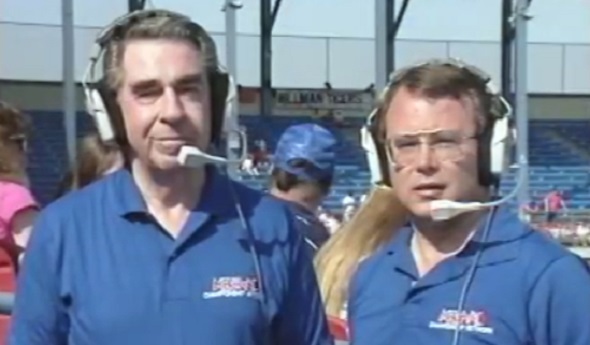
PHOTO: Paul Carey (left) and nephew Mike Carey broadcast the MHSAA 1992 Class D Baseball Final between Hillman and Athens for PASS.
2023 Forsythe Award Celebrates Leinaar's 40 Years Dedicated to School Sports
By
Geoff Kimmerly
MHSAA.com senior editor
March 8, 2023
Few people in Michigan have had a longer-lasting influence on the rules and policies of educational athletics than Frankfort’s Karen Leinaar, who has served in several roles locally, statewide and nationally over more than 40 years contributing to the school sports community.
Thank you, Bill Baker.
The longtime teacher, coach, principal and superintendent during a career that stretched across multiple schools – including Leinaar’s growing up, Delton Kellogg – made an impression on the standout multi-sport athlete before she graduated from high school in 1977. Baker’s philosophy and work led Leinaar to study education at Michigan State University and then brought her back as Delton’s athletic director to begin four decades of making the same impact on children in her hometown and eventually in hometowns all over Michigan and beyond.
Baker died in 2009, but not before continuing to mentor Leinaar through many good times and tough ones.
“The man had two daughters that I grew up with, his wife was a teacher, and he demonstrated to all of us – he never missed an event – that we were important to him. That even though we weren’t his kids, we were his kids and athletics was a way to help kids become better people – and for some kids it was the only thing that they had positive in their life,” Leinaar said. “And he made it known just to that individual kid how important their participation was and their involvement, and how that helped them become the person that they were.
“That to me was such an example of how to help people be good people, that I just took that role on.”
It’s a role in which she continues to serve. Leinaar began her career as an athletic administrator in 1982, and as the interim athletic director currently at Frankfort High School is serving her fifth district in that position. Since June 2019, she also has served as executive director of the Michigan Interscholastic Athletic Administrators Association (MIAAA), the professional organization for school sports administrators in the state with a membership of nearly 700.
 To recognize that longtime and continuing impact, Leinaar has been named the 2023 honoree for the Michigan High School Athletic Association’s Charles E. Forsythe Award.
The annual award is in its 46th year and named after former MHSAA Executive Director Charles E. Forsythe, the Association's first full-time and longest-serving chief executive. Forsythe Award recipients are selected each year by the MHSAA Representative Council, based on an individual's outstanding contributions to the interscholastic athletics community.
Leinaar also served 22 years on the MHSAA’s Representative Council and a four-year term from 2009-13 on the Board of Directors for the National Federation of State High School Associations (NFHS), and just last week was named to the 2023 class of the National Interscholastic Athletic Administrators Association (NIAAA) Hall of Fame.
“It is impossible even to estimate the number of students, coaches, administrators and others who have been affected by the work Karen Leinaar has done to make school sports the best they can be – not only in her communities, but across Michigan and throughout the country,” MHSAA Executive Director Mark Uyl said. “There are few who have equaled her dedication and her support and promotion of the ideals of school-based sports. She has always placed an emphasis on being in the room, on the field or at the arena, actively participating in her leadership roles, and our programs are better for it.”
Leinaar first served as athletic director at Delton Kellogg for nearly 17 years, from March 1982 through October 1998. She spent three years at Gaylord, then 8½ at Benzie Central before taking over at Bear Lake in November 2010 and spending the next decade organizing athletic programs for students in grades 5-12 before retiring in January 2021. She came out of retirement to return to the athletic director’s chair this past fall as interim AD at Frankfort. She has completed nearly four years as MIAAA executive director, moving into that position after previously serving nine years as an assistant to the executive.
Leinaar began her service on the Representative Council in Fall 1999 and completed her last term as a statewide at-large representative at the Fall 2021 meeting.
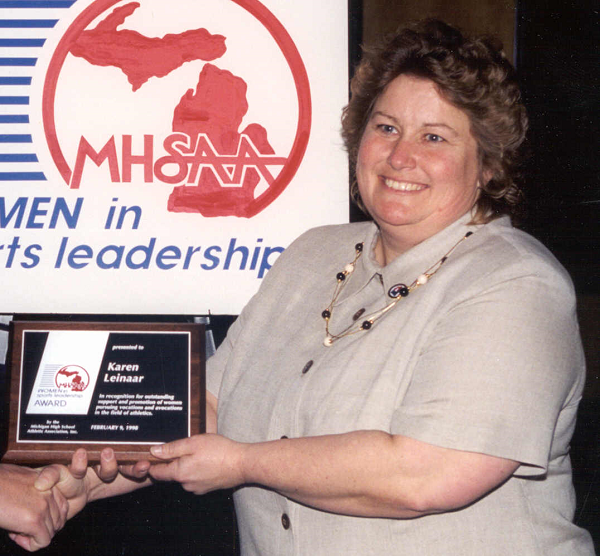
She has been honored several times for her contributions. She received the MHSAA’s Women In Sports Leadership Award in 1998, a Citation from the NFHS in 2000, and she was named MIAAA Athletic Director of the Year in 2001. She received an MHSAA’s Allen W. Bush Award in 2014 – recognition given for work done generally behind the scenes and with little attention.
“This is the top of the mountain, per se. This one does mean so much,” Leinaar said of the Forsythe Award. “The names that are associated with this over the years, I never thought I’d be put in that group.”
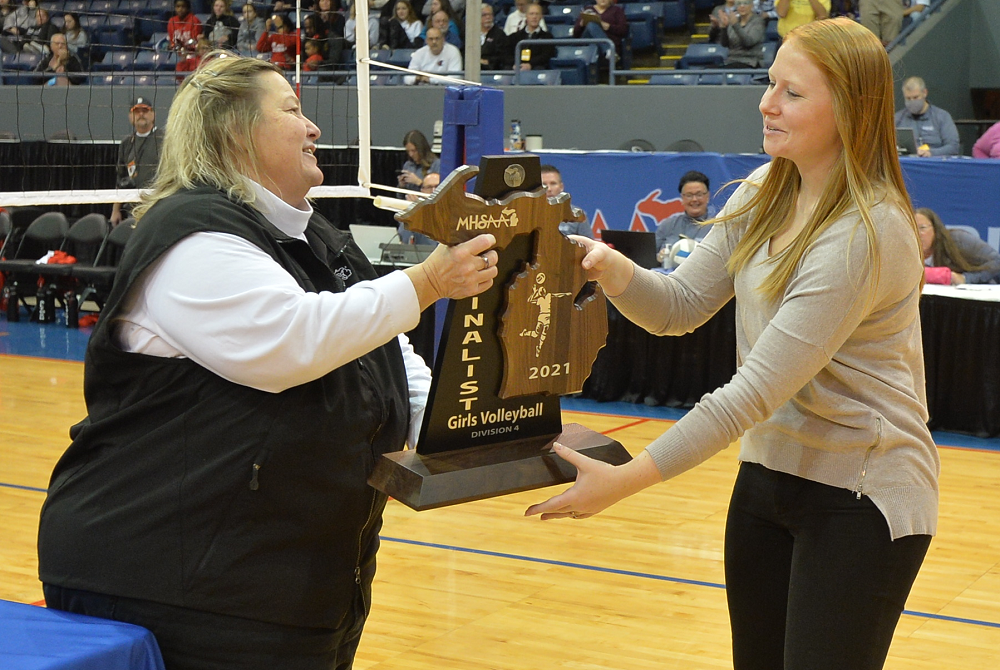
Leinaar remains a continuous source of support at a multitude of MHSAA championship events, and during her time on Council was one of the most frequent representatives handing out trophies and medals to champions and runners-up at Finals events. She began while athletic director at Delton Kellogg hosting the MHSAA Volleyball Finals in Class B and Class C and continues to assist with those championships now played at Kellogg Arena in Battle Creek.
She also hosted Competitive Cheer Finals at Delton Kellogg in 1996 and 1997, Ski Finals while at Gaylord, and many more championship events across the Lower Peninsula. She continues to assist at the MHSAA’s Lower Peninsula Cross Country and Track & Field Finals.
After attending Delton Kellogg High School, Leinaar earned a bachelor’s degree in physical education, health and recreation, with a minor in driver education, from MSU in 1982. She completed a master’s in athletic administration from Western Michigan University in 1994.
Leinaar has been a member for 40 years of both the MIAAA and NIAAA, and has served as chairperson of the MIAAA Annual Conference and awards chairperson for both the state and national bodies. She’s also served as chairperson of the MIAAA’s Exemplary Athletic Program.
Past recipients of the Charles E. Forsythe Award
1978 - Brick Fowler, Port Huron; Paul Smarks, Warren
1979 - Earl Messner, Reed City; Howard Beatty, Saginaw
1980 - Max Carey, Freesoil
1981 - Steven Sluka, Grand Haven; Samuel Madden, Detroit
1982 - Ernest Buckholz, Mt. Clemens; T. Arthur Treloar, Petoskey
1983 - Leroy Dues, Detroit; Richard Maher, Sturgis
1984 - William Hart, Marquette; Donald Stamats, Caro
1985 - John Cotton, Farmington; Robert James, Warren
1986 - William Robinson, Detroit; Irving Soderland, Norway
1987 - Jack Streidl, Plainwell; Wayne Hellenga, Decatur
1988 - Jack Johnson, Dearborn; Alan Williams, North Adams
1989 - Walter Bazylewicz, Berkley; Dennis Kiley, Jackson
1990 - Webster Morrison, Pickford; Herbert Quade, Benton Harbor
1991 - Clifford Buckmaster, Petoskey; Donald Domke, Northville
1992 - William Maskill, Kalamazoo; Thomas G. McShannock, Muskegon
1993 - Roy A. Allen Jr., Detroit; John Duncan, Cedarville
1994 - Kermit Ambrose, Royal Oak
1995 - Bob Perry, Lowell
1996 - Charles H. Jones, Royal Oak
1997 - Michael A. Foster, Richland; Robert G. Grimes, Battle Creek
1998 - Lofton C. Greene, River Rouge; Joseph J. Todey, Essexville
1999 - Bernie Larson, Battle Creek
2000 - Blake Hagman, Kalamazoo; Jerry Cvengros, Escanaba
2001 - Norm Johnson, Bangor; George Lovich, Canton
2002 - John Fundukian, Novi
2003 - Ken Semelsberger, Port Huron
2004 - Marco Marcet, Frankenmuth
2005 - Jim Feldkamp, Troy
2006 - Dan McShannock, Midland; Dail Prucka, Monroe
2007 - Keith Eldred, Williamston; Tom Hickman, Spring Lake
2008 - Jamie Gent, Haslett; William Newkirk, Sanford Meridian
2009 - Paul Ellinger, Cheboygan
2010 - Rudy Godefroidt, Hemlock; Mike Boyd, Waterford
2011 - Eric C. Federico, Trenton
2012 - Bill Mick, Midland
2013 - Jim Gilmore, Tecumseh; Dave Hutton, Grandville
2014 - Dan Flynn, Escanaba
2015 - Hugh Matson, Saginaw
2016 - Gary Hice, Petoskey; Gina Mazzolini, Lansing
2017 - Chuck Nurek, Rochester Hills
2018 - Gary Ellis, Allegan
2019 - Jim Derocher, Negaunee; Fredrick J. Smith, Stevensville
2020 - Michael Garvey, Lawton
2021 - Leroy Hackley Jr., Byron Center; Patti Tibaldi, Traverse City
2022 - Bruce Horsch, Houghton
PHOTOS (Top) Karen Leinaar, left, awards the 2022 Division 4 volleyball finalist trophy to Indian River Inland Lakes coach Nicole Moore. (Middle) Leinaar accepts the MHSAA's Women In Sports Leadership Award in 1998.