

Powerful Voice for High School Sports
December 19, 2014
By Geoff Kimmerly
Second Half editor
Paul Carey was home from the U.S. Army only a few months and just shy of 25 years old when Beal City embarked on its first trip deep into the MHSAA boys basketball tournament.
On the call for local radio station WCEN from gyms at Saginaw Arthur Hill and Lansing Sexton, Carey served as the voice of the previously “laughable” Aggies as they reached the Class D Semifinals before falling just six points short of playing for the title.
“All of Beal City emptied out. They’d never had anything before,” Carey recalled during his annual Thanksgiving weekend visit to the MHSAA Football Finals at Ford Field. “When I got home, within the next two weeks I got a letter from every citizen of Beal City thanking me for broadcasting their games. That’s the kind of appreciation that meant so much.”
During 42 years on the airwaves, Carey was best known as a voice of the Detroit Tigers bounding out of transistor radios all over Michigan, thanks to WJR’s powerful signal.
But for the state’s high school sports community, his legacy is similarly memorable as the voice of the longtime football and basketball scoreboard show and a voter for various all-state teams and wire polls over the decades.
Now 86 and retired since 1991, Carey remains a regular during the first day of the Football Finals, taking in games he broadcast for the MHSAA during the late 1970s and that continue to hold his eye as they have for more than a half-century.
“It was a passion of mine. High school sports always has been,” Carey said. “I think because my dad was a high school coach, and teacher initially, and my brother was a high school coach and teacher, I just grew up in families that appreciated coaching and athletics. I was not a great athlete, but it kept my hand in following sports that way.”
Now, the scores
Carey partnered with Ernie Harwell for Tigers radio broadcasts from 1973-91, including during the march to the 1984 World Series championship. He was named Michigan Sportscaster of the Year six times and to the Michigan Sports Hall of Fame in 1992.
But Carey’s early career included sitting on top of a car, plugged into a phone pole, for a Sacred Heart football game at old Fancher Field just a few blocks from his family’s Mount Pleasant home. Among many more accolades are a Distinguished Service Award from the Michigan High School Coaches Association and a place in the Basketball Coaches Association of Michigan Hall of Fame.
In fact, the start of his weekly announcing of statewide football and basketball scores preceded his baseball career by 16 years and ended two months after he announced his final professional out.
The Michigan High School Scoreboard show was a staple of WJR’s late Friday nights from 1957-91. Carey would read every score he could collect from a variety of sources, often organized by league and with state rankings and context mixed in.
His idea came from something similar read by Len Colby for Kalamazoo’s WKZO. Carey’s brother Terry was coaching at Niles during the second half of the 1950s, and he and other coaches would get together to listen to the Friday night scores from the southwestern part of the state.
Carey, who left WKNX in Saginaw for WJR in 1956, explained to then-sports director Bob Reynolds that the station’s strong signal could provide for a truly statewide scoreboard experience.
Carey then connected with Edgar Hayes of the former Detroit Times, who gave the OK for Carey to call the paper on Friday nights to get scores from the Detroit metro area. For the rest, Carey relied on wire services – there were three at the time – who relied on newspapers from all over Michigan to call in scores over the course of an evening.
Before every Friday during high school football season – and later Tuesdays and Fridays during boys basketball season – Carey typed up lists of games based on schedules in the newspaper, with spaces to add scores. More than a few times, Carey raced down a back ramp at Tiger Stadium after a Friday night game, back to the WJR studio, with 15 minutes to prep for the show’s 11:30 p.m. start.
“If the Flint Journal, the Grand Rapids Press, the Traverse City paper didn’t call in scores to the AP, then I was out of luck too. And that happened all the time,” Carey said. “I would call back occasionally, say, ‘Did you get anything more?’ It was a rat race.”
The show originally was set for 10 minutes and then extended to 15. American Airlines sponsored a record show that followed, and Carey’s scoreboard show had a sponsor only once in 35 years. Finishing up on time was expected, even with more than 200 scores to read.
But Carey said he always went 20 minutes, sometimes 25.
“Because I wasn’t done. I just kept right on going,” Carey said. “Jay Roberts did the all-night show most of the time, and he was patient with me. He didn’t say too much on the air about ‘that guy ahead of me took all of my time.’”
Carey continued the “rat race” until his final scoreboard show, Dec. 20, 1991. He retired from WJR at the end of that calendar year. And it's important to note: Carey was never paid a dime extra for doing the program. .
“I think Paul is really just a sports fan, and that came across to the listener on his broadcasts,” MHSAA historian Ron Pesch said. “Paul would gather as much as possible off the wire. He'd interject if scores were missing from sections of the state. Press polls from the Free Press, News, AP and UPI were big, so he could point out close calls and upsets.
“He provided immediacy, or the closest thing to it in the days before cable TV and the Internet, and because of his scoreboard show, you could get the results before the morning paper. For listeners, he brought life to something as simple as game scores.”
First team all the way
Carey, who resides in Rochester, also served as the engineer on Tigers broadcasts for 16 years, through 1990. He broadcast Pistons games on the radio for six seasons and did the first broadcast of a Central Michigan University football game, in 1949.
Harry Atkins, covering Detroit’s teams while with The Associated Press for 29 years including the last 21 as its sports editor for Detroit, took note of his colleague's hard work – and especially that Carey was one of few broadcasters who was a journalist in addition to a voice.
That made Carey's other major role in high school sports a natural fit.
Atkins split The Associated Press all-state selection panels for football and basketball into 11 regions, and Carey represented the Detroit area for a number of years. He also was a longtime voter in those sports' weekly polls.
“Paul is just that kind of guy. He thought it was important and he made time in his busy schedule to do it,” Atkins said “And it had an impact on the other 10 voters on the All-State panels, too.
“Some of them were from small out-state newspapers or radio or TV stations. Yet every one of them knew who Paul Carey was. And when he spoke, of course, with what often is called "The Voice of God," those voters paid attention.”
And he still does, as well.
At the end of each fall, Carey still puts together a compilation of the three high school all-state football teams – Associated Press, Detroit Free Press and Detroit News – and files them with years of research and results.
“It’s important to me. Nobody sees it but me, but I get a certain kick,” Carey said. “Once in a while I’ll see a kid playing at Central, Western or (Michigan) State or Michigan, and they’ll say he came from Clawson. I’ll go into my all-state collections, say that would’ve been 2009 he played, and I find a name.”
In addition to the Football Finals on WJR, Carey was part of the Baseball Finals broadcasts into the early 1990s, continuing to contribute even after his retirement from his fulltime gig.
He spent high school games over the years sitting next to legends like the Free Press’ Hal Schram and remembers when current Free Press longtime scribe Mick McCabe was just a rookie. One of Carey's final broadcasts was a 1992 Baseball Final with his nephew Mike Carey, who continues to broadcast MHSAA championship games to this day.
“I am eternally grateful to Paul Carey. His contribution to high school sports in Michigan has been great and significant,” Atkins said.
“We are lucky to have him.”
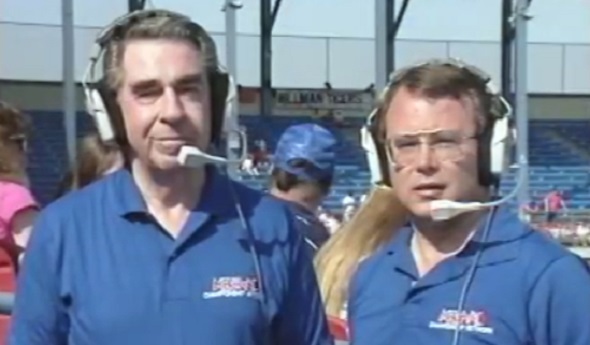
PHOTO: Paul Carey (left) and nephew Mike Carey broadcast the MHSAA 1992 Class D Baseball Final between Hillman and Athens for PASS.
2023 WISL Award Honoree Glass Continuing to Create Leaders On Court & Off
By
Geoff Kimmerly
MHSAA.com senior editor
March 2, 2023
Hailing from one of Michigan’s smallest communities, Laurie Glass has made an impact that continues to connect all over Michigan.
But her impact on women’s athletics began long before a career that has seen the longtime Leland volleyball coach become one of the winningest in her sport in state history.
As a high school junior in 1976, she recruited seven classmates and a coach to form Leland’s first girls sports team – for basketball – and the same group then played volleyball that winter. She was a senior and major contributor when, during their second season, the Comets won the 1978 Class D volleyball championship.
More than four decades later, Glass is a Michigan legend in that sport – a winner of 1,218 matches with Leland and Traverse City Central and three Finals championships with the Comets. She’s also a nationally-recognized voice in volleyball and women’s athletics as a whole – and this year’s MHSAA Women in Sports Leadership honoree for those many and continuing contributions.
“Because I’m a teacher and coach, that’s my desire to help the youth be the best they could be. And if I can impact a coach or impact another district or program, that means I’m affecting more youth in a positive way,” Glass said. “So for me, it’s just the ripple effect; it gets a lot bigger when I’m starting little drops in other places. So I can affect the hundreds of kids that I’ve seen go through Leland, or I can impact the larger audience by impacting coaches or impacting kids in other places that can then impact other people. It allows me a wider audience for wanting to help young women to be their best young woman self in however way I can make that happen.”
Each year, the Representative Council considers the achievements of women coaches, officials and athletic administrators affiliated with the MHSAA who show exemplary leadership capabilities and positive contributions to athletics.
Leland finished 49-13 this past season and reached the Division 4 Quarterfinals. Glass has a record of 1,218-393-122 over more than three decades as a varsity volleyball coach, having led the Comets for a combined 29 seasons over three tenures, the first beginning with the 1989-90 winter season and later picking up with her most recent return for Fall 2010. She also coached Traverse City Central for four seasons beginning in 1991-92.
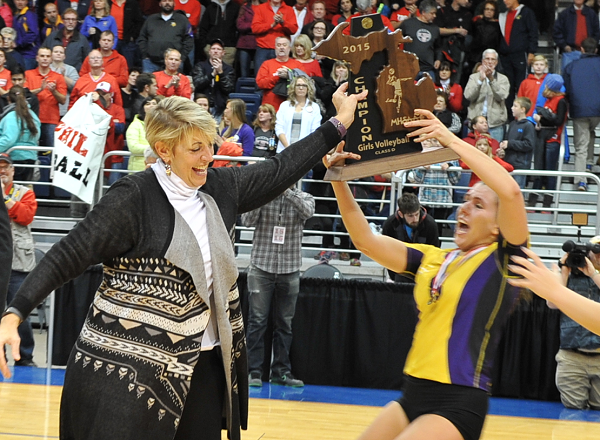 Glass led Leland to Class D Finals championships in 2002, 2006 and 2015, and runner-up finishes in Class D in 2014 and Division 4 in 2018 and 2019. She was named to the Michigan Interscholastic Volleyball Coaches Association (MIVCA) Hall of Fame in 2006, and selected as national Coach of the Year in volleyball in 2014 by the National Federation of State High School Associations (NFHS) Coaches Association. She’s a three-time MIVCA Coach of the Year and was named Michigan High School Coaches Association (MHSCA) Coach of the Year for volleyball in 2015. She also was a finalist for National High School Athletic Coaches Association (NHSACA) national Coach of the Year in 2014.
Glass has spoken multiple times at the MHSAA Women In Sports Leadership Conference and several times at the MIVCA Coaches Clinic, and among various other engagements was the featured speaker at the Nebraska Athletic Association Coaches Clinic. She will receive the Women In Sports Leadership Award during the MHSAA Division 1 Girls Basketball Final on March 18 at Michigan State University’s Breslin Center.
“Laurie Glass is recognized most on the statewide level for leading one of the most successful volleyball programs in state history. But she is known among her peers most for the way she teaches not only volleyball but life skills to her athletes,” MHSAA Executive Director Mark Uyl said. “Her leadership creates more leaders, be they the athletes who have the opportunity to play for her or the coaches who learn from her and receive her mentorship.”
Glass’ roots are in one of the most accomplished athletic families in Michigan high school history.
Her father Larry Glass coached Northwestern University’s men’s basketball program from 1963-69, and later took over the Leland girls basketball program and led the Comets to a 388-110 record and three straight Class D Finals championships (1980-82) over two tenures from 1977-91 and 2000-05. Laurie’s sister Rebecca McKee played basketball at Leland and Michigan State University, and her brother Michael Glass played basketball at Lansing Community College before also becoming a high school and college coach.
Laurie also coached and parented arguably the most accomplished volleyball player – and perhaps top female athlete across all sports – in Michigan high school history. Her daughter Alisha Glass-Childress graduated from Leland in 2006 with national records for career kills, aces and blocks, and the first two still top those respective lists. Alisha, also an all-state basketball player, went on to star on the volleyball court at Penn State and as the U.S. Olympic team setter in 2016 in helping that team to the bronze medal.
Larry Glass’ lessons still ring true as Laurie passes them on to another generation. One of her favorite sayings from her father was “you can’t take money out of the bank until you put money in” – in essence, a coach can’t expect athletes to accept criticism or a hard ask if that coach first hasn’t invested in them. Another of her dad’s themes involved making sure players learned fundamentals at young ages and improved on them at all levels, whether they won games or not during those early years. As one of his middle school coaches, that stuck with her, and it remains a basic component of her coaching.
“I’ve always said that we compete with teams that are way more athletic, have all the things on paper that should beat us. And the fact that we know how to be a really good team is what allows us to beat people who on paper should be better than us,” Laurie Glass said. “I’ve always valued the time spent on culture and team because that’s the advantage we hold. We’re never going to be the tallest or most talented – Alisha being the anomaly, of course.”
Laurie Glass has served on the MIVCA Executive Board, including as president, and is a member of the MHSCA and American Volleyball Coaches Association (AVCA). Locally, her program annually hosts the Forever Dig Abby match in honor of former player Abby Gross, who died after a fight against cancer in 2015. Proceeds most years go to benefit another community member battling the disease, and this past season went to a fund for efforts related to ovarian cancer.
Glass has served nearly 35 years in education and retired from her duties as a behavior intervention specialist and special education teacher in the Traverse Bay Area Intermediate School District in 2019. She has returned to the school setting, however, and is in her second year as a behavior intervention specialist at Leland.
Glass earned a bachelor’s degree in special education with an endorsement in emotional impairment from Western Michigan University in 1988, and has done master-level coursework in education administration and technology. She also is a certified instructor for the Crisis Prevention Institute. Glass first attended Grand Valley State University and played a season of volleyball before transferring. (NOTE: Glass also coached the Kalamazoo Central varsity for two seasons during the mid-1980s. Those records are unavailable currently but will be added to her overall record when research is complete.)
Past Women In Sports Leadership Award Winners
1990 – Carol Seavoy, L’Anse
1991 – Diane Laffey, Harper Woods
1992 – Patricia Ashby, Scotts
1993 – Jo Lake, Grosse Pointe
1994 – Brenda Gatlin, Detroit
1995 – Jane Bennett, Ann Arbor
1996 – Cheryl Amos-Helmicki, Huntington Woods
1997 – Delores L. Elswick, Detroit
1998 – Karen S. Leinaar, Delton
1999 – Kathy McGee, Flint
2000 – Pat Richardson, Grass Lake
2001 – Suzanne Martin, East Lansing
2002 – Susan Barthold, Kentwood
2003 – Nancy Clark, Flint
2004 – Kathy Vruggink Westdorp, Grand Rapids
2005 – Barbara Redding, Capac
2006 – Melanie Miller, Lansing
2007 – Jan Sander, Warren Woods
2008 – Jane Bos, Grand Rapids
2009 – Gail Ganakas, Flint; Deb VanKuiken, Holly
2010 – Gina Mazzolini, Lansing
2011 – Ellen Pugh, West Branch; Patti Tibaldi, Traverse City
2012 – Janet Gillette, Comstock Park
2013 – Barbara Beckett, Traverse City
2014 – Teri Reyburn, DeWitt
2015 – Jean LaClair, Bronson
2016 – Betty Wroubel, Pontiac
2017 – Dottie Davis, Ann Arbor
2018 – Meg Seng, Ann Arbor
2019 – Kris Isom, Adrian
2020 – Nikki Norris, East Lansing
2021 – Dorene Ingalls, St. Ignace
2022 – Lori Hyman, Livonia
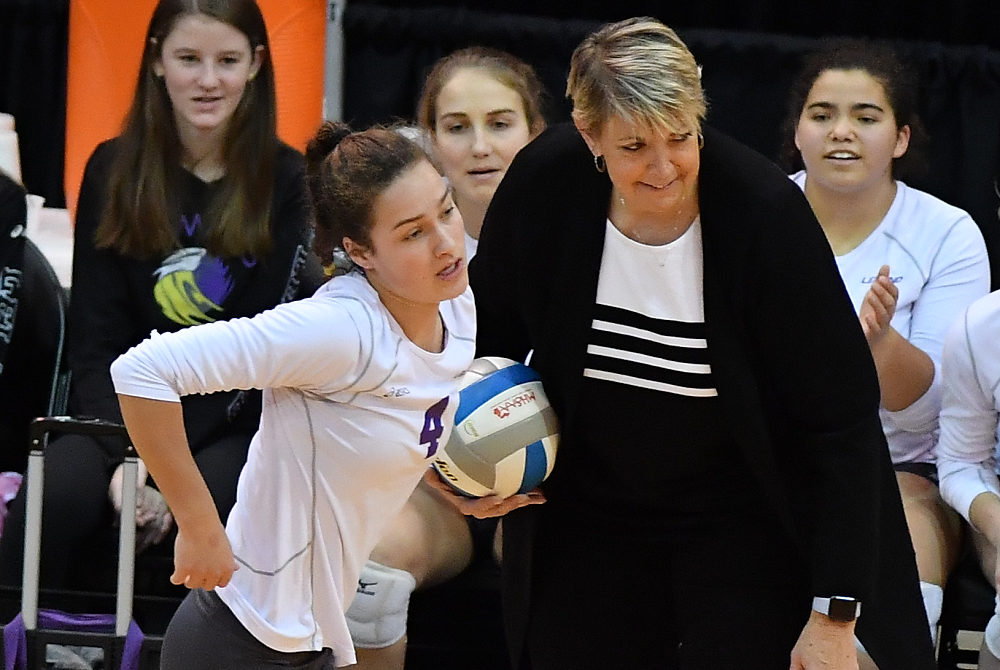
PHOTOS (Top) Leland coach Laurie Glass confers with one of her players during the 2019 Division 4 Final at Kellogg Arena. (Middle) Glass passes the championship trophy to her team after the Comets won the 2015 Class D title.