


Powerful Voice for High School Sports
December 19, 2014
By Geoff Kimmerly
Second Half editor
Paul Carey was home from the U.S. Army only a few months and just shy of 25 years old when Beal City embarked on its first trip deep into the MHSAA boys basketball tournament.
On the call for local radio station WCEN from gyms at Saginaw Arthur Hill and Lansing Sexton, Carey served as the voice of the previously “laughable” Aggies as they reached the Class D Semifinals before falling just six points short of playing for the title.
“All of Beal City emptied out. They’d never had anything before,” Carey recalled during his annual Thanksgiving weekend visit to the MHSAA Football Finals at Ford Field. “When I got home, within the next two weeks I got a letter from every citizen of Beal City thanking me for broadcasting their games. That’s the kind of appreciation that meant so much.”
During 42 years on the airwaves, Carey was best known as a voice of the Detroit Tigers bounding out of transistor radios all over Michigan, thanks to WJR’s powerful signal.
But for the state’s high school sports community, his legacy is similarly memorable as the voice of the longtime football and basketball scoreboard show and a voter for various all-state teams and wire polls over the decades.
Now 86 and retired since 1991, Carey remains a regular during the first day of the Football Finals, taking in games he broadcast for the MHSAA during the late 1970s and that continue to hold his eye as they have for more than a half-century.
“It was a passion of mine. High school sports always has been,” Carey said. “I think because my dad was a high school coach, and teacher initially, and my brother was a high school coach and teacher, I just grew up in families that appreciated coaching and athletics. I was not a great athlete, but it kept my hand in following sports that way.”
Now, the scores
Carey partnered with Ernie Harwell for Tigers radio broadcasts from 1973-91, including during the march to the 1984 World Series championship. He was named Michigan Sportscaster of the Year six times and to the Michigan Sports Hall of Fame in 1992.
But Carey’s early career included sitting on top of a car, plugged into a phone pole, for a Sacred Heart football game at old Fancher Field just a few blocks from his family’s Mount Pleasant home. Among many more accolades are a Distinguished Service Award from the Michigan High School Coaches Association and a place in the Basketball Coaches Association of Michigan Hall of Fame.
In fact, the start of his weekly announcing of statewide football and basketball scores preceded his baseball career by 16 years and ended two months after he announced his final professional out.
The Michigan High School Scoreboard show was a staple of WJR’s late Friday nights from 1957-91. Carey would read every score he could collect from a variety of sources, often organized by league and with state rankings and context mixed in.
His idea came from something similar read by Len Colby for Kalamazoo’s WKZO. Carey’s brother Terry was coaching at Niles during the second half of the 1950s, and he and other coaches would get together to listen to the Friday night scores from the southwestern part of the state.
Carey, who left WKNX in Saginaw for WJR in 1956, explained to then-sports director Bob Reynolds that the station’s strong signal could provide for a truly statewide scoreboard experience.
Carey then connected with Edgar Hayes of the former Detroit Times, who gave the OK for Carey to call the paper on Friday nights to get scores from the Detroit metro area. For the rest, Carey relied on wire services – there were three at the time – who relied on newspapers from all over Michigan to call in scores over the course of an evening.
Before every Friday during high school football season – and later Tuesdays and Fridays during boys basketball season – Carey typed up lists of games based on schedules in the newspaper, with spaces to add scores. More than a few times, Carey raced down a back ramp at Tiger Stadium after a Friday night game, back to the WJR studio, with 15 minutes to prep for the show’s 11:30 p.m. start.
“If the Flint Journal, the Grand Rapids Press, the Traverse City paper didn’t call in scores to the AP, then I was out of luck too. And that happened all the time,” Carey said. “I would call back occasionally, say, ‘Did you get anything more?’ It was a rat race.”
The show originally was set for 10 minutes and then extended to 15. American Airlines sponsored a record show that followed, and Carey’s scoreboard show had a sponsor only once in 35 years. Finishing up on time was expected, even with more than 200 scores to read.
But Carey said he always went 20 minutes, sometimes 25.
“Because I wasn’t done. I just kept right on going,” Carey said. “Jay Roberts did the all-night show most of the time, and he was patient with me. He didn’t say too much on the air about ‘that guy ahead of me took all of my time.’”
Carey continued the “rat race” until his final scoreboard show, Dec. 20, 1991. He retired from WJR at the end of that calendar year. And it's important to note: Carey was never paid a dime extra for doing the program. .
“I think Paul is really just a sports fan, and that came across to the listener on his broadcasts,” MHSAA historian Ron Pesch said. “Paul would gather as much as possible off the wire. He'd interject if scores were missing from sections of the state. Press polls from the Free Press, News, AP and UPI were big, so he could point out close calls and upsets.
“He provided immediacy, or the closest thing to it in the days before cable TV and the Internet, and because of his scoreboard show, you could get the results before the morning paper. For listeners, he brought life to something as simple as game scores.”
First team all the way
Carey, who resides in Rochester, also served as the engineer on Tigers broadcasts for 16 years, through 1990. He broadcast Pistons games on the radio for six seasons and did the first broadcast of a Central Michigan University football game, in 1949.
Harry Atkins, covering Detroit’s teams while with The Associated Press for 29 years including the last 21 as its sports editor for Detroit, took note of his colleague's hard work – and especially that Carey was one of few broadcasters who was a journalist in addition to a voice.
That made Carey's other major role in high school sports a natural fit.
Atkins split The Associated Press all-state selection panels for football and basketball into 11 regions, and Carey represented the Detroit area for a number of years. He also was a longtime voter in those sports' weekly polls.
“Paul is just that kind of guy. He thought it was important and he made time in his busy schedule to do it,” Atkins said “And it had an impact on the other 10 voters on the All-State panels, too.
“Some of them were from small out-state newspapers or radio or TV stations. Yet every one of them knew who Paul Carey was. And when he spoke, of course, with what often is called "The Voice of God," those voters paid attention.”
And he still does, as well.
At the end of each fall, Carey still puts together a compilation of the three high school all-state football teams – Associated Press, Detroit Free Press and Detroit News – and files them with years of research and results.
“It’s important to me. Nobody sees it but me, but I get a certain kick,” Carey said. “Once in a while I’ll see a kid playing at Central, Western or (Michigan) State or Michigan, and they’ll say he came from Clawson. I’ll go into my all-state collections, say that would’ve been 2009 he played, and I find a name.”
In addition to the Football Finals on WJR, Carey was part of the Baseball Finals broadcasts into the early 1990s, continuing to contribute even after his retirement from his fulltime gig.
He spent high school games over the years sitting next to legends like the Free Press’ Hal Schram and remembers when current Free Press longtime scribe Mick McCabe was just a rookie. One of Carey's final broadcasts was a 1992 Baseball Final with his nephew Mike Carey, who continues to broadcast MHSAA championship games to this day.
“I am eternally grateful to Paul Carey. His contribution to high school sports in Michigan has been great and significant,” Atkins said.
“We are lucky to have him.”
PHOTO: Paul Carey (left) and nephew Mike Carey broadcast the MHSAA 1992 Class D Baseball Final between Hillman and Athens for PASS.
Jackson's Imprint on MHSAA Stretches 45 Years, Across 4 Executive Directors
By
Geoff Kimmerly
MHSAA.com senior editor
October 5, 2022
First impressions can be significant, as many a saying goes. And Karen Brown unknowingly provided one in 1978 that helped affect the course of athletics in this state over the next 40-plus years.
A Michigan State University student named Karen Leinaar had shown up at the Michigan High School Athletic Association for a meeting about a 5K road race she was planning that was unrelated to the MHSAA except that the building provided a good meeting place – and Brown, just a year out of high school, was the first person to greet her at the old Trowbridge Road headquarters.
Seeing someone her age immediately made Leinaar more comfortable. She ended up returning to that office several times over the years, registering as an MHSAA game official while still an MSU student and then starting a career in 1982 that has included nearly 40 years as a high school athletic director and two decades of shaping policy as part of the MHSAA Representative Council.
That’s the kind of impact that’s emanated from Karen Jackson, formerly Brown, and over the last 45 years as assistant to four of the five executive directors during the MHSAA’s 98-year history. Jackson finished that run with her retirement Friday.
“She was always one that would welcome you, and whether you walked into the office or called on the phone, she always had an answer that would calm you down or provide you with the information you needed,” said Leinaar, who currently is serving as interim athletic director at Frankfort High School in addition to her duties as executive director of the Michigan Interscholastic Athletic Administrators Association.
“I remember initially calling and needing something from Mr. Norris – it was always Mr. Norris – and she could answer the question,” Leinaar added, referring to retired MHSAA executive director Vern Norris, who served in that role from 1978-86. “You didn’t want to talk to scary Mr. Norris – Vern was a wonderful man, but he was like the superintendent or principal. Karen always had the answer. … It was always that smile that made you feel like you were more than welcomed, wanted in the office, and everything is going to be OK.”
 Jackson began at the MHSAA in June 1977, two days before her graduation from long ago-closed Harry Hill High School in Lansing.
Her high school sports career amounted to about half a season on the Hill varsity volleyball team as a sophomore before she had to switch gears to begin working for the Lansing Regional Chamber of Commerce as part of a school co-op program.
Jackson graduated as a co-valedictorian of Hill’s Class of 1977. Despite her academic standing, she hadn’t received much guidance at school on the possibility of college. But she had a job offer from the Chamber – and also had heard from grade-school friend Deborah Norris (Vern’s daughter) about an opening at the MHSAA.
The MHSAA was offering more money, and Jackson was hoping to buy a car – and so at 18, she became the secretary for executive director Allen W. Bush.
The title has changed over the years, from secretary to the executive director, to executive assistant, to senior executive assistant. The MHSAA’s administrative processes obviously have changed, mostly because of technology, from everything done on paper and through the mail to just about everything conducted digitally over the internet.
But many of Jackson’s most important duties at the end of her tenure resembled those she was hired to carry out nearly half a century ago.
Setting Exemplary Expectations
Bush retired a year after Jackson began, and she then assisted Norris for his eight as executive director. She served with Jack Roberts through his 32 years as executive director from 1986-2018 and then for these first 3½ under current director Mark Uyl.
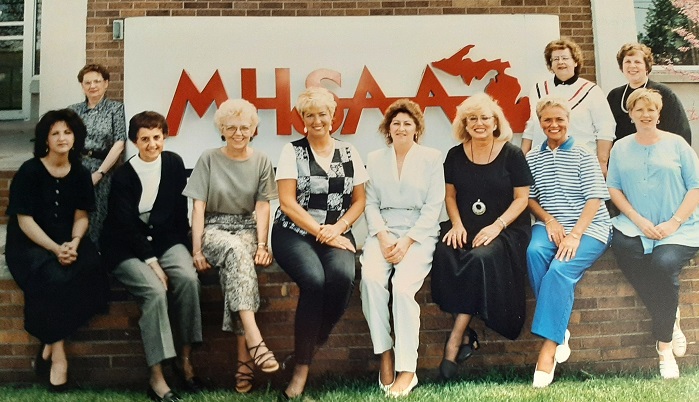
She was considered the “baby” of the MHSAA staff during her first 12 years, until she turned 30 and her support staff teammates declared she wasn’t the baby anymore during a Christmas party serenade. Just about 33 years later, she’s leaving as one of two people left who worked in the old offices before the MHSAA moved to another East Lansing headquarters at Ramblewood Drive in 1996.
School sports happen thanks to a Karen Jackson or two in every community -- people who provide the unseen support that makes these programs possible every day.
For the last 45 years, she’s provided a consistent anchor for service to 1,500 schools and millions of student-athletes across Michigan.
 “She’s shaped so much of what we’ve done,” said MHSAA assistant director Kathy Vruggink Westdorp, who joined the staff during the 2003-04 school year after more than two decades working for Grand Rapids-area schools. “Her service to schools was imperative to what she was doing, and it was a valuable part for our membership. Hers was such a dedicated service, such an exemplary service – finding solutions, to do what’s needed.”
There are file cabinets and libraries and hard drives at the MHSAA office, the contents of which are known by only a handful of people on Earth – and Jackson perhaps the most as she did most of the sorting and maintaining of those files over the years.
For a 1996 Lansing State Journal feature on the MHSAA’s support staff, Jackson (then Yonkers) explained “there are always new challenges, new issues and controversies. It never gets boring. In the past 19 years, we’ve slowly shifted from dealing with athletic administrators, principals and superintendents to dealing with legislators, attorneys and courts.”
The last 25 years has seen much of the work swing back to providing service directly to schools. And Jackson’s mind has become part MHSAA library and part card catalog of where to find those few snippets she might not recall immediately from the last half century.
“I guess what I’m proud of is being able to find things, to know where to find things and how to find things that other people don’t,” Jackson said. “Yes, the technology has changed everything. … We used to have more schools – they used to have 40-some Detroit public schools – and there was a whole era of (litigation), but it’s calmed down now.
“I liked what I did, and it kept me on my toes – that’s for sure.”
The MHSAA is rooted in its responsibilities as a championship and eligibility rules maker, and Jackson was involved in just about every communication in those areas during her time. Tournament changes are made at Representative Council meetings, and she’s reported the minutes for at least 150 of those, including piles of special sessions as the MHSAA managed sports through the COVID-19 pandemic. Eligibility waivers are requested at Executive Committee meetings, and she’s prepared somewhere north of 505 sets of minutes for those monthly sessions even as those agendas have grown in content substantially over the years.
Then there’s all of the correspondence from those four executive directors – all with the initials “kb” or “kj” to go with “AWB” or “VLN” or “JER” and “MU.” She also was in charge of MHSAA election ballots for 35 years, served as the lead organizer of cooperative programs, helped with football tickets for a time and briefly was part of the program-selling crew at early Football Finals at the Pontiac Silverdome.
“I think I’m pretty lucky, being on the Council and Executive Committee, that I’ve been able to work with her a lot. And most athletic directors, they may not even know who she is because they may not have contact with her or do anything with her – but she’s obviously been the unsung hero of that office,” said Vic Michaels, who serves as director of physical education & athletics for the Archdiocese of Detroit and has served on the Representative Council since 2003.
“She just does so much that you don’t really know about, especially with the Council. Whenever I need anything, Karen’s the one I call. She is the history, really. She’s the keeper of that.”
Unprecedented & 'Never to be Replicated'
A longtime co-worker of Jackson, Shirley Hytinen, retired in 1998 after just a few months more than 43 years. She too had worked for four executive directors, as she began in 1955 during the Charles E. Forsythe era.
Jackson surpassed Hytinen’s tenure a few years into Uyl’s, and can readily recall some of what stood out from all four directors she’s assisted.
Bush was “really stern” – he had served in the U.S. Marines – and she said he didn’t smile much until the day he announced his retirement, when it was “like a switch turned. He was smiling and happy and joking around.”
Norris was “the sweetest guy in the world.” Jackson had bought her first house in her mid-20s and was preparing to move in with only her dad and his motor home to assist, when Norris showed up to help at 7:30 a.m. that morning to provide another set of hands.
Roberts is known by Michigan administrators and national colleagues for his writing, and Jackson said jokingly she still “cringes” when she sees a yellow legal pad. She was an important proofreader and spent the majority of her career serving with her desk just a few paces away from that of the recent National Federation Hall of Fame selection, and she attended his induction this past summer and San Antonio.
 Roberts pointed out that during the 1980s, the MHSAA would conduct nine Executive Committee meetings, each averaging fewer than 10 requests for waivers. By the end of his 32 years, there were 11 Executive Committee meetings annually – with approximately 50 waiver requests presented on average. Still, he and Jackson were able to process the meeting minutes and continue to distribute those decisions within 24 hours.
“Over the more than three decades that Karen and I worked together at the MHSAA, the work became increasingly more voluminous and complicated – and Karen kept finding ways to increase our efficiency and maximize our output,” Roberts said.
Like Norris when Bush was executive director, Uyl had been part of the MHSAA staff under Roberts since 2004 before eventually moving into the corner office. After those first 15 years together, Uyl knew what a valuable person he had just a few yards away to assist in his transition, and “he just says to do this” and allows his staff to run with it, which Jackson enjoyed.
Her duties have been shifted confidently, mostly to Jamie VanDerMoere, another longtime administrative assistant who is best-known to Michigan school sports people for her leadership with the annual wrestling championship tournaments.
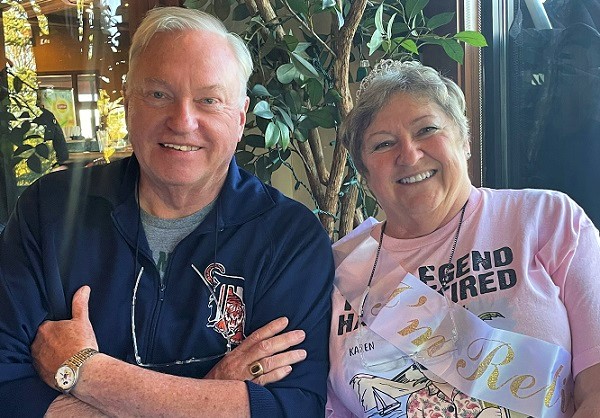
Jackson recently was married to Jim Jackson, and they have plans as they close in on their first anniversary – they’re hoping to travel to Italy at some point and also The Masters in Augusta, Ga., next spring. “I’m not going to miss coming to work every day, but the people,” Karen Jackson said.
And many in school sports across Michigan, although they may not realize it, will miss the contributions Jackson has made to their community over the decades including the context she’s provided as thousands of decisions have been made.
“Not only her understanding of our regulations and the processes of our regulations, but understanding why we have those things in place – when someone does something 45 years, you get a lot of historical context,” Uyl said. “What’s made her so effective is understanding the why – and that to me is something that’s almost impossible to replace.
“When an organization has been around 98 years with only five directors, it says something to have worked for four out of the five. That will never be replicated again.”
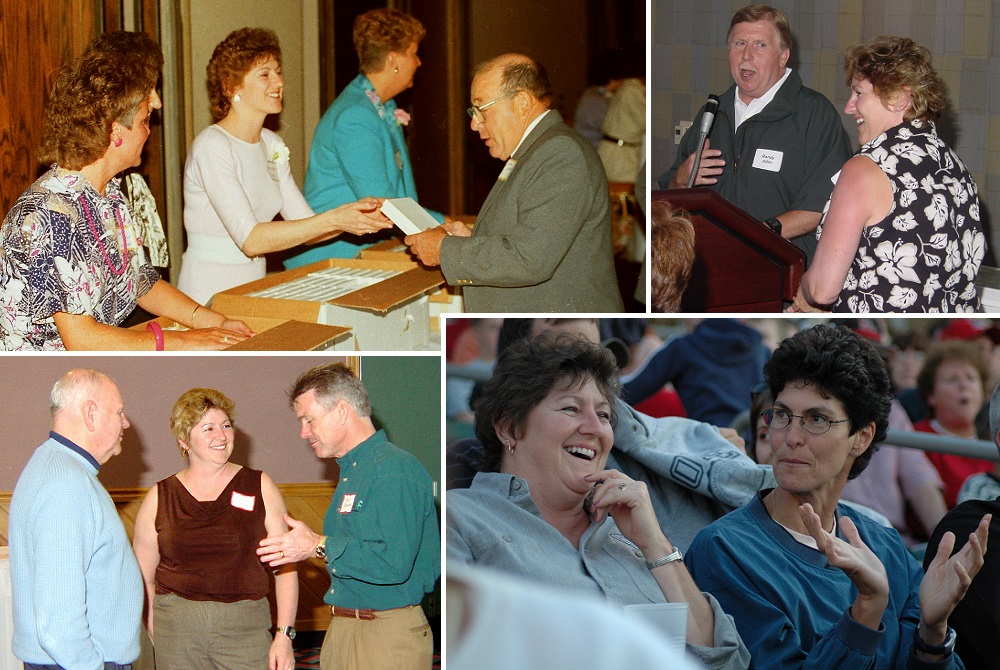
PHOTOS (Top) From top left, Karen Jackson has been a mainstay of the MHSAA for decades – serving membership, working with administrators like Randy Allen and Gina Mazzolini or serving as assistant to executive directors like Jack Roberts (right) and Vern Norris. (Middle) Jackson, sitting fourth from left, was the “baby” of the MHSAA staff after joining when she was 18. (Below) Jackson and husband Jim have plans to travel in retirement. (MHSAA archives.)