

Powerful Voice for High School Sports
December 19, 2014
By Geoff Kimmerly
Second Half editor
Paul Carey was home from the U.S. Army only a few months and just shy of 25 years old when Beal City embarked on its first trip deep into the MHSAA boys basketball tournament.
On the call for local radio station WCEN from gyms at Saginaw Arthur Hill and Lansing Sexton, Carey served as the voice of the previously “laughable” Aggies as they reached the Class D Semifinals before falling just six points short of playing for the title.
“All of Beal City emptied out. They’d never had anything before,” Carey recalled during his annual Thanksgiving weekend visit to the MHSAA Football Finals at Ford Field. “When I got home, within the next two weeks I got a letter from every citizen of Beal City thanking me for broadcasting their games. That’s the kind of appreciation that meant so much.”
During 42 years on the airwaves, Carey was best known as a voice of the Detroit Tigers bounding out of transistor radios all over Michigan, thanks to WJR’s powerful signal.
But for the state’s high school sports community, his legacy is similarly memorable as the voice of the longtime football and basketball scoreboard show and a voter for various all-state teams and wire polls over the decades.
Now 86 and retired since 1991, Carey remains a regular during the first day of the Football Finals, taking in games he broadcast for the MHSAA during the late 1970s and that continue to hold his eye as they have for more than a half-century.
“It was a passion of mine. High school sports always has been,” Carey said. “I think because my dad was a high school coach, and teacher initially, and my brother was a high school coach and teacher, I just grew up in families that appreciated coaching and athletics. I was not a great athlete, but it kept my hand in following sports that way.”
Now, the scores
Carey partnered with Ernie Harwell for Tigers radio broadcasts from 1973-91, including during the march to the 1984 World Series championship. He was named Michigan Sportscaster of the Year six times and to the Michigan Sports Hall of Fame in 1992.
But Carey’s early career included sitting on top of a car, plugged into a phone pole, for a Sacred Heart football game at old Fancher Field just a few blocks from his family’s Mount Pleasant home. Among many more accolades are a Distinguished Service Award from the Michigan High School Coaches Association and a place in the Basketball Coaches Association of Michigan Hall of Fame.
In fact, the start of his weekly announcing of statewide football and basketball scores preceded his baseball career by 16 years and ended two months after he announced his final professional out.
The Michigan High School Scoreboard show was a staple of WJR’s late Friday nights from 1957-91. Carey would read every score he could collect from a variety of sources, often organized by league and with state rankings and context mixed in.
His idea came from something similar read by Len Colby for Kalamazoo’s WKZO. Carey’s brother Terry was coaching at Niles during the second half of the 1950s, and he and other coaches would get together to listen to the Friday night scores from the southwestern part of the state.
Carey, who left WKNX in Saginaw for WJR in 1956, explained to then-sports director Bob Reynolds that the station’s strong signal could provide for a truly statewide scoreboard experience.
Carey then connected with Edgar Hayes of the former Detroit Times, who gave the OK for Carey to call the paper on Friday nights to get scores from the Detroit metro area. For the rest, Carey relied on wire services – there were three at the time – who relied on newspapers from all over Michigan to call in scores over the course of an evening.
Before every Friday during high school football season – and later Tuesdays and Fridays during boys basketball season – Carey typed up lists of games based on schedules in the newspaper, with spaces to add scores. More than a few times, Carey raced down a back ramp at Tiger Stadium after a Friday night game, back to the WJR studio, with 15 minutes to prep for the show’s 11:30 p.m. start.
“If the Flint Journal, the Grand Rapids Press, the Traverse City paper didn’t call in scores to the AP, then I was out of luck too. And that happened all the time,” Carey said. “I would call back occasionally, say, ‘Did you get anything more?’ It was a rat race.”
The show originally was set for 10 minutes and then extended to 15. American Airlines sponsored a record show that followed, and Carey’s scoreboard show had a sponsor only once in 35 years. Finishing up on time was expected, even with more than 200 scores to read.
But Carey said he always went 20 minutes, sometimes 25.
“Because I wasn’t done. I just kept right on going,” Carey said. “Jay Roberts did the all-night show most of the time, and he was patient with me. He didn’t say too much on the air about ‘that guy ahead of me took all of my time.’”
Carey continued the “rat race” until his final scoreboard show, Dec. 20, 1991. He retired from WJR at the end of that calendar year. And it's important to note: Carey was never paid a dime extra for doing the program. .
“I think Paul is really just a sports fan, and that came across to the listener on his broadcasts,” MHSAA historian Ron Pesch said. “Paul would gather as much as possible off the wire. He'd interject if scores were missing from sections of the state. Press polls from the Free Press, News, AP and UPI were big, so he could point out close calls and upsets.
“He provided immediacy, or the closest thing to it in the days before cable TV and the Internet, and because of his scoreboard show, you could get the results before the morning paper. For listeners, he brought life to something as simple as game scores.”
First team all the way
Carey, who resides in Rochester, also served as the engineer on Tigers broadcasts for 16 years, through 1990. He broadcast Pistons games on the radio for six seasons and did the first broadcast of a Central Michigan University football game, in 1949.
Harry Atkins, covering Detroit’s teams while with The Associated Press for 29 years including the last 21 as its sports editor for Detroit, took note of his colleague's hard work – and especially that Carey was one of few broadcasters who was a journalist in addition to a voice.
That made Carey's other major role in high school sports a natural fit.
Atkins split The Associated Press all-state selection panels for football and basketball into 11 regions, and Carey represented the Detroit area for a number of years. He also was a longtime voter in those sports' weekly polls.
“Paul is just that kind of guy. He thought it was important and he made time in his busy schedule to do it,” Atkins said “And it had an impact on the other 10 voters on the All-State panels, too.
“Some of them were from small out-state newspapers or radio or TV stations. Yet every one of them knew who Paul Carey was. And when he spoke, of course, with what often is called "The Voice of God," those voters paid attention.”
And he still does, as well.
At the end of each fall, Carey still puts together a compilation of the three high school all-state football teams – Associated Press, Detroit Free Press and Detroit News – and files them with years of research and results.
“It’s important to me. Nobody sees it but me, but I get a certain kick,” Carey said. “Once in a while I’ll see a kid playing at Central, Western or (Michigan) State or Michigan, and they’ll say he came from Clawson. I’ll go into my all-state collections, say that would’ve been 2009 he played, and I find a name.”
In addition to the Football Finals on WJR, Carey was part of the Baseball Finals broadcasts into the early 1990s, continuing to contribute even after his retirement from his fulltime gig.
He spent high school games over the years sitting next to legends like the Free Press’ Hal Schram and remembers when current Free Press longtime scribe Mick McCabe was just a rookie. One of Carey's final broadcasts was a 1992 Baseball Final with his nephew Mike Carey, who continues to broadcast MHSAA championship games to this day.
“I am eternally grateful to Paul Carey. His contribution to high school sports in Michigan has been great and significant,” Atkins said.
“We are lucky to have him.”
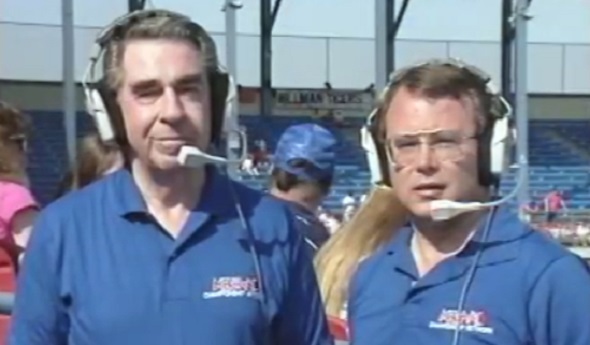
PHOTO: Paul Carey (left) and nephew Mike Carey broadcast the MHSAA 1992 Class D Baseball Final between Hillman and Athens for PASS.
Building Beginning as Okemos Follows 1st-Year Coach Scott-Emuakpor
By
Geoff Kimmerly
MHSAA.com senior editor
August 9, 2022
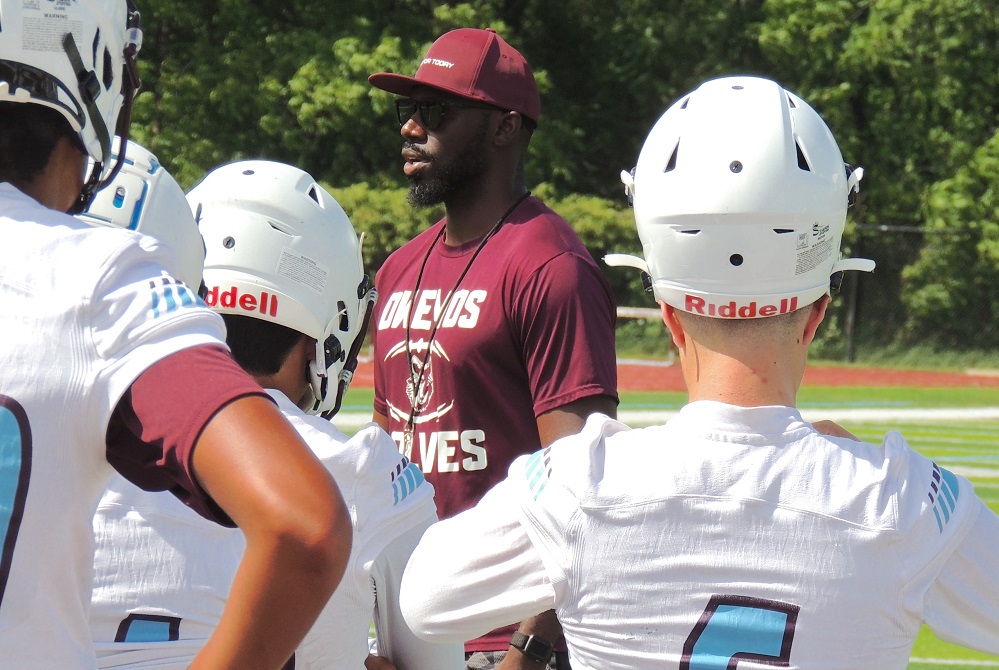
OKEMOS – The football lay on the turf, landing there before the play had really begun, and the most booming voice from the tallest man on the field yelled a reassuring, “It’s OK. Let’s go,” followed the next play by “Go again,” and then “Figure it out.”
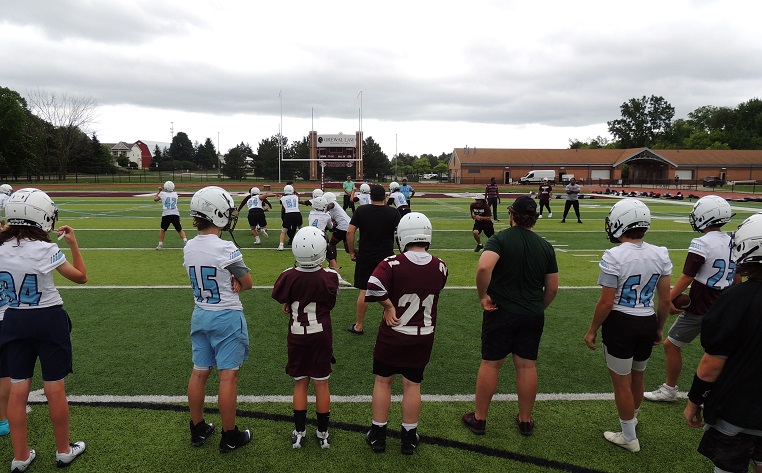
 An hour earlier, first-year Okemos varsity football coach Efe Scott-Emuakpor had been on the phone asking a parent to bring the helmet and practice jersey one of his players had left at home. Nearby, another small group also stood helmetless as they hadn’t yet gotten the pre-participation physical required to join their friends on the field.
Those are typical first-day glitches no matter the school, and fall practices for all sports began Monday at 750 high schools across the state.
But those relatively minor symptoms are what Scott-Emuakpor is focused on treating in the immediate term as he takes on one of the most serious rebuilding efforts in Michigan high school football.
“This is progress,” Scott-Emuakpor said halfway through his team’s first practice, looking out at 39 players on Okemos’ game field – 33 more than showed up for his first offseason workout.
“We’d like to have everything right now. But it’s growing. It’s slowly growing.”
And after Monday, Okemos is one step closer to what would be an incredible turnaround story.
The Wolves have not won since Week 2 of the 2019 season, a stretch of 23 games. After scoring on an 84-yard run during the first quarter of last fall’s opener against Mason, Okemos didn’t score again the rest of the season.
Standing 6-foot-3, and still only a few years from his last college game as a receiver at Ball State University, Scott-Emuakpor looks capable of stepping back into a huddle at a moment’s notice. A little more than a decade ago, in 2011, he was beginning a senior season at East Lansing that would see him cap his varsity career in the MHSAA record book with 134 catches, gaining 1,624 yards, over three seasons. He also was an all-leaguer in basketball and Finals placer in high jump before joining the Cardinals.
 After graduating from Ball State with a computer science bachelor’s degree, and on the way to earning his master’s in business from Saginaw Valley State University, Scott-Emuakpor came home and has worked nearly six years as a business systems analyst with Red Cedar Solutions Group on efforts including the MI School Data website.
But that’s just his fulltime job. Scott-Emuakpor also co-founded a clothing line, Live For Today, and over the last five seasons served as a volunteer assistant coach with his hometown Trojans – who have made the MHSAA Playoffs six seasons running.
He'd never applied for a head coaching job. He’d never really considered coaching at that level. In fact, he was pretty happy with how assisting at East Lansing for longtime coach Bill Feraco fit into his schedule and other pursuits.
But Scott-Emuakpor also is a studier. And as a past rival and co-member of the Capital Area Activities Conference Blue, he and East Lansing saw Okemos plenty.
The Wolves had made the playoffs as recently as 2018, and won their first playoff game that season since 2011. Scott-Emuakpor had played against Okemos’ Taylor Moton, now considered one of the NFL’s top offensive tackles. And the school has had loads of success in other sports, annually ranking among the Lansing area’s best in just about all of them and coming off a statewide Division 1 championship in boys soccer from last fall.
“I paid attention to how things have been around here. And I know what they could be capable of,” Scott-Emuakpor said. “This program was once a good program that was very well-respected; I respected them playing against them in high school. They had great athletes. I think my senior year we beat them by one point (20-19 in 2011). So we had good battles.
“I just saw where they’re at. … We have some good kids around here, and I know there’s more in the school not playing. Maybe when they’re sophomores, juniors, they’ll come out. I think I’m capable of getting that interest up, getting them out on the field and just building something.”
 Raj Singh is a senior this fall, one of only five or so Scott-Emuakpor is expecting to come out this week. He’s also a near all-A student, will play some quarterback and safety along with his receiver spot, and was the guy bringing carloads of classmates to workouts over the summer as he joined his coach in recruiting prospective players.
Singh is following his older brother Joe Singh, an admittedly “smaller than everyone” offensive lineman who earned all-league honors as a senior in 2017. When Joe Singh told his younger brother that playing under the lights on a Friday night is a feeling unlike any other, the idea stuck – which is why it made sense when Raj Singh fractured his wrist in Week 2 last season but was back by Week 7 despite a cast covering one hand.
Watching Singh catch passes one-handed last season during East Lansing’s 49-0 win over Okemos stuck with Scott-Emuakpor. Joe Singh had told his little bother that all that matters is having more heart than his opponent and a fighting spirit – in other words, being the type of player Scott-Emuakpor will rely on to get Okemos up and succeeding again.
“I’ve been playing football since I was 6 years old. It’s just been a dream of mine to be at this moment,” Raj Singh said.
“Coach Efe is bringing in a lot of new aspects, and that’s been very helpful to make it different than last year – make us feel a little more at home this year. Compared to last year, he’s brought a lot of structure. We’ve been really coming together as a family … and it just shows Coach Efe wants to build a community around here.”
The process is about more than building stronger, faster bodies and learning football skills and technique. The Wolves aren’t talking a lot about last year, but there’s something there to overcome – and Scott-Emuakpor started working on that soon after he was hired at the end of March.
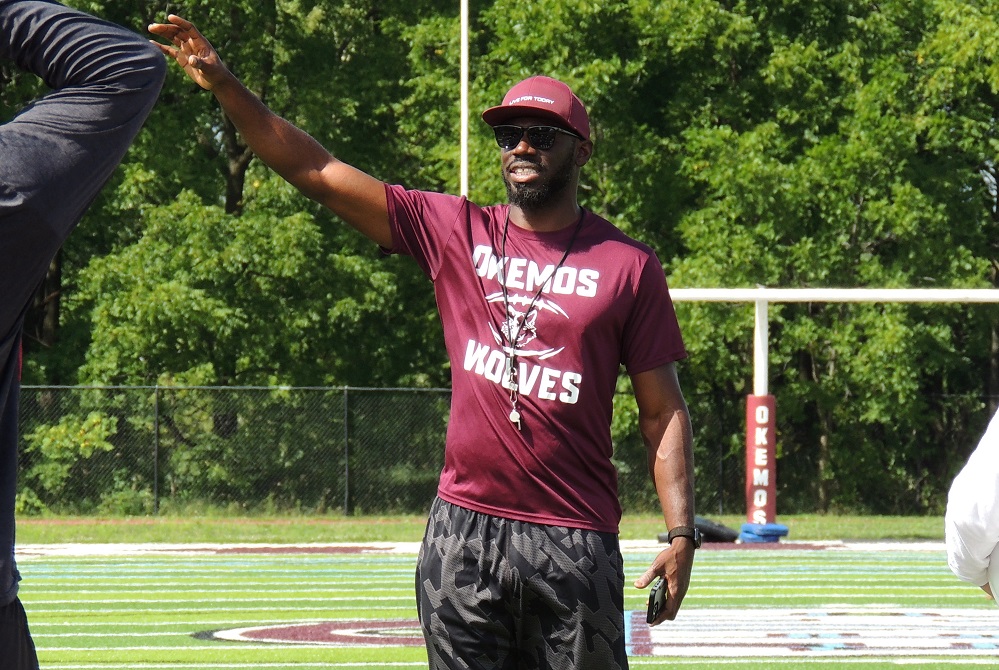 “In the springtime, we were fortunate enough to get in the weight room and I was able to see kids put up good weight and do some things. I’d tell them, ‘You’re actually strong. You’re actually a fast kid,’” Scott-Emuakpor said. “But when you’re not successful for so long, and the way they were losing last year, it was easy for them to not feel confident, not feel they were able to ultimately get the job done. And so I was just there working on minds.”
Last season was going to be uphill for Okemos no matter what. A mid-summer coaching change brought on by a major fulltime job promotion for the former coach led to an interim staff, players leaving the program, and an applaudable effort to just keep teams on the field.
Scott-Emuakpor has surrounded himself with a staff that includes a pair of his past coaches growing up in East Lansing, past players from when he was coaching there and others with winning experience playing at DeWitt and Williamston.
In addition to what he learned playing and coaching under Feraco, Scott-Emuakpor brings a ton of insight from his experiences at Ball State; he had only one catch during his college career while battling injuries, but he spent that time on the sideline observing his coaches and taking mental notes. Just Sunday, he was pulling from the 2012-13 Ball State football handbook a few details to incorporate into his work in progress with the Wolves.
Okemos will have varsity and freshman teams this fall, and the majority of players at Monday’s combined practice were juniors and sophomores – so recruiting remains ongoing. But Singh said the number of classmates who did come out Monday exceeded his expectations – and that just added to the excitement of starting again.
“If you walk through the school, you’ll see some guys, you’ll (say), ‘OK, what does that guy do?’ You find out he plays (only) lacrosse, or only wrestles, where in other areas, other schools, they might do everything because that’s what they do, what they’ve grown up doing” Scott-Emuakpor said. “I’ve been trying to rebuild that connection, that love for football. A lot of them are very intrigued; I feel like some of them are kinda peeking and saying, ‘What’s going on? This new coach seems to be young and interesting.’ And I’ve just been trying to stay focused on the process and not get too far ahead of myself.”
 Geoff Kimmerly joined the MHSAA as its Media & Content Coordinator in Sept. 2011 after 12 years as Prep Sports Editor of the Lansing State Journal. He has served as Editor of Second Half since its creation in January 2012, and MHSAA Communications Director since January 2021. Contact him at [email protected] with story ideas for the Barry, Eaton, Ingham, Livingston, Ionia, Clinton, Shiawassee, Gratiot, Isabella, Clare and Montcalm counties.
PHOTOS (Top) First-year Okemos varsity football coach Efe Scott-Emuakpor, middle, huddles up his players during Monday's first day of practice. (2) Scott-Emuakpor confers with senior Raj Singh on blocking from his receiver position. (3) The Wolves work on offense during the first part of their Monday session. (4) Scott-Emuakpor speaks with his team at the start of the workout. (Photos by Geoff Kimmerly.)