

Powerful Voice for High School Sports
December 19, 2014
By Geoff Kimmerly
Second Half editor
Paul Carey was home from the U.S. Army only a few months and just shy of 25 years old when Beal City embarked on its first trip deep into the MHSAA boys basketball tournament.
On the call for local radio station WCEN from gyms at Saginaw Arthur Hill and Lansing Sexton, Carey served as the voice of the previously “laughable” Aggies as they reached the Class D Semifinals before falling just six points short of playing for the title.
“All of Beal City emptied out. They’d never had anything before,” Carey recalled during his annual Thanksgiving weekend visit to the MHSAA Football Finals at Ford Field. “When I got home, within the next two weeks I got a letter from every citizen of Beal City thanking me for broadcasting their games. That’s the kind of appreciation that meant so much.”
During 42 years on the airwaves, Carey was best known as a voice of the Detroit Tigers bounding out of transistor radios all over Michigan, thanks to WJR’s powerful signal.
But for the state’s high school sports community, his legacy is similarly memorable as the voice of the longtime football and basketball scoreboard show and a voter for various all-state teams and wire polls over the decades.
Now 86 and retired since 1991, Carey remains a regular during the first day of the Football Finals, taking in games he broadcast for the MHSAA during the late 1970s and that continue to hold his eye as they have for more than a half-century.
“It was a passion of mine. High school sports always has been,” Carey said. “I think because my dad was a high school coach, and teacher initially, and my brother was a high school coach and teacher, I just grew up in families that appreciated coaching and athletics. I was not a great athlete, but it kept my hand in following sports that way.”
Now, the scores
Carey partnered with Ernie Harwell for Tigers radio broadcasts from 1973-91, including during the march to the 1984 World Series championship. He was named Michigan Sportscaster of the Year six times and to the Michigan Sports Hall of Fame in 1992.
But Carey’s early career included sitting on top of a car, plugged into a phone pole, for a Sacred Heart football game at old Fancher Field just a few blocks from his family’s Mount Pleasant home. Among many more accolades are a Distinguished Service Award from the Michigan High School Coaches Association and a place in the Basketball Coaches Association of Michigan Hall of Fame.
In fact, the start of his weekly announcing of statewide football and basketball scores preceded his baseball career by 16 years and ended two months after he announced his final professional out.
The Michigan High School Scoreboard show was a staple of WJR’s late Friday nights from 1957-91. Carey would read every score he could collect from a variety of sources, often organized by league and with state rankings and context mixed in.
His idea came from something similar read by Len Colby for Kalamazoo’s WKZO. Carey’s brother Terry was coaching at Niles during the second half of the 1950s, and he and other coaches would get together to listen to the Friday night scores from the southwestern part of the state.
Carey, who left WKNX in Saginaw for WJR in 1956, explained to then-sports director Bob Reynolds that the station’s strong signal could provide for a truly statewide scoreboard experience.
Carey then connected with Edgar Hayes of the former Detroit Times, who gave the OK for Carey to call the paper on Friday nights to get scores from the Detroit metro area. For the rest, Carey relied on wire services – there were three at the time – who relied on newspapers from all over Michigan to call in scores over the course of an evening.
Before every Friday during high school football season – and later Tuesdays and Fridays during boys basketball season – Carey typed up lists of games based on schedules in the newspaper, with spaces to add scores. More than a few times, Carey raced down a back ramp at Tiger Stadium after a Friday night game, back to the WJR studio, with 15 minutes to prep for the show’s 11:30 p.m. start.
“If the Flint Journal, the Grand Rapids Press, the Traverse City paper didn’t call in scores to the AP, then I was out of luck too. And that happened all the time,” Carey said. “I would call back occasionally, say, ‘Did you get anything more?’ It was a rat race.”
The show originally was set for 10 minutes and then extended to 15. American Airlines sponsored a record show that followed, and Carey’s scoreboard show had a sponsor only once in 35 years. Finishing up on time was expected, even with more than 200 scores to read.
But Carey said he always went 20 minutes, sometimes 25.
“Because I wasn’t done. I just kept right on going,” Carey said. “Jay Roberts did the all-night show most of the time, and he was patient with me. He didn’t say too much on the air about ‘that guy ahead of me took all of my time.’”
Carey continued the “rat race” until his final scoreboard show, Dec. 20, 1991. He retired from WJR at the end of that calendar year. And it's important to note: Carey was never paid a dime extra for doing the program. .
“I think Paul is really just a sports fan, and that came across to the listener on his broadcasts,” MHSAA historian Ron Pesch said. “Paul would gather as much as possible off the wire. He'd interject if scores were missing from sections of the state. Press polls from the Free Press, News, AP and UPI were big, so he could point out close calls and upsets.
“He provided immediacy, or the closest thing to it in the days before cable TV and the Internet, and because of his scoreboard show, you could get the results before the morning paper. For listeners, he brought life to something as simple as game scores.”
First team all the way
Carey, who resides in Rochester, also served as the engineer on Tigers broadcasts for 16 years, through 1990. He broadcast Pistons games on the radio for six seasons and did the first broadcast of a Central Michigan University football game, in 1949.
Harry Atkins, covering Detroit’s teams while with The Associated Press for 29 years including the last 21 as its sports editor for Detroit, took note of his colleague's hard work – and especially that Carey was one of few broadcasters who was a journalist in addition to a voice.
That made Carey's other major role in high school sports a natural fit.
Atkins split The Associated Press all-state selection panels for football and basketball into 11 regions, and Carey represented the Detroit area for a number of years. He also was a longtime voter in those sports' weekly polls.
“Paul is just that kind of guy. He thought it was important and he made time in his busy schedule to do it,” Atkins said “And it had an impact on the other 10 voters on the All-State panels, too.
“Some of them were from small out-state newspapers or radio or TV stations. Yet every one of them knew who Paul Carey was. And when he spoke, of course, with what often is called "The Voice of God," those voters paid attention.”
And he still does, as well.
At the end of each fall, Carey still puts together a compilation of the three high school all-state football teams – Associated Press, Detroit Free Press and Detroit News – and files them with years of research and results.
“It’s important to me. Nobody sees it but me, but I get a certain kick,” Carey said. “Once in a while I’ll see a kid playing at Central, Western or (Michigan) State or Michigan, and they’ll say he came from Clawson. I’ll go into my all-state collections, say that would’ve been 2009 he played, and I find a name.”
In addition to the Football Finals on WJR, Carey was part of the Baseball Finals broadcasts into the early 1990s, continuing to contribute even after his retirement from his fulltime gig.
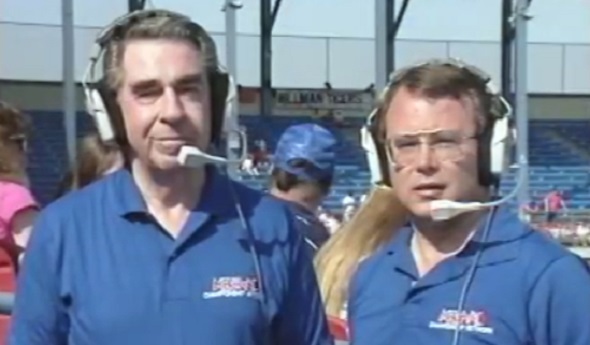
He spent high school games over the years sitting next to legends like the Free Press’ Hal Schram and remembers when current Free Press longtime scribe Mick McCabe was just a rookie. One of Carey's final broadcasts was a 1992 Baseball Final with his nephew Mike Carey, who continues to broadcast MHSAA championship games to this day.
“I am eternally grateful to Paul Carey. His contribution to high school sports in Michigan has been great and significant,” Atkins said.
“We are lucky to have him.”
PHOTO: Paul Carey (left) and nephew Mike Carey broadcast the MHSAA 1992 Class D Baseball Final between Hillman and Athens for PASS.
Trenton, Lakeshore Emerge with 1-Run Semifinal Wins, Advance to Saturday
By
Tom Kendra
Special for MHSAA.com
June 16, 2022
EAST LANSING – Trenton and Essexville Garber are not used to making long runs in softball.
In fact, most of the players on both teams weren’t even born the last time their schools reached the Softball Semifinals.
The newcomers put on a show Thursday on the state’s biggest stage, with Trenton holding off Garber, 2-1, in a classic pitcher’s duel at sunny, windswept Secchia Stadium.
“We just told them to believe,” said third-year Trenton coach Rick Tanguay. “Believe it’s going to happen and believe you’re going to put the ball in play. I’ve had a lot of these kids since they were 9 or 10 years old, and I’m proud of them.”
Trenton (34-10), which lost in the Division 2 Final in 2005 and had not been back to the Semifinals before this season, will play perennial power Stevensville Lakeshore in Saturday’s 12:30 p.m. championship game. Lakeshore defeated Escanaba, 2-1, in Thursday’s last Semifinal.
The Trojans had to come from behind to advance, after Garber jumped out to a 1-0 lead during the first inning.
Kortney Kotenko, a junior catcher, belted an RBI double to bring the big crowd from Essexville to its feet. The Dukes previously lost in the Class B Final in 1997, but hadn’t been back to the state’s Final Four until Thursday.
Garber would keep that 1-0 lead until the fifth inning, as junior pitcher Sarah Basket kept the Trojans off-balance.
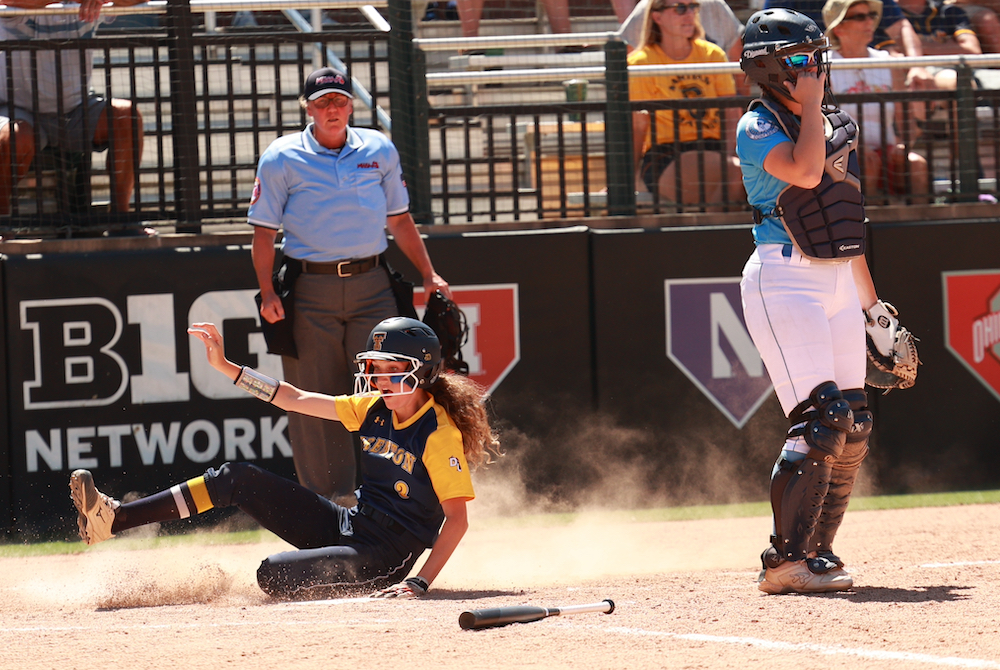
Trenton finally broke through by manufacturing single runs in the fifth and sixth innings. Pinch-runner Jordyn Emery scored on a fielding error in the fifth, then sophomore shortstop London Williams singled to left in the sixth inning to score Maddie Dobbs.
Those two runs would prove to be just enough as Trenton senior pitcher Aila Johnson turned back Garber’s last-chance, seventh-inning rally.
The Dukes put the pressure on, as Basket singled and then Jacqueline Brinkman was hit by a pitch. After a double steal, Garber had runners on second and third with two outs, before Johnson was able to shut the door with a strikeout.
“I have to be confident out there for my team, but that last inning was rough,” Johnson said with a smile. “I was trying to hide it, but I was nervous out there.”
Johnson may have been battling nerves on the inside, but it didn’t show in her stellar performance. The Siena Heights commit finished with just four strikeouts, but she kept the Dukes guessing for most of the game and allowed just four hits and one walk.
Tanguay said it was a classic performance by the battery of Johnson and her senior catcher, Olivia Hickman, who are two of just four seniors on the Trojans’ 16-player roster.
“Aila doesn’t get a lot of love; she doesn’t get a lot of press,” said Tanguay. “She’s not one of the top 10 (ranked) pitchers in the state, but she comes out and she’s a workhorse and she does it.”
Matching her every pitch along the way was Basket, a junior, who finished with a five-hitter, no walks, one earned run and nine strikeouts.
Garber (35-9) is an even younger team than Trenton, with just three seniors on the 16-player roster. The Dukes relied on their stellar junior class to pull out several come-from-behind victories in Districts and Regionals en route to MSU.
“You know, this is the first time we’ve been this far in 25 years – and 25 is a long time,” said second-year Garber coach Chris Kokaly. “Losing by one run is hard because you think about all of the opportunities we had where we just needed a key hit. We’ve been getting those hits all season and today, it just didn’t happen.”
Stevensville Lakeshore 2, Escanaba 1
Lakeshore advanced to the championship game despite having just two hits in the Semifinal, both of them singles.
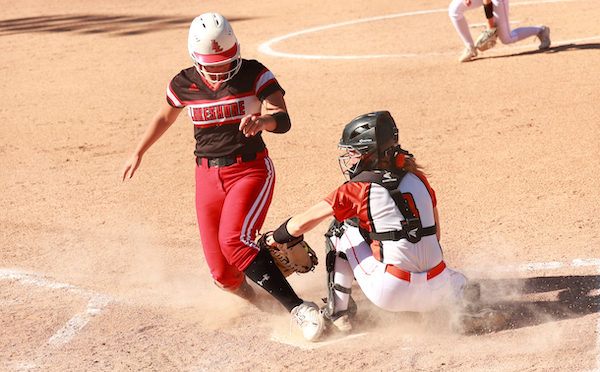
The Lancers (39-4) played small ball and took advantage of Escanaba miscues to manufacture single runs in the first inning and the sixth inning, and that proved to be just enough.
 “The girls believe in their pitchers and their defense,” said 43rd-year Lakeshore coach Denny Dock, who ranks third in state softball history with 1,055 victories. “If we could get our bats out of the deep freeze, we’d be pretty good.”
Lakeshore’s pitching combination of junior Ava Mullen and sophomore Avery Atwood was outstanding, combining on a three-hitter.
Mullen set the tone by getting the first five outs of the game by strikeout. She kept cruising until the top of the sixth inning, when Escanaba used a walk and a solid single to right field by senior Lizzy Silva to tie the game, 1-1. After McKayla Mott singled, Dock decided to make a pitching change – bringing in Atwood with two runners on and two outs.
To say the decision turned out good is an understatement.
Atwood got the next hitter to pop out to the catcher on her first pitch, then struck out the side in the top of the seventh to get the win.
“I knew that Avery would do great, and she did,” said Mullen, who finished with 10 strikeouts. “I’m super proud of this team. We’ve worked on our attitudes and staying positive, and I really think that was a big reason why we won today.”
Gianna Kerschbaum and Gabby Solloway had the lone hits for Lakeshore, which has scored just five runs over its last three games – all wins – including a 2-1 victory over Wayland in the Regional Final and a 1-0 win over Jackson Northwest in Tuesday’s Quarterfinal.
Dock, also the longtime football coach at Lakeshore, has led Lancers softball to seven Finals championships, the most recent in 2015. Lakeshore finished runner-up in Division 2 in 2019.
Escanaba (30-6), which won Division 2 titles in 2018 and 2019 and made the Semifinals for the fifth time in six seasons, was out of sorts from the start Thursday. Mott relieved the starting pitcher after two walks and a wild pitch and threw most of the game, before freshman Grayson LaMarche relieved her in the fifth inning and took the loss.
“When two great teams play it comes down to a couple of plays, and that’s what happened today,” said second-year Escanaba coach Andy Fields. “Overall, this season was a phenomenal ride.”
PHOTOS (Top) Trenton’s Jordyn Emery scores her team’s first run in the fifth inning Thursday. (Middle) A Lakeshore runner gets across the plate just before the tag by Escanaba’s Carney Salo.