

Powerful Voice for High School Sports
December 19, 2014
By Geoff Kimmerly
Second Half editor
Paul Carey was home from the U.S. Army only a few months and just shy of 25 years old when Beal City embarked on its first trip deep into the MHSAA boys basketball tournament.
On the call for local radio station WCEN from gyms at Saginaw Arthur Hill and Lansing Sexton, Carey served as the voice of the previously “laughable” Aggies as they reached the Class D Semifinals before falling just six points short of playing for the title.
“All of Beal City emptied out. They’d never had anything before,” Carey recalled during his annual Thanksgiving weekend visit to the MHSAA Football Finals at Ford Field. “When I got home, within the next two weeks I got a letter from every citizen of Beal City thanking me for broadcasting their games. That’s the kind of appreciation that meant so much.”
During 42 years on the airwaves, Carey was best known as a voice of the Detroit Tigers bounding out of transistor radios all over Michigan, thanks to WJR’s powerful signal.
But for the state’s high school sports community, his legacy is similarly memorable as the voice of the longtime football and basketball scoreboard show and a voter for various all-state teams and wire polls over the decades.
Now 86 and retired since 1991, Carey remains a regular during the first day of the Football Finals, taking in games he broadcast for the MHSAA during the late 1970s and that continue to hold his eye as they have for more than a half-century.
“It was a passion of mine. High school sports always has been,” Carey said. “I think because my dad was a high school coach, and teacher initially, and my brother was a high school coach and teacher, I just grew up in families that appreciated coaching and athletics. I was not a great athlete, but it kept my hand in following sports that way.”
Now, the scores
Carey partnered with Ernie Harwell for Tigers radio broadcasts from 1973-91, including during the march to the 1984 World Series championship. He was named Michigan Sportscaster of the Year six times and to the Michigan Sports Hall of Fame in 1992.
But Carey’s early career included sitting on top of a car, plugged into a phone pole, for a Sacred Heart football game at old Fancher Field just a few blocks from his family’s Mount Pleasant home. Among many more accolades are a Distinguished Service Award from the Michigan High School Coaches Association and a place in the Basketball Coaches Association of Michigan Hall of Fame.
In fact, the start of his weekly announcing of statewide football and basketball scores preceded his baseball career by 16 years and ended two months after he announced his final professional out.
The Michigan High School Scoreboard show was a staple of WJR’s late Friday nights from 1957-91. Carey would read every score he could collect from a variety of sources, often organized by league and with state rankings and context mixed in.
His idea came from something similar read by Len Colby for Kalamazoo’s WKZO. Carey’s brother Terry was coaching at Niles during the second half of the 1950s, and he and other coaches would get together to listen to the Friday night scores from the southwestern part of the state.
Carey, who left WKNX in Saginaw for WJR in 1956, explained to then-sports director Bob Reynolds that the station’s strong signal could provide for a truly statewide scoreboard experience.
Carey then connected with Edgar Hayes of the former Detroit Times, who gave the OK for Carey to call the paper on Friday nights to get scores from the Detroit metro area. For the rest, Carey relied on wire services – there were three at the time – who relied on newspapers from all over Michigan to call in scores over the course of an evening.
Before every Friday during high school football season – and later Tuesdays and Fridays during boys basketball season – Carey typed up lists of games based on schedules in the newspaper, with spaces to add scores. More than a few times, Carey raced down a back ramp at Tiger Stadium after a Friday night game, back to the WJR studio, with 15 minutes to prep for the show’s 11:30 p.m. start.
“If the Flint Journal, the Grand Rapids Press, the Traverse City paper didn’t call in scores to the AP, then I was out of luck too. And that happened all the time,” Carey said. “I would call back occasionally, say, ‘Did you get anything more?’ It was a rat race.”
The show originally was set for 10 minutes and then extended to 15. American Airlines sponsored a record show that followed, and Carey’s scoreboard show had a sponsor only once in 35 years. Finishing up on time was expected, even with more than 200 scores to read.
But Carey said he always went 20 minutes, sometimes 25.
“Because I wasn’t done. I just kept right on going,” Carey said. “Jay Roberts did the all-night show most of the time, and he was patient with me. He didn’t say too much on the air about ‘that guy ahead of me took all of my time.’”
Carey continued the “rat race” until his final scoreboard show, Dec. 20, 1991. He retired from WJR at the end of that calendar year. And it's important to note: Carey was never paid a dime extra for doing the program. .
“I think Paul is really just a sports fan, and that came across to the listener on his broadcasts,” MHSAA historian Ron Pesch said. “Paul would gather as much as possible off the wire. He'd interject if scores were missing from sections of the state. Press polls from the Free Press, News, AP and UPI were big, so he could point out close calls and upsets.
“He provided immediacy, or the closest thing to it in the days before cable TV and the Internet, and because of his scoreboard show, you could get the results before the morning paper. For listeners, he brought life to something as simple as game scores.”
First team all the way
Carey, who resides in Rochester, also served as the engineer on Tigers broadcasts for 16 years, through 1990. He broadcast Pistons games on the radio for six seasons and did the first broadcast of a Central Michigan University football game, in 1949.
Harry Atkins, covering Detroit’s teams while with The Associated Press for 29 years including the last 21 as its sports editor for Detroit, took note of his colleague's hard work – and especially that Carey was one of few broadcasters who was a journalist in addition to a voice.
That made Carey's other major role in high school sports a natural fit.
Atkins split The Associated Press all-state selection panels for football and basketball into 11 regions, and Carey represented the Detroit area for a number of years. He also was a longtime voter in those sports' weekly polls.
“Paul is just that kind of guy. He thought it was important and he made time in his busy schedule to do it,” Atkins said “And it had an impact on the other 10 voters on the All-State panels, too.
“Some of them were from small out-state newspapers or radio or TV stations. Yet every one of them knew who Paul Carey was. And when he spoke, of course, with what often is called "The Voice of God," those voters paid attention.”
And he still does, as well.
At the end of each fall, Carey still puts together a compilation of the three high school all-state football teams – Associated Press, Detroit Free Press and Detroit News – and files them with years of research and results.
“It’s important to me. Nobody sees it but me, but I get a certain kick,” Carey said. “Once in a while I’ll see a kid playing at Central, Western or (Michigan) State or Michigan, and they’ll say he came from Clawson. I’ll go into my all-state collections, say that would’ve been 2009 he played, and I find a name.”
In addition to the Football Finals on WJR, Carey was part of the Baseball Finals broadcasts into the early 1990s, continuing to contribute even after his retirement from his fulltime gig.
He spent high school games over the years sitting next to legends like the Free Press’ Hal Schram and remembers when current Free Press longtime scribe Mick McCabe was just a rookie. One of Carey's final broadcasts was a 1992 Baseball Final with his nephew Mike Carey, who continues to broadcast MHSAA championship games to this day.
“I am eternally grateful to Paul Carey. His contribution to high school sports in Michigan has been great and significant,” Atkins said.
“We are lucky to have him.”
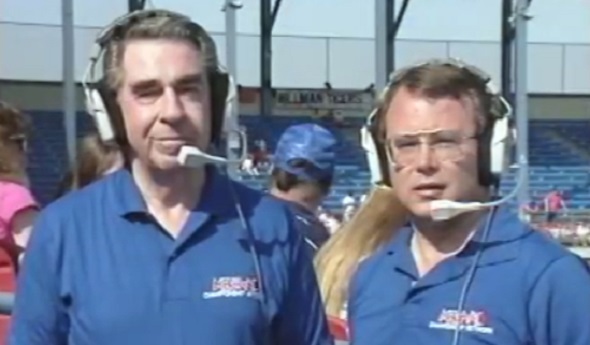
PHOTO: Paul Carey (left) and nephew Mike Carey broadcast the MHSAA 1992 Class D Baseball Final between Hillman and Athens for PASS.
Preview: Past Champions Filling Upper Peninsula Girls Track & Field Finals
By
Geoff Kimmerly
MHSAA.com senior editor
June 2, 2022
An extraordinary 16 individual champions from last season’s Upper Peninsula Girls Track & Field Finals will return to Kingsford this weekend seeking the same success and more. And only six of them are seniors.
The star-studded meet will feature the final high school races for standouts like three-time champion Landry Koski from Rock Mid Peninsula and Houghton distance star Ingrid Seagren. But the Division 2 meet easily could be dominated by sophomores, and the Division 3 Finals return nine of last year’s 13 individual winners including five sophomores and juniors.
Events begin at 10 a.m. (EDT) and tickets to attend can be purchased online only at GoFan. The meets also will be broadcast on MHSAA.tv and viewable with subscription.
Below is a glance at team contenders and individuals to watch in all three divisions.
Division 1
Team forecast: Marquette solidly won its ninth championship over the last 10 seasons (not counting canceled 2020) last spring, but at last month’s Regional edged Sault Ste. Marie by just five points. The Blue Devils were last season’s Finals runner-up as well, and Negaunee in 2018 is the only team other than Marquette to claim a UPD1 championship over the last decade. The Miners had winners in three relays at their Regional and swept hurdles and throws to hold off star-powered Houghton.
Claire Erickson, Sault Ste. Marie junior: The top-seeded contender in the 300 hurdles (50.52) ran the race eight tenths of a second faster than anyone else at a UPD1 Regional. She was third in the 300 at last season’s Finals and ran on two placing relays.
Alyssa Hill, Negaunee senior: She’s seeded first in the discus by nearly 19 feet with a Regional throw of 123-4, and second in shot put at 34 as one of only two (with teammate Eliana Juchemich) who tossed farther than 31-1 in UPD1 qualifying.
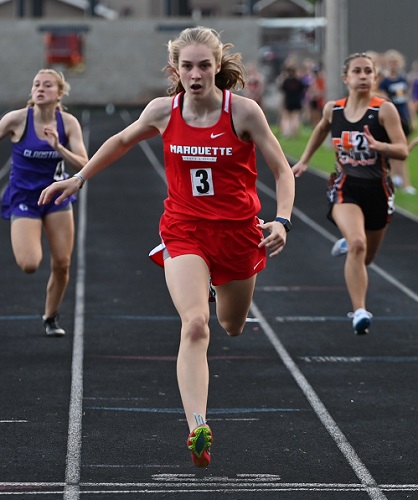 Julia Ott, Marquette junior: She’s seeded second in two events – the 100 and 200 behind teammate Baux Truckey – and tied for the top seed in high jump (5-0) after winning that event last year. She’ll also run on the top-seeded 800 relay and being part of the winning 400 relay in 2021.
Ingrid Seagren, Houghton senior: The reigning 1,600 champ is seeded first in that race (5:30.23) by 13 seconds, the 800 (2:30.43) by six seconds and the 3,200 (12:34.34) by six seconds as well. She won the UPD1 cross country championship in the fall.
Baux Truckey, Marquette junior: She entered the mix in a big way last season winning the 100 and 200, and she’s seeded first in both at 12.86 and 26.73 seconds, respectively. She’ll also run on top-seeded 400 and 800 relays after helping both to wins in 2021.
Division 2
Team forecast: West Iron edged Ishpeming by 3½ points at last season’s Final and can match star power with any of the contenders with three-event champion Danica Shamion returning. Ishpeming with another returning three-event champ in Lola Korpi should be in the mix again despite just a third-place Regional finish. Bark River-Harris especially in relays and field events and St. Ignace across the board have enough potential scorers to make this a close meet.
Mckenzie Hoffmeyer, Bark River-Harris sophomore: Her Finals debut last season included the long jump championship and second places in the 100 and 200. She’s seeded first in long jump (15-11½), second in the 200 (27.99) and third in the 100 (13.57) this weekend, and also could run on the top-seeded 800 relay.
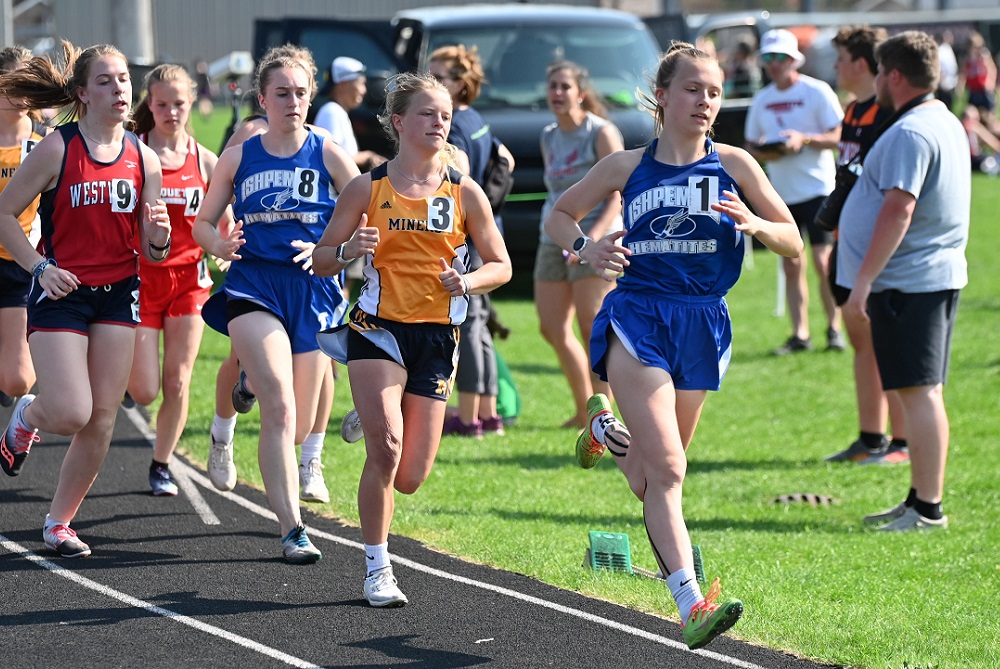
Lola Korpi, Ishpeming sophomore: This fall’s UPD2 cross country champion also is the reigning track champion in the 800, 1,600 and 3,200. She’s seeded first in those three in 2:31.91, 5:47.79 and 13:09.59, respectively, but in the 3,200 she’ll have to hold off UPD3 cross country champion Kaylen Clark from Newberry. Korpi also is slated to run on the top-seeded 3,200 relay.
Danielle Lund, Manistique sophomore: She placed sixth in shot put in UPD1 last season, and she enters this weekend seeded first in shot put (33-4) and discus (96-0) in UPD2. She’s also slated to run on the top-seeded 1,600 relay.
Chloe Maycroft, Iron Mountain junior: She’s set to compete in the high jump, long jump and run on two third-seeded relays after winning high jump last season. She’s seeded second in that event (4-8) this time.
Danica Shamion, West Iron County sophomore: She burst onto the scene with championships in the 100, 200 and 400 last season, and she’s seeded first in all three this weekend in 13.2, 27.01 and 1:01.23, respectively. The 200 and 400 meet records could be hers with major performances. She’ll also compete in high jump.
Division 3
Team forecast: Ontonagon broke Lake Linden-Hubbell’s three-season Finals winning streak last spring, and won a closely-contested Regional two weeks ago that saw the top five teams all finish less than 11 points from each other. Relay strength and qualifiers throughout the meet should have the Gladiators in the mix, with Pickford’s potential for a number of meet champions make it another favorite.
Lucy Bennin, Pickford senior: Last season’s 200 champion will run that race again and also is seeded second in long jump (14-3¼) and expected to run on the top-seeded 800 relay and second-seeded 400 relay.
Abi Codere, Lake Linden-Hubbell sophomore: The reigning champion in the 100 hurdles is seeded first in that event (17.45) and also will compete in pole vault.
Ellie Delene, Baraga sophomore: The reigning high jump champion is among 10 qualifiers who went between 4-6 and 4-8 at Regionals. She’ll also run both hurdles races.
Daisy Grinsteiner, Stephenson junior: The returning pole vault champion is seeded first (8-6) by a foot, and she’ll also run on two relays.
Emily Jokela, Lake Linden-Hubbell freshman: She’s set up for a major debut seeded first in the 200 (28.48) and 400 (1:03.00), fourth in the 100 (14.01) and second in the 300 hurdles (52.52).
Landry Koski, Rock Mid Peninsula senior: One of the finest distance runners in the peninsula during her career, she’ll look to add to two 1,600 championships and a 3,200 title she’s won over her first two Finals. She’s seeded first in the 800 (2:39.04), 1,600 (5:44.73) and 3,200 (12:56.05), and third in the 400 (1:04.79).
Lilly McIntyre, Ontonagon junior: She won the 100 last season and will run that race again as well as three relays, including as part of the top-seeded 400 and 1,600 groups.
Tristin Smith, Rudyard senior: Last season’s 400 champion will run that race again, is seeded second in the 1,600 (5:48.64) and will run on two relays including the second-seeded 3,200.
Lizzie Storey, Pickford senior: The reigning 300 hurdles champ is seeded first in that race (50.07) and second in the 100 hurdles (18.18) and also will run on the top-seeded 800 and second-seeded 400 relays.
Makennah Uotila, Ontonagon junior: Last year’s long jump champ is seeded first (14-10½) in that event and fourth in the 400 (1:05.19) and will also run the 800 and potentially as part of the top-seeded 1,600 relay.
PHOTOS Ishpeming's Lola Korpi (1) takes the early lead in the 1,600 at the May 13 Negaunee Lions Invitational, with Negaunee's Marlee Plaxco (3) following close behind. (Middle) Marquette's Julia Ott wins the 200 that afternoon. (Photos by Cara Kamps.)