

Powerful Voice for High School Sports
December 19, 2014
By Geoff Kimmerly
Second Half editor
Paul Carey was home from the U.S. Army only a few months and just shy of 25 years old when Beal City embarked on its first trip deep into the MHSAA boys basketball tournament.
On the call for local radio station WCEN from gyms at Saginaw Arthur Hill and Lansing Sexton, Carey served as the voice of the previously “laughable” Aggies as they reached the Class D Semifinals before falling just six points short of playing for the title.
“All of Beal City emptied out. They’d never had anything before,” Carey recalled during his annual Thanksgiving weekend visit to the MHSAA Football Finals at Ford Field. “When I got home, within the next two weeks I got a letter from every citizen of Beal City thanking me for broadcasting their games. That’s the kind of appreciation that meant so much.”
During 42 years on the airwaves, Carey was best known as a voice of the Detroit Tigers bounding out of transistor radios all over Michigan, thanks to WJR’s powerful signal.
But for the state’s high school sports community, his legacy is similarly memorable as the voice of the longtime football and basketball scoreboard show and a voter for various all-state teams and wire polls over the decades.
Now 86 and retired since 1991, Carey remains a regular during the first day of the Football Finals, taking in games he broadcast for the MHSAA during the late 1970s and that continue to hold his eye as they have for more than a half-century.
“It was a passion of mine. High school sports always has been,” Carey said. “I think because my dad was a high school coach, and teacher initially, and my brother was a high school coach and teacher, I just grew up in families that appreciated coaching and athletics. I was not a great athlete, but it kept my hand in following sports that way.”
Now, the scores
Carey partnered with Ernie Harwell for Tigers radio broadcasts from 1973-91, including during the march to the 1984 World Series championship. He was named Michigan Sportscaster of the Year six times and to the Michigan Sports Hall of Fame in 1992.
But Carey’s early career included sitting on top of a car, plugged into a phone pole, for a Sacred Heart football game at old Fancher Field just a few blocks from his family’s Mount Pleasant home. Among many more accolades are a Distinguished Service Award from the Michigan High School Coaches Association and a place in the Basketball Coaches Association of Michigan Hall of Fame.
In fact, the start of his weekly announcing of statewide football and basketball scores preceded his baseball career by 16 years and ended two months after he announced his final professional out.
The Michigan High School Scoreboard show was a staple of WJR’s late Friday nights from 1957-91. Carey would read every score he could collect from a variety of sources, often organized by league and with state rankings and context mixed in.
His idea came from something similar read by Len Colby for Kalamazoo’s WKZO. Carey’s brother Terry was coaching at Niles during the second half of the 1950s, and he and other coaches would get together to listen to the Friday night scores from the southwestern part of the state.
Carey, who left WKNX in Saginaw for WJR in 1956, explained to then-sports director Bob Reynolds that the station’s strong signal could provide for a truly statewide scoreboard experience.
Carey then connected with Edgar Hayes of the former Detroit Times, who gave the OK for Carey to call the paper on Friday nights to get scores from the Detroit metro area. For the rest, Carey relied on wire services – there were three at the time – who relied on newspapers from all over Michigan to call in scores over the course of an evening.
Before every Friday during high school football season – and later Tuesdays and Fridays during boys basketball season – Carey typed up lists of games based on schedules in the newspaper, with spaces to add scores. More than a few times, Carey raced down a back ramp at Tiger Stadium after a Friday night game, back to the WJR studio, with 15 minutes to prep for the show’s 11:30 p.m. start.
“If the Flint Journal, the Grand Rapids Press, the Traverse City paper didn’t call in scores to the AP, then I was out of luck too. And that happened all the time,” Carey said. “I would call back occasionally, say, ‘Did you get anything more?’ It was a rat race.”
The show originally was set for 10 minutes and then extended to 15. American Airlines sponsored a record show that followed, and Carey’s scoreboard show had a sponsor only once in 35 years. Finishing up on time was expected, even with more than 200 scores to read.
But Carey said he always went 20 minutes, sometimes 25.
“Because I wasn’t done. I just kept right on going,” Carey said. “Jay Roberts did the all-night show most of the time, and he was patient with me. He didn’t say too much on the air about ‘that guy ahead of me took all of my time.’”
Carey continued the “rat race” until his final scoreboard show, Dec. 20, 1991. He retired from WJR at the end of that calendar year. And it's important to note: Carey was never paid a dime extra for doing the program. .
“I think Paul is really just a sports fan, and that came across to the listener on his broadcasts,” MHSAA historian Ron Pesch said. “Paul would gather as much as possible off the wire. He'd interject if scores were missing from sections of the state. Press polls from the Free Press, News, AP and UPI were big, so he could point out close calls and upsets.
“He provided immediacy, or the closest thing to it in the days before cable TV and the Internet, and because of his scoreboard show, you could get the results before the morning paper. For listeners, he brought life to something as simple as game scores.”
First team all the way
Carey, who resides in Rochester, also served as the engineer on Tigers broadcasts for 16 years, through 1990. He broadcast Pistons games on the radio for six seasons and did the first broadcast of a Central Michigan University football game, in 1949.
Harry Atkins, covering Detroit’s teams while with The Associated Press for 29 years including the last 21 as its sports editor for Detroit, took note of his colleague's hard work – and especially that Carey was one of few broadcasters who was a journalist in addition to a voice.
That made Carey's other major role in high school sports a natural fit.
Atkins split The Associated Press all-state selection panels for football and basketball into 11 regions, and Carey represented the Detroit area for a number of years. He also was a longtime voter in those sports' weekly polls.
“Paul is just that kind of guy. He thought it was important and he made time in his busy schedule to do it,” Atkins said “And it had an impact on the other 10 voters on the All-State panels, too.
“Some of them were from small out-state newspapers or radio or TV stations. Yet every one of them knew who Paul Carey was. And when he spoke, of course, with what often is called "The Voice of God," those voters paid attention.”
And he still does, as well.
At the end of each fall, Carey still puts together a compilation of the three high school all-state football teams – Associated Press, Detroit Free Press and Detroit News – and files them with years of research and results.
“It’s important to me. Nobody sees it but me, but I get a certain kick,” Carey said. “Once in a while I’ll see a kid playing at Central, Western or (Michigan) State or Michigan, and they’ll say he came from Clawson. I’ll go into my all-state collections, say that would’ve been 2009 he played, and I find a name.”
In addition to the Football Finals on WJR, Carey was part of the Baseball Finals broadcasts into the early 1990s, continuing to contribute even after his retirement from his fulltime gig.
He spent high school games over the years sitting next to legends like the Free Press’ Hal Schram and remembers when current Free Press longtime scribe Mick McCabe was just a rookie. One of Carey's final broadcasts was a 1992 Baseball Final with his nephew Mike Carey, who continues to broadcast MHSAA championship games to this day.
“I am eternally grateful to Paul Carey. His contribution to high school sports in Michigan has been great and significant,” Atkins said.
“We are lucky to have him.”
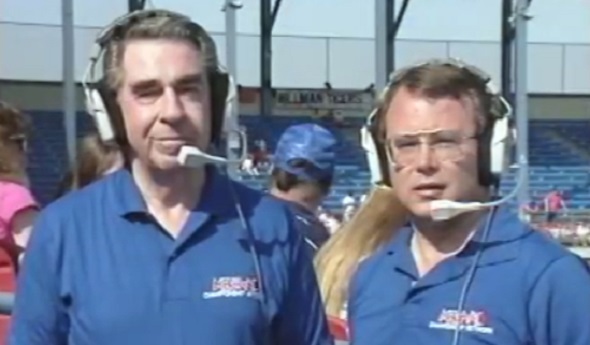
PHOTO: Paul Carey (left) and nephew Mike Carey broadcast the MHSAA 1992 Class D Baseball Final between Hillman and Athens for PASS.
Self-Taught Lutzke Leaving Williamston with Decades of Memorable Lessons
By
Geoff Kimmerly
MHSAA.com senior editor
June 1, 2022
WILLIAMSTON – If it were possible to string together all of the moments that made Mitch Lutzke into a Hall of Fame high school track & field coach, the first half of the video would look like a one-man pentathlon.
 At most, the now-longtime Williamston leader brought into coaching a season of mostly-junior varsity cross country experience as a student at Albion High, and some additional knowledge gleaned from marrying a college All-American runner.
He also didn’t have the internet back then to speed up the learning curve. But he had books to show him technique, and coaching clinics where he’d learn more. The skills he was using as a morning radio news reporter surely helped him digest information and pass it on to his pupils. And he had an open track facility, where he’d go when no one else was around and try to teach himself all of the events so he could better serve as his wife Karen’s assistant as she was coaching middle school kids in Illinois before she herself would go on to lead college programs for most of the last three decades.
“I just wanted to make my wife happy and said, ‘I'll coach middle school track,’ which I didn't want to do. And I almost tried to quit. I'm like, I don't want to do this. I don't even know what I'm doing. And she's like, ‘No, you could just learn,’” Mitch Lutzke recalled last week.
“I tell people I’d do this, and they think I’m making this up. I’d stand there with a book and say, ‘OK,’ and I would go do it, and like, ‘OK, that’s how you do it right.’ So I decided, but nobody needs to know when they do it right – they need to know when they do it wrong. So I would take a book and look at discus. I said, ‘OK, I’m throwing it straight. How do I throw it left? So I’ve changed my feet. And if I step in a bucket, I’m going left. Or if I don’t block out, or if I do this … so I’d write down all these things to fix the kids. I did trial and error; what do I do if it goes too high in shot? OK, what did I do with my thumb? So I wrote a bunch of little notes down.”
His experiences, especially over the last 32 years leading the Hornets girls and now both the girls and boys programs, could fill a book – and he’s written a few of those too, on other subjects that have interested the also big-time sports fan and local historian.
Lutzke has begun the final week of a coaching career that’s seen him build upon one of the state’s most consistently-strong track & field programs and make it his own. Since taking over the Hornets girls team in 1993 and then adding the boys team in 2014, Lutzke has amassed 250 meet wins, 16 girls league championships and five conference titles with the boys, 12 Regional championships, eight top-10 MHSAA Finals finishes and nine Michigan Interscholastic Track Coaches Association team state titles. In 2020, he was named to the MITCA Hall of Fame.
 That’s a whale of a list for someone whose “gift for gab” had him headed initially down a path aspiring to be the next Dan Rather. He had earned accolades and opportunities to continue in broadcasting, but found himself instead taking a path back to school to become a teacher, into the classroom and onto the track and sideline, with his communication skills and knowledge no doubt pouring into the multiple books and other pieces he’s written on baseball and local history, the classes he’s taught as a popular social studies and television broadcast teacher at Williamston and the years serving most recently as the public address announcer at many Hornets events.
“The thing about Mitch is he’s not one dimensional, even in coaching – he can coach many different events. He has many different interests outside of track & field. And when he does something, he does it 100 percent,” Karen Lutzke said. “Even when he started coaching a long, long time ago with me … he just kept learning. He likes working with kids. He enjoys that and watching them get better, whether it’s a guy who’s a 30-foot shot putter or a 45-foot shot putter, or any event. It’s not how far they throw, it’s are they doing the best they can?
“He just likes the kids, and being around them. I think it’s going to be harder than he thinks, retiring – because the kids are what make coaching fun. Being around the kids and watching them have success, and he’s had a lot of success.”
‘Expectation of Excellence’
Williamston has had its fair share of MHSAA Finals individual placers over the years, with the best of those eight top-10 team finishes under Lutzke coming in 2007 when the girls placed fourth in Lower Peninsula Division 3.
The MHSAA Finals team championships are determined by the success of individuals who qualify from Regionals, which could be just a handful. Williamston has shined even brighter, however, at the MITCA Team Finals, where the competition pits full teams against each other and the Hornets’ talent and depth across all events frequently has stood out.
Longtime and similarly-legendary coach Paul Nilsson led both Williamston track & field programs from the 1970s into the 1990s. Lutzke joined him as an assistant for both in 1991 – following Karen after she’d been hired to coach women’s cross country and assist with track & field at Michigan State. In 1993, Lutzke took over the Hornets girls track & field program.
Known now for success in a variety of sports, Williamston during the first decade of the 2000s was most consistently revered for that MHSAA championship-caliber track & field success – and on the girls side, that superiority was rooted in part in the daily grind of January and February workouts often in the school’s hallways or later on an inside track that circles the gym.
 Lutzke’s “Winter Warriors” got a T-shirt if they trained a certain number of days during the offseason. But that was just a small bonus for showing up. The memorable pay offs came three and four months later in league titles, Regional successes, MITCA titles and MHSAA Finals achievements.
“I’ve never quite had another experience in my lifetime that demonstrated that as much to me. Now I know moving forward in my life that if I expect to be great at something, or I expect to achieve results, I have to put the work in myself,” said 2019 graduate Jessica Robach, who that spring helped Williamston finish 10th at the MHSAA LPD2 Final running on a championship relay and placing third in long jump and as part of another relay. “It’s really kind of a personal integrity and motivation thing that draws a direct parallel to my career in track and to when I really decided to push myself to be great – you put in the hours of work, and then it finally happens.
“That’s just something Mitch always reiterated to us: That you can have all the natural talent in the world, but a person who works hard is going to get to where they want to be.”
Robach began attending Williamston as a freshman, and didn’t feel entirely comfortable with her new school until track season came – when “everything fell together.”
That “expectation of excellence” wasn’t just about competing athletically, but striving to be a good person. The camaraderie he established, the way he made sure knowledge was passed down from the oldest athletes to the youngest, and again, the emphasis on work ethic overcoming talent, have continued to stick with Robach as she’s gone on to study at Western Michigan.
“Mitch does things the right way. He believes in fair play, hard work, and preparation. He keeps an even keel with athletes – he doesn't get overly hyped when the team is successful or overly critical when the team struggles,” said assistant Ray Herek, who has coached with Lutzke since 2002 and taught with him since 2000. “I have learned a ton from watching him coach. He does an excellent job of knowing how to approach each athlete – he reads people very well. He seems to know what makes each person tick, and finds the right words or coaching tips to help each athlete excel.”
A decade before Robach, Leanne Selinger was learning the same lessons. The team’s leadership award is named after her, and after running on two Finals-placing relays as a senior in 2010 she actually went on to serve as an assistant coach on Lutzke’s staff over the next four seasons while at college.
These days she’s working in supply chain management – a higher-pressure-than-usual field lately because of headline-making materials shortages in a number of industries. But what she learned from Lutzke about being flexible and prepared for the unexpected – in a track meet, maybe a scratch or an injury – while trying to lead people from different subgroups (sprinters, distance runners, jumpers, etc.) toward a common goal are among lessons she continues to keep front of mind.
“Even in my professional career now, I get a lot of feedback that I am not afraid to roll up my sleeves, get dirty,” Selinger said. “And I think that comes from some of my track history with Coach Lutzke and being able to go out, let’s go out and get the job done. If we have to do X-Y-Z, let’s go do it.”
Signing Off
After the couple moved from Illinois, Mitch Lutzke taught in Lansing for five years while coaching at Williamston, then came to Williamston to teach as well. He added coaching in basketball and cross country at the middle school and subvarsity levels, and immersed himself in the family’s new community. Karen Lutzke is now in her second tenure at Olivet College, coaching the women’s and men’s cross country and track & field teams, and the couple has sent three children through Williamston schools with two going on to run at the college level.
Mitch let the decision to retire sink in over this school year – he’s retiring from teaching as well – and eventually he had one more major objective to complete this spring. And he accomplished it.
Williamston track & field wasn’t alone trying to dodge the wrenches thrown its way by COVID-19. But the effects certainly were noticeable.
When the 2020 spring season was suspended (to be ultimately canceled) late that March, Williamston’s teams had practiced four days – with 125 students (nearly 20 percent of the entire student body) signed up and hopes high with lots of talent and experience returning. When spring sports returned a year ago, Williamston was down to 49 athletes in the program – including only 16 girls – with that missing year of older athletes recruiting and mentoring the younger ones striking a massive blow.
 This spring, numbers didn’t return all the way to pre-COVID levels. But 90 athletes came out to put the program on solid footing for this season and whoever comes next.
“I've been amazed this year how many coaches have approached Mitch with words of appreciation and admiration for the job he has done at Williamston,” Herek said. “Anybody that has coached track and field knows that it is so hard getting kids outside in the spring when it is 40 degrees outside. It is difficult to know how to coach all of the events. It is difficult to know how to reach each athlete – there are so many different types of students that go out for track. But Mitch is as good as it gets.”
He’ll pour his energies into other things. He’s going to do some announcing of Olivet College events. He wants to write more. He’d like to visit baseball spring training for the first time. “Whatever he’s involved, in he’s very passionate about and gets things done,” Karen Lutzke said. “Maybe we’ll have a very clean house (and) the lawn will look wonderful after this.”
Although Williamston’s boys team won’t send anyone to the MHSAA Finals this weekend for the first time in a number of seasons, Mitch Lutzke will bring five athletes to Saturday’s Lower Peninsula Division 2 championship meet at Ada Forest Hills Eastern. They will combine to run two relays, in two more individual races and participate in one field event.
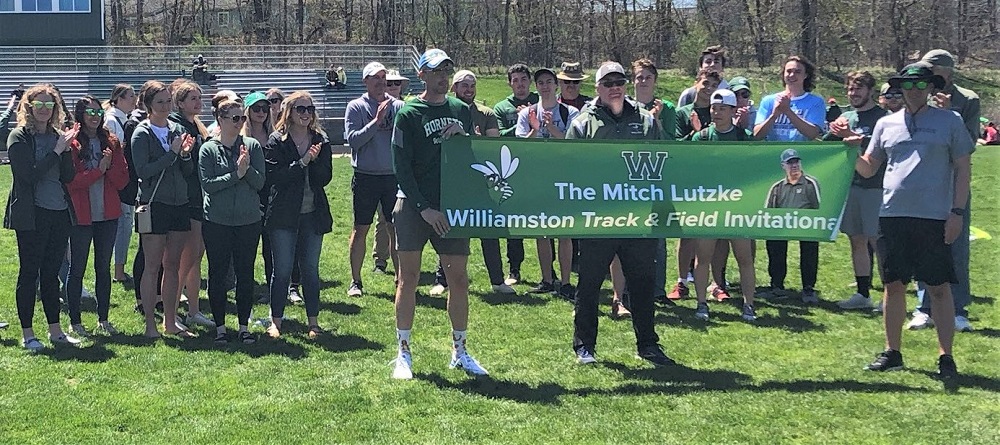
Next year, he’ll cheer from the stands, maybe help move hurdles or clerk a meet if needed. Williamston has renamed its annual meet the Mitch Lutzke Williamston Track & Field Invitational, after all, and the namesake can’t be a no show.
“I say at the end of every year, if you've got more negatives than positives in what you did in track this year, then don't come out (next year). Because we're not changing. This is what we do,” Lutzke said. “I always tell the kids, I want you to support the program of track & field in the community you grow up in or you move to, that you put your kids in track & field because you thought it was a positive experience because of what you went through here in the program, and you just give back.”
 Geoff Kimmerly joined the MHSAA as its Media & Content Coordinator in Sept. 2011 after 12 years as Prep Sports Editor of the Lansing State Journal. He has served as Editor of Second Half since its creation in January 2012, and MHSAA Communications Director since January 2021. Contact him at [email protected] with story ideas for the Barry, Eaton, Ingham, Livingston, Ionia, Clinton, Shiawassee, Gratiot, Isabella, Clare and Montcalm counties.
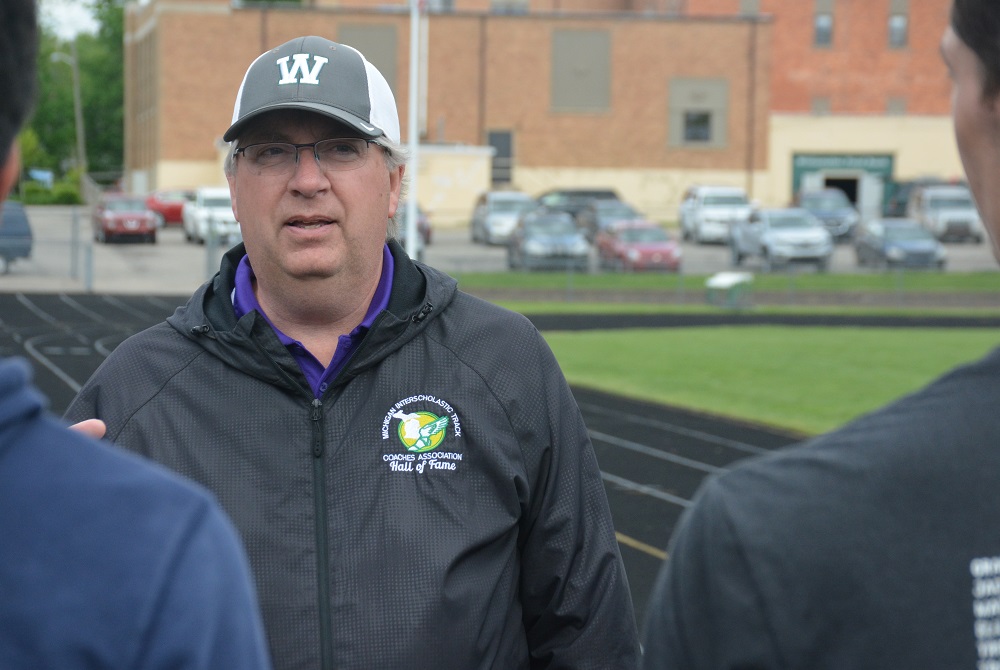
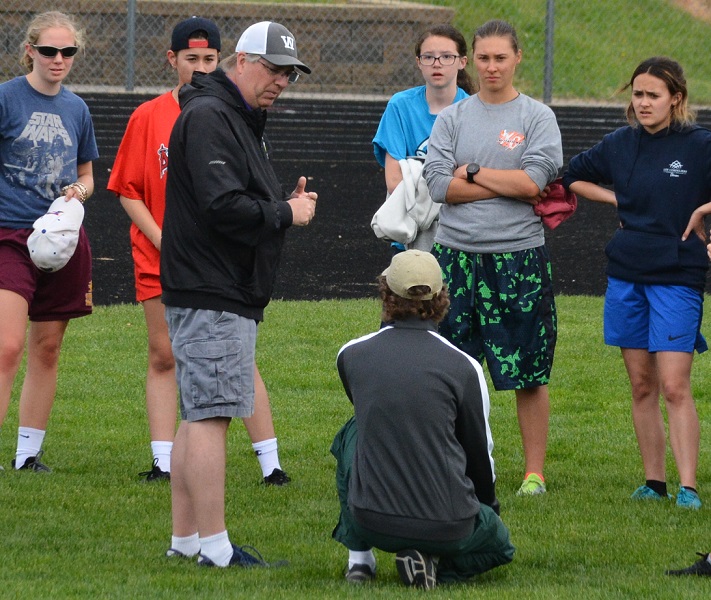
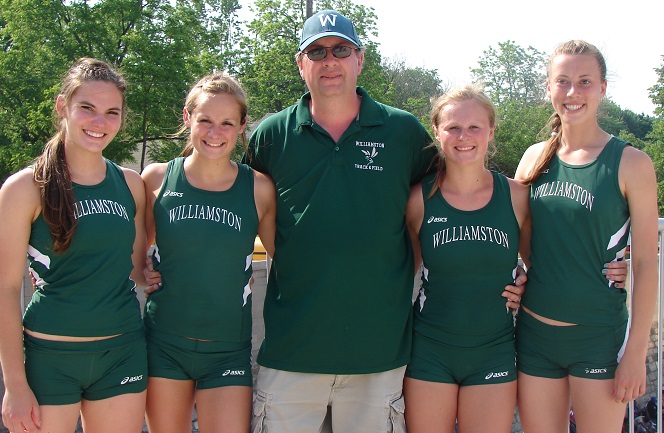
PHOTOS (Top) Williamston coach Mitch Lutzke talks things over with his boys team captains last week. (2) Lutzke stands with, from left, Diana Eidt, Cassidy Metzer, Mallory Metzer and Elizabeth Dutcher – who ran on school record-setting 400 and 800 relays in 2011. (3) Lutzke is recognized earlier this spring as Williamston’s annual meet is named after him. (4) Lutzke and assistant Ray Herek (kneeling) confer with their girls team. (5) The 2009 team dumps a cooler over Lutzke’s head to celebrate a Capital Area Activities Conference league meet championship. (Last week’s photos by Geoff Kimmerly; others courtesy of Williamston track & field and athletic department.)