

Powerful Voice for High School Sports
December 19, 2014
By Geoff Kimmerly
Second Half editor
Paul Carey was home from the U.S. Army only a few months and just shy of 25 years old when Beal City embarked on its first trip deep into the MHSAA boys basketball tournament.
On the call for local radio station WCEN from gyms at Saginaw Arthur Hill and Lansing Sexton, Carey served as the voice of the previously “laughable” Aggies as they reached the Class D Semifinals before falling just six points short of playing for the title.
“All of Beal City emptied out. They’d never had anything before,” Carey recalled during his annual Thanksgiving weekend visit to the MHSAA Football Finals at Ford Field. “When I got home, within the next two weeks I got a letter from every citizen of Beal City thanking me for broadcasting their games. That’s the kind of appreciation that meant so much.”
During 42 years on the airwaves, Carey was best known as a voice of the Detroit Tigers bounding out of transistor radios all over Michigan, thanks to WJR’s powerful signal.
But for the state’s high school sports community, his legacy is similarly memorable as the voice of the longtime football and basketball scoreboard show and a voter for various all-state teams and wire polls over the decades.
Now 86 and retired since 1991, Carey remains a regular during the first day of the Football Finals, taking in games he broadcast for the MHSAA during the late 1970s and that continue to hold his eye as they have for more than a half-century.
“It was a passion of mine. High school sports always has been,” Carey said. “I think because my dad was a high school coach, and teacher initially, and my brother was a high school coach and teacher, I just grew up in families that appreciated coaching and athletics. I was not a great athlete, but it kept my hand in following sports that way.”
Now, the scores
Carey partnered with Ernie Harwell for Tigers radio broadcasts from 1973-91, including during the march to the 1984 World Series championship. He was named Michigan Sportscaster of the Year six times and to the Michigan Sports Hall of Fame in 1992.
But Carey’s early career included sitting on top of a car, plugged into a phone pole, for a Sacred Heart football game at old Fancher Field just a few blocks from his family’s Mount Pleasant home. Among many more accolades are a Distinguished Service Award from the Michigan High School Coaches Association and a place in the Basketball Coaches Association of Michigan Hall of Fame.
In fact, the start of his weekly announcing of statewide football and basketball scores preceded his baseball career by 16 years and ended two months after he announced his final professional out.
The Michigan High School Scoreboard show was a staple of WJR’s late Friday nights from 1957-91. Carey would read every score he could collect from a variety of sources, often organized by league and with state rankings and context mixed in.
His idea came from something similar read by Len Colby for Kalamazoo’s WKZO. Carey’s brother Terry was coaching at Niles during the second half of the 1950s, and he and other coaches would get together to listen to the Friday night scores from the southwestern part of the state.
Carey, who left WKNX in Saginaw for WJR in 1956, explained to then-sports director Bob Reynolds that the station’s strong signal could provide for a truly statewide scoreboard experience.
Carey then connected with Edgar Hayes of the former Detroit Times, who gave the OK for Carey to call the paper on Friday nights to get scores from the Detroit metro area. For the rest, Carey relied on wire services – there were three at the time – who relied on newspapers from all over Michigan to call in scores over the course of an evening.
Before every Friday during high school football season – and later Tuesdays and Fridays during boys basketball season – Carey typed up lists of games based on schedules in the newspaper, with spaces to add scores. More than a few times, Carey raced down a back ramp at Tiger Stadium after a Friday night game, back to the WJR studio, with 15 minutes to prep for the show’s 11:30 p.m. start.
“If the Flint Journal, the Grand Rapids Press, the Traverse City paper didn’t call in scores to the AP, then I was out of luck too. And that happened all the time,” Carey said. “I would call back occasionally, say, ‘Did you get anything more?’ It was a rat race.”
The show originally was set for 10 minutes and then extended to 15. American Airlines sponsored a record show that followed, and Carey’s scoreboard show had a sponsor only once in 35 years. Finishing up on time was expected, even with more than 200 scores to read.
But Carey said he always went 20 minutes, sometimes 25.
“Because I wasn’t done. I just kept right on going,” Carey said. “Jay Roberts did the all-night show most of the time, and he was patient with me. He didn’t say too much on the air about ‘that guy ahead of me took all of my time.’”
Carey continued the “rat race” until his final scoreboard show, Dec. 20, 1991. He retired from WJR at the end of that calendar year. And it's important to note: Carey was never paid a dime extra for doing the program. .
“I think Paul is really just a sports fan, and that came across to the listener on his broadcasts,” MHSAA historian Ron Pesch said. “Paul would gather as much as possible off the wire. He'd interject if scores were missing from sections of the state. Press polls from the Free Press, News, AP and UPI were big, so he could point out close calls and upsets.
“He provided immediacy, or the closest thing to it in the days before cable TV and the Internet, and because of his scoreboard show, you could get the results before the morning paper. For listeners, he brought life to something as simple as game scores.”
First team all the way
Carey, who resides in Rochester, also served as the engineer on Tigers broadcasts for 16 years, through 1990. He broadcast Pistons games on the radio for six seasons and did the first broadcast of a Central Michigan University football game, in 1949.
Harry Atkins, covering Detroit’s teams while with The Associated Press for 29 years including the last 21 as its sports editor for Detroit, took note of his colleague's hard work – and especially that Carey was one of few broadcasters who was a journalist in addition to a voice.
That made Carey's other major role in high school sports a natural fit.
Atkins split The Associated Press all-state selection panels for football and basketball into 11 regions, and Carey represented the Detroit area for a number of years. He also was a longtime voter in those sports' weekly polls.
“Paul is just that kind of guy. He thought it was important and he made time in his busy schedule to do it,” Atkins said “And it had an impact on the other 10 voters on the All-State panels, too.
“Some of them were from small out-state newspapers or radio or TV stations. Yet every one of them knew who Paul Carey was. And when he spoke, of course, with what often is called "The Voice of God," those voters paid attention.”
And he still does, as well.
At the end of each fall, Carey still puts together a compilation of the three high school all-state football teams – Associated Press, Detroit Free Press and Detroit News – and files them with years of research and results.
“It’s important to me. Nobody sees it but me, but I get a certain kick,” Carey said. “Once in a while I’ll see a kid playing at Central, Western or (Michigan) State or Michigan, and they’ll say he came from Clawson. I’ll go into my all-state collections, say that would’ve been 2009 he played, and I find a name.”
In addition to the Football Finals on WJR, Carey was part of the Baseball Finals broadcasts into the early 1990s, continuing to contribute even after his retirement from his fulltime gig.
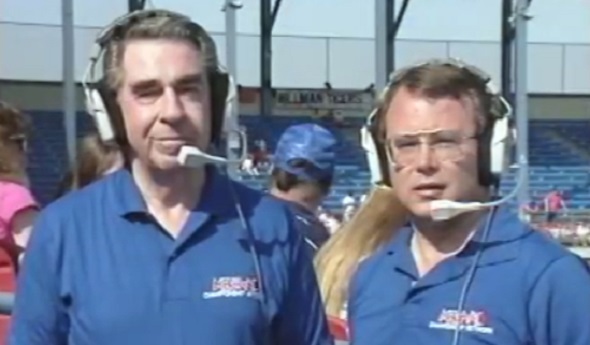
He spent high school games over the years sitting next to legends like the Free Press’ Hal Schram and remembers when current Free Press longtime scribe Mick McCabe was just a rookie. One of Carey's final broadcasts was a 1992 Baseball Final with his nephew Mike Carey, who continues to broadcast MHSAA championship games to this day.
“I am eternally grateful to Paul Carey. His contribution to high school sports in Michigan has been great and significant,” Atkins said.
“We are lucky to have him.”
PHOTO: Paul Carey (left) and nephew Mike Carey broadcast the MHSAA 1992 Class D Baseball Final between Hillman and Athens for PASS.
Rep Council Approves New Hockey Classification Procedure, Wrestling Weights at Spring Meeting
By
Geoff Kimmerly
MHSAA.com senior editor
May 6, 2022
The selection of a restructured classification procedure for ice hockey and the approval of new boys wrestling weight classes were among the most notable actions taken by the Representative Council of the Michigan High School Athletic Association during its annual Spring Meeting, May 1-2 in Gaylord.
The Spring Meeting of the 19-member legislative body of the Association’s more than 1,500 member schools is generally the busiest of its sessions each year. The Council considered 33 committee proposals and dealt with a variety of eligibility rule, postseason tournament and operational issues.
The Council approved an Ice Hockey Committee proposal to continue classifying teams by enrollment, but with consideration to whether those teams are standalone (one school) or cooperative (multi-school) programs. Approximately half of MHSAA member hockey programs are cooperatives. Beginning with the 2022-23 season, standalone and cooperative programs will be ranked by enrollment but on separate lists, with the top one-third from each list put into Division 1, the second thirds into Division 2 and the lowest thirds into Division 3. This change is expected to rebalance the divisions; in the recent past, Division 1 has been made up mostly of cooperative programs because the combined enrollments of schools involved in co-ops pushed them to the top of the overall classification list for the sport. However, cooperatives generally have not derived an advantage by having more schools involved; instead, cooperatives primarily have allowed schools to continue providing opportunities to athletes who wanted to play hockey when a school doesn’t have enough for a full team.
The Council also approved a switch from current boys wrestling weight classes to those determined by the National Federation of State High School Associations (NFHS): 106, 113, 120, 126, 132, 138, 144, 150, 157, 165, 175, 190, 215 and 285 pounds. The NFHS will begin use of those weights nationally in 2023-24, but MHSAA member schools will make the switch beginning with 2022-23. The Council also approved a change to one girls weight, from 255 pounds to 235, aligning all MHSAA girls weight classes with those determined by the NFHS.
A pair of new opportunities to utilize video replay beginning with the 2022-23 school year will provide further support for game officials as they make split-second calls during competition, while assuring the correct outcome of some of the most controversial plays. The Council approved an Officials Review Committee recommendation to provide MHSAA staff the ability to review video of an ejection and modify subsequent penalties in three instances – when there is a clear misidentification and the incorrect athlete is ejected, when that participant is ejected as the direct result of a rules misapplication, or when incontrovertible video evidence shows an ejection or suspension for flagrant contact with an opponent or official was in error. Officials have continued to support the use of replay at MHSAA events where possible, and game officials make up more than half of the Officials Review Committee.
Also concerning video review, replay will be expanded at the 11-Player Football Finals to allow head coaches one challenge during the game. The challenge will cost that team a timeout if the original outcome is confirmed. Coaches will be allowed to challenge the following: complete/incomplete passes, if a runner/receiver was in/out of bounds, a runner who is ruled not down, the forward progress spot as it relates to the yard to gain, which player first touched a kick, the recovery of a ball in/out of bounds, if a pass was forward or backward, and penalties for illegal forward pass, targeting or illegal helmet contact, and pass interference only as it relates to the pass being previously tipped. All potential scores and turnovers will remain automatically reviewed by replay booth officials. This was a proposal by the MHSAA Football Committee.
The Council took multiple actions concerning the “fifth quarter” regulation that allows athletes to play both at the subvarsity and varsity levels on the same day (or same competition week for football) to help programs that are otherwise lacking enough participants to field teams at both levels. The Council approved a Soccer Committee recommendation to allow athletes to play in no more than three halves on a day not followed by a school day. The Council also approved an enhanced penalty stating that violators of the fifth quarter rule must forfeit the contest during which the violation took place (either varsity of subvarsity), and that head coach in violation will be ineligible for the next day of competition. Additionally, the Council approved a Junior High/Middle School Committee recommendation allowing leagues and conferences to request from the MHSAA staff the opportunity to use the fifth quarter rule for basketball.
Here is a summary of other notable actions taken by the Representative Council at the Spring Meeting, which will take effect during the 2022-23 school year unless noted:
Regulations
• Minnesota has been added as a “border state” for all out-of-state competition purposes. MHSAA member schools will be allowed to play opponents from anywhere in Minnesota regardless of the 300-mile travel limit rule, as is also allowed for opponents in Illinois, Indiana, Ohio, Ontario and Wisconsin.
Sport Matters
• For baseball and softball, the Council approved the creation of separate site selection committees to determine where District and Regional rounds of those tournaments will be played.
• In bowling, the Council approved a Bowling Committee proposal to make the Team Regional qualifying block format the same as the Team Final format. Teams will play eight Baker games and two regular games at both levels of the MHSAA Tournament beginning with the 2022-23 season. Previously, teams bowled six Baker games and three regular games at Regionals.
• In competitive cheer, the Council approved a Girls Competitive Cheer Committee recommendation to, beginning with the 2023-24 season, adopt a new choreography chart that awards points based on tumbling, one-leg extensions, vertical twists/360s and release skills which cannot supersede a 10-point maximum of points earned.
• Also in cheer, the Council approved a Committee recommendation adjusting the penalty for going over the time limit in each round to one penalty point for every second over the time limit, not to exceed 15 points.
• In football, the Council approved a Football Committee recommendation to allow players to wear shoulder pads at college camps sponsored and conducted directly by NCAA or NAIA institutions.
• In golf, the Council approved a pair of Golf Committee recommendations concerning MHSAA Tournament play. Beginning with the 2022-23 school year, teams will be allowed two “school-approved” coaches to be present and actively coaching during postseason competition. Also, the Council approved a reduction in the maximum number of strokes allowed per hole during MHSAA Tournament play from 12 to 10.
• Two more Council actions on Hockey Committee recommendations will affect MHSAA Tournament play in that sport. Beginning with the 2022-23 season, Michigan Power Ratings (MPR) will be used to seed the entire Regional round (which is the first round of postseason play in hockey; there is no District round). Also, teams will be reseeded prior to the start of the Semifinals by a seeding committee, with the top seed in each division then facing the No. 4 seed, and the No. 2 seed facing No. 3 in the other Semifinal.
• In soccer, the Council approved a Soccer Committee recommendation allowing the two seeded teams at the District level to host their games if they are not to be played at a prearranged host site. For these Districts, the No. 1 seed gets hosting priority, followed by the No. 2 seed, followed by the team on the top line of the bracket.
• For diving, the Council approved a Swimming & Diving Committee proposal reorganizing how many Finals qualifiers will advance from each Diving Regional. In each of the three divisions, each Regional will be guaranteed 10 qualifiers for the Finals; the remaining six qualifying spots per division will be distributed to the Regionals that have one of the previous year’s top six returning Finals divers in their fields.
• In tennis, the Council approved a Tennis Committee recommendation allowing for seeding at No. 1 singles of up to seven players if there are between 21-23 in the field, and seeding of up to eight players if the field includes 24 or more. No. 1 singles is the only flight where participants may qualify for the Finals separately from their full team.
Junior High/Middle School
• In track & field, the Council approved a Junior High/Middle School Committee recommendation to begin conducting Regionals beginning with the 2022-23 school year.
• In wrestling, the Council approved a Junior High/Middle School Committee recommendation to add weights of 215 pounds, 245 pounds and heavyweight, with the heavyweight class not to exceed 285 pounds.
• In competitive cheer, the Council approved a Girls Competitive Cheer Committee recommendation allowing junior high/middle school teams to perform a one-leg extension as part of a pyramid with one bracer. A liberty flair is the only flair allowed, and this pyramid requires two points of contact from the bracer.
Calendar
• The Council approved the seven-year calendar of MHSAA Tournament events, with notable basketball changes for two years. For the 2023-24 and 2024-25 school years, the Boys Basketball Tournament will be completed first, followed by the Girls Basketball Tournament – a switch from the traditional order of the girls tournament Finals followed by the boys Finals. This will allow for flexibility in the event Michigan State University is selected to host NCAA Women’s Basketball Tournament first and second-round games at the Breslin Center.
The Council also reviewed reports on membership, with 750 senior high schools and 759 junior high/middle schools in 2021-22 plus 62 elementary schools with 6th-grader participation; cooperative programs, with 378 high school programs for 699 teams during 2021-22; eligibility advancement applications, which totaled zero for the second-straight school year; the use of Educational Transfer Forms, of which there were 142; school violations, attendance at athletic director in-service workshops and Coaches Advancement Program sessions; officials’ registrations, rules meetings attendance and officials reports submitted for the past three sports seasons. The Association’s $12.8 million budget for the 2022-23 school year also was approved.
The Representative Council is the 19-member legislative body of the MHSAA. All but five are elected by member schools. Four members are appointed by the Council to facilitate representation of females and minorities, and the 19th position is occupied by the Superintendent of Public Instruction or designee.
The MHSAA is a private, not-for-profit corporation of voluntary membership by more than 1,500 public and private senior high schools and junior high/middle schools which exists to develop common rules for athletic eligibility and competition. No government funds or tax dollars support the MHSAA, which was the first such association nationally to not accept membership dues or tournament entry fees from schools. Member schools which enforce these rules are permitted to participate in MHSAA tournaments, which attract more than 1.4 million spectators each year.