

Powerful Voice for High School Sports
December 19, 2014
By Geoff Kimmerly
Second Half editor
Paul Carey was home from the U.S. Army only a few months and just shy of 25 years old when Beal City embarked on its first trip deep into the MHSAA boys basketball tournament.
On the call for local radio station WCEN from gyms at Saginaw Arthur Hill and Lansing Sexton, Carey served as the voice of the previously “laughable” Aggies as they reached the Class D Semifinals before falling just six points short of playing for the title.
“All of Beal City emptied out. They’d never had anything before,” Carey recalled during his annual Thanksgiving weekend visit to the MHSAA Football Finals at Ford Field. “When I got home, within the next two weeks I got a letter from every citizen of Beal City thanking me for broadcasting their games. That’s the kind of appreciation that meant so much.”
During 42 years on the airwaves, Carey was best known as a voice of the Detroit Tigers bounding out of transistor radios all over Michigan, thanks to WJR’s powerful signal.
But for the state’s high school sports community, his legacy is similarly memorable as the voice of the longtime football and basketball scoreboard show and a voter for various all-state teams and wire polls over the decades.
Now 86 and retired since 1991, Carey remains a regular during the first day of the Football Finals, taking in games he broadcast for the MHSAA during the late 1970s and that continue to hold his eye as they have for more than a half-century.
“It was a passion of mine. High school sports always has been,” Carey said. “I think because my dad was a high school coach, and teacher initially, and my brother was a high school coach and teacher, I just grew up in families that appreciated coaching and athletics. I was not a great athlete, but it kept my hand in following sports that way.”
Now, the scores
Carey partnered with Ernie Harwell for Tigers radio broadcasts from 1973-91, including during the march to the 1984 World Series championship. He was named Michigan Sportscaster of the Year six times and to the Michigan Sports Hall of Fame in 1992.
But Carey’s early career included sitting on top of a car, plugged into a phone pole, for a Sacred Heart football game at old Fancher Field just a few blocks from his family’s Mount Pleasant home. Among many more accolades are a Distinguished Service Award from the Michigan High School Coaches Association and a place in the Basketball Coaches Association of Michigan Hall of Fame.
In fact, the start of his weekly announcing of statewide football and basketball scores preceded his baseball career by 16 years and ended two months after he announced his final professional out.
The Michigan High School Scoreboard show was a staple of WJR’s late Friday nights from 1957-91. Carey would read every score he could collect from a variety of sources, often organized by league and with state rankings and context mixed in.
His idea came from something similar read by Len Colby for Kalamazoo’s WKZO. Carey’s brother Terry was coaching at Niles during the second half of the 1950s, and he and other coaches would get together to listen to the Friday night scores from the southwestern part of the state.
Carey, who left WKNX in Saginaw for WJR in 1956, explained to then-sports director Bob Reynolds that the station’s strong signal could provide for a truly statewide scoreboard experience.
Carey then connected with Edgar Hayes of the former Detroit Times, who gave the OK for Carey to call the paper on Friday nights to get scores from the Detroit metro area. For the rest, Carey relied on wire services – there were three at the time – who relied on newspapers from all over Michigan to call in scores over the course of an evening.
Before every Friday during high school football season – and later Tuesdays and Fridays during boys basketball season – Carey typed up lists of games based on schedules in the newspaper, with spaces to add scores. More than a few times, Carey raced down a back ramp at Tiger Stadium after a Friday night game, back to the WJR studio, with 15 minutes to prep for the show’s 11:30 p.m. start.
“If the Flint Journal, the Grand Rapids Press, the Traverse City paper didn’t call in scores to the AP, then I was out of luck too. And that happened all the time,” Carey said. “I would call back occasionally, say, ‘Did you get anything more?’ It was a rat race.”
The show originally was set for 10 minutes and then extended to 15. American Airlines sponsored a record show that followed, and Carey’s scoreboard show had a sponsor only once in 35 years. Finishing up on time was expected, even with more than 200 scores to read.
But Carey said he always went 20 minutes, sometimes 25.
“Because I wasn’t done. I just kept right on going,” Carey said. “Jay Roberts did the all-night show most of the time, and he was patient with me. He didn’t say too much on the air about ‘that guy ahead of me took all of my time.’”
Carey continued the “rat race” until his final scoreboard show, Dec. 20, 1991. He retired from WJR at the end of that calendar year. And it's important to note: Carey was never paid a dime extra for doing the program. .
“I think Paul is really just a sports fan, and that came across to the listener on his broadcasts,” MHSAA historian Ron Pesch said. “Paul would gather as much as possible off the wire. He'd interject if scores were missing from sections of the state. Press polls from the Free Press, News, AP and UPI were big, so he could point out close calls and upsets.
“He provided immediacy, or the closest thing to it in the days before cable TV and the Internet, and because of his scoreboard show, you could get the results before the morning paper. For listeners, he brought life to something as simple as game scores.”
First team all the way
Carey, who resides in Rochester, also served as the engineer on Tigers broadcasts for 16 years, through 1990. He broadcast Pistons games on the radio for six seasons and did the first broadcast of a Central Michigan University football game, in 1949.
Harry Atkins, covering Detroit’s teams while with The Associated Press for 29 years including the last 21 as its sports editor for Detroit, took note of his colleague's hard work – and especially that Carey was one of few broadcasters who was a journalist in addition to a voice.
That made Carey's other major role in high school sports a natural fit.
Atkins split The Associated Press all-state selection panels for football and basketball into 11 regions, and Carey represented the Detroit area for a number of years. He also was a longtime voter in those sports' weekly polls.
“Paul is just that kind of guy. He thought it was important and he made time in his busy schedule to do it,” Atkins said “And it had an impact on the other 10 voters on the All-State panels, too.
“Some of them were from small out-state newspapers or radio or TV stations. Yet every one of them knew who Paul Carey was. And when he spoke, of course, with what often is called "The Voice of God," those voters paid attention.”
And he still does, as well.
At the end of each fall, Carey still puts together a compilation of the three high school all-state football teams – Associated Press, Detroit Free Press and Detroit News – and files them with years of research and results.
“It’s important to me. Nobody sees it but me, but I get a certain kick,” Carey said. “Once in a while I’ll see a kid playing at Central, Western or (Michigan) State or Michigan, and they’ll say he came from Clawson. I’ll go into my all-state collections, say that would’ve been 2009 he played, and I find a name.”
In addition to the Football Finals on WJR, Carey was part of the Baseball Finals broadcasts into the early 1990s, continuing to contribute even after his retirement from his fulltime gig.
He spent high school games over the years sitting next to legends like the Free Press’ Hal Schram and remembers when current Free Press longtime scribe Mick McCabe was just a rookie. One of Carey's final broadcasts was a 1992 Baseball Final with his nephew Mike Carey, who continues to broadcast MHSAA championship games to this day.
“I am eternally grateful to Paul Carey. His contribution to high school sports in Michigan has been great and significant,” Atkins said.
“We are lucky to have him.”
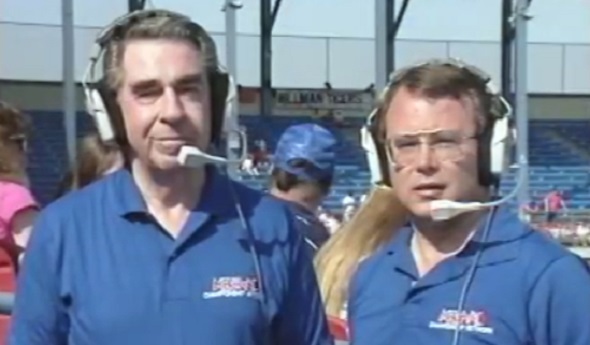
PHOTO: Paul Carey (left) and nephew Mike Carey broadcast the MHSAA 1992 Class D Baseball Final between Hillman and Athens for PASS.
Northville Slugger Makes Memorable Marks on Way to Pro Baseball Stardom
By
Geoff Kimmerly
MHSAA.com senior editor
January 16, 2026
Dante’ Nori capped his high school baseball career in 2024 by leading Northville to the Division 1 championship – and cementing himself in the record book for a handful of individual accomplishments.
He finished his four seasons fourth all-time with 120 walks, fifth with 21 triples and 10th with 193 runs scored, plus is listed twice for single-season triples with a high of eight as a junior.
Nori was drafted in the first round of the 2024 Major League Baseball draft by the Philadelphia Phillies and reached Class AA last season.
See below for several recently-added listings to the baseball record book, and click the heading to see the record book in full. Several more applications have been received and are in the process of being confirmed.
Baseball
A pair of Montague standouts made the records during the 2023 season . Then-senior Nick Moss was added for hitting safely in 13 straight at bats from May 6-16, and classmate Kade Johnson made the single-season triples list with seven. Moss is slated to play next at Milligan in Tennessee.
Niles Brandywine basketball standout Jamier Palmer made the record book as a junior in 2023 with 55 stolen bases, stole 52 a year later, and finished his four-year career with 177 (tied for third-most) among four record book career listings – he also had 154 runs, 26 times hit by pitches and a .464 average over 109 games. He was joined by senior Owen Hulett, who is listed for a 1.13 career ERA over three seasons. Hulett played at Lake Michigan College, and Palmer played baseball and basketball at Kalamazoo Valley Community College.
White Cloud’s Alex Cruzan made getting hit by pitches a key way to get on base during his three-season varsity career that ended in 2023. He was twice added for the HBPs in a game as a senior and for 16 total that spring – plus 42 for his career, which ranks 12th all-time.
Alex Fenkell finished his Birmingham Groves career in 2022 on the career batting average list at .459 and also on the single-season triples list with eight as a junior. Those eight contributed to Groves making the team triples list with 20 that season, and they also stole 12 bases in a game that spring. Fenkell is continuing at Kalamazoo College.
Portage Northern was menacing on the basepaths during the 2023 season, stealing 182 bases over 32 games. That total tied for 11th-most for one season.
Thomas Fox had seven hits last season as a junior in 2023, but led Johannesburg-Lewiston with a .644 on-base percentage in part thanks to being hit by 35 pitches over 33 games. That set a single-season MHSAA record in the category, and he also was listed four times for three HBPs in one game – including in both halves of a doubleheader.
Farmington earned six total entries for stolen bases in 2024, led by then-senior Owen Matteson’s two for stealing six in one game and 56 total. Farmington also made the team record book with 16 stolen bases in a game twice and 170 for the season over 34 games. Matteson is continuing his career at Jackson College.
Algonac standout Josh Kasner finished his four-year varsity career in 2024 on the career wins list with a 33-5 record, on the career ERA list at 1.06 and on the career strikeouts list with 449 over 257 1/3 innings pitched. He appears on the single-season ERA list three times including with a career-best 0.59 as a senior, and was joined that season by teammate Bryce Simpson at 0.93. Teammate Cole Thaler also was added for being hit by three pitches in one game that spring. Kasner plays at Michigan, Simpson graduated in 2025 at plays at Wayne State and Thaler is a senior this school year. Algonac as a team also was added for a 37-4 record, 352 strikeouts and 1.47 ERA during the 2023 season.
Rudyard earned its first team record book entry on May 25, 2021, when the team stole 15 bases in a 7-4 win over Pickford. Seven players contributed to the total, which is tied for 15th all-time for a single game.
More than a half-century later, one of the most magnificent pitchers’ duels has taken its place in the record book. On June 6, 1969, Hamtramck St. Ladislaus defeated Detroit St. Hedwig 1-0 in 14 innings to decide a Catholic High School League championship at Tiger Stadium. Doug Konieczny struck out 28 for St. Ladislaus – that total ranking fourth all-time – and St. Hedwig’s Carey Wyler struck out 22. Wyler, a senior that season, also made the single-season ERA list with a 0.15 across 62 innings. Konieczny went on to play at St. Clair County Community College and was drafted by both the Detroit Tigers and Houston Astros, the latter with the third overall pick in the 1971. He played four seasons with Houston.
Conor Rentfrow earned Brooklyn Columbia Central’s second baseball record book listing with 19 doubles in 2024. He’s a senior and committed to Taylor (Indiana).
Holt’s Mitchell Dubois became his program’s latest to reach the record book, pitching to a 0.69 ERA in 2024 over 61 1/3 innings. He graduated last spring and is playing at Spring Arbor.
Kingsley’s Garrett Martz found an additional way to pump up his on-base percentage as a junior in 2024. In addition to hitting .326, Martz was hit by pitches 19 times, which is tied for 15th-most for a single-season.
East Jordan’s Korbyn Russell finished his three-season varsity career this spring with six record book listings including some of the highest strikeout-per-game averages of all time. He had a 0.34 ERA as a senior and 1.14 ERA for his career, striking out 15.6 batters per game both as a junior and senior. He totaled 392 strikeouts over his three seasons and finished with an average of 13.9 strikeouts per game for his career, which ranks third all-time. He’ll continue his career at Aquinas.
Paw Paw earned its second and third listings in 2024 for being hit by pitch, on the team list with 49 over 35 games and with senior Jacob Major on the individual list with 30 over four seasons. Teammate Jake Hindenach made the single-season triples list with eight. Major is continuing at Lake Michigan College, and Hindenach at Kellogg Community College.
Frankfort’s Rylan Lewis was added for eight triples over 32 games in 2024 as a sophomore.
Millington made the team record book lists two straight seasons for stolen bases, swiping 169 over 31 games in 2024 and 170 over 40 games in 2023. Then-junior Truk Terbush made the individual list with 50 steals in 2023 and is continuing at Delta College.
Onsted’s Alex Schmidt tied for the 10th-most times being hit by a pitch last season, with 21 over 34 games as a senior in 2024.
Powers North Central’s Adrian Mercier completed a four-year varsity career in 2024 among the leaders in career batting average at .522, which ranks ninth. His .619 hit during his junior season, which continues to rank 10th all-time. He’s playing at Lakeland in Wisconsin.
Daniel Robinson had 76 hits for Grosse Pointe North in 2015, at the time ranking fifth and still tied for ninth-most all-time. A senior that season, he went on to play at Central Michigan and two seasons with Los Angeles Dodgers minor-league affiliates.
Schoolcraft’s Jacob Taylor finished sophomore year in 2024 tying for the fifth-most times hit by pitch during a season – 24 over 39 games. Now a senior, he will continue at Aquinas.
Flint Powers Catholic won the Division 2 championship in 2024 in part on the arm of Grant Garman, who capped a four-year varsity career with nine record book listings. He was 14-0 as a senior to make the single-season wins list and finished tied for fourth on the career wins list with 45. His 0.71 career ERA ranks fifth, and his 446 strikeouts over 284 innings rank 16th. He played at Oakland and will continue at Hawaii.
Fran Love earned Ann Arbor Greenhills’ first record book listing in this sport with a 0.81 ERA during the 2024 season, when he finished 7-1. He graduated last spring and plays at Alma College.
Ryan Zweng capped his four-year varsity career at Union City in 2024 on four career lists, with 175 hits, 159 runs, 131 RBI and 27 times hit by pitch over 134 games. He made the Division 3 all-state first team in 2024, his school’s first first-team all-state selection since 2000.
Bridgman’s Alec MacMartin added 26 more hit-by-pitches as a senior in 2024 for this third single-season listing in that category – and finished with a record 83 over three varsity seasons.
Ottawa Lake Whiteford ranked 13th for strikeouts as a team during the 2024 season. The Bobcats fanned 314 over 36 games.
Watervliet recent run of success has included a lot of success running the base paths, as the team was added for 222 stolen bases during its Division 3 championship season in 2024 and 208 stolen bases in 2023, with Wyatt Epple (121) and Chase Tremblay (112) both added to the individual stolen base career list for their four-year runs ending that title-winning spring. Epple also was added for 183 career hits, 182 career runs, 48 career doubles and 12 career triples. Travis Bolin was added for 13 career triples and 106 career stolen bases from 2010-13, which also included Watervliet as a team making the stolen bases list again with 214 in 2012. Epple is playing at Davenport, and Bolin played there as well.
Three Rivers’ Gabe Young made the single-game stolen bases list with five against Coldwater last April 17. He’s currently a junior. Plainwell’s Andrew Hampton also made the single-game stolen bases list, with seven against Sturgis on April 29 to tie for third-most in one game. He’s a senior. Jadn’ McGowen made the single-game stolen bases list for Wyandotte Roosevelt with six against Plymouth Christian Academy on April 4. He was a senior and is continuing at Madonna. Haslett’s Ayden Smith also was added for five stolen bases in his team’s win over Jackson Northwest on May 15. Smith has committed to continue at Henry Ford College after this upcoming season.
Stockbridge’s Jayden Pilch tied for third on the single game hit-by-pitch list, getting hit by three against Reading on May 1. The then-senior also made the single-season list with 21 HBPs over 31 games.
Richland Gull Lake ranked fourth all-time last spring in being hit by pitches 82 times. The Blue Devils finished 31-7.
Bangor’s Jaret McCoy stole 62 bases in 63 attempts in 2025 to tie for 10th-most steals. He’s a junior this school year. Wyoming’s Donnie Petree also made the single-season steals list last spring with 49 to cap his career.
Kingston’s Isaiah Helton’s dominance on the mound resulted in some of the most impressive strikeout numbers in MHSAA history. He posted 456 strikeouts in 222 1/3 innings from 2021-24, making the career total strikeouts list but also the career strikeouts per game list at 14.4. He made the single-season strikeouts per game list as both a junior (15.95) and senior (16.15).
Napoleon’s Collin Bradley completed his four-year varsity career in 2019 all over the record book on the way to finishing with a 36-6 career pitching record. He had eight shutouts over his career, including three no-hitters as a senior, and made ERA lists at 0.23 as a senior and 1.59 for his career. He also totaled 20 strikeouts in a seven-inning game, 15.8 per game as a senior, and 364 for his career. He went on to play at Grand Rapids Community College and Grand Valley State. Younger brother Grant Bradley earned seven record book listings during his career from 2021-24, including for eight shutouts, five no-hitters, a career 1.61 ERA and 845 strikeouts over 226 2/3 innings pitched. Grant Bradley is continuing at Michigan.
Hudsonville batters were hit by pitches 99 times over 41 games last spring, the second-highest total in MHSAA baseball history. Braylon Miller made the individual list with 16; he’s a senior this school year.
Mount Pleasant Sacred Heart’s Grady Pieratt earned nine record book listings over his four seasons and 149 games ending last spring, including a few of the highest in their respective categories. He finished third in career runs with 238, sixth in career hits at 210, second in career stolen bases with 178, and tied for 11th with 17 career triples, including 11 (tying for sixth-most for a season) as a senior. His 60 stolen bases as a junior tied for 12th on that list. Teammate Connor Stempky was added for 158 career runs, 140 career RBI and 98 career walks from 2021-24, and Aidan Halliday was added for 141 career RBI also from 2021-24. Pieratt is playing at Alma College, and Halliday plays football at Northwood.
Benji Allen finished his Maple City Glen Lake career last spring with 11 record book listings including for a .500 career average, 150 career runs scored, 48 times hit by pitch (ranking seventh) and a career ERA of 1.63. He was joined by teammate Cooper Bufalini, who was added for 44 times hit by pitch and a 1.10 career ERA; both played from 2022-25. Peter Gelsinger was added for being hit by pitches 33 times during the same career tenure, while Isaac Hlavka was added for a 0.99 ERA this past season. Glen Lake also was added several times for team record categories, and coach Kris Herman was added to the all-time wins list with a record of 504-242-8 since 2005. Allen is playing football at Grand Valley State.
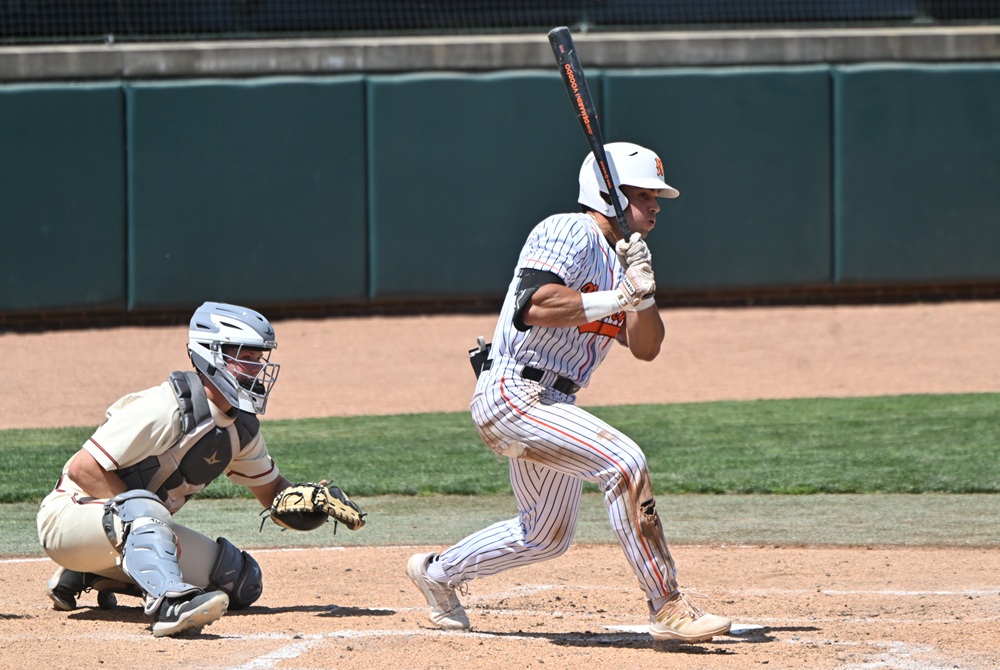
PHOTO Northville’s Dante Nori (6) turns on a pitch during his team’s 2024 Division 1 championship game win over Bloomfield Hills Brother Rice.