

Powerful Voice for High School Sports
December 19, 2014
By Geoff Kimmerly
Second Half editor
Paul Carey was home from the U.S. Army only a few months and just shy of 25 years old when Beal City embarked on its first trip deep into the MHSAA boys basketball tournament.
On the call for local radio station WCEN from gyms at Saginaw Arthur Hill and Lansing Sexton, Carey served as the voice of the previously “laughable” Aggies as they reached the Class D Semifinals before falling just six points short of playing for the title.
“All of Beal City emptied out. They’d never had anything before,” Carey recalled during his annual Thanksgiving weekend visit to the MHSAA Football Finals at Ford Field. “When I got home, within the next two weeks I got a letter from every citizen of Beal City thanking me for broadcasting their games. That’s the kind of appreciation that meant so much.”
During 42 years on the airwaves, Carey was best known as a voice of the Detroit Tigers bounding out of transistor radios all over Michigan, thanks to WJR’s powerful signal.
But for the state’s high school sports community, his legacy is similarly memorable as the voice of the longtime football and basketball scoreboard show and a voter for various all-state teams and wire polls over the decades.
Now 86 and retired since 1991, Carey remains a regular during the first day of the Football Finals, taking in games he broadcast for the MHSAA during the late 1970s and that continue to hold his eye as they have for more than a half-century.
“It was a passion of mine. High school sports always has been,” Carey said. “I think because my dad was a high school coach, and teacher initially, and my brother was a high school coach and teacher, I just grew up in families that appreciated coaching and athletics. I was not a great athlete, but it kept my hand in following sports that way.”
Now, the scores
Carey partnered with Ernie Harwell for Tigers radio broadcasts from 1973-91, including during the march to the 1984 World Series championship. He was named Michigan Sportscaster of the Year six times and to the Michigan Sports Hall of Fame in 1992.
But Carey’s early career included sitting on top of a car, plugged into a phone pole, for a Sacred Heart football game at old Fancher Field just a few blocks from his family’s Mount Pleasant home. Among many more accolades are a Distinguished Service Award from the Michigan High School Coaches Association and a place in the Basketball Coaches Association of Michigan Hall of Fame.
In fact, the start of his weekly announcing of statewide football and basketball scores preceded his baseball career by 16 years and ended two months after he announced his final professional out.
The Michigan High School Scoreboard show was a staple of WJR’s late Friday nights from 1957-91. Carey would read every score he could collect from a variety of sources, often organized by league and with state rankings and context mixed in.
His idea came from something similar read by Len Colby for Kalamazoo’s WKZO. Carey’s brother Terry was coaching at Niles during the second half of the 1950s, and he and other coaches would get together to listen to the Friday night scores from the southwestern part of the state.
Carey, who left WKNX in Saginaw for WJR in 1956, explained to then-sports director Bob Reynolds that the station’s strong signal could provide for a truly statewide scoreboard experience.
Carey then connected with Edgar Hayes of the former Detroit Times, who gave the OK for Carey to call the paper on Friday nights to get scores from the Detroit metro area. For the rest, Carey relied on wire services – there were three at the time – who relied on newspapers from all over Michigan to call in scores over the course of an evening.
Before every Friday during high school football season – and later Tuesdays and Fridays during boys basketball season – Carey typed up lists of games based on schedules in the newspaper, with spaces to add scores. More than a few times, Carey raced down a back ramp at Tiger Stadium after a Friday night game, back to the WJR studio, with 15 minutes to prep for the show’s 11:30 p.m. start.
“If the Flint Journal, the Grand Rapids Press, the Traverse City paper didn’t call in scores to the AP, then I was out of luck too. And that happened all the time,” Carey said. “I would call back occasionally, say, ‘Did you get anything more?’ It was a rat race.”
The show originally was set for 10 minutes and then extended to 15. American Airlines sponsored a record show that followed, and Carey’s scoreboard show had a sponsor only once in 35 years. Finishing up on time was expected, even with more than 200 scores to read.
But Carey said he always went 20 minutes, sometimes 25.
“Because I wasn’t done. I just kept right on going,” Carey said. “Jay Roberts did the all-night show most of the time, and he was patient with me. He didn’t say too much on the air about ‘that guy ahead of me took all of my time.’”
Carey continued the “rat race” until his final scoreboard show, Dec. 20, 1991. He retired from WJR at the end of that calendar year. And it's important to note: Carey was never paid a dime extra for doing the program. .
“I think Paul is really just a sports fan, and that came across to the listener on his broadcasts,” MHSAA historian Ron Pesch said. “Paul would gather as much as possible off the wire. He'd interject if scores were missing from sections of the state. Press polls from the Free Press, News, AP and UPI were big, so he could point out close calls and upsets.
“He provided immediacy, or the closest thing to it in the days before cable TV and the Internet, and because of his scoreboard show, you could get the results before the morning paper. For listeners, he brought life to something as simple as game scores.”
First team all the way
Carey, who resides in Rochester, also served as the engineer on Tigers broadcasts for 16 years, through 1990. He broadcast Pistons games on the radio for six seasons and did the first broadcast of a Central Michigan University football game, in 1949.
Harry Atkins, covering Detroit’s teams while with The Associated Press for 29 years including the last 21 as its sports editor for Detroit, took note of his colleague's hard work – and especially that Carey was one of few broadcasters who was a journalist in addition to a voice.
That made Carey's other major role in high school sports a natural fit.
Atkins split The Associated Press all-state selection panels for football and basketball into 11 regions, and Carey represented the Detroit area for a number of years. He also was a longtime voter in those sports' weekly polls.
“Paul is just that kind of guy. He thought it was important and he made time in his busy schedule to do it,” Atkins said “And it had an impact on the other 10 voters on the All-State panels, too.
“Some of them were from small out-state newspapers or radio or TV stations. Yet every one of them knew who Paul Carey was. And when he spoke, of course, with what often is called "The Voice of God," those voters paid attention.”
And he still does, as well.
At the end of each fall, Carey still puts together a compilation of the three high school all-state football teams – Associated Press, Detroit Free Press and Detroit News – and files them with years of research and results.
“It’s important to me. Nobody sees it but me, but I get a certain kick,” Carey said. “Once in a while I’ll see a kid playing at Central, Western or (Michigan) State or Michigan, and they’ll say he came from Clawson. I’ll go into my all-state collections, say that would’ve been 2009 he played, and I find a name.”
In addition to the Football Finals on WJR, Carey was part of the Baseball Finals broadcasts into the early 1990s, continuing to contribute even after his retirement from his fulltime gig.
He spent high school games over the years sitting next to legends like the Free Press’ Hal Schram and remembers when current Free Press longtime scribe Mick McCabe was just a rookie. One of Carey's final broadcasts was a 1992 Baseball Final with his nephew Mike Carey, who continues to broadcast MHSAA championship games to this day.
“I am eternally grateful to Paul Carey. His contribution to high school sports in Michigan has been great and significant,” Atkins said.
“We are lucky to have him.”
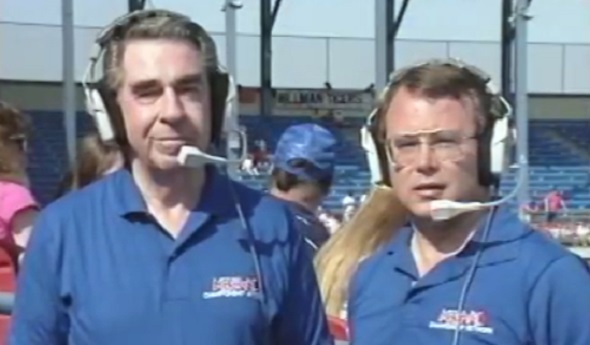
PHOTO: Paul Carey (left) and nephew Mike Carey broadcast the MHSAA 1992 Class D Baseball Final between Hillman and Athens for PASS.
Schoolcraft Soccer Record Setter Brings Scoring Touch to Football Field
By
Pam Shebest
Special for MHSAA.com
September 21, 2021
SCHOOLCRAFT — Soccer phenom Hannah Thompson has a flare for finding the net.
 This fall, the Schoolcraft High School senior is aiming even higher – in the most literal sense.
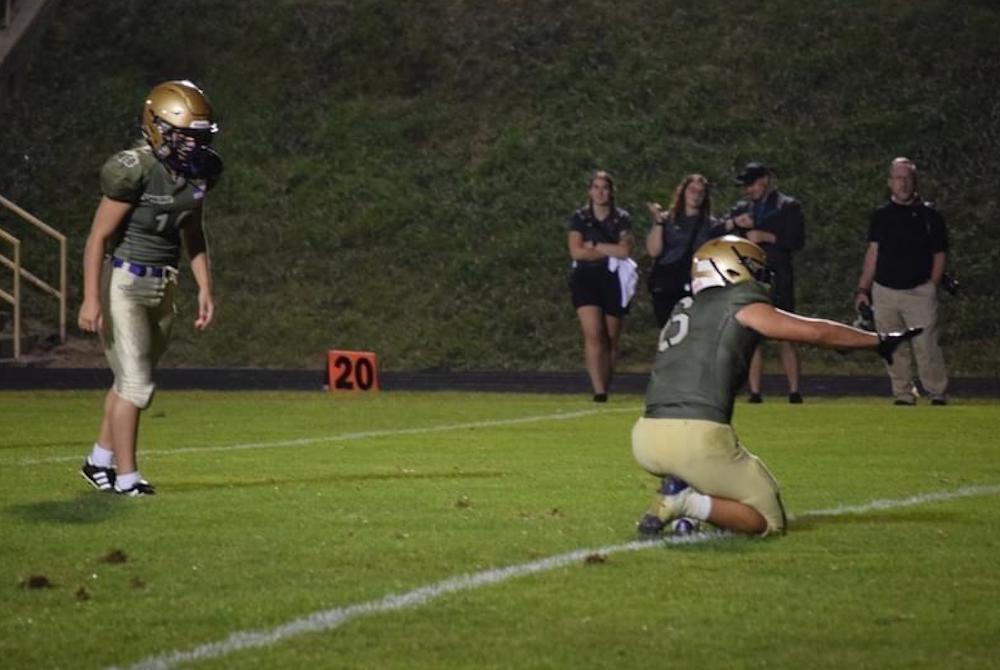
Thompson is the place kicker on the Eagles’ football team, and in the team’s three games so far, she has connected on 4 of 5 point-after attempts.
The first female varsity football player in school history, Thompson is no stranger to breaking records.
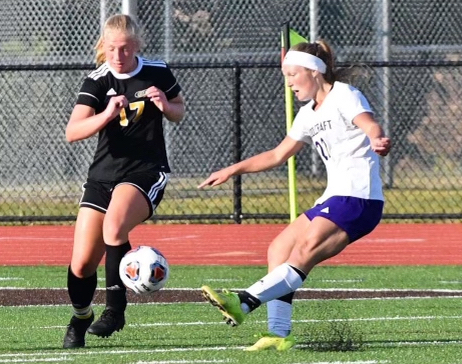
Her 87 goals in soccer last spring not only set an MHSAA girls record for most goals in a season, but also eclipsed the boys mark.
Kristi Vandeberghe, a standout at Mount Clemens, had set the previous girls record with 66 goals in 2001. The boys record of 76 goals was set in 2009 by Dearborn’s Soony Saad.
While both sports involve kicking, the vivacious senior said there are differences.
“In soccer, you’re supposed to keep your body over the ball,” she said. “In football, you’re supposed to lean back so the ball goes higher. That’s probably the biggest difference.
“In football, if you try to kick as hard as you can, like for power, the ball can go off to the side. In soccer, you want to kick it hard.”
Head football coach Nathan Ferency, who teaches health and physical education at the high school, had tried to convince Thompson to join the team since she expressed an interest as a freshman.
 “I took my health class outside one spring morning and worked her out a little bit to see if she could kick — and she can actually kick,” he added with a grin.
Ferency immediately offered her a spot on the junior varsity team, but since she plays travel hockey in the fall, she opted to concentrate on that until this year.
Her high school soccer coach, Scott Thompson, also her dad, has no problem with her playing football, “and my (soccer) teammates think it’s cool and amazing,” the senior said.
 “They’re very supportive of me. My (travel) coaches do not like it whatsoever. They’re not a fan.”
Her dad sees some positives coming from football.
“As her coach, I have no issues with her playing football,” he said. “She’s working on driving through the ball and working on her leg muscles.
“Being in high school, I didn’t see any issues. As a place kicker, she has minimal opportunities for getting hurt.”
Ferency is aware that soccer is her main interest.
“We’re never going to put her into a kickoff situation where she has to hit somebody,” he said. “We feel comfortable in a PAT or field goal situation where she’s protected and unlikely to have contact.
“We want to preserve her senior year of soccer. That’s her love, and we want to make sure her goals are met.”
Thompson, who has committed to play soccer at Eastern Michigan University, said the hardest part of football is putting on the equipment, especially clipping down the shoulder pads.
“I wear youth large pads so they’re like the middle school pads, and it’s hard to get them clipped down,” she said, laughing while she demonstrated with her hands.
Pads also posed a bit of a problem for her debut.
“The first game, the girdle has the hip pads and the butt pads,” she said. “The pants have pads on the front and on the knees.
“I didn’t know you only had to wear one set. The first game I wore both and I had two pads everywhere. I didn’t know until the next game.”
Thompson said she is also developing her neck muscles.
“The helmet’s really heavy,” she said. “My neck’s getting strong.
“I have a big head, so I have to wear size large. But I got a new helmet that no one’s ever worn, so that’s good.”
Unlike the constant action in soccer, Thompson waits on the sidelines for the nod to play.
When she got the call during that first game, “I wasn’t really nervous because it happened super fast, so I didn’t really think about it,” she said.
“It was exciting. I’m supposed to keep my head down when I kick it so I don’t see it, but I looked up and saw it going (over).”
She almost had a chance for a field goal that would have clinched a win for the Eagles.
“Week 1, we were down two points late in the game and getting close to field goal range,” Ferency said.
 “Unfortunately we threw an interception before she had an opportunity, but I was prepared to let her kick the game-winner at that point.”
Thompson practices with the football team twice a week and with her travel team twice a week.
“She puts the work in,” Ferency said. “We go through her kicking game, and she conditions and runs with the team afterwards.
“She makes it a point to do everything she can to be a part of the team, and we accept her just like anybody else.”
Pressure in football and soccer is nothing compared to pressure she felt twice before in her young life.
When she was 5 years old, she was home with her newborn sister, Makenna, when their mother suffered a brain aneurysm.
“I called my dad, who was going out of town, and said mom’s not OK,” she said.
Her father came home and her mom, Alyssa, was rushed to the hospital where she was in ICU for 17 days.
“It was remarkable for a 5-year-old,” her dad said. “We had just taught her how to use the phone. She was very heroic.”
Ten years later, it happened again, but this time her father was away on business and could not make it home.
Although she had just a driver’s permit, she loaded her mother and sister into the car and headed to the hospital.
“She remembered that I said earlier that it would be quicker for me to drive her mom to the hospital than wait for an ambulance to find us,” her dad said.
“When she talked with me, I could hear the confidence in her voice. She handled that better than most adults would and she took care of her sister.”
He said that confidence carries over to everything his daughter does, and he is savoring this time with her, especially during her senior year.
“It’s more fun to watch (her play) as a parent, but it’s also very satisfying to help your daughter (as a coach),” he said. “No one can ever take that time back.”
 Pam Shebest served as a sportswriter at the Kalamazoo Gazette from 1985-2009 after 11 years part-time with the Gazette while teaching French and English at White Pigeon High School. She can be reached at [email protected] with story ideas for Calhoun, Kalamazoo and Van Buren counties.
PHOTOS: (Top) Schoolcraft’s Hannah Thompson, left, lines up for an extra point this season. (Middle) Thompson and Schoolcraft football coach Nathan Ferency. (Below) Thompson set the MHSAA single-season record for goals scored as a junior. (Football photo by Jamie Zinsmaster, head shots by Pam Shebest, and soccer photo by Walt Tokarchick.)