


Powerful Voice for High School Sports
December 19, 2014
By Geoff Kimmerly
Second Half editor
Paul Carey was home from the U.S. Army only a few months and just shy of 25 years old when Beal City embarked on its first trip deep into the MHSAA boys basketball tournament.
On the call for local radio station WCEN from gyms at Saginaw Arthur Hill and Lansing Sexton, Carey served as the voice of the previously “laughable” Aggies as they reached the Class D Semifinals before falling just six points short of playing for the title.
“All of Beal City emptied out. They’d never had anything before,” Carey recalled during his annual Thanksgiving weekend visit to the MHSAA Football Finals at Ford Field. “When I got home, within the next two weeks I got a letter from every citizen of Beal City thanking me for broadcasting their games. That’s the kind of appreciation that meant so much.”
During 42 years on the airwaves, Carey was best known as a voice of the Detroit Tigers bounding out of transistor radios all over Michigan, thanks to WJR’s powerful signal.
But for the state’s high school sports community, his legacy is similarly memorable as the voice of the longtime football and basketball scoreboard show and a voter for various all-state teams and wire polls over the decades.
Now 86 and retired since 1991, Carey remains a regular during the first day of the Football Finals, taking in games he broadcast for the MHSAA during the late 1970s and that continue to hold his eye as they have for more than a half-century.
“It was a passion of mine. High school sports always has been,” Carey said. “I think because my dad was a high school coach, and teacher initially, and my brother was a high school coach and teacher, I just grew up in families that appreciated coaching and athletics. I was not a great athlete, but it kept my hand in following sports that way.”
Now, the scores
Carey partnered with Ernie Harwell for Tigers radio broadcasts from 1973-91, including during the march to the 1984 World Series championship. He was named Michigan Sportscaster of the Year six times and to the Michigan Sports Hall of Fame in 1992.
But Carey’s early career included sitting on top of a car, plugged into a phone pole, for a Sacred Heart football game at old Fancher Field just a few blocks from his family’s Mount Pleasant home. Among many more accolades are a Distinguished Service Award from the Michigan High School Coaches Association and a place in the Basketball Coaches Association of Michigan Hall of Fame.
In fact, the start of his weekly announcing of statewide football and basketball scores preceded his baseball career by 16 years and ended two months after he announced his final professional out.
The Michigan High School Scoreboard show was a staple of WJR’s late Friday nights from 1957-91. Carey would read every score he could collect from a variety of sources, often organized by league and with state rankings and context mixed in.
His idea came from something similar read by Len Colby for Kalamazoo’s WKZO. Carey’s brother Terry was coaching at Niles during the second half of the 1950s, and he and other coaches would get together to listen to the Friday night scores from the southwestern part of the state.
Carey, who left WKNX in Saginaw for WJR in 1956, explained to then-sports director Bob Reynolds that the station’s strong signal could provide for a truly statewide scoreboard experience.
Carey then connected with Edgar Hayes of the former Detroit Times, who gave the OK for Carey to call the paper on Friday nights to get scores from the Detroit metro area. For the rest, Carey relied on wire services – there were three at the time – who relied on newspapers from all over Michigan to call in scores over the course of an evening.
Before every Friday during high school football season – and later Tuesdays and Fridays during boys basketball season – Carey typed up lists of games based on schedules in the newspaper, with spaces to add scores. More than a few times, Carey raced down a back ramp at Tiger Stadium after a Friday night game, back to the WJR studio, with 15 minutes to prep for the show’s 11:30 p.m. start.
“If the Flint Journal, the Grand Rapids Press, the Traverse City paper didn’t call in scores to the AP, then I was out of luck too. And that happened all the time,” Carey said. “I would call back occasionally, say, ‘Did you get anything more?’ It was a rat race.”
The show originally was set for 10 minutes and then extended to 15. American Airlines sponsored a record show that followed, and Carey’s scoreboard show had a sponsor only once in 35 years. Finishing up on time was expected, even with more than 200 scores to read.
But Carey said he always went 20 minutes, sometimes 25.
“Because I wasn’t done. I just kept right on going,” Carey said. “Jay Roberts did the all-night show most of the time, and he was patient with me. He didn’t say too much on the air about ‘that guy ahead of me took all of my time.’”
Carey continued the “rat race” until his final scoreboard show, Dec. 20, 1991. He retired from WJR at the end of that calendar year. And it's important to note: Carey was never paid a dime extra for doing the program. .
“I think Paul is really just a sports fan, and that came across to the listener on his broadcasts,” MHSAA historian Ron Pesch said. “Paul would gather as much as possible off the wire. He'd interject if scores were missing from sections of the state. Press polls from the Free Press, News, AP and UPI were big, so he could point out close calls and upsets.
“He provided immediacy, or the closest thing to it in the days before cable TV and the Internet, and because of his scoreboard show, you could get the results before the morning paper. For listeners, he brought life to something as simple as game scores.”
First team all the way
Carey, who resides in Rochester, also served as the engineer on Tigers broadcasts for 16 years, through 1990. He broadcast Pistons games on the radio for six seasons and did the first broadcast of a Central Michigan University football game, in 1949.
Harry Atkins, covering Detroit’s teams while with The Associated Press for 29 years including the last 21 as its sports editor for Detroit, took note of his colleague's hard work – and especially that Carey was one of few broadcasters who was a journalist in addition to a voice.
That made Carey's other major role in high school sports a natural fit.
Atkins split The Associated Press all-state selection panels for football and basketball into 11 regions, and Carey represented the Detroit area for a number of years. He also was a longtime voter in those sports' weekly polls.
“Paul is just that kind of guy. He thought it was important and he made time in his busy schedule to do it,” Atkins said “And it had an impact on the other 10 voters on the All-State panels, too.
“Some of them were from small out-state newspapers or radio or TV stations. Yet every one of them knew who Paul Carey was. And when he spoke, of course, with what often is called "The Voice of God," those voters paid attention.”
And he still does, as well.
At the end of each fall, Carey still puts together a compilation of the three high school all-state football teams – Associated Press, Detroit Free Press and Detroit News – and files them with years of research and results.
“It’s important to me. Nobody sees it but me, but I get a certain kick,” Carey said. “Once in a while I’ll see a kid playing at Central, Western or (Michigan) State or Michigan, and they’ll say he came from Clawson. I’ll go into my all-state collections, say that would’ve been 2009 he played, and I find a name.”
In addition to the Football Finals on WJR, Carey was part of the Baseball Finals broadcasts into the early 1990s, continuing to contribute even after his retirement from his fulltime gig.
He spent high school games over the years sitting next to legends like the Free Press’ Hal Schram and remembers when current Free Press longtime scribe Mick McCabe was just a rookie. One of Carey's final broadcasts was a 1992 Baseball Final with his nephew Mike Carey, who continues to broadcast MHSAA championship games to this day.
“I am eternally grateful to Paul Carey. His contribution to high school sports in Michigan has been great and significant,” Atkins said.
“We are lucky to have him.”
PHOTO: Paul Carey (left) and nephew Mike Carey broadcast the MHSAA 1992 Class D Baseball Final between Hillman and Athens for PASS.
St. Phil's Winning Ways Lead to Summer Celebration, Fall Anticipation
By
Pam Shebest
Special for MHSAA.com
August 24, 2021
BATTLE CREEK — Last season’s Division 4 championship gave Battle Creek St. Philip 11 over coach Vicky Groat’s 22 seasons leading the program.
 But those stats are a bit off. They do not include the three Class D titles she won as a player at St. Phil, giving her 14 overall.
“We won three state titles with Mom in ’83, ’84, ’85 and were in the final four in ’82,” Groat said.
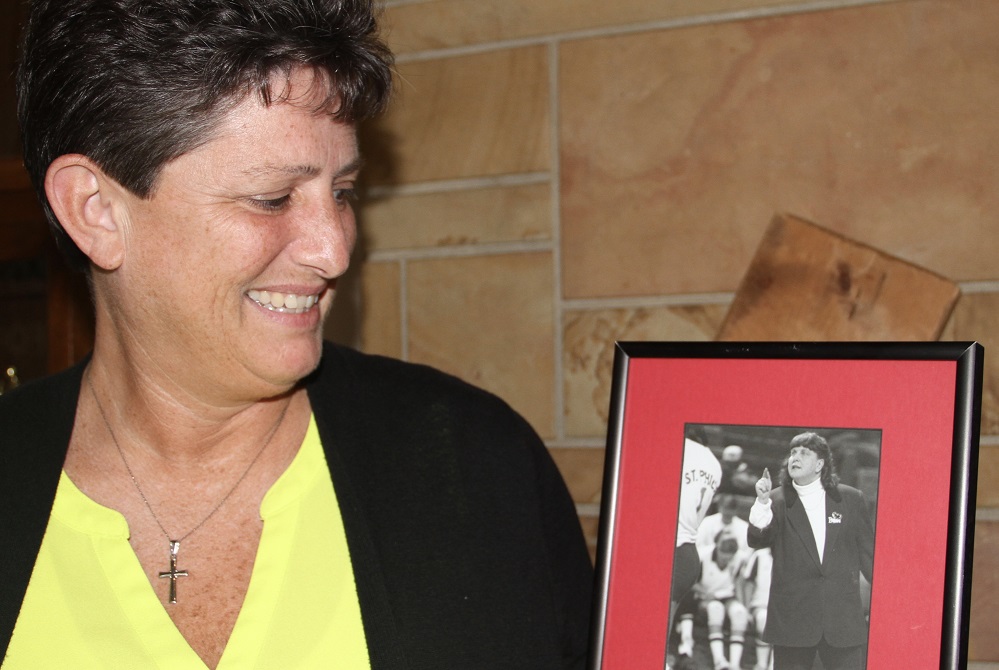
“Mom” is Sheila Guerra, who led the Tigers to nine Finals championships while guiding the program from 1982-1997. Together, the mother-daughter duo has accounted for 20 of the school’s MHSAA-record 21 state volleyball titles. (The first was under coach Becky Emrich in 1979.) Those 21 championships, in fact, are more than twice as many as any other volleyball program in the state, and the Tigers’ 30 MHSAA Finals appearances are 17 more than the next best achiever.
That incredible success was recognized in July when Groat was named the National High School Athletic Coaches Association’s Volleyball Coach of the Year.
Guerra died in May 2006. But Mom was very much on Groat’s mind as she received her award. While accolades, awards and championships continue to pile up, Groat said her mother is the foundation for it all.
“Mom always encouraged me, and there are still things I do today that she did,” Groat said. “It may be old school, but it still works.”
And the Tigers will have another strong chance this fall to show how.
Plenty to celebrate
Groat did not tell her players that she was a finalist for the award but they found out anyway, said senior standout Brooke Dzwik, an all-state first-team outside hitter last season.
“(The players) went on this camping trip up to Leland and stayed in Coach (Laurie) Glass’ backyard,” Dzwik said. “We were also with Notre Dame Prep and Bronson. Four winning coaches.”
 Dzwik said Bronson coach Jean LaClair spilled the beans, telling the players the news.
“(The other coaches) were teasing (Groat) about having a speech prepared and she was like ‘No way,’” Dzwik said.
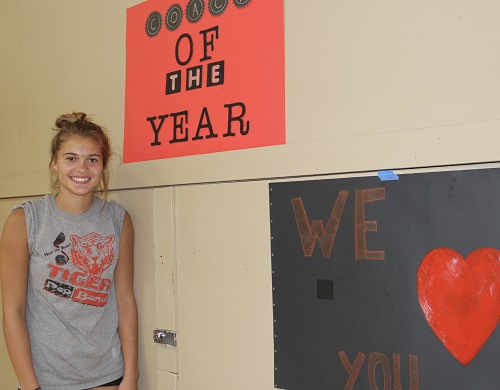
Groat texted her players a picture of herself with the trophy, and during the first day of tryouts in August, the girls welcomed the coach with a few signs, a balloon, a card and Mountain Dew, “her favorite,” Dzwik said.
“We were just overjoyed because no one deserves it more than her.
“She walked in (to the gym) and I think she was pretty happy, but she doesn’t like the attention on her so she will never admit it.”
After her mom retired after the 1996-97 season, Groat took over, stepped away for 1999-2000 but then returned to direct the Tigers again for the last two decades.
No one, including Groat, expected her team to win the Division 4 title after starting last season with a 23-13 record, just nine athletes on the team and no junior varsity to draw from in case of injury.
“I begged (current senior) Alex Kersten to come out — she’s a cross country runner — and she did,” Groat said.
After a two-month delay because of the pandemic a year ago, practice was held outside at Battle Creek’s Bailey Park.
“We started off in the sand, and we were grateful that we were even allowed to get together and see everyone’s faces for the first time,” Dzwik said.
“It was awful at first, but (playing in sand) definitely made our legs stronger by the end of the season, and we were thankful for it.”
This year, expectations are much higher.
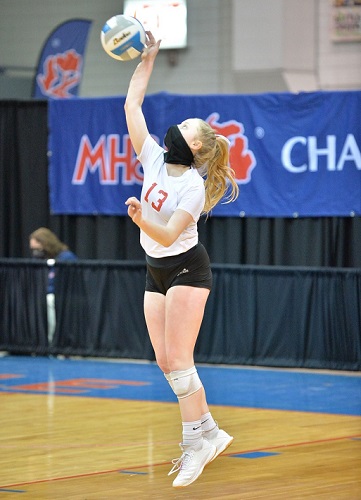
The Tigers lost just one player, Harleen Deol, to graduation and return five seniors also including Rachel Myers, Alexis Snyder and Bailey Fancher. Fancher made the all-state third team last season at libero.
“I feel more pressure now,” Dzwik said. “We didn’t have an amazing record last year and then pulled out a win.
“This year, we do have a (championship) win, so we placed a target on our backs.”
This season already includes a “first” for St. Phil.
“For the first time in St. Phil history, we have an eighth grader, Charli Greger (on varsity),” Groat said. “We were under 100 students last year, so we could have eighth graders play this year.
“Right now, we’re at 100 (students) so next year we won’t be able to have eighth graders.”
Other players are juniors Maddie Hoelscher and Kate Doyle and sophomores Rylee Altman and Makenzee Grimm.
Groat also has a junior varsity team for the first time in two years – a really good thing, she said.
“Take out the five seniors next year and I’m left with four players if I don’t have a JV team,” she said. “We brought eighth graders up to the JV team with four freshmen.
“Never thought we’d have to do that, but we want a program. I couldn’t imagine not having a St. Phil volleyball team. That would be a sad day.”
Family tradition
While a student at St. Phil, Groat was coached by her mother in volleyball and track. In addition, Groat’s father Lou coached basketball at the school.
Her parents as her coaches was not always an easy combination for a young teen.
“It’s always the coach’s kid who gets the brunt of it.” Groat said. “I still remember one of my friends and I were fighting during volleyball and my mom was blaming me. I was like, what about her?
“In track if she had no one to run something, ‘Vicky, you’re going to do it.’ But it was fun.”
 Groat, who is also principal and athletic director at the school, credits her parents for not only her coaching success, but her life skills.
“I learned from the best.” she said. “I try to carry both their philosophies in the way they treated people.
“My mom was tough on kids, but if anybody needed anything, she was the first one there. She pushed hard and had high expectations, but she really was a softie inside. People still don’t believe me on that.”
Groat relies on one other person who is like family: assistant coach Angela Williams Frost.
“We call her Willi,” Groat said. “She’s been a great assistant for 18 years. She was a head coach at Springport and could be a head coach anywhere in the state.
“She’s very talented and smart. It makes my job easier knowing that Willi is there. I’ll be in practice and someone will come to the door for me and Willi is there to take over.”
July’s recognition was a total surprise, Groat said, deflecting any accolades. But it also can be regarded as deserved praise for her work teaching an abundance of lessons she learned herself as part of the volleyball program and the Guerra coaching tree.
“It’s just so much about my kids, the kids who have been here and who have played in our system,” she said. “It’s not a big school; we have our traditions, and they buy into it. It’s been great.
“Hopefully over the years we, as coaches, have taught them the important things in life, the life lessons that they will carry on. Sports are an important part of it, but there are other things involved.”
 Pam Shebest served as a sportswriter at the Kalamazoo Gazette from 1985-2009 after 11 years part-time with the Gazette while teaching French and English at White Pigeon High School. She can be reached at [email protected] with story ideas for Calhoun, Kalamazoo and Van Buren counties.
PHOTOS: (Top) Battle Creek St. Philip coach Vicky Groat holds up a picture of her mother, Sheila Guerra, with whom she’s combined to lead the Tigers to 20 of their 21 MHSAA Finals volleyball championships. (Middle) Senior Brooke Dzwik shows some of the signs she and teammates made to celebrate Groat’s national Coach of the Year recognition. (Below) Then-junior Bailey Fancher serves during last season’s Division 4 title match. (Top and middle photos by Pam Shebest.)