

Powerful Voice for High School Sports
December 19, 2014
By Geoff Kimmerly
Second Half editor
Paul Carey was home from the U.S. Army only a few months and just shy of 25 years old when Beal City embarked on its first trip deep into the MHSAA boys basketball tournament.
On the call for local radio station WCEN from gyms at Saginaw Arthur Hill and Lansing Sexton, Carey served as the voice of the previously “laughable” Aggies as they reached the Class D Semifinals before falling just six points short of playing for the title.
“All of Beal City emptied out. They’d never had anything before,” Carey recalled during his annual Thanksgiving weekend visit to the MHSAA Football Finals at Ford Field. “When I got home, within the next two weeks I got a letter from every citizen of Beal City thanking me for broadcasting their games. That’s the kind of appreciation that meant so much.”
During 42 years on the airwaves, Carey was best known as a voice of the Detroit Tigers bounding out of transistor radios all over Michigan, thanks to WJR’s powerful signal.
But for the state’s high school sports community, his legacy is similarly memorable as the voice of the longtime football and basketball scoreboard show and a voter for various all-state teams and wire polls over the decades.
Now 86 and retired since 1991, Carey remains a regular during the first day of the Football Finals, taking in games he broadcast for the MHSAA during the late 1970s and that continue to hold his eye as they have for more than a half-century.
“It was a passion of mine. High school sports always has been,” Carey said. “I think because my dad was a high school coach, and teacher initially, and my brother was a high school coach and teacher, I just grew up in families that appreciated coaching and athletics. I was not a great athlete, but it kept my hand in following sports that way.”
Now, the scores
Carey partnered with Ernie Harwell for Tigers radio broadcasts from 1973-91, including during the march to the 1984 World Series championship. He was named Michigan Sportscaster of the Year six times and to the Michigan Sports Hall of Fame in 1992.
But Carey’s early career included sitting on top of a car, plugged into a phone pole, for a Sacred Heart football game at old Fancher Field just a few blocks from his family’s Mount Pleasant home. Among many more accolades are a Distinguished Service Award from the Michigan High School Coaches Association and a place in the Basketball Coaches Association of Michigan Hall of Fame.
In fact, the start of his weekly announcing of statewide football and basketball scores preceded his baseball career by 16 years and ended two months after he announced his final professional out.
The Michigan High School Scoreboard show was a staple of WJR’s late Friday nights from 1957-91. Carey would read every score he could collect from a variety of sources, often organized by league and with state rankings and context mixed in.
His idea came from something similar read by Len Colby for Kalamazoo’s WKZO. Carey’s brother Terry was coaching at Niles during the second half of the 1950s, and he and other coaches would get together to listen to the Friday night scores from the southwestern part of the state.
Carey, who left WKNX in Saginaw for WJR in 1956, explained to then-sports director Bob Reynolds that the station’s strong signal could provide for a truly statewide scoreboard experience.
Carey then connected with Edgar Hayes of the former Detroit Times, who gave the OK for Carey to call the paper on Friday nights to get scores from the Detroit metro area. For the rest, Carey relied on wire services – there were three at the time – who relied on newspapers from all over Michigan to call in scores over the course of an evening.
Before every Friday during high school football season – and later Tuesdays and Fridays during boys basketball season – Carey typed up lists of games based on schedules in the newspaper, with spaces to add scores. More than a few times, Carey raced down a back ramp at Tiger Stadium after a Friday night game, back to the WJR studio, with 15 minutes to prep for the show’s 11:30 p.m. start.
“If the Flint Journal, the Grand Rapids Press, the Traverse City paper didn’t call in scores to the AP, then I was out of luck too. And that happened all the time,” Carey said. “I would call back occasionally, say, ‘Did you get anything more?’ It was a rat race.”
The show originally was set for 10 minutes and then extended to 15. American Airlines sponsored a record show that followed, and Carey’s scoreboard show had a sponsor only once in 35 years. Finishing up on time was expected, even with more than 200 scores to read.
But Carey said he always went 20 minutes, sometimes 25.
“Because I wasn’t done. I just kept right on going,” Carey said. “Jay Roberts did the all-night show most of the time, and he was patient with me. He didn’t say too much on the air about ‘that guy ahead of me took all of my time.’”
Carey continued the “rat race” until his final scoreboard show, Dec. 20, 1991. He retired from WJR at the end of that calendar year. And it's important to note: Carey was never paid a dime extra for doing the program. .
“I think Paul is really just a sports fan, and that came across to the listener on his broadcasts,” MHSAA historian Ron Pesch said. “Paul would gather as much as possible off the wire. He'd interject if scores were missing from sections of the state. Press polls from the Free Press, News, AP and UPI were big, so he could point out close calls and upsets.
“He provided immediacy, or the closest thing to it in the days before cable TV and the Internet, and because of his scoreboard show, you could get the results before the morning paper. For listeners, he brought life to something as simple as game scores.”
First team all the way
Carey, who resides in Rochester, also served as the engineer on Tigers broadcasts for 16 years, through 1990. He broadcast Pistons games on the radio for six seasons and did the first broadcast of a Central Michigan University football game, in 1949.
Harry Atkins, covering Detroit’s teams while with The Associated Press for 29 years including the last 21 as its sports editor for Detroit, took note of his colleague's hard work – and especially that Carey was one of few broadcasters who was a journalist in addition to a voice.
That made Carey's other major role in high school sports a natural fit.
Atkins split The Associated Press all-state selection panels for football and basketball into 11 regions, and Carey represented the Detroit area for a number of years. He also was a longtime voter in those sports' weekly polls.
“Paul is just that kind of guy. He thought it was important and he made time in his busy schedule to do it,” Atkins said “And it had an impact on the other 10 voters on the All-State panels, too.
“Some of them were from small out-state newspapers or radio or TV stations. Yet every one of them knew who Paul Carey was. And when he spoke, of course, with what often is called "The Voice of God," those voters paid attention.”
And he still does, as well.
At the end of each fall, Carey still puts together a compilation of the three high school all-state football teams – Associated Press, Detroit Free Press and Detroit News – and files them with years of research and results.
“It’s important to me. Nobody sees it but me, but I get a certain kick,” Carey said. “Once in a while I’ll see a kid playing at Central, Western or (Michigan) State or Michigan, and they’ll say he came from Clawson. I’ll go into my all-state collections, say that would’ve been 2009 he played, and I find a name.”
In addition to the Football Finals on WJR, Carey was part of the Baseball Finals broadcasts into the early 1990s, continuing to contribute even after his retirement from his fulltime gig.
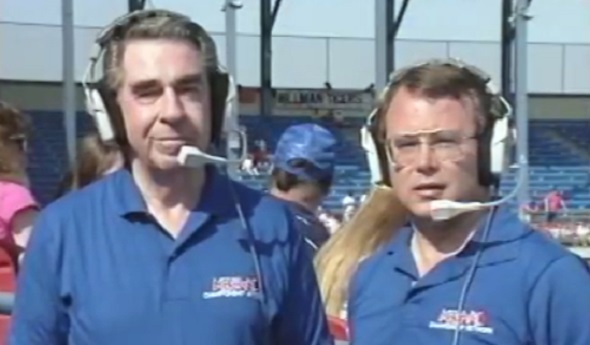
He spent high school games over the years sitting next to legends like the Free Press’ Hal Schram and remembers when current Free Press longtime scribe Mick McCabe was just a rookie. One of Carey's final broadcasts was a 1992 Baseball Final with his nephew Mike Carey, who continues to broadcast MHSAA championship games to this day.
“I am eternally grateful to Paul Carey. His contribution to high school sports in Michigan has been great and significant,” Atkins said.
“We are lucky to have him.”
PHOTO: Paul Carey (left) and nephew Mike Carey broadcast the MHSAA 1992 Class D Baseball Final between Hillman and Athens for PASS.

Flashback 1981: Softball Showcase Makes Ranney Park Home
By
Ron Pesch
MHSAA historian
May 28, 2021
After years of grouping the championship games by classification across various diamonds in the state, talks about creating a new format for both the Michigan High School Athletic Association baseball and softball championships began following the 1980 spring tournaments.
 “Baseball and softball coaches have been complaining about spreading the tournament sites throughout the state,” according to an article in the Lansing State Journal. “They feel if football championships can be held at the Silverdome and basketball at Crisler Arena in Ann Arbor, why not showcase their sports (at a single location).”
“The coaches are certainly in favor of the four-class finals at the same site and were looking into it,” said Vern Norris, executive director of the MHSAA in June 1980. “There are several exceptional sites right now.”
In September, the Association announced that the 1981 Baseball Finals would be held at Central Michigan University’s Alumni Field, and that the Softball Finals would be played at Lansing’s Ranney Park, a sports complex that featured nearly $70,000 in recent renovations. Rain delayed all four championship games, scheduled for Saturday, June 13. Instead, they were played on the following Monday.

Class A: Lansing Eastern 8, Warren Cousino 0
Lefty Sally Sohn allowed just three hits as Lansing Eastern shut down once-beaten Warren Cousino, 8-0. It was Sohn’s 17th win on the year without a defeat. Diane Gentry, previously unbeaten in 19 games, took the loss.
Eastern pounded out 13 hits, scoring once in the first inning and twice in the second for a quick 3-0 lead. Leftfielder Sue Spagnuolo, who went 4 for 5 at the plate, piled up a double and three singles in the championship game, drove in one of the runs in the second inning, and then followed with two more RBI in the third. Senior Kelley Keyton, who led the team in batting with a .412 average and six home runs, singled in two more runs in the third. Playing first base, she was one of three sisters, including Lesley Keyton (second) and Michelle Keyton (third), who occupied the infield for the Quakers. Sophomore shortstop Rachel Dexter added three hits and was outstanding defensively. The team’s final run came in the fifth.
Dexter, Lesley Keyton and Gentry would all later become teammates at Michigan State, while Sohn would carve out an outstanding career at Ferris State. Spagnuolo would attend Alma College, earning all-MIAA honors and setting multiple Scots records on the basketball court.
In eight postseason contests, Eastern outscored its opponents 79-9, with the Cousino win marking the only tournament shutout. In 1995, the Quakers’ team was honored with induction into the Greater Lansing Sports Hall of Fame.

Class B: Saginaw MacArthur 8, Eaton Rapids 4
Saginaw MacArthur’s Liz Alfano held Eaton Rapids to four hits, all coming in the fifth inning, to lead her team to an 8-4 win over the Greyhounds. MacArthur, which lost its 1980 Regional Final to eventual Class B champion Fenton, finished the season with a 20-5 record.
The Generals opened up a 6-0 advantage early in the contest.
After walking in her first at bat, Pam Carpenter scored the game’s opening run on a Greyhounds throwing error in the bottom of the first inning, and then doubled in two runs in the second. A bloop single by Alfano in the third pushed across another run. That was followed by a single by Jenny Scoggin that scored two more runs, giving MacArthur its lead.
Alfano hadn’t allowed a hit through the first four innings before a bad hop on a grounder in the top of the fifth allowed Eaton Rapids to score a run. Trailing 6-1, the Greyhounds filled the bases with nobody out. MacArthur’s second baseman Cindy Devers came up big defensively, turning a double play on a grounder by tagging the runner headed from first to second before making the easy toss to first. While the runner at third scored, it appeared that “MacArthur might escape without further damage, “ according to Mike Thompson of the Saginaw News.
“However, an infield error allowed a third run to score. Another error, followed by a base hit, produced another run and cut MacArthur’s lead to 6-4.
With “the tying runs in scoring position … Generals Coach Sue Skulley made a trip to the pitching rubber.” Skulley knew Eaton Rapids had a reputation as a strong comeback team, and hoped a little break might help Alfano on this hot, muggy day.
‘“It was nearly 90 degrees out there,’” said Skulley. “’She was tired and she let up a little.’”
Following the mound visit, Alfano got the third out of the inning on a fly to right field.
Devers scored in the fifth and Carpenter scored again after notching a triple in the sixth to seal the victory.
Alfano finished with a 16-3 win-loss mark on the year. Eaton Rapids ended with a 14-9 record as Denise Miller was tagged with the loss.

Class C: Vandercook Lake 5, Breckenridge 4
Five walks, two hit batters, and eight errors – including a pair in the ninth inning – helped the Vandercook Lake Jayhawks (14-4) earn a surprise 5-4 win over Breckenridge (18-6).
>Vandercook Lake blew an early 3-1 lead, and with the game tied, 3-3, a lead-off triple by Breckenridge first baseman Brenda Rohn in the top of the seventh appeared to set the stage for a comeback win by the Huskies. “However,” according to Lansing State Journal coverage, “an unsuccessful squeeze play and two pop ups got Jayhawks pitcher Beth Eagle out of the touchy situation.” With Vandercook Lake unable to score in the bottom half, the teams headed for extra innings.
In the top of the ninth, Rohn, who finished 4 for 4 from the plate, notched her third triple of the day, and then scored on a two-out single by Claudia Parfitt to break the tie, 4-3.
But Vandercook Lake scored twice in the bottom of the inning to grab the title.
“Barb Boyt reached first for the Jayhawks on a throwing error then moved to third after a wild pitch and a passed ball,” stated the Jackson Citizen Patriot years later, recalling the drama. “After Breckenridge issued a walk to put the game-winning run on first, Coach Yvonne Freeman put Sherry Gilbert in to pinch run. Boyt scored on another error and Gilbert moved to second. With two outs, Paula May hit a groundball to third base and Gilbert slid under the tag for a 5-4 win.”
Freeman had only four players turn out for varsity tryouts that spring, and junked the JV squad to compile a team.
Breckenridge’s Evelyn O’Boyle, who allowed two hits on the day, was unbeaten entering the match-up and took the loss.

Class D: Portland St. Patrick 3, Wyoming Lee 2
Portland St. Patrick opened up an early 3-0 lead, then held on for a 3-2 win over Wyoming Lee before a crowd of 500. It was the Shamrocks’ 26th win on the year against two losses.
“We’ve played well all year,” St. Patrick coach Dick Willemin told the Journal correspondent Steven Waite following the game. “We got super play out of our infield today. But I’ve said all along we’d go as far as (pitcher) Jane (Rogers) took us.”
Sophomore Karen Kramer opened the St. Patrick scoring in the bottom of the first inning. In the second, Carmen Simon “walked, moved to second on a wild pitch and scored on Laurie Hoppes’ single to center,” according to the Journal’s account of the game. “(Freshman Laurie) Leik was safe on a fielder’s choice, stole second, and took third on a passed ball. She scored on catcher Doreen Schrauben’s ground out.”
Lee (21-8) rallied back in the fourth, as Tammi Melinn doubled, moved to third on a Cassie McCann single, then scored on a single by Cheryl DeLaat. McCann, who had advanced to third on DeLaat’s hit, scored “on an ensuing ‘pickle play’” as DeLaat was thrown out attempting to steal second. “Rogers got St. Patrick out of further trouble by forcing the next two batters to pop out.”
Rogers’ strong pitching combined with solid defense sealed the victory. Just a junior, Rogers allowed four hits and fanned five to end the year with a 21-2 mark. She struck out more than 100 during the season and established Shamrocks records for strikeouts in a game, season, and career, as well as wins in a season with 21 against two defeats.
A special thanks to Saginaw’s Jeffrey Cottrell at the Castle Museum and Stacy McNally at the Hoyt Library for their assistance in gathering reference materials.
 Ron Pesch has taken an active role in researching the history of MHSAA events since 1985 and began writing for MHSAA Finals programs in 1986, adding additional features and "flashbacks" in 1992. He inherited the title of MHSAA historian from the late Dick Kishpaugh following the 1993-94 school year, and resides in Muskegon. Contact him at [email protected] with ideas for historical articles.
PHOTOS: The 1981 Portland St. Patrick softball team celebrates 40 years since its championship season during a May 20 reunion. Back row: Coach Tom Russman, Michelle (Simon) Nakfoor, Laurie (Leik) Kinne, Karen (Kramer) Trierweiler, Julie (Schrauben) May, Coach Ralph Willemin, Carmen (Simon) Stiffler, Jane (Rogers) Wheaton, Rhonda (Lehman) Goodrich. Front row: Joyce (Gensterblum) Werner, Sherri (Fox) Gensterblum, Kaye (Schrauben) Sandborn, Brenda (Schrauben) Smith. Missing: Maureen (Eddy) Devota, Renee (Vallier) Haneghan, Lisa (Cook) Barrone, Barb (Manning) Renterghem, Lori (Kissane) Rademacher, Doreen (Schrauben) Spohn, Head Coach Dick Willemin (deceased). (2) Lansing Eastern's Kelley Keyton celebrates following the final out of the Class A championship game in 1981. (3-6) Team photos from the 1981 champions. (Photos collected by Ron Pesch.)