

Powerful Voice for High School Sports
December 19, 2014
By Geoff Kimmerly
Second Half editor
Paul Carey was home from the U.S. Army only a few months and just shy of 25 years old when Beal City embarked on its first trip deep into the MHSAA boys basketball tournament.
On the call for local radio station WCEN from gyms at Saginaw Arthur Hill and Lansing Sexton, Carey served as the voice of the previously “laughable” Aggies as they reached the Class D Semifinals before falling just six points short of playing for the title.
“All of Beal City emptied out. They’d never had anything before,” Carey recalled during his annual Thanksgiving weekend visit to the MHSAA Football Finals at Ford Field. “When I got home, within the next two weeks I got a letter from every citizen of Beal City thanking me for broadcasting their games. That’s the kind of appreciation that meant so much.”
During 42 years on the airwaves, Carey was best known as a voice of the Detroit Tigers bounding out of transistor radios all over Michigan, thanks to WJR’s powerful signal.
But for the state’s high school sports community, his legacy is similarly memorable as the voice of the longtime football and basketball scoreboard show and a voter for various all-state teams and wire polls over the decades.
Now 86 and retired since 1991, Carey remains a regular during the first day of the Football Finals, taking in games he broadcast for the MHSAA during the late 1970s and that continue to hold his eye as they have for more than a half-century.
“It was a passion of mine. High school sports always has been,” Carey said. “I think because my dad was a high school coach, and teacher initially, and my brother was a high school coach and teacher, I just grew up in families that appreciated coaching and athletics. I was not a great athlete, but it kept my hand in following sports that way.”
Now, the scores
Carey partnered with Ernie Harwell for Tigers radio broadcasts from 1973-91, including during the march to the 1984 World Series championship. He was named Michigan Sportscaster of the Year six times and to the Michigan Sports Hall of Fame in 1992.
But Carey’s early career included sitting on top of a car, plugged into a phone pole, for a Sacred Heart football game at old Fancher Field just a few blocks from his family’s Mount Pleasant home. Among many more accolades are a Distinguished Service Award from the Michigan High School Coaches Association and a place in the Basketball Coaches Association of Michigan Hall of Fame.
In fact, the start of his weekly announcing of statewide football and basketball scores preceded his baseball career by 16 years and ended two months after he announced his final professional out.
The Michigan High School Scoreboard show was a staple of WJR’s late Friday nights from 1957-91. Carey would read every score he could collect from a variety of sources, often organized by league and with state rankings and context mixed in.
His idea came from something similar read by Len Colby for Kalamazoo’s WKZO. Carey’s brother Terry was coaching at Niles during the second half of the 1950s, and he and other coaches would get together to listen to the Friday night scores from the southwestern part of the state.
Carey, who left WKNX in Saginaw for WJR in 1956, explained to then-sports director Bob Reynolds that the station’s strong signal could provide for a truly statewide scoreboard experience.
Carey then connected with Edgar Hayes of the former Detroit Times, who gave the OK for Carey to call the paper on Friday nights to get scores from the Detroit metro area. For the rest, Carey relied on wire services – there were three at the time – who relied on newspapers from all over Michigan to call in scores over the course of an evening.
Before every Friday during high school football season – and later Tuesdays and Fridays during boys basketball season – Carey typed up lists of games based on schedules in the newspaper, with spaces to add scores. More than a few times, Carey raced down a back ramp at Tiger Stadium after a Friday night game, back to the WJR studio, with 15 minutes to prep for the show’s 11:30 p.m. start.
“If the Flint Journal, the Grand Rapids Press, the Traverse City paper didn’t call in scores to the AP, then I was out of luck too. And that happened all the time,” Carey said. “I would call back occasionally, say, ‘Did you get anything more?’ It was a rat race.”
The show originally was set for 10 minutes and then extended to 15. American Airlines sponsored a record show that followed, and Carey’s scoreboard show had a sponsor only once in 35 years. Finishing up on time was expected, even with more than 200 scores to read.
But Carey said he always went 20 minutes, sometimes 25.
“Because I wasn’t done. I just kept right on going,” Carey said. “Jay Roberts did the all-night show most of the time, and he was patient with me. He didn’t say too much on the air about ‘that guy ahead of me took all of my time.’”
Carey continued the “rat race” until his final scoreboard show, Dec. 20, 1991. He retired from WJR at the end of that calendar year. And it's important to note: Carey was never paid a dime extra for doing the program. .
“I think Paul is really just a sports fan, and that came across to the listener on his broadcasts,” MHSAA historian Ron Pesch said. “Paul would gather as much as possible off the wire. He'd interject if scores were missing from sections of the state. Press polls from the Free Press, News, AP and UPI were big, so he could point out close calls and upsets.
“He provided immediacy, or the closest thing to it in the days before cable TV and the Internet, and because of his scoreboard show, you could get the results before the morning paper. For listeners, he brought life to something as simple as game scores.”
First team all the way
Carey, who resides in Rochester, also served as the engineer on Tigers broadcasts for 16 years, through 1990. He broadcast Pistons games on the radio for six seasons and did the first broadcast of a Central Michigan University football game, in 1949.
Harry Atkins, covering Detroit’s teams while with The Associated Press for 29 years including the last 21 as its sports editor for Detroit, took note of his colleague's hard work – and especially that Carey was one of few broadcasters who was a journalist in addition to a voice.
That made Carey's other major role in high school sports a natural fit.
Atkins split The Associated Press all-state selection panels for football and basketball into 11 regions, and Carey represented the Detroit area for a number of years. He also was a longtime voter in those sports' weekly polls.
“Paul is just that kind of guy. He thought it was important and he made time in his busy schedule to do it,” Atkins said “And it had an impact on the other 10 voters on the All-State panels, too.
“Some of them were from small out-state newspapers or radio or TV stations. Yet every one of them knew who Paul Carey was. And when he spoke, of course, with what often is called "The Voice of God," those voters paid attention.”
And he still does, as well.
At the end of each fall, Carey still puts together a compilation of the three high school all-state football teams – Associated Press, Detroit Free Press and Detroit News – and files them with years of research and results.
“It’s important to me. Nobody sees it but me, but I get a certain kick,” Carey said. “Once in a while I’ll see a kid playing at Central, Western or (Michigan) State or Michigan, and they’ll say he came from Clawson. I’ll go into my all-state collections, say that would’ve been 2009 he played, and I find a name.”
In addition to the Football Finals on WJR, Carey was part of the Baseball Finals broadcasts into the early 1990s, continuing to contribute even after his retirement from his fulltime gig.
He spent high school games over the years sitting next to legends like the Free Press’ Hal Schram and remembers when current Free Press longtime scribe Mick McCabe was just a rookie. One of Carey's final broadcasts was a 1992 Baseball Final with his nephew Mike Carey, who continues to broadcast MHSAA championship games to this day.
“I am eternally grateful to Paul Carey. His contribution to high school sports in Michigan has been great and significant,” Atkins said.
“We are lucky to have him.”
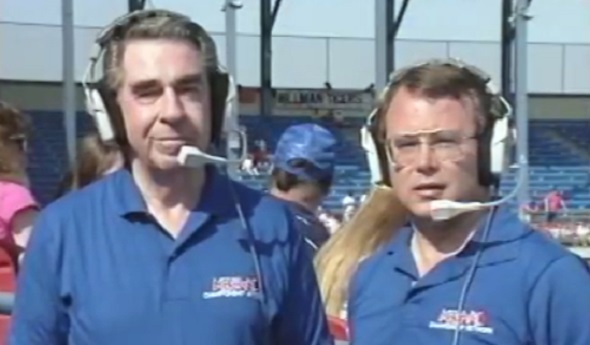
PHOTO: Paul Carey (left) and nephew Mike Carey broadcast the MHSAA 1992 Class D Baseball Final between Hillman and Athens for PASS.
Romulus Summit Academy Continuing Impressive Climb
By
Tom Markowski
Special for Second Half
March 17, 2021
As a co-founder of Romulus Summit Academy, Leann Hedke was intent on creating an atmosphere conducive to academic achievement.
 Summit opened its doors in Flat Rock in 1996 for grades K-5, soon expanding to K-12 once the school moved to Romulus the following year. According to Hedke, in the last 10 years 100 percent of those graduating were accepted to a college or university.
Also, according to a 2017 report, Summit had the highest graduation rate among charter schools in Michigan and was ranked in the top 50 by graduation rate during the 2015-2016 school year. Summit, rated No. 17, had a graduation rate of 98.58 percent, nearly 20 percent better than the state average of 79.65.
Mission accomplished.
But something was missing: a competitive athletics program. Often a viable athletic program will enhance academics. A competitive athletic program can generate enthusiasm and give students a reason to be proud of their school, in addition to academics.
Summit Academy North High School didn’t sponsor varsity sports until the early 2000s and, frankly, they weren’t very good, particularly in the sports of boys basketball and football. From 2004-2016 the football team boasted three winning seasons and made the playoffs once (2007). Until the 2019-20 season, the most wins the basketball team totaled was 10.
“Our focus has been on the scholar-athlete,” Hedke said. “We focus on academics. Our GPA (grade-point average) requirements are higher than what the (Michigan High School Athletic Association) requires.”
Hedke said there’s been quite of bit of turnover in the coaching ranks in boys basketball over the years. Part of this is due to the lack of success, as far as wins and losses, but some of this can be attributed to the high standards Hedke and her fellow administrators demand. Swearing is taboo, and a coach is expected to be a stickler for discipline, and must adhere to a strict decorum.
With the backing of Summit athletic director William McKoy, veteran coach Mark White, less than a month before the start of the season, was hired in November of 2018. Summit was 9-12 during White’s first season before showing vast improvement last winter finishing 16-4. Highlighting that season was the school’s first division title (within the Charter School Conference) and a spot in a Division 2 District Final against Flat Rock. Summit has never won a District title so this game loomed as the most important in school history.
Then COVID-19 hit, ending the season.
 Summit returned four starters from that team and is off to a 15-0 start with the MHSAA Tournament less than a week away. Most of its victories have been by double digits including last Saturday’s 71-53 victory over Taylor, a Division 1 school, and Tuesday’s 72-46 victory over Detroit Community in a conference tournament quarterfinal. Summit’s semifinal is scheduled for Thursday.
Two wins stand out in particular, and both came on the road. Summit defeated Harper Woods Chandler Park Academy, 54-51, on March 1 and then upset No. 3-ranked (in Division 2) Detroit Edison, 49-46, on March 8. Edison’s only other loss this season was to Warren De La Salle Collegiate, a Division 1 school, 72-68. Both Chandler Park and Edison are Charter School Conference members and have had strong programs over the years.
White starts one senior, guard Jamel Johnson, who’s averaging 10 points per game and was selected second-team all-conference. Sophomore James Wright averages 17 points and nine rebounds. White’s top player is junior and three-year starter Orlando Lovejoy, Jr., a 6-2 guard who was selected conference player of the year. His 23 points led Summit in its victory over Community. Lovejoy averages 21 points, 10 rebounds and seven assists per game.
“All of our players got better during the offseason,” Lovejoy said. “(White) is an intense coach. He’s demanding. He’s constantly pushing us. He’s a perfectionist.”
Much of the credit goes to White for the recent success, but one can’t overlook the talented players within the school. Take the recent success of the football program for example. The football team was 0-9 in both 2015 and 2016. The Dragons went 5-4 the next two seasons before finishing 8-3 in 2019, a run which included an 18-12 victory over Redford Union in a Division 4 District opener, the program’s first playoff win. This past regular season was shortened to six games because of the pandemic, and Summit won two playoff games finishing 7-2.
“Summit is an excellent school,” White said. “They’re in line with what I want to be as a coach.
“There are more accolades for a team that hasn’t been that good in the past. (Winning) has never been done before here. I feel the best is yet to come, and not just for the team, but for the school as well. Gaining recognition in basketball helps promote the school. People will find out about how good Summit is as a school.”
Winning is anything but new for White. His first season as a head coach was at his alma mater Detroit Renaissance in 1998. In 2000 Renaissance, which had never played for a Detroit Public School League title, won the PSL defeating Detroit Redford, 41-37, in the championship game. Renaissance won the title again in 2002 and 2003. Renaissance then won two MHSAA Class B titles (2004, 2006) under White.
White left Renaissance after the 2005-06 season to become head coach at Adrian College, another alma mater. He spent seven seasons there before returning to the high school level at River Rouge. White guided River Rouge to the Class B Semifinals in 2017 and 2018.
White said he couldn’t be happier, at this time in his professional life, than he is now at Summit. In addition to his duties as the boys basketball coach, White is also the school’s academic interventionist and assistant athletic director.
 Lovejoy is aware of the success his coach has had at other schools. And even though Summit hasn’t achieved that type of success, he said anything is possible.
“We want to win our conference tournament, a District and Regional title, and the states,” Lovejoy said. “To some that’s farfetched, but it is realistic. We’re with a coach who’s done it before.
“This is special. (Summit) has never won a District, and here we are undefeated. We’re soaking it all in. We want to give the school something to cheer about.”
Lovejoy and his teammates recently gave Hedke a gift from their hearts. It’s a poster, a collage of sorts, with photos of the team in addition to pictures the players painted. This was in response to Hedke being a cancer survivor. She was diagnosed with breast cancer this past November and now is cancer-free.
“Mark is a wonderful coach,” Hedke said. “He focuses on what (the players) do well. He talks about who they are and what they represent. He teaches them to be aware. When I was going through my cancer, he told the players that we’re fighting on the court to win a game. She’s fighting for her life.”
The players have since dedicated their season to Hedke.
 Tom Markowski is a correspondent for the State Champs! Sports Network and previously directed its web coverage. He also covered primarily high school sports for the The Detroit News from 1984-2014, focusing on the Detroit area and contributing to statewide coverage of football and basketball. Contact him at [email protected] with story ideas for Oakland, Macomb and Wayne counties.
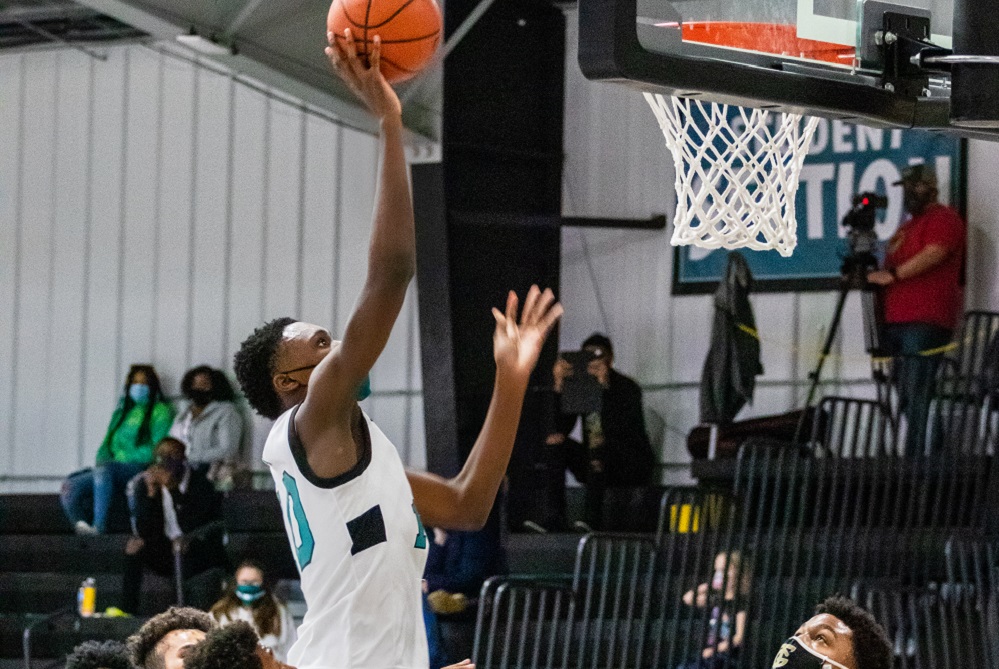
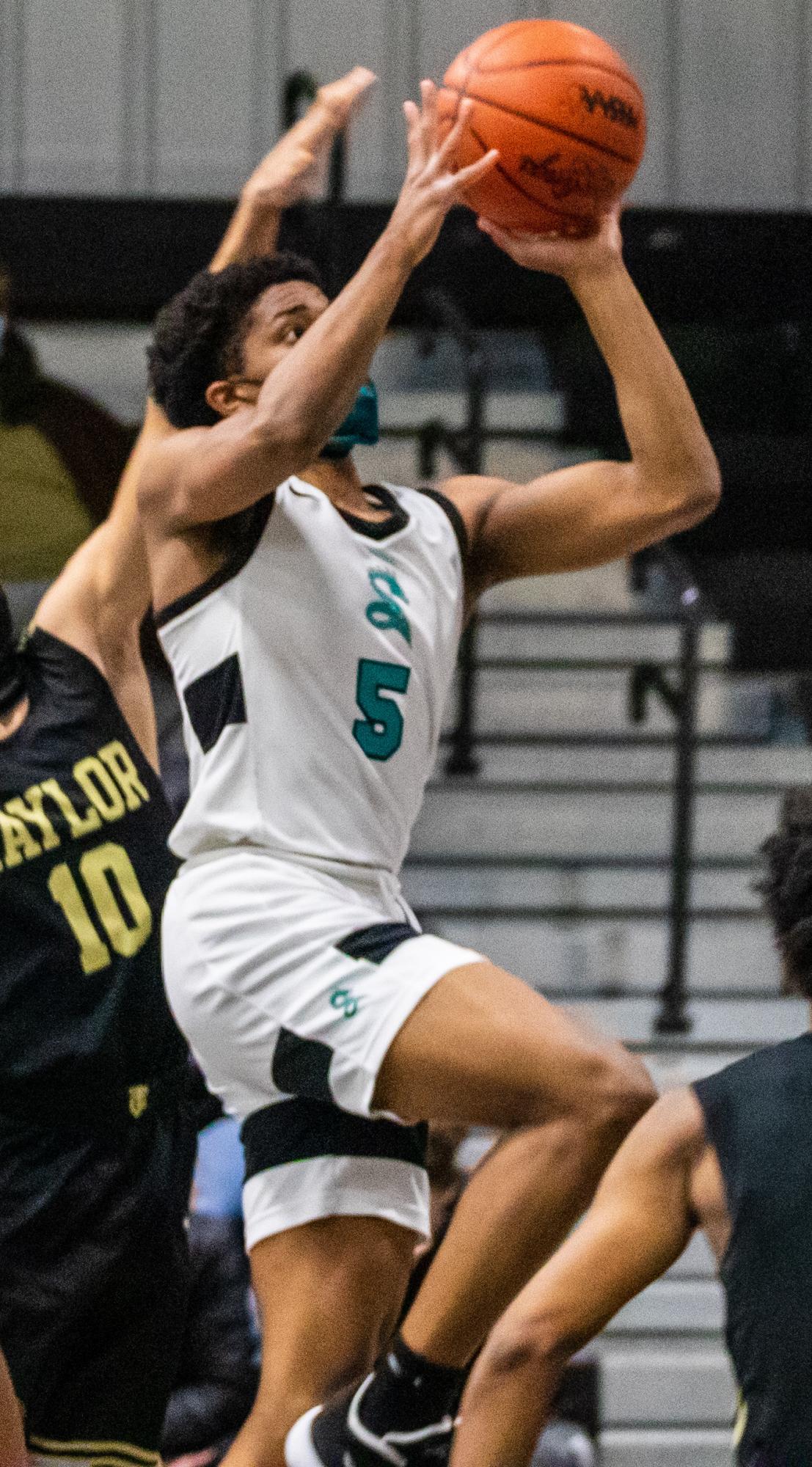
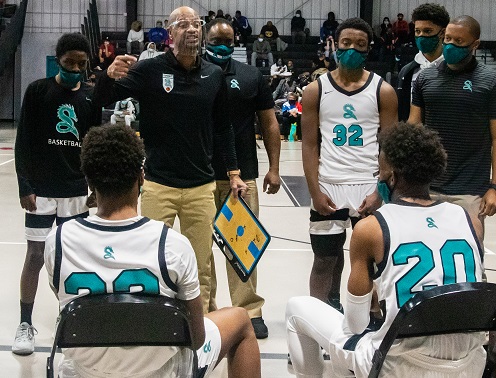
PHOTOS: (Top) Raevon Thomas (10) gets up a shot during Summit Academy’s Senior Night win over Taylor. (Middle) Summit’s Orlando Lovejoy makes a move to the basket Saturday. (Below) Dragons coach Mark White huddles his team. (Photos by Aaron Goodman.)