

Powerful Voice for High School Sports
December 19, 2014
By Geoff Kimmerly
Second Half editor
Paul Carey was home from the U.S. Army only a few months and just shy of 25 years old when Beal City embarked on its first trip deep into the MHSAA boys basketball tournament.
On the call for local radio station WCEN from gyms at Saginaw Arthur Hill and Lansing Sexton, Carey served as the voice of the previously “laughable” Aggies as they reached the Class D Semifinals before falling just six points short of playing for the title.
“All of Beal City emptied out. They’d never had anything before,” Carey recalled during his annual Thanksgiving weekend visit to the MHSAA Football Finals at Ford Field. “When I got home, within the next two weeks I got a letter from every citizen of Beal City thanking me for broadcasting their games. That’s the kind of appreciation that meant so much.”
During 42 years on the airwaves, Carey was best known as a voice of the Detroit Tigers bounding out of transistor radios all over Michigan, thanks to WJR’s powerful signal.
But for the state’s high school sports community, his legacy is similarly memorable as the voice of the longtime football and basketball scoreboard show and a voter for various all-state teams and wire polls over the decades.
Now 86 and retired since 1991, Carey remains a regular during the first day of the Football Finals, taking in games he broadcast for the MHSAA during the late 1970s and that continue to hold his eye as they have for more than a half-century.
“It was a passion of mine. High school sports always has been,” Carey said. “I think because my dad was a high school coach, and teacher initially, and my brother was a high school coach and teacher, I just grew up in families that appreciated coaching and athletics. I was not a great athlete, but it kept my hand in following sports that way.”
Now, the scores
Carey partnered with Ernie Harwell for Tigers radio broadcasts from 1973-91, including during the march to the 1984 World Series championship. He was named Michigan Sportscaster of the Year six times and to the Michigan Sports Hall of Fame in 1992.
But Carey’s early career included sitting on top of a car, plugged into a phone pole, for a Sacred Heart football game at old Fancher Field just a few blocks from his family’s Mount Pleasant home. Among many more accolades are a Distinguished Service Award from the Michigan High School Coaches Association and a place in the Basketball Coaches Association of Michigan Hall of Fame.
In fact, the start of his weekly announcing of statewide football and basketball scores preceded his baseball career by 16 years and ended two months after he announced his final professional out.
The Michigan High School Scoreboard show was a staple of WJR’s late Friday nights from 1957-91. Carey would read every score he could collect from a variety of sources, often organized by league and with state rankings and context mixed in.
His idea came from something similar read by Len Colby for Kalamazoo’s WKZO. Carey’s brother Terry was coaching at Niles during the second half of the 1950s, and he and other coaches would get together to listen to the Friday night scores from the southwestern part of the state.
Carey, who left WKNX in Saginaw for WJR in 1956, explained to then-sports director Bob Reynolds that the station’s strong signal could provide for a truly statewide scoreboard experience.
Carey then connected with Edgar Hayes of the former Detroit Times, who gave the OK for Carey to call the paper on Friday nights to get scores from the Detroit metro area. For the rest, Carey relied on wire services – there were three at the time – who relied on newspapers from all over Michigan to call in scores over the course of an evening.
Before every Friday during high school football season – and later Tuesdays and Fridays during boys basketball season – Carey typed up lists of games based on schedules in the newspaper, with spaces to add scores. More than a few times, Carey raced down a back ramp at Tiger Stadium after a Friday night game, back to the WJR studio, with 15 minutes to prep for the show’s 11:30 p.m. start.
“If the Flint Journal, the Grand Rapids Press, the Traverse City paper didn’t call in scores to the AP, then I was out of luck too. And that happened all the time,” Carey said. “I would call back occasionally, say, ‘Did you get anything more?’ It was a rat race.”
The show originally was set for 10 minutes and then extended to 15. American Airlines sponsored a record show that followed, and Carey’s scoreboard show had a sponsor only once in 35 years. Finishing up on time was expected, even with more than 200 scores to read.
But Carey said he always went 20 minutes, sometimes 25.
“Because I wasn’t done. I just kept right on going,” Carey said. “Jay Roberts did the all-night show most of the time, and he was patient with me. He didn’t say too much on the air about ‘that guy ahead of me took all of my time.’”
Carey continued the “rat race” until his final scoreboard show, Dec. 20, 1991. He retired from WJR at the end of that calendar year. And it's important to note: Carey was never paid a dime extra for doing the program. .
“I think Paul is really just a sports fan, and that came across to the listener on his broadcasts,” MHSAA historian Ron Pesch said. “Paul would gather as much as possible off the wire. He'd interject if scores were missing from sections of the state. Press polls from the Free Press, News, AP and UPI were big, so he could point out close calls and upsets.
“He provided immediacy, or the closest thing to it in the days before cable TV and the Internet, and because of his scoreboard show, you could get the results before the morning paper. For listeners, he brought life to something as simple as game scores.”
First team all the way
Carey, who resides in Rochester, also served as the engineer on Tigers broadcasts for 16 years, through 1990. He broadcast Pistons games on the radio for six seasons and did the first broadcast of a Central Michigan University football game, in 1949.
Harry Atkins, covering Detroit’s teams while with The Associated Press for 29 years including the last 21 as its sports editor for Detroit, took note of his colleague's hard work – and especially that Carey was one of few broadcasters who was a journalist in addition to a voice.
That made Carey's other major role in high school sports a natural fit.
Atkins split The Associated Press all-state selection panels for football and basketball into 11 regions, and Carey represented the Detroit area for a number of years. He also was a longtime voter in those sports' weekly polls.
“Paul is just that kind of guy. He thought it was important and he made time in his busy schedule to do it,” Atkins said “And it had an impact on the other 10 voters on the All-State panels, too.
“Some of them were from small out-state newspapers or radio or TV stations. Yet every one of them knew who Paul Carey was. And when he spoke, of course, with what often is called "The Voice of God," those voters paid attention.”
And he still does, as well.
At the end of each fall, Carey still puts together a compilation of the three high school all-state football teams – Associated Press, Detroit Free Press and Detroit News – and files them with years of research and results.
“It’s important to me. Nobody sees it but me, but I get a certain kick,” Carey said. “Once in a while I’ll see a kid playing at Central, Western or (Michigan) State or Michigan, and they’ll say he came from Clawson. I’ll go into my all-state collections, say that would’ve been 2009 he played, and I find a name.”
In addition to the Football Finals on WJR, Carey was part of the Baseball Finals broadcasts into the early 1990s, continuing to contribute even after his retirement from his fulltime gig.
He spent high school games over the years sitting next to legends like the Free Press’ Hal Schram and remembers when current Free Press longtime scribe Mick McCabe was just a rookie. One of Carey's final broadcasts was a 1992 Baseball Final with his nephew Mike Carey, who continues to broadcast MHSAA championship games to this day.
“I am eternally grateful to Paul Carey. His contribution to high school sports in Michigan has been great and significant,” Atkins said.
“We are lucky to have him.”
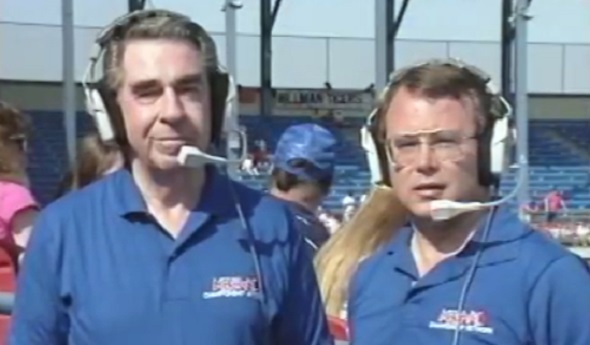
PHOTO: Paul Carey (left) and nephew Mike Carey broadcast the MHSAA 1992 Class D Baseball Final between Hillman and Athens for PASS.
Search for Longest FG Starts in '50s
October 30, 2020
By Ron Pesch
Special for Second Half
Rob LaMielle’s first attempted field goal was a memorable one, and frankly, a bit amazing.
For starters, his track record on extra points, at least to that point in the season, was less than stellar. Flint Holy Redeemer entered their third game of the 1963 slate with a 1-1 record. The Flyers were defeated by Bad Axe in Week 1, then trounced Imlay City the next week. The senior had been successful on only 3 of 9 extra-point placements on the year.
“You had to bring that up,” said LaMielle over 55 years later, laughing at the statistic. “That’s probably so. Bad Axe was rated No. 1 in the state in Class ‘B.’ We were a ‘C’ school. They beat us 13-12 that night, because I missed two extra points. They scored in the very last couple minutes.”
The fact that his field goal was on the mark is all the more impressive considering it traveled 50 yards, clearing the crossbar by three feet, according to observers. Even more remarkable, it was a mere three yards shy of Lou ‘The Toe’ Groza’s best effort for the National Football League’s Cleveland Browns, and just six yards short of the NFL record, set by Bert Rechichar of the Baltimore Colts in 1953. Rechichar held the mark until it was famously topped by New Orleans Saints kicker Tom Dempsey in 1970 against the Detroit Lions.
“We practiced behind our football field,” said LaMielle, recalling how he got the job. “Behind our football field was two baseball fields with a backstop at each end. Well the coach lined everybody up on second base and said, ‘OK, we’re going to find out who can kick a field goal.’ So we started kicking the ball over the backstop. One of the times I kicked it, and it went a long ways.”
St. Redeemer’s coach Dick Clark stopped the drill and named LaMielle the team’s kicker.
“Before my senior year, I’d never kicked off, never attempted an extra point.”
At the time, the 220-pound LaMielle, who, like Groza, played tackle, was asked if he was surprised by the success of his kick.
“I was more surprised Coach Clark asked me to try it,” he said.
The field goal helped Flint Holy Redeemer top Bay City St. James, 29-6.
It also prompted another question from sports reporters. Was LaMielle’s kick a Michigan high school record?
The Search
The publicity surrounding the kick sent sportswriters around the state scurrying for the archives.
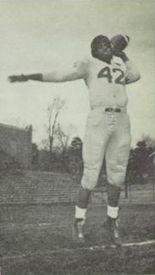 Initial inquiries indicated that Jim Yore of Battle Creek Central held the state mark, with a 56-yard field goal about 10 years prior, but a recheck of records by Dick Kishpaugh, “sports publicity director at Kalamazoo College and a close observer of Michigan prep football records,” indicated that Yore’s longest had been a 38-yard field goal, kicked on the last play of the game to beat Ypsilanti 3-0 on Oct. 3, 1952. It was thought to be the longest in state history.
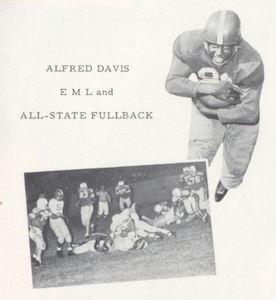
Additional digging found that Port Huron High School’s Alfred Davis, a 212-pound fullback, had drilled a flawless 46-yard field goal in a 19-14 win over Hazel Park in 1953.
“The word ‘tremendous’ is probably one of the most overused words in sports lexicon,” wrote Port Huron Times reporter Fred J. Vincent, “but it should be used in describing this kick.”
Vincent called it “perfect, splitting the uprights and clearing the bar by about six feet.”
Impressively, Davis also had kicked a 36-yarder earlier in the contest. “Bob Boyd held on both kicks,” added the sportswriter. “Not since Oct. 8, 1930 had a Big Red player kicked a three pointer. Hank Ceasor did it then to best Ferndale, 3-0.”
Word came that Cheboygan Catholic’s Joe Poirier had kicked one “reported to have traveled at least 53 yards from the point of the kick to the goal posts” in a 10-0 victory over Alcona in 1957. Since the MHSAA didn’t keep records at the time, Kishpaugh added it to his listing of unofficial state records.
The Ironwood Daily Globe unearthed a nugget. While it wasn’t considered by Kishpaugh for his record book, it did bring back memories of changes seen in the game.
Ironwood’s John ‘Cutz’ Cavosie made a “tremendous boot on Oct. 10, 1925 in the final seconds of a game at Oliver Field here in which Ironwood swamped Menominee 41-0. Cavosie apparently was back to punt, but instead he dropkicked the ball squarely through the goal posts 55 yards away. He was in his senior year that fall and was captain of the team. He played a big role in the rout on Menominee by scoring on runs of 42, 51 and 67 yards.”
Record Toppled
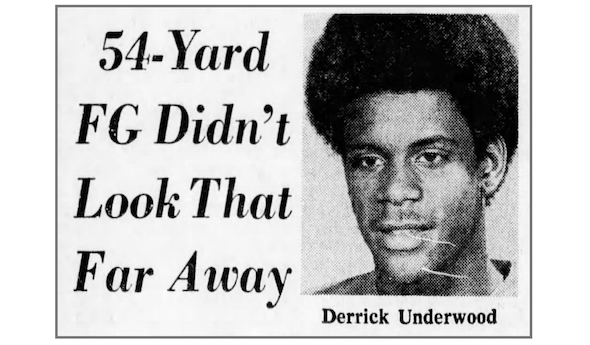
So it was quite the event when, nearly 19 years later, junior Derrick Underwood broke Poirier’s mark on a cold October Friday at Inkster.
A week earlier, Underwood had made his first field goal of the season, a 23-yard boot in overtime to give Ecorse its first victory of the year in five starts, 9-6, over River Rouge. This time, his kick gave Ecorse a 3-0 victory over the Vikings, although in decidedly less dramatic fashion as the kick came in the second quarter.
 “The strange thing is I didn’t even know that I was kicking it from the 44-yard line. To be honest, I wasn’t paying that much attention and it didn’t look that long,” Underwood told the Detroit Free Press in 1976. “But I got a real good snap on it and an excellent hold.
Red Raiders coach Patrick Kearney believed the kick would have been good from another five or 10 yards out.
“It felt good when I hit it,” added Underwood, “but because I was in front of the goal posts, I couldn’t tell whether it went over or under the crossbar. But I saw my teammates jumping up and down on the sidelines and I knew it made it.
“I was pretty loose because I figured that if I missed, we still had another half to come back and win it.”
Underwood’s accomplishment garnered national attention in the June/July ’77 issue of Joe Namath’s National Prep Sports magazine. At the time, Jerry Spicer of Hobart (Ind.) High School held the national record with a kick of 61 yards in 1975.
Exasperation to Jubilation
Underwood, who also served as the Red Raiders’ quarterback and defensive end, guided the team to Inkster’s one-foot line in that same game as the clock wound down. But with the lead, instead of pushing for the end zone, they let time expire.
A year earlier, in 1975, the Ecorse players watched their season disappear after a single game.
“The school millage was defeated just prior to the start of that season,” said Underwood, recalling his high school days some 45 years later. “I was the starting QB for the Red Raiders through my senior year ('78). We were heartbroken that our season was over after the first game against Muskegon Heights. No energy for that game.
“We were foaming at the mouth to be playing organized football. Some of us played flag football to stay active.”
“I was just practicing holding for a teammate,” Underwood had told the Free Press back in October 1976. “Eventually I thought I’d try and I got to be pretty good at it.”
“I didn’t take kicking seriously at all,” he states now. “I wasn’t a dedicated kicker. My stars were aligned in my head as being the next Thomas Lott.”
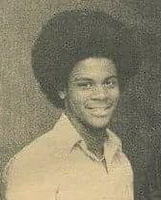 Lott, a Parade All-American out of San Antonio, Texas, played quarterback at Oklahoma, where his coach, the legendary Barry Switzer, once called him the greatest wishbone quarterback in Oklahoma history.
“Went down to Tennessee State University and found out how much football I didn’t know,” Underwood said.
Reminiscing he added, “Looking back, wouldn’t change a thing growing up in Ecorse.”
Equaled, then Topped – in the Same Game
Underwood’s mark would hold in Michigan until 1979, when junior Harold Moore of Dearborn equaled, then topped the mark in a season-ending game against Plymouth Canton.
Moore, a left-footed, straight-on kicking specialist, matched Underwood’s record with a 54-yard boot in the game’s first half, and then topped the record with a 55-yard field goal during the second half.
“I’ve never seen anyone with the leg power he has,” said his coach, Dick Ryan. “His 55-yard field goal cleared the bar with 20 feet to spare.”
Over the next two seasons, three players – Mike Prindle of Grand Rapids Union (1980), Bob Hirschman from Sterling Heights Ford (1980), and Dave Blackmer of Farmington Hills Harrison (1981) – would match Moore’s longest kick.
Since then, only five players have matched or exceeded 55 yards. John Langeloh of Utica shattered the mark in 1985 with a 58 yarder. Doug Kochanski of Warren Woods-Tower is the state’s current record holder, with a kick in 1994 that traveled 59 yards before splitting the uprights. The successful kick came in his final high school contest.
In these days of more and more specialization, one wonders, will Michigan ever see one of 60 yards or more?
 Ron Pesch has taken an active role in researching the history of MHSAA events since 1985 and began writing for MHSAA Finals programs in 1986, adding additional features and "flashbacks" in 1992. He inherited the title of MHSAA historian from the late Dick Kishpaugh following the 1993-94 school year, and resides in Muskegon. Contact him at [email protected] with ideas for historical articles.
PHOTOS: (Top) The Detroit Free Press told the story behind Derrick Underwood’s record field goal for Ecorse in its Oct. 30, 1976 edition. (2) Battle Creek Central’s Jim Yore was one of the earliest record holders for longest field goal in Michigan high school history. (3) Alfred Davis also was a standout fullback for Port Huron. (4) Underwood also played quarterback and defensive end for the Red Raiders. (Photos gathered by Ron Pesch.)