

Powerful Voice for High School Sports
December 19, 2014
By Geoff Kimmerly
Second Half editor
Paul Carey was home from the U.S. Army only a few months and just shy of 25 years old when Beal City embarked on its first trip deep into the MHSAA boys basketball tournament.
On the call for local radio station WCEN from gyms at Saginaw Arthur Hill and Lansing Sexton, Carey served as the voice of the previously “laughable” Aggies as they reached the Class D Semifinals before falling just six points short of playing for the title.
“All of Beal City emptied out. They’d never had anything before,” Carey recalled during his annual Thanksgiving weekend visit to the MHSAA Football Finals at Ford Field. “When I got home, within the next two weeks I got a letter from every citizen of Beal City thanking me for broadcasting their games. That’s the kind of appreciation that meant so much.”
During 42 years on the airwaves, Carey was best known as a voice of the Detroit Tigers bounding out of transistor radios all over Michigan, thanks to WJR’s powerful signal.
But for the state’s high school sports community, his legacy is similarly memorable as the voice of the longtime football and basketball scoreboard show and a voter for various all-state teams and wire polls over the decades.
Now 86 and retired since 1991, Carey remains a regular during the first day of the Football Finals, taking in games he broadcast for the MHSAA during the late 1970s and that continue to hold his eye as they have for more than a half-century.
“It was a passion of mine. High school sports always has been,” Carey said. “I think because my dad was a high school coach, and teacher initially, and my brother was a high school coach and teacher, I just grew up in families that appreciated coaching and athletics. I was not a great athlete, but it kept my hand in following sports that way.”
Now, the scores
Carey partnered with Ernie Harwell for Tigers radio broadcasts from 1973-91, including during the march to the 1984 World Series championship. He was named Michigan Sportscaster of the Year six times and to the Michigan Sports Hall of Fame in 1992.
But Carey’s early career included sitting on top of a car, plugged into a phone pole, for a Sacred Heart football game at old Fancher Field just a few blocks from his family’s Mount Pleasant home. Among many more accolades are a Distinguished Service Award from the Michigan High School Coaches Association and a place in the Basketball Coaches Association of Michigan Hall of Fame.
In fact, the start of his weekly announcing of statewide football and basketball scores preceded his baseball career by 16 years and ended two months after he announced his final professional out.
The Michigan High School Scoreboard show was a staple of WJR’s late Friday nights from 1957-91. Carey would read every score he could collect from a variety of sources, often organized by league and with state rankings and context mixed in.
His idea came from something similar read by Len Colby for Kalamazoo’s WKZO. Carey’s brother Terry was coaching at Niles during the second half of the 1950s, and he and other coaches would get together to listen to the Friday night scores from the southwestern part of the state.
Carey, who left WKNX in Saginaw for WJR in 1956, explained to then-sports director Bob Reynolds that the station’s strong signal could provide for a truly statewide scoreboard experience.
Carey then connected with Edgar Hayes of the former Detroit Times, who gave the OK for Carey to call the paper on Friday nights to get scores from the Detroit metro area. For the rest, Carey relied on wire services – there were three at the time – who relied on newspapers from all over Michigan to call in scores over the course of an evening.
Before every Friday during high school football season – and later Tuesdays and Fridays during boys basketball season – Carey typed up lists of games based on schedules in the newspaper, with spaces to add scores. More than a few times, Carey raced down a back ramp at Tiger Stadium after a Friday night game, back to the WJR studio, with 15 minutes to prep for the show’s 11:30 p.m. start.
“If the Flint Journal, the Grand Rapids Press, the Traverse City paper didn’t call in scores to the AP, then I was out of luck too. And that happened all the time,” Carey said. “I would call back occasionally, say, ‘Did you get anything more?’ It was a rat race.”
The show originally was set for 10 minutes and then extended to 15. American Airlines sponsored a record show that followed, and Carey’s scoreboard show had a sponsor only once in 35 years. Finishing up on time was expected, even with more than 200 scores to read.
But Carey said he always went 20 minutes, sometimes 25.
“Because I wasn’t done. I just kept right on going,” Carey said. “Jay Roberts did the all-night show most of the time, and he was patient with me. He didn’t say too much on the air about ‘that guy ahead of me took all of my time.’”
Carey continued the “rat race” until his final scoreboard show, Dec. 20, 1991. He retired from WJR at the end of that calendar year. And it's important to note: Carey was never paid a dime extra for doing the program. .
“I think Paul is really just a sports fan, and that came across to the listener on his broadcasts,” MHSAA historian Ron Pesch said. “Paul would gather as much as possible off the wire. He'd interject if scores were missing from sections of the state. Press polls from the Free Press, News, AP and UPI were big, so he could point out close calls and upsets.
“He provided immediacy, or the closest thing to it in the days before cable TV and the Internet, and because of his scoreboard show, you could get the results before the morning paper. For listeners, he brought life to something as simple as game scores.”
First team all the way
Carey, who resides in Rochester, also served as the engineer on Tigers broadcasts for 16 years, through 1990. He broadcast Pistons games on the radio for six seasons and did the first broadcast of a Central Michigan University football game, in 1949.
Harry Atkins, covering Detroit’s teams while with The Associated Press for 29 years including the last 21 as its sports editor for Detroit, took note of his colleague's hard work – and especially that Carey was one of few broadcasters who was a journalist in addition to a voice.
That made Carey's other major role in high school sports a natural fit.
Atkins split The Associated Press all-state selection panels for football and basketball into 11 regions, and Carey represented the Detroit area for a number of years. He also was a longtime voter in those sports' weekly polls.
“Paul is just that kind of guy. He thought it was important and he made time in his busy schedule to do it,” Atkins said “And it had an impact on the other 10 voters on the All-State panels, too.
“Some of them were from small out-state newspapers or radio or TV stations. Yet every one of them knew who Paul Carey was. And when he spoke, of course, with what often is called "The Voice of God," those voters paid attention.”
And he still does, as well.
At the end of each fall, Carey still puts together a compilation of the three high school all-state football teams – Associated Press, Detroit Free Press and Detroit News – and files them with years of research and results.
“It’s important to me. Nobody sees it but me, but I get a certain kick,” Carey said. “Once in a while I’ll see a kid playing at Central, Western or (Michigan) State or Michigan, and they’ll say he came from Clawson. I’ll go into my all-state collections, say that would’ve been 2009 he played, and I find a name.”
In addition to the Football Finals on WJR, Carey was part of the Baseball Finals broadcasts into the early 1990s, continuing to contribute even after his retirement from his fulltime gig.
He spent high school games over the years sitting next to legends like the Free Press’ Hal Schram and remembers when current Free Press longtime scribe Mick McCabe was just a rookie. One of Carey's final broadcasts was a 1992 Baseball Final with his nephew Mike Carey, who continues to broadcast MHSAA championship games to this day.
“I am eternally grateful to Paul Carey. His contribution to high school sports in Michigan has been great and significant,” Atkins said.
“We are lucky to have him.”
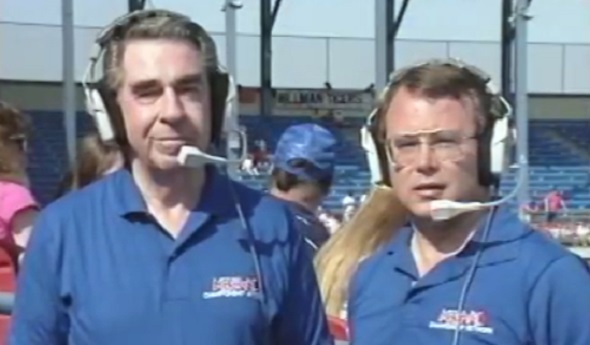
PHOTO: Paul Carey (left) and nephew Mike Carey broadcast the MHSAA 1992 Class D Baseball Final between Hillman and Athens for PASS.

After Inspiring Return, Bartlett Marches On
March 27, 2020
By Doug Donnelly
Special for Second Half
TEMPERANCE – Just before the Temperance Bedford wrestling team was to enter the arena at Kalamazoo’s Wings Event Center for opening ceremonies of the MHSAA Team Finals this winter, head coach Kevin Vogel told Connor Bartlett he had a job for him.
 “I had no idea what it was,” Bartlett said. “Then, he called me up to the front and handed me the flag.”
Bartlett had been chosen to usher in the event. It was a moving tribute to the 17-year-old Bedford athlete who, about a year ago, wasn’t sure he would still be alive.
“It was a great honor,” Bartlett said. “I had never been to the state finals before. I didn’t know anything about the ceremony.
“We were the first team to enter the arena. They had me carrying the flag for the City of Kalamazoo. I led my team and all of the wrestlers into the arena. It was amazing. It’s something I’ll never forget. To be at the forefront of my team and lead them was fantastic.”
Bartlett was the perfect choice to lead Bedford into its first trip to Finals weekend since 2016. The senior wrestler missed his junior season on the mat while he battled testicular carcinoma. At times, he was forced to make peace with the possibility that the cancer might win.
“I always kept that in mind – that I wanted to get back on the mat. That was a big source of inspiration and something I wanted,” he said.
Bartlett went to Ottawa Lake Whiteford until his freshman year, when his family moved into neighboring Bedford Township. He had never wrestled before but had heard about Bedford’s storied wrestling program.
“My brother had started wrestling a year or two before me,” he said. “I had always heard about Bedford’s wrestling program. My freshman year came, and I played football at Bedford. I thought I would wrestle as a way to stay in shape for football. I ended up loving wrestling so much I decided to give up football and concentrate on wrestling.”
That first year on the mat, he said, there was a huge learning curve.
“My first year was pretty rough,” he said. “I only won a single match all year.”
His sophomore year saw rapid improvement, enough that he won a JV tournament.
“I do not consider myself a natural at wrestling,” he said. “It was 100-percent hard work. Actually, most of it was the great coaches that Bedford has.”
He anticipated an even more improved season as a junior, but that had to be put on hold. Near the end of his sophomore school year, Bartlett was watching TV at home when the right side of his body went numb. It felt, to him, like it fell asleep. He didn’t think much of it until a short time later he was at school and it happened again. This time, it was his entire body that went numb.
 “The paramedics came,” he said. “I knew something was wrong.”
After a series of tests, doctors soon discovered Bartlett had testicular carcinoma. If that wasn’t enough bad news, doctors told Bartlett it was stage four.
“It had spread to my lungs, my brain and part of my kidney,” he said.
He began chemotherapy treatments almost immediately. He had tumors removed, went through more treatments and had a bone marrow transplant that kept him hospitalized for about 40 days. It was during that time that Vogel brought the Bedford wrestling team on a surprise visit to see him at the University of Michigan Hospital in Ann Arbor. The visit had a major impact on him, Bartlett said.
“That was pretty big,” he said. “I had so much support.”
While doctors continued treatments, scans and tests, Bartlett never lost faith.
“It was pretty severe,” he said. “The doctors told me everything. I didn’t want them to hold anything back.
“Throughout the process I was at peace. I was calm. I had 100-percent faith if I died, I would wake up in heaven. I had no doubts about that.”
While things looked bleak at times, Bartlett pressed on, determined. The treatments worked. Finally, the last spot of cancer on his lungs went away, and the cancer remains in remission. He’s had a couple of follow-up tests and is cancer-free now.
He rejoined the wrestling team this year. Bartlett had lost between 20-30 pounds but was able to get back to his wrestling weight for the season.
“I had done some stuff, but I had just started to lift and run around the time the season started,” Bartlett said. “Once I got used to it, I was just working out with the team. It was an ongoing thing. It felt good to get back into the swing of things. I was done with that portion of my life.”
It was about midseason that he began to feel like he was back in wrestling shape. He ended the season with a 13-14 record.
“It was better than I could have expected,” Bartlett said.
Now that wrestling season is complete, Bartlett is focused on the next stage in life. He wants to go to college, study nursing, and become a missionary through the church in Lambertville where his dad, Brett Bartlett, is pastor. He wants to take the message of God to other countries. A couple of years ago he went on a mission trip to Hungary and helped put on what amounted to a vacation Bible school for children. “It was awesome seeing all of these kids accept Christ,” he said. “It was great to be part of that.”
Bartlett is grateful for his church, family and teammates who stuck with him through the entire ordeal. His dad, mom (Kim) and three siblings were always by his side.
“They were with me 100 percent,” he said. “I always had someone by my bedside. They gave up part of their lives to be with me.”
 Doug Donnelly has served as a sports and news reporter and city editor over 25 years, writing for the Daily Chief-Union in Upper Sandusky, Ohio from 1992-1995, the Monroe Evening News from 1995-2012 and the Adrian Daily Telegram since 2013. He's also written a book on high school basketball in Monroe County and compiles record books for various schools in southeast Michigan. E-mail him at [email protected] with story ideas for Jackson, Washtenaw, Hillsdale, Lenawee and Monroe counties.
PHOTOS: (Top) Temperance Bedford’s Connor Bartlett leads his team into the Wings Event Center arena before the Division 1 Team Quarterfinals on Feb. 28. (Middle) Bartlett prepares to carry the City of Kalamazoo flag during the procession. (Click for more from HighSchoolSportsScene.com.)