

Powerful Voice for High School Sports
December 19, 2014
By Geoff Kimmerly
Second Half editor
Paul Carey was home from the U.S. Army only a few months and just shy of 25 years old when Beal City embarked on its first trip deep into the MHSAA boys basketball tournament.
On the call for local radio station WCEN from gyms at Saginaw Arthur Hill and Lansing Sexton, Carey served as the voice of the previously “laughable” Aggies as they reached the Class D Semifinals before falling just six points short of playing for the title.
“All of Beal City emptied out. They’d never had anything before,” Carey recalled during his annual Thanksgiving weekend visit to the MHSAA Football Finals at Ford Field. “When I got home, within the next two weeks I got a letter from every citizen of Beal City thanking me for broadcasting their games. That’s the kind of appreciation that meant so much.”
During 42 years on the airwaves, Carey was best known as a voice of the Detroit Tigers bounding out of transistor radios all over Michigan, thanks to WJR’s powerful signal.
But for the state’s high school sports community, his legacy is similarly memorable as the voice of the longtime football and basketball scoreboard show and a voter for various all-state teams and wire polls over the decades.
Now 86 and retired since 1991, Carey remains a regular during the first day of the Football Finals, taking in games he broadcast for the MHSAA during the late 1970s and that continue to hold his eye as they have for more than a half-century.
“It was a passion of mine. High school sports always has been,” Carey said. “I think because my dad was a high school coach, and teacher initially, and my brother was a high school coach and teacher, I just grew up in families that appreciated coaching and athletics. I was not a great athlete, but it kept my hand in following sports that way.”
Now, the scores
Carey partnered with Ernie Harwell for Tigers radio broadcasts from 1973-91, including during the march to the 1984 World Series championship. He was named Michigan Sportscaster of the Year six times and to the Michigan Sports Hall of Fame in 1992.
But Carey’s early career included sitting on top of a car, plugged into a phone pole, for a Sacred Heart football game at old Fancher Field just a few blocks from his family’s Mount Pleasant home. Among many more accolades are a Distinguished Service Award from the Michigan High School Coaches Association and a place in the Basketball Coaches Association of Michigan Hall of Fame.
In fact, the start of his weekly announcing of statewide football and basketball scores preceded his baseball career by 16 years and ended two months after he announced his final professional out.
The Michigan High School Scoreboard show was a staple of WJR’s late Friday nights from 1957-91. Carey would read every score he could collect from a variety of sources, often organized by league and with state rankings and context mixed in.
His idea came from something similar read by Len Colby for Kalamazoo’s WKZO. Carey’s brother Terry was coaching at Niles during the second half of the 1950s, and he and other coaches would get together to listen to the Friday night scores from the southwestern part of the state.
Carey, who left WKNX in Saginaw for WJR in 1956, explained to then-sports director Bob Reynolds that the station’s strong signal could provide for a truly statewide scoreboard experience.
Carey then connected with Edgar Hayes of the former Detroit Times, who gave the OK for Carey to call the paper on Friday nights to get scores from the Detroit metro area. For the rest, Carey relied on wire services – there were three at the time – who relied on newspapers from all over Michigan to call in scores over the course of an evening.
Before every Friday during high school football season – and later Tuesdays and Fridays during boys basketball season – Carey typed up lists of games based on schedules in the newspaper, with spaces to add scores. More than a few times, Carey raced down a back ramp at Tiger Stadium after a Friday night game, back to the WJR studio, with 15 minutes to prep for the show’s 11:30 p.m. start.
“If the Flint Journal, the Grand Rapids Press, the Traverse City paper didn’t call in scores to the AP, then I was out of luck too. And that happened all the time,” Carey said. “I would call back occasionally, say, ‘Did you get anything more?’ It was a rat race.”
The show originally was set for 10 minutes and then extended to 15. American Airlines sponsored a record show that followed, and Carey’s scoreboard show had a sponsor only once in 35 years. Finishing up on time was expected, even with more than 200 scores to read.
But Carey said he always went 20 minutes, sometimes 25.
“Because I wasn’t done. I just kept right on going,” Carey said. “Jay Roberts did the all-night show most of the time, and he was patient with me. He didn’t say too much on the air about ‘that guy ahead of me took all of my time.’”
Carey continued the “rat race” until his final scoreboard show, Dec. 20, 1991. He retired from WJR at the end of that calendar year. And it's important to note: Carey was never paid a dime extra for doing the program. .
“I think Paul is really just a sports fan, and that came across to the listener on his broadcasts,” MHSAA historian Ron Pesch said. “Paul would gather as much as possible off the wire. He'd interject if scores were missing from sections of the state. Press polls from the Free Press, News, AP and UPI were big, so he could point out close calls and upsets.
“He provided immediacy, or the closest thing to it in the days before cable TV and the Internet, and because of his scoreboard show, you could get the results before the morning paper. For listeners, he brought life to something as simple as game scores.”
First team all the way
Carey, who resides in Rochester, also served as the engineer on Tigers broadcasts for 16 years, through 1990. He broadcast Pistons games on the radio for six seasons and did the first broadcast of a Central Michigan University football game, in 1949.
Harry Atkins, covering Detroit’s teams while with The Associated Press for 29 years including the last 21 as its sports editor for Detroit, took note of his colleague's hard work – and especially that Carey was one of few broadcasters who was a journalist in addition to a voice.
That made Carey's other major role in high school sports a natural fit.
Atkins split The Associated Press all-state selection panels for football and basketball into 11 regions, and Carey represented the Detroit area for a number of years. He also was a longtime voter in those sports' weekly polls.
“Paul is just that kind of guy. He thought it was important and he made time in his busy schedule to do it,” Atkins said “And it had an impact on the other 10 voters on the All-State panels, too.
“Some of them were from small out-state newspapers or radio or TV stations. Yet every one of them knew who Paul Carey was. And when he spoke, of course, with what often is called "The Voice of God," those voters paid attention.”
And he still does, as well.
At the end of each fall, Carey still puts together a compilation of the three high school all-state football teams – Associated Press, Detroit Free Press and Detroit News – and files them with years of research and results.
“It’s important to me. Nobody sees it but me, but I get a certain kick,” Carey said. “Once in a while I’ll see a kid playing at Central, Western or (Michigan) State or Michigan, and they’ll say he came from Clawson. I’ll go into my all-state collections, say that would’ve been 2009 he played, and I find a name.”
In addition to the Football Finals on WJR, Carey was part of the Baseball Finals broadcasts into the early 1990s, continuing to contribute even after his retirement from his fulltime gig.
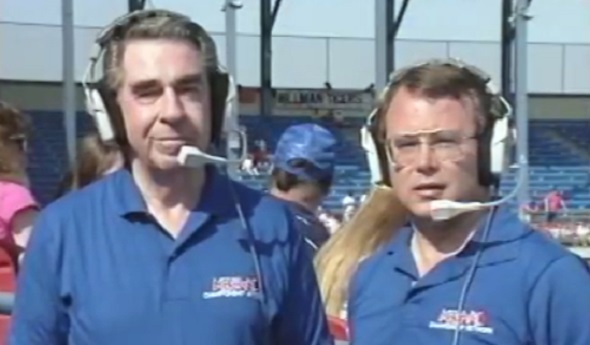
He spent high school games over the years sitting next to legends like the Free Press’ Hal Schram and remembers when current Free Press longtime scribe Mick McCabe was just a rookie. One of Carey's final broadcasts was a 1992 Baseball Final with his nephew Mike Carey, who continues to broadcast MHSAA championship games to this day.
“I am eternally grateful to Paul Carey. His contribution to high school sports in Michigan has been great and significant,” Atkins said.
“We are lucky to have him.”
PHOTO: Paul Carey (left) and nephew Mike Carey broadcast the MHSAA 1992 Class D Baseball Final between Hillman and Athens for PASS.

More States Begin Mental Health Efforts
January 2, 2020
Editor’s Note: This is part of a series on NFHS News addressing the challenges of mental health issues in high school athletics. This article explores one statewide approach to this important subject.
Suicide is a serious public health problem. It is the second-leading cause of death of high school-aged individuals in the United States. (National Vital Statistics Report 2016 Data Published by the CDC July 2018)
In Oregon, the suicide rate is higher than the national average, and a recent survey of 11th-graders found that within the past year, 18 percent seriously considered suicide and 7 percent attempted suicide. (Youth Suicide Annual Report 2017 & Oregon Healthy Teens Survey 2017)
More concerning is the fact that the rate of completed suicides in youth has been increasing since 2011. Not only does suicide lead to a life lost much too early, it leaves a devastating impact on those left behind.
Fortunately, suicides are preventable. The Oregon Youth Suicide Intervention and Prevention Plan was created calling for “Zero Suicide ... through collective action among health and behavioral health systems, schools, communities, parents and other systems that touch the lives of youth.” (Youth Suicide Annual Report 2017) For numerous reasons, schools are being used as the primary means of dissemination and implementation of suicide prevention interventions.
One group of school personnel that had not been traditionally considered in school-based efforts are school activities personnel: coaches, athletic trainers and athletic administrators. These individuals spend a great deal of time with students, developing relationships that may go beyond what a student typically has with a teacher.
 Coaches, athletic trainers and athletic administrators are in the ideal position to recognize behavioral warning signs or be the point person for students to go to if they have concerns about a peer. This is vital as youth considering suicide often talk about suicide and exhibit behaviors and/or moods associated with increased suicide risk. Additionally, activities personnel are school leaders who are often known and trusted by parents, thus creating more opportunities for dialogue on suicide prevention.
Realizing the impact youth suicide has on school communities and the prevention opportunities that exist, the leadership of the Oregon School Activities Association (OSAA), the Oregon Athletic Coaches Association, the Oregon Athletic Directors Association and the Oregon Athletic Trainers’ Society partnered to promote the role of high school activities personnel in preventing youth suicide. While these groups had multiple means of reaching out to the intended audience, the leadership realized help was needed from experts for a statewide education campaign to be successful. The Suicide Intervention Coordinator for the Oregon Health Authority (the state agency charged with overseeing Oregon’s health-related programs) was contacted and agreed to assist in developing a statewide educational campaign geared to activities personnel.
The Campaign
It was determined that a series of articles geared specifically to activities personnel would be written by the Oregon Health Authority and then disseminated by the OSAA throughout the academic year.
The articles typically contained two pages of practical information and tips. The campaign was not designed to replace a formal suicide gatekeeper training; rather, it served to promote awareness of the role activities personnel play in countering the rising problem. The articles and additional resources were also posted to the OSAA website.
The OSAA Foundation provided funding for a poster that was provided to schools to be placed in locker rooms, team rooms, athletic training rooms and other areas where students congregate. The primary goal of the poster was to provide students with contact information for crisis lines.
Toward the end of the campaign, workshops were presented by a representative from the American Foundation for Suicide Prevention at the Oregon Athletic Directors Association’s annual statewide conference. The goal was to provide information on programs and policies that athletic administrators could implement at their schools.
While the campaign only spanned the 2017-18 academic year, the leadership of the stakeholder groups believed there was still more that could be done. In 2018-19, a campaign on anti-hazing and anti-bullying (which is a risk factor for suicide) was implemented using a similar approach as the suicide prevention campaign.
In addition, the groups coordinated a high school coaches’ symposium that included breakout sessions on suicide prevention, hazing prevention and character education.
Lessons Learned
Individuals who work with students involved with high school activity programs realize the power and opportunities which exist for positive character development. The focus of this campaign was to highlight a significant and growing public health problem – youth suicide. The goal of the campaign was to increase awareness and provide appropriate resources – not to create experts in suicide prevention.
The collaborative nature of this campaign strengthened the relationships between the different groups working together with a specific purpose. The groups have now partnered on several additional campaigns – the aforementioned anti-hazing/anti-bullying campaign and promoting the development of Emergency Action Plans.
The campaign also allowed the groups to work closely with state public health officials. While the OSAA had previously partnered with state public health officials regarding air quality policies and a guidance document for medical providers on pre-participation physical exams, this campaign provided several new and distinct advantages.
State public health officials were able to see the positive impact of participation in high school activity programs beyond just the activity itself – namely the positive mentorship relationships that may develop. They were also impressed by the large audience the campaign reached and the feedback provided (due to the expansive network of activities administrators, coaches and athletic trainers that the OSAA reaches). Ideally, this will spur additional collaborations in the future.
A major challenge for schools and school personnel is the competing demands for time and resources for the many worthy interventions and activities. Unfortunately, it is impossible to commit to all interventions and activities that may benefit students. While there was a monetary cost for the posters to be distributed to schools, development of the actual campaign articles and presentations were done by individuals as part of their job related to suicide prevention, so the campaign was relatively inexpensive. Since it was distributed throughout the year, it did not require a large time commitment from activities personnel and the monthly articles kept the issue front and center.
Conclusion
The statewide Youth Suicide Awareness Campaign is just one example of how the unique role of school activities personnel can be leveraged and how stakeholder organizations and state public health agencies can maximize their impact and reach through collaboration. While we will continue to review suicide incidence in Oregon during the coming years, the campaign is seen as a success at this point. It has strengthened relationships between the involved entities, and it promoted the role of coaches, athletic trainers and athletic administrators as mentors and trusted individuals to make an impact that extends beyond wins and losses.
— Sam Johnson, Rob Younger, Peter Weber, NFHS News, March 12, 2019
Colorado Institutes Mental Health Requirement
In a major step aimed at improving mental health of students across Colorado high schools, the CHSAA Board of Directors approved as a requirement that all coaches take a course on student mental health.
It is among the major topics facing high school students today. According to the U.S. Department of Health & Human Services, 31 percent of high school students reported symptoms of depression in 2017, and 17 percent reported they seriously considered attempting suicide.
 So, starting this fall, all coaches must take a course “Student Mental Health and Suicide Prevention” on the NFHS Learning Center, or a district-led mental health training. The NFHS Learn course is free.
In order to be a registered coach, this requirement must be satisfied. Unregistered coaches are not permitted to coach, per CHSAA bylaws. Other required courses or training are based around concussion, first aid, mandatory reporting, and the CHSAA coaches course.
“CHSAA’s vision is to deconstruct the stereotypes around mental health and help start the conversations that need to happen around our kids,” said CHSAA commissioner Rhonda Blanford-Green. “The mental and physical well-being of our student participants is our priority.”
The decision was made with the full support of the Sports Medicine Advisory Committee (SMAC), which discussed the topic at length during its meeting last school year.
“The committee was focused on finding great tools that we can give to our schools and coaches to help provide awareness around mental health, which is among the most important issues our students face,” said Jenn Roberts-Uhlig, the CHSAA staff liaison to SMAC. “We believe it is important for coaches to not be afraid to look for the signs and symptoms of a student who is struggling with their mental health, and this training will provide valuable instruction in how to do that.”
— Ryan Casey/CHSAA, June 27, 2019