

Powerful Voice for High School Sports
December 19, 2014
By Geoff Kimmerly
Second Half editor
Paul Carey was home from the U.S. Army only a few months and just shy of 25 years old when Beal City embarked on its first trip deep into the MHSAA boys basketball tournament.
On the call for local radio station WCEN from gyms at Saginaw Arthur Hill and Lansing Sexton, Carey served as the voice of the previously “laughable” Aggies as they reached the Class D Semifinals before falling just six points short of playing for the title.
“All of Beal City emptied out. They’d never had anything before,” Carey recalled during his annual Thanksgiving weekend visit to the MHSAA Football Finals at Ford Field. “When I got home, within the next two weeks I got a letter from every citizen of Beal City thanking me for broadcasting their games. That’s the kind of appreciation that meant so much.”
During 42 years on the airwaves, Carey was best known as a voice of the Detroit Tigers bounding out of transistor radios all over Michigan, thanks to WJR’s powerful signal.
But for the state’s high school sports community, his legacy is similarly memorable as the voice of the longtime football and basketball scoreboard show and a voter for various all-state teams and wire polls over the decades.
Now 86 and retired since 1991, Carey remains a regular during the first day of the Football Finals, taking in games he broadcast for the MHSAA during the late 1970s and that continue to hold his eye as they have for more than a half-century.
“It was a passion of mine. High school sports always has been,” Carey said. “I think because my dad was a high school coach, and teacher initially, and my brother was a high school coach and teacher, I just grew up in families that appreciated coaching and athletics. I was not a great athlete, but it kept my hand in following sports that way.”
Now, the scores
Carey partnered with Ernie Harwell for Tigers radio broadcasts from 1973-91, including during the march to the 1984 World Series championship. He was named Michigan Sportscaster of the Year six times and to the Michigan Sports Hall of Fame in 1992.
But Carey’s early career included sitting on top of a car, plugged into a phone pole, for a Sacred Heart football game at old Fancher Field just a few blocks from his family’s Mount Pleasant home. Among many more accolades are a Distinguished Service Award from the Michigan High School Coaches Association and a place in the Basketball Coaches Association of Michigan Hall of Fame.
In fact, the start of his weekly announcing of statewide football and basketball scores preceded his baseball career by 16 years and ended two months after he announced his final professional out.
The Michigan High School Scoreboard show was a staple of WJR’s late Friday nights from 1957-91. Carey would read every score he could collect from a variety of sources, often organized by league and with state rankings and context mixed in.
His idea came from something similar read by Len Colby for Kalamazoo’s WKZO. Carey’s brother Terry was coaching at Niles during the second half of the 1950s, and he and other coaches would get together to listen to the Friday night scores from the southwestern part of the state.
Carey, who left WKNX in Saginaw for WJR in 1956, explained to then-sports director Bob Reynolds that the station’s strong signal could provide for a truly statewide scoreboard experience.
Carey then connected with Edgar Hayes of the former Detroit Times, who gave the OK for Carey to call the paper on Friday nights to get scores from the Detroit metro area. For the rest, Carey relied on wire services – there were three at the time – who relied on newspapers from all over Michigan to call in scores over the course of an evening.
Before every Friday during high school football season – and later Tuesdays and Fridays during boys basketball season – Carey typed up lists of games based on schedules in the newspaper, with spaces to add scores. More than a few times, Carey raced down a back ramp at Tiger Stadium after a Friday night game, back to the WJR studio, with 15 minutes to prep for the show’s 11:30 p.m. start.
“If the Flint Journal, the Grand Rapids Press, the Traverse City paper didn’t call in scores to the AP, then I was out of luck too. And that happened all the time,” Carey said. “I would call back occasionally, say, ‘Did you get anything more?’ It was a rat race.”
The show originally was set for 10 minutes and then extended to 15. American Airlines sponsored a record show that followed, and Carey’s scoreboard show had a sponsor only once in 35 years. Finishing up on time was expected, even with more than 200 scores to read.
But Carey said he always went 20 minutes, sometimes 25.
“Because I wasn’t done. I just kept right on going,” Carey said. “Jay Roberts did the all-night show most of the time, and he was patient with me. He didn’t say too much on the air about ‘that guy ahead of me took all of my time.’”
Carey continued the “rat race” until his final scoreboard show, Dec. 20, 1991. He retired from WJR at the end of that calendar year. And it's important to note: Carey was never paid a dime extra for doing the program. .
“I think Paul is really just a sports fan, and that came across to the listener on his broadcasts,” MHSAA historian Ron Pesch said. “Paul would gather as much as possible off the wire. He'd interject if scores were missing from sections of the state. Press polls from the Free Press, News, AP and UPI were big, so he could point out close calls and upsets.
“He provided immediacy, or the closest thing to it in the days before cable TV and the Internet, and because of his scoreboard show, you could get the results before the morning paper. For listeners, he brought life to something as simple as game scores.”
First team all the way
Carey, who resides in Rochester, also served as the engineer on Tigers broadcasts for 16 years, through 1990. He broadcast Pistons games on the radio for six seasons and did the first broadcast of a Central Michigan University football game, in 1949.
Harry Atkins, covering Detroit’s teams while with The Associated Press for 29 years including the last 21 as its sports editor for Detroit, took note of his colleague's hard work – and especially that Carey was one of few broadcasters who was a journalist in addition to a voice.
That made Carey's other major role in high school sports a natural fit.
Atkins split The Associated Press all-state selection panels for football and basketball into 11 regions, and Carey represented the Detroit area for a number of years. He also was a longtime voter in those sports' weekly polls.
“Paul is just that kind of guy. He thought it was important and he made time in his busy schedule to do it,” Atkins said “And it had an impact on the other 10 voters on the All-State panels, too.
“Some of them were from small out-state newspapers or radio or TV stations. Yet every one of them knew who Paul Carey was. And when he spoke, of course, with what often is called "The Voice of God," those voters paid attention.”
And he still does, as well.
At the end of each fall, Carey still puts together a compilation of the three high school all-state football teams – Associated Press, Detroit Free Press and Detroit News – and files them with years of research and results.
“It’s important to me. Nobody sees it but me, but I get a certain kick,” Carey said. “Once in a while I’ll see a kid playing at Central, Western or (Michigan) State or Michigan, and they’ll say he came from Clawson. I’ll go into my all-state collections, say that would’ve been 2009 he played, and I find a name.”
In addition to the Football Finals on WJR, Carey was part of the Baseball Finals broadcasts into the early 1990s, continuing to contribute even after his retirement from his fulltime gig.
He spent high school games over the years sitting next to legends like the Free Press’ Hal Schram and remembers when current Free Press longtime scribe Mick McCabe was just a rookie. One of Carey's final broadcasts was a 1992 Baseball Final with his nephew Mike Carey, who continues to broadcast MHSAA championship games to this day.
“I am eternally grateful to Paul Carey. His contribution to high school sports in Michigan has been great and significant,” Atkins said.
“We are lucky to have him.”
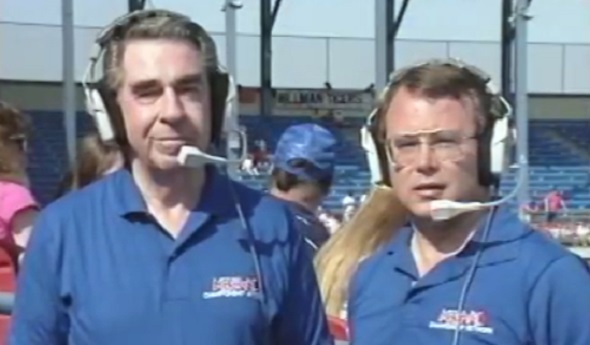
PHOTO: Paul Carey (left) and nephew Mike Carey broadcast the MHSAA 1992 Class D Baseball Final between Hillman and Athens for PASS.
Inside Selection Sunday: Mapnalysis '19
By
Geoff Kimmerly
MHSAA.com senior editor
October 27, 2019
This will be the final MHSAA Football Playoffs under the format created in 1999, with significant changes coming beginning with the 2020 season.
But the soon-to-be old way isn’t going out without a bang.
From a record number of additional qualifiers, to a first-ever coin flip to determine the final team in the 11-player field, to a series of maps that arguably included the toughest to draw at least this decade, this year’s “Selection Sunday” was jammed with notable moments that will play out in 10 divisions over the next five weeks.
Below, we explain how we made many of the most difficult decisions – and follow with a few points of interest that immediately jump out from this season’s brackets.
This process actually begins in April, when we start collecting schedules for the upcoming season – this time for 607 teams, from which 531 ended up eligible for the 11-player playoffs and 71 were eligible in 8-player. And of course, now that the brackets are drawn the major lifting begins – assigning officials for every game, gathering potential Semifinal sites in 11-player and working with our Finals hosts to again create once-in-a-lifetime experiences (for most) when our 8-player finalists face off Nov. 23 at Northern Michigan University’s Superior Dome and our 11-player finalists play for titles Nov. 29-30 at Ford Field.
So let’s dive in. Those familiar with this “Selection Sunday” recap will recognize first a refresher on the playoff selection process, followed by “Observations & Answers: 2019.” That’s followed by thoughts after a glance at this year’s brackets, and be sure to visit MHSAA.com to see all of the pairings in full.
Ground Rules
Our past: The MHSAA 11-player playoff structure – with 256 teams in eight divisions, and six wins equaling an automatic berth (or five wins for teams playing eight or fewer games) – debuted in 1999. An 8-player tournament was added in 2011, and in 2017 a second division of 8-player football was introduced.
The first playoffs were conducted in 1975 with four champions. Four more football classes were added in 1990 for a total of eight champions each fall. Through 1998, only 128 teams made the postseason, based on their playoff point averages within regions (four for each class) that were drawn before the beginning of the season. The drawing of Districts and Regionals after the end of the regular season did not begin until the most recent 11-player playoff expansion.
In early years of the current process, lines were drawn by hand. Dots representing qualifying schools were pasted on maps, one map for each division, and those maps were then covered by plastic sheets. Districts and Regionals literally were drawn with dry-erase markers.
Our present: The last few scores of this regular season were added to MHSAA.com by 8 p.m. Saturday. Re-checking and triple-checking of enrollments, what schools played in co-ops and opted to play as a higher class start a week in advance, and more numbers are crunched Sunday morning as the fields are set.
This final season of 6-wins-and-in (or five wins playing eight games or fewer) produced 202 automatic qualifiers for the 11-player field with a record 54 additional qualifiers then selected by playoff point average – that group of additional qualifiers easily blowing past last year’s then-record total of 43. Additional qualifiers were selected from each class in order (A, B, C, D) until the field was filled. There were only two Class D additional qualifiers with 5-4 or 4-4 (playing eight games) records from which we could choose, and likewise there were 16 additional qualifiers available in Class C – so with those 18 spots filled, we added 18 teams from both Class A and B to fill out the field.
Here’s where the tie-breaker was forced into play. Among Class B teams, Durand and Imlay City tied for the 18th spot with playoff point averages of 42.667. They did not play each other during the regular season – so the first tie-breaker of head-to-head result couldn’t be used. The next tie-breaker is opponents’ winning percentage – and both teams’ opponents won 45.7 percent of their games this season. So we went to the coin flip, and Durand was awarded the final spot in the field.
Those 256 11-player teams were then split into eight equal divisions based on enrollment, and their locations were marked on digital maps then projected on wall-size screens and discussed by nearly half of the MHSAA staff plus two representatives from the Michigan High School Football Coaches Association. Only the locations themselves were marked (by red dots) – not records, playoff point averages or names of the schools or towns. In fact, mentions of those are strictly prohibited. Records and playoff points are not part of the criteria. Matchups, rivalries, previous playoff pairings, etc. also DO NOT come into play.
The 8-player process is different for team selection and similar for designation of Regionals. We take the top 32 teams in 8-player based on playoff point average as our field, then re-sort those 32 by enrollment – the 16 biggest make up Division 1, followed by the next 16 in Division 2. There are no automatic qualifiers by record for 8-player, and those fields remain in flux right through the last Week 9 games. For example: Colon as recently as after Week 7 was slated for Division 2. But the Magi after this weekend ended up in Division 1 with the second-highest playoff-point average but the 16th-highest enrollment – meaning Colon (160 students) and Cedarville (154) were the line between Divisions 1 and 2 this year.
Our future: 11-player divisions determined in March. More bonus points awarded in losses. Read all about it: Comparison of old and new playoff formats
Geography rules: This long has been rule number one for drawing MHSAA brackets in any sport. Travel distance and ease DO come into play. Jumping on a major highway clearly is easier than driving across county-wide back roads, and that’s taken into consideration. Also, remember there’s only one Mackinac Bridge and hence only one way to cross between peninsulas – and boats are not considered a possible form of transportation. When opponents from both peninsulas will be in the same District, distance to the bridge is far more important than as the bird flies.
Tradition doesn’t reign: Every group of 32 (or in 8-player, 16) dots is a new group – these 32 teams have not been placed in a bracket together before. How maps have been drawn in the past isn’t considered – it’s hard to say a division has been drawn in a certain way traditionally when this set of 32 teams is making up a division for the first time.
Observations & Answers: 2019
We always start with CONGRATULATIONS: Detroit Leadership Academy, Detroit Communication Media Arts, and Pellston will be making their debuts in the MHSAA Playoffs this week, taking the list of teams that have never qualified for the postseason down to 11. Beal City and Crystal Falls Forest Park will make their MHSAA-best 35th playoff appearances. Five teams will be playing in at least their 17th consecutive playoffs – Rockford (25), Forest Park (23), Jackson Lumen Christi (22), Macomb Dakota (20) and Climax-Scotts (17).
Head-to-head rules: As noted above, it’s the first tie-breaker and comes into play immediately this week. In Division 3, East Lansing and DeWitt have identical playoff point averages, and East Lansing will host their first-round game thanks to a 21-2 Week 5 win. If Portland and Lansing Catholic both advance to an 11-Player Division 5 District Final, Portland will host thanks to a 21-20 Week 5 win over the Cougars. Same in 8-player Division 2, where if Powers North Central and Pickford meet in a Regional Final, the Jets will host thanks to their 20-14 win when the teams met in Week 3.
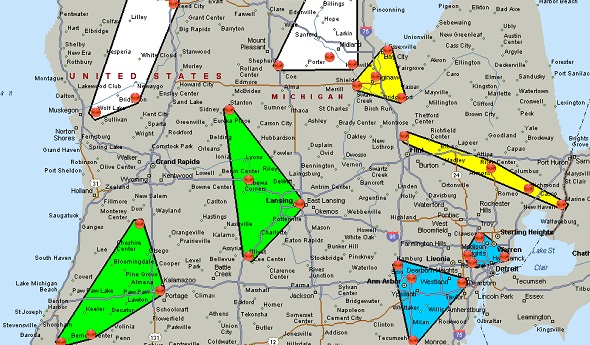
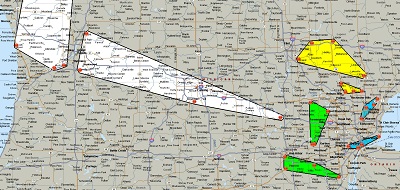 Traverse City traveling: Many years, we have to pay special consideration to ease of travel when we have one of 32 teams from a division in the Upper Peninsula. This year, we spent a lot more time discussing Traverse City schools – notably how to position Traverse City West in Division 1 and Traverse City Central in Division 2. There are three main north-south highways in the Lower Peninsula, with U.S. 131 the thoroughfare out of Traverse City. We also used it as the defining line in Division 1, with West going west with Grand Haven, Grandville and Hudsonville instead of staying with a more northern group that would’ve included Rockford and split Grandville and Hudsonville – which are six miles apart down I-196. In Division 2, we brought U.S. 127 into the mix, figuring it made more sense for travel to use that and 131 in grouping Traverse City Central with Muskegon Mona Shores, Midland and Midland Dow instead of creating a western District stretching from Traverse City to south of Kalamazoo.
Avoid the crisscross: Sometimes Districts drawn on the maps look perfect – but we run into trouble putting them together for a logical Regional. Sometimes we know eight dots should be a Regional, but there’s no reasonable way to split them into two four-team Districts. We do everything possible to keep a team from driving past a different District (or in 8-player Regional) on the way to its first or second-round game. The 8-Player Division 1 map probably looks a little odd with Deckerville possibly playing Morrice in the second round and the Orioles driving past Mayville or Kingston from another Regional to get there. However, there is a distinct northeast-to-southwest line separating those four schools – and if the Regional had been drawn to keep Deckerville with Mayville and Kingston, it would’ve meant Regional champs “jumping” over each other for their Semifinal matchup.
North/South vs. East/West: There isn’t one guiding directional when creating these Districts and Regionals. The 11-player Division 7 map has a little bit of both, with a pair of Districts along I-94 on the south side of the Lower Peninsula, but then Madison Heights Bishop Foley grouped with three Thumb-area teams for a north-south grouping. The other option was sending Bishop Foley northwest toward Flint and Lansing, but that would’ve left the Thumb schools and Beaverton maneuvering around Saginaw Bay.
At the end of the day …
Here’s my annual reminder: We draw these maps not knowing which schools are represented by the dots. The Division 5 and 6 maps were so easy to draw, I had no idea which schools were matched up until checking out the brackets hours later to put together this report.
But with all of that in front of me, here’s a glance at what jumps off the page:
• The Division 1 District made up of unbeaten Belleville and Brownstown Woodhaven, Saline (8-1) and Ann Arbor Pioneer (5-4) is obviously loaded. Belleville and Saline both made the Semifinals last season, and Saline’s only loss this fall was to reigning Division 1 champion Clinton Township Chippewa Valley. Woodhaven finished the regular season unbeaten for the second time in six years and its seeking its first District title.
• Last season’s Division 4 champion Edwardsburg has won 23 straight games and is back in the Division 3 bracket – the Eddies played in Division 4 the last two seasons and most recently in Division 3 in 2016. A possible return to Ford Field starts this week with St. Joseph and could include a trip to Zeeland West and matchup with also-unbeaten Mason.
• Hudsonville Unity Christian is another reigning champion in a new division, moving into Division 4 after winning the championship in Division 5 last fall. Unity begins with Otsego and would play either Grand Rapids Christian or South Christian with a win.
• Make way for Division 7. Unbeaten New Lothrop is the reigning champion and shares a District with undefeated Beaverton and a Regional with also-undefeated Pewamo-Westphalia. Iron Mountain, Lawton, Jackson Lumen Christi and Clinton also have yet to lose a game this season. Lumen Christi has won the last three Division 6 championships and 31 straight games.
• Math can lead to some unpredictable situations, including the occasional undefeated road team during the first round. Almont defeated Richmond 28-10 in Week 7 on the way to the Blue Water Area Conference title and a perfect regular-season record. But the Raiders will travel this week back to Richmond because the Blue Devils finished with a better playoff point average – Almont’s two nonleague opponents finished a combined 1-17, and Richmond’s both made the playoffs with a combined 13-5 record. That difference made the difference in playoff point average by about nine-tenths of a point in Richmond’s favor.
• This year’s 8-player brackets are loaded with intrigue, especially with 2018 Division 2 champion Rapid River not in the field and last year’s Division 1 runner-up Pickford in Division 2 this time. Morrice is the reigning Division 1 champion and could see undefeated Deckerville in a Regional Final. Pickford has to get through another 8-1 team in Engadine this week but could see undefeated Powers North Central in a Division 2 Regional Final.
• And it should shock no one if a team entering the playoffs 4-5 makes it to NMU. Gaylord St. Mary had to forfeit four victories but still made the playoffs with that record. Undefeated Suttons Bay is a possible Regional Final opponent, and St. Mary won their Week 6 matchup on the field 48-47 before later forfeiting that game.
That’s the start of what we’re looking forward to over the next five weeks. The steps taken today were just a few along the way as memories are made for thousands of Michigan high school football players this November.
PHOTOS: (Top) The Division 5 map, with clear-cut Districts, received quick support from the selection committee. (Middle) The Division 1 map split Grand Rapids-area teams along U.S. 131.