

Powerful Voice for High School Sports
December 19, 2014
By Geoff Kimmerly
Second Half editor
Paul Carey was home from the U.S. Army only a few months and just shy of 25 years old when Beal City embarked on its first trip deep into the MHSAA boys basketball tournament.
On the call for local radio station WCEN from gyms at Saginaw Arthur Hill and Lansing Sexton, Carey served as the voice of the previously “laughable” Aggies as they reached the Class D Semifinals before falling just six points short of playing for the title.
“All of Beal City emptied out. They’d never had anything before,” Carey recalled during his annual Thanksgiving weekend visit to the MHSAA Football Finals at Ford Field. “When I got home, within the next two weeks I got a letter from every citizen of Beal City thanking me for broadcasting their games. That’s the kind of appreciation that meant so much.”
During 42 years on the airwaves, Carey was best known as a voice of the Detroit Tigers bounding out of transistor radios all over Michigan, thanks to WJR’s powerful signal.
But for the state’s high school sports community, his legacy is similarly memorable as the voice of the longtime football and basketball scoreboard show and a voter for various all-state teams and wire polls over the decades.
Now 86 and retired since 1991, Carey remains a regular during the first day of the Football Finals, taking in games he broadcast for the MHSAA during the late 1970s and that continue to hold his eye as they have for more than a half-century.
“It was a passion of mine. High school sports always has been,” Carey said. “I think because my dad was a high school coach, and teacher initially, and my brother was a high school coach and teacher, I just grew up in families that appreciated coaching and athletics. I was not a great athlete, but it kept my hand in following sports that way.”
Now, the scores
Carey partnered with Ernie Harwell for Tigers radio broadcasts from 1973-91, including during the march to the 1984 World Series championship. He was named Michigan Sportscaster of the Year six times and to the Michigan Sports Hall of Fame in 1992.
But Carey’s early career included sitting on top of a car, plugged into a phone pole, for a Sacred Heart football game at old Fancher Field just a few blocks from his family’s Mount Pleasant home. Among many more accolades are a Distinguished Service Award from the Michigan High School Coaches Association and a place in the Basketball Coaches Association of Michigan Hall of Fame.
In fact, the start of his weekly announcing of statewide football and basketball scores preceded his baseball career by 16 years and ended two months after he announced his final professional out.
The Michigan High School Scoreboard show was a staple of WJR’s late Friday nights from 1957-91. Carey would read every score he could collect from a variety of sources, often organized by league and with state rankings and context mixed in.
His idea came from something similar read by Len Colby for Kalamazoo’s WKZO. Carey’s brother Terry was coaching at Niles during the second half of the 1950s, and he and other coaches would get together to listen to the Friday night scores from the southwestern part of the state.
Carey, who left WKNX in Saginaw for WJR in 1956, explained to then-sports director Bob Reynolds that the station’s strong signal could provide for a truly statewide scoreboard experience.
Carey then connected with Edgar Hayes of the former Detroit Times, who gave the OK for Carey to call the paper on Friday nights to get scores from the Detroit metro area. For the rest, Carey relied on wire services – there were three at the time – who relied on newspapers from all over Michigan to call in scores over the course of an evening.
Before every Friday during high school football season – and later Tuesdays and Fridays during boys basketball season – Carey typed up lists of games based on schedules in the newspaper, with spaces to add scores. More than a few times, Carey raced down a back ramp at Tiger Stadium after a Friday night game, back to the WJR studio, with 15 minutes to prep for the show’s 11:30 p.m. start.
“If the Flint Journal, the Grand Rapids Press, the Traverse City paper didn’t call in scores to the AP, then I was out of luck too. And that happened all the time,” Carey said. “I would call back occasionally, say, ‘Did you get anything more?’ It was a rat race.”
The show originally was set for 10 minutes and then extended to 15. American Airlines sponsored a record show that followed, and Carey’s scoreboard show had a sponsor only once in 35 years. Finishing up on time was expected, even with more than 200 scores to read.
But Carey said he always went 20 minutes, sometimes 25.
“Because I wasn’t done. I just kept right on going,” Carey said. “Jay Roberts did the all-night show most of the time, and he was patient with me. He didn’t say too much on the air about ‘that guy ahead of me took all of my time.’”
Carey continued the “rat race” until his final scoreboard show, Dec. 20, 1991. He retired from WJR at the end of that calendar year. And it's important to note: Carey was never paid a dime extra for doing the program. .
“I think Paul is really just a sports fan, and that came across to the listener on his broadcasts,” MHSAA historian Ron Pesch said. “Paul would gather as much as possible off the wire. He'd interject if scores were missing from sections of the state. Press polls from the Free Press, News, AP and UPI were big, so he could point out close calls and upsets.
“He provided immediacy, or the closest thing to it in the days before cable TV and the Internet, and because of his scoreboard show, you could get the results before the morning paper. For listeners, he brought life to something as simple as game scores.”
First team all the way
Carey, who resides in Rochester, also served as the engineer on Tigers broadcasts for 16 years, through 1990. He broadcast Pistons games on the radio for six seasons and did the first broadcast of a Central Michigan University football game, in 1949.
Harry Atkins, covering Detroit’s teams while with The Associated Press for 29 years including the last 21 as its sports editor for Detroit, took note of his colleague's hard work – and especially that Carey was one of few broadcasters who was a journalist in addition to a voice.
That made Carey's other major role in high school sports a natural fit.
Atkins split The Associated Press all-state selection panels for football and basketball into 11 regions, and Carey represented the Detroit area for a number of years. He also was a longtime voter in those sports' weekly polls.
“Paul is just that kind of guy. He thought it was important and he made time in his busy schedule to do it,” Atkins said “And it had an impact on the other 10 voters on the All-State panels, too.
“Some of them were from small out-state newspapers or radio or TV stations. Yet every one of them knew who Paul Carey was. And when he spoke, of course, with what often is called "The Voice of God," those voters paid attention.”
And he still does, as well.
At the end of each fall, Carey still puts together a compilation of the three high school all-state football teams – Associated Press, Detroit Free Press and Detroit News – and files them with years of research and results.
“It’s important to me. Nobody sees it but me, but I get a certain kick,” Carey said. “Once in a while I’ll see a kid playing at Central, Western or (Michigan) State or Michigan, and they’ll say he came from Clawson. I’ll go into my all-state collections, say that would’ve been 2009 he played, and I find a name.”
In addition to the Football Finals on WJR, Carey was part of the Baseball Finals broadcasts into the early 1990s, continuing to contribute even after his retirement from his fulltime gig.
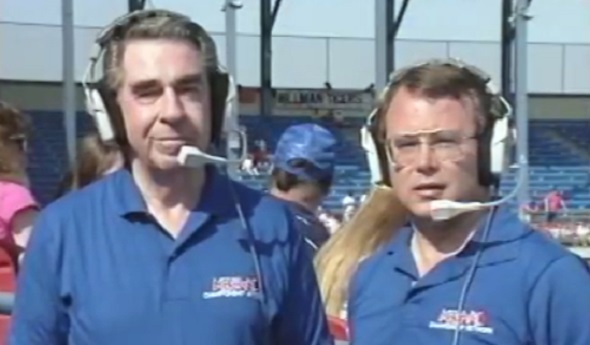
He spent high school games over the years sitting next to legends like the Free Press’ Hal Schram and remembers when current Free Press longtime scribe Mick McCabe was just a rookie. One of Carey's final broadcasts was a 1992 Baseball Final with his nephew Mike Carey, who continues to broadcast MHSAA championship games to this day.
“I am eternally grateful to Paul Carey. His contribution to high school sports in Michigan has been great and significant,” Atkins said.
“We are lucky to have him.”
PHOTO: Paul Carey (left) and nephew Mike Carey broadcast the MHSAA 1992 Class D Baseball Final between Hillman and Athens for PASS.
1979: Rice Meets Moeller in 'Biggest Game Ever'
August 30, 2019
By Ron Pesch
Special for Second Half
DATELINE: Cincinnati, Ohio, 1979
“The Brother Rice-Moeller game is the biggest game any Michigan high school football team has ever played.”
Hal Schram - ‘The Swami’
Detroit Free Press
“I’m nervous as heck,” said Birmingham Brother Rice coach Al Fracassa to Free Press sportswriter Mick McCabe. “This is the biggest challenge of my life.”
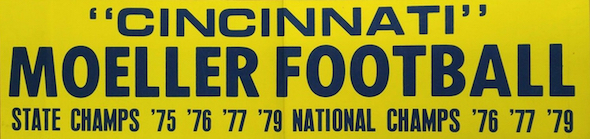
On Saturday, September 22, 1979, Fracassa’s Warriors travelled 270 miles south from the hotbed of Michigan high school football to the hotbed of Ohio high school football for a first-ever showdown with Cincinnati Moeller. Heading into the 1980s, many would argue that Brother Rice was the top football (and perhaps the top boys prep sports) program in the state of Michigan. At the same time, many would say Moeller had replaced Washington Massillon High School as the premier grid program in the Buckeye State, and that Moeller also represented the nation’s top prep football team. To quote McCabe in his pregame write-up:
 “Moeller had a 53-game winning streak snapped last fall after winning Ohio’s Class AAA state championship the previous three years. It also won the mythical national championship in 1976 and ’77. Seventeen players from (the 1978) Moeller team received college scholarships, including wide receiver Tony Hunter at Notre Dame and Larry Gates, the backup quarterback at Purdue.”
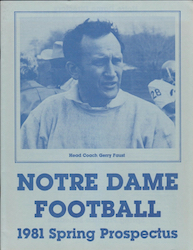
Moeller was coached by 44-year-old Gerry Faust – soon to become a Notre Dame legend. But in the fall of 1979, he was still building his impressive resume at Moeller.
 While both were all-male Catholic schools and maintained three football teams – varsity, JV and freshman – there were stark differences. Fracassa’s varsity coaching staff at the time included three members: Mike Popson, Ron Kalczynski and Mike Cieslak. In comparison, Faust had 17 assistant coaches on his varsity staff (and 25 student managers).
“Every year is a rebuilding year for us,” said Faust. “We average between 24 and 38 seniors a year and about 20 of them start.”
“Their second team is as good as most teams around here, and I’m not exaggerating,” Fracassa told McCabe.
Entering the contest, Faust had posted a 152-17-2 record in 17 seasons at Moeller, while Fracassa, in his 20th year as a head coach, was 123-31-8. A former Detroit Pershing and Michigan State quarterback, Fracassa was named head football coach at Royal Oak Shrine in June 1960. After eight seasons at Shrine, Fracassa moved to Brother Rice and compiled an 86-14-3 mark, including a Class A mythical state title in 1974. His Warriors began an impressive 24-game winning streak in 1976, earning an MHSAA Class A playoff title in 1977, but the streak was ended by North Farmington in the Semifinal round of the MHSAA tournament in November 1978.
Faust arrived at Moeller in 1960 to start a football team and had guided the squad since the school began playing varsity ball in 1963. He first started bringing outstate teams to Cincinnati in 1977 with a game against Monsignor Farrell High School of Staten Island, NY. Jesuit High from Dallas, Texas, followed with a visit to Moeller in 1978.
Both Moeller and Rice were undefeated to start the 1979 season. Faust’s Crusaders had allowed only three first downs over three games, including a big 34-7 win over city rival Cincinnati Princeton, the school that had ended Moeller’s long winning streak, and a 30-13 victory over powerhouse Pittsburgh Penn Hills, a school with an enrollment of 4,200 that had compiled consecutive Class AAA Western Pennsylvania Interscholastic Athletic League championships in the three previous years under coach Andy Urbanic. With the defeat of Penn Hills, the Crusaders were a flawless 3-0 against teams from across state lines entering the Brother Rice contest.
Undefeated in two games, Brother Rice was rated fourth in Class A in Hal Schram’s initial Top Ten rankings. Inexperienced following the graduation of quarterback Jon English (Michigan State) and receiver Marty Martinez (Stanford), the Warriors had downed St. Clair Shores Lake Shore, 21-7, then Grosse Pointe North, 13-7.
Game Time
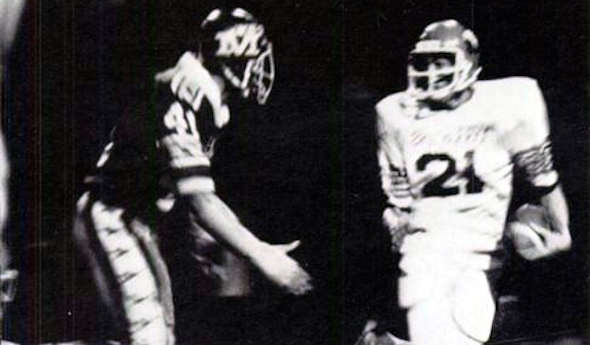
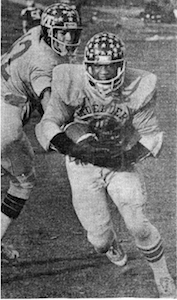
A crowd of 20,792 (including members of the Brother Rice pep band) packed the University of Cincinnati’s Nippert Stadium for the 8 p.m. prep version of the Michigan-Ohio State game. Moeller did not have its own field, playing games at Nippert, Cincinnati’s Riverfront Stadium (home to the NFL’s Bengals and MLB’s Reds), or a nearby high school field. Moeller dominated the first half with 282 yards of total offense to Brother Rice’s 64, but held only a 13-7 lead at the half. Senior wingback Eric Ellington awed the crowd with touchdown runs of 43 and 61 yards during the first quarter. Rice rebounded with a five-yard touchdown on a bootleg by 5-foot-11, 170-pound senior quarterback Brian Brennan following a fumble recovery by Emil Nagengast during the second period.
Starting their first possession of the third quarter on their own 33-yard line, Ellington ripped off a 34-yard run to the Rice 33 on Moeller’s first play of the drive. Three plays later, he went left for 10 yards and his third touchdown of the game. The Crusaders opened up a 33-7 lead in the fourth quarter before Rice got back on the scoreboard. Fracassa went to the playbook for some “razzle dazzle.”
Operating from their own 32-yard line with 2:19 left to play, “Brennan tossed a deliberate bounce pass on a lateral to reserve quarterback Dave Yarema,” wrote Randy Holtz in the Cincinnati Enquirer. “Yarema then fired a 68-yard touchdown to the wide open Steve Allen to finish the game’s scoring.”
“We’ve been using it a long time,” said Fracassa, commenting on the play with limited delight following the 33-14 loss. “We told the kids before the game that this would be one of the best teams they were ever going to play against. They’re really a tremendous team. If you can’t contain Ellington, you’re in trouble. You’ve got to be something else to catch this kid.”
Ellington ended with 178 yards on 10 carries.
“Eric really ran well,” added Faust. “He’s a great back, but you’ve got to give credit to (our) line up front.”
 Due to the early format of the MHSAA playoffs, which were introduced in 1975, the defeat likely had eliminated Brother Rice from the state playoff picture. A 10-7 loss to Catholic League opponent Detroit Catholic Central in Week 5 of the season and a 6-3 regular-season record ensured no postseason play for the Warriors in 1979. Detroit Catholic would end the year as Class A state champ with a perfect 12-0 record.
The Ohio High School Athletic Association had begun its football playoff system in the fall of 1972. To little surprise, Moeller went on to win the state’s Class AAA title for the fourth time in 1979, defeating Parma Padua Franciscan 41-7. Moeller again was proclaimed national champion by the National Sports News Service. (For those interested, highlights can be found here).
College Comes Calling
Back in Michigan, in February 1980, Fracassa applied for the head coaching position at Michigan State to replace Darryl Rogers, but wasn’t interviewed. When Frank “Muddy” Waters was named as MSU’s new coach, he offered Fracassa the position of offensive coordinator. But Fracassa chose not to go. In the fall, his Warriors again won the Class A championship. It wouldn’t be his last opportunity to jump to the college game.
The Great Experiment
In Ohio, Faust’s Crusaders would win the state and national titles again in late November 1980. After more than a month of rumors, on the day after winning the state title, Gerald Anthony Faust was officially announced as “the only head coach Notre Dame has ever selected from the high school ranks.”
Another Chance at MSU
Fracassa was a back-up signal caller at Michigan State. “I was always stuck behind the All-Americans,” he told the Detroit Times in 1960 shortly after taking charge at Royal Oak Shrine.
“First, he understudied Al Dorow,” wrote Wally Dwyer in the Times. “Then it was Tom Yewcic and finally Earl Morrall.”
Morrall’s son Matt, Leon Hart’s son Kevin, Tobin Rote’s son, Rocky, Roger Zatkoff’s son David and Jack Simmons’ son, Terry, were the offspring of past Detroit Lions who played on Fracassa’s 1974 champion.
 In December 1982, George Perles was named to replace Waters as head coach at Michigan State. A former teammate of Fracassa’s at MSU and, later, a coaching friend and rival when Perles coached Detroit St. Ambrose and Fracassa guided Shrine, Perles spoke to Fracassa about the possibility of joining the Spartans’ defensive staff. Again, Fracassa chose to remain at Brother Rice.
A Legacy Sealed …
In the fall of 1983, Fracassa’s Warriors grabbed another Class A title. It was the third of nine MHSAA championships his teams would ultimately earn. When he retired following the 2013 season, he was the state’s all-time winningest football coach with a 430-117-7 mark.
… and a Legacy Altered
In November 1985, Faust resigned from his position at Notre Dame.
“Faust said the job was ‘the fulfillment of a lifelong dream,’” wrote Mitch Albom in the Free Press, days after the announcement. “And he did it proud on most counts. He worked feverishly, turned out good men, a clean program. And technically, a winning program, 30-25-1. But nowhere near winning enough for Notre Dame.”
“Faust knew it.”
To the dismay of countless Irish fans, Notre Dame continued to honor its contract despite the losses. “No matter how loudly the fans yelled,” noted Albom, “the school would not fire Faust.”
“So, with a choked voice and moist eyes, he saved the university the ugliness of firing him by resigning with one game left on his contract.”
“We probably won’t see another Gerry Faust experiment again,” added Albom at the time. “Everyone will point out that it didn’t work the first time …”
“College football was once a game of its name. College kids playing football. That was long ago. Today it is a multimillion-dollar industry …”
The great experiment certainly altered memories of Faust, the structure of coaching contracts, and the path for all high school coaches who aspired to lead at a higher level. One might even say it was a turning point for winning and losing, and what would be ‘acceptable’ at all levels of sports across America.
P.S. Moeller and Rice again met in 2007, with the Crusaders again topping Brother Rice, this time 14-6. Both schools had entered this match-up with identical 2-1 records.
 Ron Pesch has taken an active role in researching the history of MHSAA events since 1985 and began writing for MHSAA Finals programs in 1986, adding additional features and "flashbacks" in 1992. He inherited the title of MHSAA historian from the late Dick Kishpaugh following the 1993-94 school year, and resides in Muskegon. Contact him at [email protected] with ideas for historical articles.
PHOTOS: (Top) Brother's Rice's Brian Brennan looks for an opening while a Moeller defender pursues. (2) Brother Rice coach Al Fracassa. (3) Moeller coach Gerry Faust. (4) A Moeller bumper sticker tells of its many successes during the 1970s. (5) Eric Ellington starred for Moeller against Brother Rice. (6) Faust left Moeller for Notre Dame in 1980. (Photos gathered by Ron Pesch.)