

Powerful Voice for High School Sports
December 19, 2014
By Geoff Kimmerly
Second Half editor
Paul Carey was home from the U.S. Army only a few months and just shy of 25 years old when Beal City embarked on its first trip deep into the MHSAA boys basketball tournament.
On the call for local radio station WCEN from gyms at Saginaw Arthur Hill and Lansing Sexton, Carey served as the voice of the previously “laughable” Aggies as they reached the Class D Semifinals before falling just six points short of playing for the title.
“All of Beal City emptied out. They’d never had anything before,” Carey recalled during his annual Thanksgiving weekend visit to the MHSAA Football Finals at Ford Field. “When I got home, within the next two weeks I got a letter from every citizen of Beal City thanking me for broadcasting their games. That’s the kind of appreciation that meant so much.”
During 42 years on the airwaves, Carey was best known as a voice of the Detroit Tigers bounding out of transistor radios all over Michigan, thanks to WJR’s powerful signal.
But for the state’s high school sports community, his legacy is similarly memorable as the voice of the longtime football and basketball scoreboard show and a voter for various all-state teams and wire polls over the decades.
Now 86 and retired since 1991, Carey remains a regular during the first day of the Football Finals, taking in games he broadcast for the MHSAA during the late 1970s and that continue to hold his eye as they have for more than a half-century.
“It was a passion of mine. High school sports always has been,” Carey said. “I think because my dad was a high school coach, and teacher initially, and my brother was a high school coach and teacher, I just grew up in families that appreciated coaching and athletics. I was not a great athlete, but it kept my hand in following sports that way.”
Now, the scores
Carey partnered with Ernie Harwell for Tigers radio broadcasts from 1973-91, including during the march to the 1984 World Series championship. He was named Michigan Sportscaster of the Year six times and to the Michigan Sports Hall of Fame in 1992.
But Carey’s early career included sitting on top of a car, plugged into a phone pole, for a Sacred Heart football game at old Fancher Field just a few blocks from his family’s Mount Pleasant home. Among many more accolades are a Distinguished Service Award from the Michigan High School Coaches Association and a place in the Basketball Coaches Association of Michigan Hall of Fame.
In fact, the start of his weekly announcing of statewide football and basketball scores preceded his baseball career by 16 years and ended two months after he announced his final professional out.
The Michigan High School Scoreboard show was a staple of WJR’s late Friday nights from 1957-91. Carey would read every score he could collect from a variety of sources, often organized by league and with state rankings and context mixed in.
His idea came from something similar read by Len Colby for Kalamazoo’s WKZO. Carey’s brother Terry was coaching at Niles during the second half of the 1950s, and he and other coaches would get together to listen to the Friday night scores from the southwestern part of the state.
Carey, who left WKNX in Saginaw for WJR in 1956, explained to then-sports director Bob Reynolds that the station’s strong signal could provide for a truly statewide scoreboard experience.
Carey then connected with Edgar Hayes of the former Detroit Times, who gave the OK for Carey to call the paper on Friday nights to get scores from the Detroit metro area. For the rest, Carey relied on wire services – there were three at the time – who relied on newspapers from all over Michigan to call in scores over the course of an evening.
Before every Friday during high school football season – and later Tuesdays and Fridays during boys basketball season – Carey typed up lists of games based on schedules in the newspaper, with spaces to add scores. More than a few times, Carey raced down a back ramp at Tiger Stadium after a Friday night game, back to the WJR studio, with 15 minutes to prep for the show’s 11:30 p.m. start.
“If the Flint Journal, the Grand Rapids Press, the Traverse City paper didn’t call in scores to the AP, then I was out of luck too. And that happened all the time,” Carey said. “I would call back occasionally, say, ‘Did you get anything more?’ It was a rat race.”
The show originally was set for 10 minutes and then extended to 15. American Airlines sponsored a record show that followed, and Carey’s scoreboard show had a sponsor only once in 35 years. Finishing up on time was expected, even with more than 200 scores to read.
But Carey said he always went 20 minutes, sometimes 25.
“Because I wasn’t done. I just kept right on going,” Carey said. “Jay Roberts did the all-night show most of the time, and he was patient with me. He didn’t say too much on the air about ‘that guy ahead of me took all of my time.’”
Carey continued the “rat race” until his final scoreboard show, Dec. 20, 1991. He retired from WJR at the end of that calendar year. And it's important to note: Carey was never paid a dime extra for doing the program. .
“I think Paul is really just a sports fan, and that came across to the listener on his broadcasts,” MHSAA historian Ron Pesch said. “Paul would gather as much as possible off the wire. He'd interject if scores were missing from sections of the state. Press polls from the Free Press, News, AP and UPI were big, so he could point out close calls and upsets.
“He provided immediacy, or the closest thing to it in the days before cable TV and the Internet, and because of his scoreboard show, you could get the results before the morning paper. For listeners, he brought life to something as simple as game scores.”
First team all the way
Carey, who resides in Rochester, also served as the engineer on Tigers broadcasts for 16 years, through 1990. He broadcast Pistons games on the radio for six seasons and did the first broadcast of a Central Michigan University football game, in 1949.
Harry Atkins, covering Detroit’s teams while with The Associated Press for 29 years including the last 21 as its sports editor for Detroit, took note of his colleague's hard work – and especially that Carey was one of few broadcasters who was a journalist in addition to a voice.
That made Carey's other major role in high school sports a natural fit.
Atkins split The Associated Press all-state selection panels for football and basketball into 11 regions, and Carey represented the Detroit area for a number of years. He also was a longtime voter in those sports' weekly polls.
“Paul is just that kind of guy. He thought it was important and he made time in his busy schedule to do it,” Atkins said “And it had an impact on the other 10 voters on the All-State panels, too.
“Some of them were from small out-state newspapers or radio or TV stations. Yet every one of them knew who Paul Carey was. And when he spoke, of course, with what often is called "The Voice of God," those voters paid attention.”
And he still does, as well.
At the end of each fall, Carey still puts together a compilation of the three high school all-state football teams – Associated Press, Detroit Free Press and Detroit News – and files them with years of research and results.
“It’s important to me. Nobody sees it but me, but I get a certain kick,” Carey said. “Once in a while I’ll see a kid playing at Central, Western or (Michigan) State or Michigan, and they’ll say he came from Clawson. I’ll go into my all-state collections, say that would’ve been 2009 he played, and I find a name.”
In addition to the Football Finals on WJR, Carey was part of the Baseball Finals broadcasts into the early 1990s, continuing to contribute even after his retirement from his fulltime gig.
He spent high school games over the years sitting next to legends like the Free Press’ Hal Schram and remembers when current Free Press longtime scribe Mick McCabe was just a rookie. One of Carey's final broadcasts was a 1992 Baseball Final with his nephew Mike Carey, who continues to broadcast MHSAA championship games to this day.
“I am eternally grateful to Paul Carey. His contribution to high school sports in Michigan has been great and significant,” Atkins said.
“We are lucky to have him.”
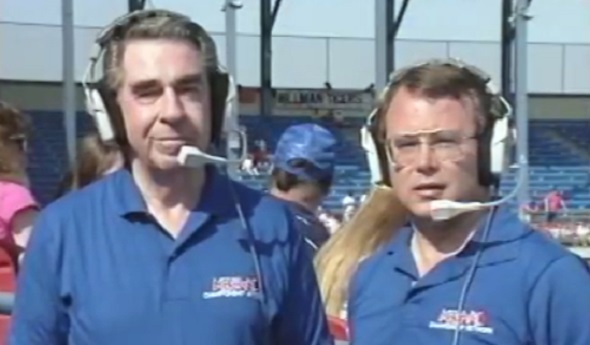
PHOTO: Paul Carey (left) and nephew Mike Carey broadcast the MHSAA 1992 Class D Baseball Final between Hillman and Athens for PASS.

Talented Escanaba Pursuing Title Repeat
May 14, 2019
By Dennis Grall
Special for Second Half
ESCANABA – Ever since softball became part of the Escanaba High School athletic program in 1997, it has been among the best and most consistent offerings in the state.
 Last year the Eskymos confirmed their elite prep status by winning the MHSAA Division 2 title, and they again are in the thick of this year's championship picture. Escanaba belted South Haven 5-0 in last season’s Final, after clipping Eaton Rapids 2-0 in the Semifinal two days before.
The Eskymos won their final 13 games last year to finish 31-3. Gabi Salo, then a sophomore, fanned 11 of the title game's opening 13 batters and allowed three hits while punching out 13 batters total. Salo and Escanaba yielded just two runs over seven postseason games. The six EHS seniors on that team compiled a 131-18 record during their four seasons.
Escanaba previously was Division 1 runner-up in 2003 and lost in Division 2 Semifinals in 2016 and 2017.
Salo has helped the Eskymos to a 15-1 record in this weather-marred spring, and Escanaba was ranked No. 1 in the state before losing to Kent State recruit Gabbie Sherman and Division 3 top-rated Millington 3-0 on Friday in Escanaba. Sherman, another of the state's prime pitchers, also throttled Escanaba 2-1 last year.
The Eskymos rebounded from Friday's loss in grand style on a frigid Saturday, whipping Marshfield, Wis., 9-5 and then clipping arch-rival Gladstone 7-0 behind a perfect game by Salo, who whiffed 14 batters.
Gladstone manager John Nevala said "if her control is good and she can get the corner called, she can be called unhittable. We had been hitting the ball pretty good until we faced Gabi."
Salo demonstrated better location and control against Gladstone than the previous night's rare loss. "She is in a class of her own," said Nevala. "She has to be one of the top pitchers in the state. She had very good movement.
"She has excellent speed (around 64-65 mph) and an excellent changeup. She changes speeds so well. She probably has three different speeds. You can't really dig in on one location at the plate."
This season Salo is 10-1 with two saves and sports a dominating 0.02 ERA. She has struck out 136 batters in 69 2/3 innings, but has also issued eight walks and hit four batters during wicked spring conditions the opening month. (NOTE: After a pair of no-hitters Monday and Tuesday against Marquette and Gladstone, respectively, Salo is 12-1 with 161 strikeouts in just under 84 innings pitched.)
A University of Wisconsin recruit since last spring, Salo felt she threw well against Millington and Gladstone, but indicated she was "pretty tight" in the freezing opener. She said her curveball and changeup worked better against Gladstone.
She didn't pay attention to keeping Gladstone off the bases. "I try not to think about those things. I feel like it is a jinx," she said.
 Salo worked hard last year to develop her back-breaking change-up and now terms it her favorite pitch. "It is spot-on," she said. "It throws the hitters off their game. I go out, focus and attack the hitter. I like getting swinging strikes." She is not afraid to use her change on a 3-2 count.
She fires her fastball down-and-in or inside-and-high and loves to get her pitches inside on the batter's fists.
The Escanaba first-year manager is her father, Gary, who was the pitching coach for the Eskymos last year under Jamie Segorski, who resigned as coach just as practice began this spring. Gary and Gabi have been together for several years on different summer travel teams.
He signals the pitches from his dugout perch, using input from his daughter and junior catcher and Ferris State commit Dakota Cloutier, who also handled that spot last season.
Senior right fielder Lexi Chaillier, a three-sport, four-year standout, leads the Eskymos with a .481 batting average and five home runs. Gabi Salo leads with 18 RBI and hits .378, while sophomore first baseman-pitcher Nicole Kamin is hitting .477 with 14 runs driven in. Cloutier is hitting .356 with 12 RBI.
Expect that quartet to lead the way this weekend when the Eskymos play in a highly-competitive 20-team invitational tournament in Ann Arbor. The strong field is what the Eskymos search for in compiling a schedule, with trips into Wisconsin and lower Michigan to find high-quality opponents.
Referring to other top hurlers, along with Millington's circle ace, Gary Salo said "we want to go up against elite pitching if we want to go to the next level." And now, with a state title, he said the Eskymos know "we are going to get everybody's best game."
After Friday's loss and the twin wins Saturday, the Escanaba skipper said "our kids are very resilient. We licked our wounds."
Much of the high school program's success is credit to a tremendous Little League program. Gabi Salo began pitching at age 10 when her youth coach asked if anyone wanted to throw. For many years she has received extensive coaching from Pat Brower in Ann Arbor. "He has developed Gabi into the pitcher she is," said her dad. "It is well worth driving six-and-a-half hours each way."
 Gabi Salo began her travel ball experience with the Escanaba Heartbreakers at age 10, then joined downstate teams, playing with Wixom Finesse the past three summers. The opportunity to play against quality travel teams in addition to high school has been crucial to her development.
Travel ball has taken the Salos to Atlanta, Huntington Beach, Calif. and Boulder, Colo. in addition to such destinations as the Grand Canyon. Gary Salo drives the family RV everywhere, with just father-daughter on most jaunts.
"Softball has given us a summer-long vacation," said Gary Salo.
"Definitely travel ball has helped me see parts of the country I would never get to see," said Gabi, who plans to enter the nursing field at UW and works at Christian Park Nursing in Escanaba. She also bowled for EHS and participates in dance, saying she would skip a softball game but would not skip a dance recital.
"The travel ball and high school competition is pretty equal," she said. "We play the best competition there is in the country."
Escanaba, which also excels in the classroom (a state-best 3.83 GPA), knows a title repeat will be difficult to achieve because teams like Richmond, Muskegon Oakridge, Eaton Rapids, Spring Lake, Detroit Country Day, Freeland and Stevensville Lakeshore are very dangerous.
"It is not a seven-game series. They are seven-inning games," Gary Salo said of the postseason dynamics.
"A lot of teams are playing really, really well," he said. "Any team has the opportunity to get lucky like we did."
 Denny Grall retired in 2012 after 39 years at the Escanaba Daily Press and four at the Green Bay Press-Gazette, plus 15 months for WLST radio in Escanaba; he served as the Daily Press sports editor from 1970-80 and again from 1984-2012 and currently is in a second stint as the interim in that position. Grall was inducted into the Upper Peninsula Sports Hall of Fame in 2002 and serves as its executive secretary. E-mail him at [email protected] with story ideas for the Upper Peninsula.
PHOTOS: (Top) Gabi Salo makes her move toward the plate during last weekend’s Escanaba Invitational. (Middle) A championship banner at the Eskymos’ home field celebrates last season’s Division 2 championship. (Below) Gary Salo has taken over the varsity this spring. (Photos by Dennis Grall.)