


Powerful Voice for High School Sports
December 19, 2014
By Geoff Kimmerly
Second Half editor
Paul Carey was home from the U.S. Army only a few months and just shy of 25 years old when Beal City embarked on its first trip deep into the MHSAA boys basketball tournament.
On the call for local radio station WCEN from gyms at Saginaw Arthur Hill and Lansing Sexton, Carey served as the voice of the previously “laughable” Aggies as they reached the Class D Semifinals before falling just six points short of playing for the title.
“All of Beal City emptied out. They’d never had anything before,” Carey recalled during his annual Thanksgiving weekend visit to the MHSAA Football Finals at Ford Field. “When I got home, within the next two weeks I got a letter from every citizen of Beal City thanking me for broadcasting their games. That’s the kind of appreciation that meant so much.”
During 42 years on the airwaves, Carey was best known as a voice of the Detroit Tigers bounding out of transistor radios all over Michigan, thanks to WJR’s powerful signal.
But for the state’s high school sports community, his legacy is similarly memorable as the voice of the longtime football and basketball scoreboard show and a voter for various all-state teams and wire polls over the decades.
Now 86 and retired since 1991, Carey remains a regular during the first day of the Football Finals, taking in games he broadcast for the MHSAA during the late 1970s and that continue to hold his eye as they have for more than a half-century.
“It was a passion of mine. High school sports always has been,” Carey said. “I think because my dad was a high school coach, and teacher initially, and my brother was a high school coach and teacher, I just grew up in families that appreciated coaching and athletics. I was not a great athlete, but it kept my hand in following sports that way.”
Now, the scores
Carey partnered with Ernie Harwell for Tigers radio broadcasts from 1973-91, including during the march to the 1984 World Series championship. He was named Michigan Sportscaster of the Year six times and to the Michigan Sports Hall of Fame in 1992.
But Carey’s early career included sitting on top of a car, plugged into a phone pole, for a Sacred Heart football game at old Fancher Field just a few blocks from his family’s Mount Pleasant home. Among many more accolades are a Distinguished Service Award from the Michigan High School Coaches Association and a place in the Basketball Coaches Association of Michigan Hall of Fame.
In fact, the start of his weekly announcing of statewide football and basketball scores preceded his baseball career by 16 years and ended two months after he announced his final professional out.
The Michigan High School Scoreboard show was a staple of WJR’s late Friday nights from 1957-91. Carey would read every score he could collect from a variety of sources, often organized by league and with state rankings and context mixed in.
His idea came from something similar read by Len Colby for Kalamazoo’s WKZO. Carey’s brother Terry was coaching at Niles during the second half of the 1950s, and he and other coaches would get together to listen to the Friday night scores from the southwestern part of the state.
Carey, who left WKNX in Saginaw for WJR in 1956, explained to then-sports director Bob Reynolds that the station’s strong signal could provide for a truly statewide scoreboard experience.
Carey then connected with Edgar Hayes of the former Detroit Times, who gave the OK for Carey to call the paper on Friday nights to get scores from the Detroit metro area. For the rest, Carey relied on wire services – there were three at the time – who relied on newspapers from all over Michigan to call in scores over the course of an evening.
Before every Friday during high school football season – and later Tuesdays and Fridays during boys basketball season – Carey typed up lists of games based on schedules in the newspaper, with spaces to add scores. More than a few times, Carey raced down a back ramp at Tiger Stadium after a Friday night game, back to the WJR studio, with 15 minutes to prep for the show’s 11:30 p.m. start.
“If the Flint Journal, the Grand Rapids Press, the Traverse City paper didn’t call in scores to the AP, then I was out of luck too. And that happened all the time,” Carey said. “I would call back occasionally, say, ‘Did you get anything more?’ It was a rat race.”
The show originally was set for 10 minutes and then extended to 15. American Airlines sponsored a record show that followed, and Carey’s scoreboard show had a sponsor only once in 35 years. Finishing up on time was expected, even with more than 200 scores to read.
But Carey said he always went 20 minutes, sometimes 25.
“Because I wasn’t done. I just kept right on going,” Carey said. “Jay Roberts did the all-night show most of the time, and he was patient with me. He didn’t say too much on the air about ‘that guy ahead of me took all of my time.’”
Carey continued the “rat race” until his final scoreboard show, Dec. 20, 1991. He retired from WJR at the end of that calendar year. And it's important to note: Carey was never paid a dime extra for doing the program. .
“I think Paul is really just a sports fan, and that came across to the listener on his broadcasts,” MHSAA historian Ron Pesch said. “Paul would gather as much as possible off the wire. He'd interject if scores were missing from sections of the state. Press polls from the Free Press, News, AP and UPI were big, so he could point out close calls and upsets.
“He provided immediacy, or the closest thing to it in the days before cable TV and the Internet, and because of his scoreboard show, you could get the results before the morning paper. For listeners, he brought life to something as simple as game scores.”
First team all the way
Carey, who resides in Rochester, also served as the engineer on Tigers broadcasts for 16 years, through 1990. He broadcast Pistons games on the radio for six seasons and did the first broadcast of a Central Michigan University football game, in 1949.
Harry Atkins, covering Detroit’s teams while with The Associated Press for 29 years including the last 21 as its sports editor for Detroit, took note of his colleague's hard work – and especially that Carey was one of few broadcasters who was a journalist in addition to a voice.
That made Carey's other major role in high school sports a natural fit.
Atkins split The Associated Press all-state selection panels for football and basketball into 11 regions, and Carey represented the Detroit area for a number of years. He also was a longtime voter in those sports' weekly polls.
“Paul is just that kind of guy. He thought it was important and he made time in his busy schedule to do it,” Atkins said “And it had an impact on the other 10 voters on the All-State panels, too.
“Some of them were from small out-state newspapers or radio or TV stations. Yet every one of them knew who Paul Carey was. And when he spoke, of course, with what often is called "The Voice of God," those voters paid attention.”
And he still does, as well.
At the end of each fall, Carey still puts together a compilation of the three high school all-state football teams – Associated Press, Detroit Free Press and Detroit News – and files them with years of research and results.
“It’s important to me. Nobody sees it but me, but I get a certain kick,” Carey said. “Once in a while I’ll see a kid playing at Central, Western or (Michigan) State or Michigan, and they’ll say he came from Clawson. I’ll go into my all-state collections, say that would’ve been 2009 he played, and I find a name.”
In addition to the Football Finals on WJR, Carey was part of the Baseball Finals broadcasts into the early 1990s, continuing to contribute even after his retirement from his fulltime gig.
He spent high school games over the years sitting next to legends like the Free Press’ Hal Schram and remembers when current Free Press longtime scribe Mick McCabe was just a rookie. One of Carey's final broadcasts was a 1992 Baseball Final with his nephew Mike Carey, who continues to broadcast MHSAA championship games to this day.
“I am eternally grateful to Paul Carey. His contribution to high school sports in Michigan has been great and significant,” Atkins said.
“We are lucky to have him.”
PHOTO: Paul Carey (left) and nephew Mike Carey broadcast the MHSAA 1992 Class D Baseball Final between Hillman and Athens for PASS.
2018-19 Stacking Up With Best on Records
By
Ron Pesch
MHSAA historian
March 29, 2019
What a sports year.
There certainly have been some amazing athletic feats over the 2018-19 high school season in Michigan, and it’s just two-thirds of the way complete.
This past fall, Kobe Clark of Schoolcraft scored nine touchdowns in a single game. Stunning!
The winter sports season saw Dylan Jergens of Marcellus Howardsville Christian top the MHSAA single season scoring record in boys basketball, finishing with 971 points. Incredible!
Then a freshman, Emoni Bates, hits for 31 points in an MHSAA Semifinal for Ypsilanti Lincoln. Wow!
So, how does that compare to years past?
First, let’s hit the pool!
SWIMMING
Across the world, as well as in Michigan, record performances seem to fall regularly in swimming. I’m certainly no expert on the sport, but research seems to indicate that optimization of stroke count, kicks and other body positioning (and not a change in the density of H2O) impact the lowering of recorded times in the water. The continued synchronization and optimization of movement may mean we’ll see regular improvement for years to come.
It’s telling that MHSAA all class/division records in eight of the 12 events that make up a girls meet have been set this decade. The remaining four marks date to 2002 or 2007, and are held by Kara Lynn Joyce of Ann Arbor Pioneer or Allison Schmitt of Canton. Joyce, of course, went on to post 18 NCAA championships and four silver medals won during three Olympic competitions. A freestyle specialist, Schmitt won eight Olympic medals across the 2008, 2012 and 2016 games.
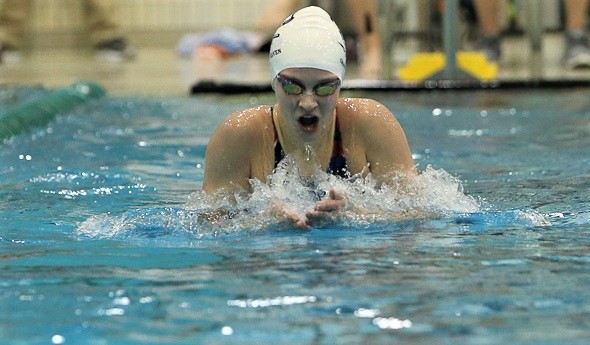
 This past fall, the triumphs of three athletes, in particular, stand out. Kathryn Ackerman set a new state mark in the 200 individual medley with a time of 1:57:25. A junior, Ackerman’s time should place nationally in the top 15 all-time. With the 2018 season complete, she now holds the top four times in the event according to the MHSAA record book.
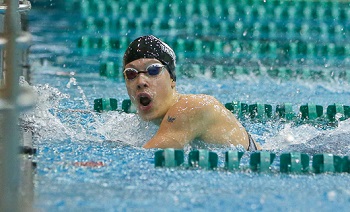
Senior Ashley Turak sprinted to a new Division I record of 22.10 in the 50 freestyle for Harrison/Farmington on the first leg of the 200 freestyle relay, as well as a time of 22.20 in the 50 freestyle. Both those times also rank in the national record books within the top 15. The MHSAA All-Class/Division Final Meet mark still belongs to Joyce, who posted a time of 22.04, set while leading off the 200 freestyle relay team in the Class A 2002 preliminaries.
Turak again mesmerized the crowd, this time in the 100-yard freestyle, posting a time of 48.72 seconds to win the event. Again, Joyce holds the Michigan All-Class/Division mark with a then-national record time of 48:59 set in 2002.
This November, Grand Ledge junior Lola Mull fell less than a half-second short of her own state mark in the 500-yard freestyle, set in the 2017 preliminaries. Mull owns the state’s top three times in the event, while Schmitt ranks fourth on the list.
Sub 20
A winter sport in Michigan, boys swimming is no different, with records in 10 of the 12 events set in the 2010s. Cam Peel of Spring Lake became the first in state history to break 20 seconds in the 50-yard freestyle, accomplishing the milestone twice this March, first in the prelim race with a record time of 19.86 and again in the finals at 19.91. The marks surpassed the previous best, set by Henry Schutte of Grand Rapids Forest Hills Central one year ago, and also rank among the “Best of the Best” in the National Federation record book.
FOOTBALL
Clark’s nine touchdowns came in Schoolcraft’s 63-27 victory over previously undefeated Constantine in a Southwestern Athletic Conference contest. Thanks to steady rain in the first half, Schoolcraft stuck to the ground game, opening a 21-0 first quarter lead on three Clark touchdowns, one of eight yards, the second of 24, and the third of 10 yards. Constantine battled back to within eight points, 21-13 late in the second quarter, but Clark would score for Schoolcraft twice more during the final three minutes before halftime.
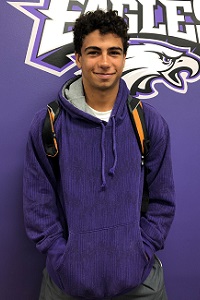 Following a 24-yard scamper, a partially blocked punt would set up Clark’s fifth rushing TD from two yards out with under a minute remaining before the break. (This appears to be a great moment to note that five players have scored five touchdowns in a single quarter). Clark added two TDs in the third quarter and two in the fourth.
Amazingly, Clark’s nine touchdowns and 54 points scored are not state records. In fact, two others have matched the touchdown and point count, while three others have exceeded the accomplishment in each category. Of course, each of those events occurred at least 90 years ago, decades before the introduction of the mercy rule in high school football.
For many years, Herb Dunphy was listed as the state’s record holder for a pair of seemingly untouchable records: touchdowns in a single game and points scored in a game. In 1917 he scored 10 TDs for Lansing Central and stood alone at the top.
But as time has proven again and again, the work of historians and researchers can alter what we believe. In 1986, research by Tom Pellow of Gwinn uncovered that Marmaduke “Duke” Christie of Escanaba had also scored 10 touchdowns, matching Dunphy’s output. In addition, Christie added six point-after-touchdowns that day, totaling 66 points, as Escanaba defeated Ishpeming 102-0 in November 1920.
“In my humble opinion, Escanaba high school in 1920 had one of the greatest football teams that ever misunderstood a signal in any language,” wrote Cy DeLynes, recalling the exploits of Christie and his teammates in the Escanaba Daily Press in 1929. “Christie was its captain. The Duke had a pair of collapsible ankles and he was able to play in only a part of four games. That, however, was just enough time to permit him to score 21 touchdowns and 38 out of a possible 50 points after touchdown – a total of 164 points. He led a backfield that made Knute Rockne’s Four Horsemen look like a quartet of super-annuated milk wagon drivers turning off the alarm clocks at 4 o’clock in the morning.”
A few years later, additional study of yearbooks and newspapers revealed the exploits of Cecil Hardy of Flint Central, again reshaping the scoring entries in the MHSAA record book.
In the 1914 season opener – a 106-0 blasting of Lapeer – Hardy carried for more than 300 yards. Within the first two minutes of play, the captain of the Flint squad had scored the first of 11 touchdowns – a “new” state mark.
“His end running was the feature of the game, his longest run being one for 50 yards and a touchdown on the first play after the kickoff. Time after time as he was making his long runs he appeared to be tackled and would wriggle out of the grasp of his opponent and run 15 or 20 yards further,” was the report of the day.
“How Is This For Football?”
Muskegon 216, Hastings 0
The Boston Globe paired the question with the football score from a Michigan high school game to readers in their Sunday edition back on September 29, 1912.
“Most of Muskegon’s touchdowns were scored on the kick-off,” stated the Globe, “and few required more than one down.”
The score was believed to be a “world’s record” for points scored in a game, at the time. Indeed, the total ranks as the tops in Michigan. Indeed, it was a record nationally, but would be surpassed on three occasions in the coming years, first in 1923, again in 1924 and finally in 1927. With today’s employment of the running clock, the scoring totals will never again be approached.
The score was 40-0 at the end of the first quarter, 102-0 following the second, and 150-0 after three quarters. Touchdowns were scored by nine different players, with six scoring multiple times. As byproducts, captain Fred Jacks finished with nine touchdowns, while Muskegon’s Nelson Stuit booted 24 of 30 extra points in the contest (another state mark that also will never be equaled).
“Although world’s records fell in the game it is not anything to be particularly proud of …” stated the Muskegon Chronicle in the prose of the time. “The visitors had about three men that knew a football from an eff, and those three could not make the Muskegon second team.”
One of the best, as it turned out, was Fred Rehor, Hastings’ “big 220 pound fullback” who would later play for Michigan, then professional ball in Ohio for the 1917 Massillon Tigers, coached by Knute Rockne.
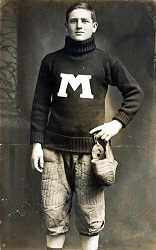 As a result of the Muskegon-Hastings game, “at least three of the football elevens which contracted this year to meet Muskegon high school have begun to make excuses in line with those usually offered before a team quits such an engagement,” wrote the Lansing State Journal. Muskegon rolled up 499 points on the year, but ended a flawless season in defeat, 13-12 against rival Grand Rapids Central in the finale. The loss was blamed on overconfidence.
The aptly named Francis Tallent of Menominee, became the next player to score nine TDs in a game.
Tallent’s skills on the gridiron had been spotted in 1928.
“Standing out like a missing tooth in a front row of the chorus … (Tallent) revealed as speedy a pair of heels as one could ever hope to cast his optics on in a high school game,” wrote one reporter after witnessing the left halfback’s performance in the annual twin cities battle between Menominee and Marinette, Wis., then played on Armistice day. Tallent scored twice in that “M & M” game, a 26-0 win by Menominee.
After thumping Green Bay in its 1929 season opener and a “helpless” Oshkosh Normal (now known as the University of Wisconsin-Oshkosh) freshmen team, 46-6, Menominee squared off for its game against “a light and green squad” from Kingsford.
According to the Milwaukee Journal Sentinel, Tallent scored nine touchdowns that day on runs of 46, 72, 90, 64, 50, 37, 90, 85 and 63 yards. In total, the paper noted that Tallent gained 597 yards rushing in the 150-0 thrashing of Kingsford. Other sources noted that it was likely more, as the sum of only the TD runs equaled the 597 yard total. Kingsford would finish its seven-game season without scoring a point. According to the Kingsfordian, the school’s high school annual, the Kingsford players “were no match for the heavier and more experienced teams on the range” that school year.
Menominee’s success and Tallent’s football exploits prompted the Journal-Sentinel to send a reporter to the U.P. to cover the 1929 M & M game between the border schools later that fall. “Mr. Tallent, who runs like the well-known hare and who slips out of tacklers’ arms and hands like a piece of wet soap, scored four touchdowns in the course of the afternoon,” wrote the staffer. “All told, this Mr. Tallent rolled up 284 yards,” as the “pride of the peninsula walloped Marinette,” 49-0, before a crowd of 10,000. The score was “the highest ever piled up in 45 years of bitter rivalry between the two cities.”
Menominee ended the 1929 season undefeated and untied in eight games, scoring over a point-a-minute while claiming the Upper Peninsula championship and demanding statewide consideration for Michigan’s mythical crown. Tallent finished the season with 27 touchdowns.
BASKETBALL
After 35 years, one began to wonder if Mark Brown’s single-season scoring mark, set in 1984-85 during his days at Hastings, would ever be surpassed. Brad Redford, named Michigan’s Mr. Basketball, came close as a senior in 2007-08, falling 17 points shy of exceeding Brown’s total of 969. Prior to that, only Drew Neitzel of Wyoming Park had come within reasonable striking distance, but that happened a decade and a half ago.
This year, Jergens of Howardsville Christian finally topped the total, finishing with 971 points. Jergens accomplished the task in 24 games, two games fewer than Brown, but with the advantage of the 3-point shot. The three was implemented after Brown had headed to college. According to press reports, Jergens had four games of at least 50 points during the season.
Still standing, 40 years later, is Jay Smith’s high school career scoring mark of 2,841 points, set at Mio between 1976 and 1979. Jergens finished third on the list with 2,782 career points, including 320 career 3-pointers – second most in state history. Brown ranks second with 2,789 points scored between 1982 and 1985.
 Freshmen
Few followers of prep basketball in Michigan could avoid coming across the name Emoni Bates, especially after the freshman phenom from Ypsilanti Lincoln knocked down 17 points in the Quarterfinals, 31 points in the Semifinal round of the Division 1 tournament, then 23 in the championship game. The immediate question on press row was, “Had another ninth grader ever exceeded his totals in a MHSAA final-rounds contests?” There was nothing to exceed it that I could recall.
While we’ve kept final round records, including single-game scoring marks, the website minimum is 40 points, and we’ve never captured a list that’s broken down by year in school.
So, I decided to dig.
Quarterfinals
The state has certainly seen some talented freshmen pass through the last rounds of the tournament. Monte Morris scored 20 points in the Quarterfinals for Flint Beecher during its Class C run in 2010. Saginaw Buena Vista played two freshmen, Mark Macon and Shawn Randolph, along its route to the Finals in 1984. Macon, at the age of 14, scored 22 points in a Quarterfinal win over Menominee that season. Two players scored 24 points in the quarters as freshmen: Flint Beecher’s Roy Marble, Jr. in 1982 in a loss to Okemos and Manton’s Matt Stuck, who scored 24 in defeat against Mio in 1989. But, according to Detroit Free Press accounts, it appears Michael Payton from Detroit St. Leo is the leading freshman point-getter in the Quarterfinal round. Payton netted 26 in a 74-62 loss to Flint St. Redeemer in the 1970 tournament.
Semifinals
Macon in 1984 and perhaps the most famous of freshmen in MHSAA Tournament history, Willie Betts of River Rouge in 1961, both scored 14 in Semifinal victories. Clyde Corley from Pontiac Central tossed in 16 points during a heartbreaking Semifinal defeat, 53-52, to Saginaw in 1976. Kelvin Torbert posted 17 points (and 10 rebounds) in a 65-62 Semifinal loss to Belleville in 1998. Morris tallied 18 in a loss to Melvindale Academy for Business & Technology in the Class C semis in 2010. So, Bates’ total of 31 certainly appears to top the list.
Finals
Only one freshman prior to Bates has hit for double digits in a state final. In 1992, Saginaw Buena Vista’s Terrance Roberson went 3 for 7 from the field and 4 for 7 from the free throw line to finish with 10 points as the Knights grabbed a 54-44 win over Grandville Calvin Christian.
Please, let me know if I missed a top performer.
 Ron Pesch has taken an active role in researching the history of MHSAA events since 1985 and began writing for MHSAA Finals programs in 1986, adding additional features and "flashbacks" in 1992. He inherited the title of MHSAA historian from the late Dick Kishpaugh following the 1993-94 school year, and resides in Muskegon. Contact him at [email protected] with ideas for historical articles.
PHOTOS: (Top) Grand Haven’s Kathryn Ackerman swims the breaststroke portion of her record-setting 200-yard individual medley this past fall. (Top middle) Harrison-Farmington’s Ashley Turak looks to the clock after her 100 freestyle at the Lower Peninsula Division 1 Finals. (Middle) Schoolcraft’s Kobe Clark. (Middle below) Muskegon's Fred Jacks. (Below) Ypsilanti Lincoln’s Emoni Bates fires a jumper during his team’s Division 1 Semifinal win over Howell