

Powerful Voice for High School Sports
December 19, 2014
By Geoff Kimmerly
Second Half editor
Paul Carey was home from the U.S. Army only a few months and just shy of 25 years old when Beal City embarked on its first trip deep into the MHSAA boys basketball tournament.
On the call for local radio station WCEN from gyms at Saginaw Arthur Hill and Lansing Sexton, Carey served as the voice of the previously “laughable” Aggies as they reached the Class D Semifinals before falling just six points short of playing for the title.
“All of Beal City emptied out. They’d never had anything before,” Carey recalled during his annual Thanksgiving weekend visit to the MHSAA Football Finals at Ford Field. “When I got home, within the next two weeks I got a letter from every citizen of Beal City thanking me for broadcasting their games. That’s the kind of appreciation that meant so much.”
During 42 years on the airwaves, Carey was best known as a voice of the Detroit Tigers bounding out of transistor radios all over Michigan, thanks to WJR’s powerful signal.
But for the state’s high school sports community, his legacy is similarly memorable as the voice of the longtime football and basketball scoreboard show and a voter for various all-state teams and wire polls over the decades.
Now 86 and retired since 1991, Carey remains a regular during the first day of the Football Finals, taking in games he broadcast for the MHSAA during the late 1970s and that continue to hold his eye as they have for more than a half-century.
“It was a passion of mine. High school sports always has been,” Carey said. “I think because my dad was a high school coach, and teacher initially, and my brother was a high school coach and teacher, I just grew up in families that appreciated coaching and athletics. I was not a great athlete, but it kept my hand in following sports that way.”
Now, the scores
Carey partnered with Ernie Harwell for Tigers radio broadcasts from 1973-91, including during the march to the 1984 World Series championship. He was named Michigan Sportscaster of the Year six times and to the Michigan Sports Hall of Fame in 1992.
But Carey’s early career included sitting on top of a car, plugged into a phone pole, for a Sacred Heart football game at old Fancher Field just a few blocks from his family’s Mount Pleasant home. Among many more accolades are a Distinguished Service Award from the Michigan High School Coaches Association and a place in the Basketball Coaches Association of Michigan Hall of Fame.
In fact, the start of his weekly announcing of statewide football and basketball scores preceded his baseball career by 16 years and ended two months after he announced his final professional out.
The Michigan High School Scoreboard show was a staple of WJR’s late Friday nights from 1957-91. Carey would read every score he could collect from a variety of sources, often organized by league and with state rankings and context mixed in.
His idea came from something similar read by Len Colby for Kalamazoo’s WKZO. Carey’s brother Terry was coaching at Niles during the second half of the 1950s, and he and other coaches would get together to listen to the Friday night scores from the southwestern part of the state.
Carey, who left WKNX in Saginaw for WJR in 1956, explained to then-sports director Bob Reynolds that the station’s strong signal could provide for a truly statewide scoreboard experience.
Carey then connected with Edgar Hayes of the former Detroit Times, who gave the OK for Carey to call the paper on Friday nights to get scores from the Detroit metro area. For the rest, Carey relied on wire services – there were three at the time – who relied on newspapers from all over Michigan to call in scores over the course of an evening.
Before every Friday during high school football season – and later Tuesdays and Fridays during boys basketball season – Carey typed up lists of games based on schedules in the newspaper, with spaces to add scores. More than a few times, Carey raced down a back ramp at Tiger Stadium after a Friday night game, back to the WJR studio, with 15 minutes to prep for the show’s 11:30 p.m. start.
“If the Flint Journal, the Grand Rapids Press, the Traverse City paper didn’t call in scores to the AP, then I was out of luck too. And that happened all the time,” Carey said. “I would call back occasionally, say, ‘Did you get anything more?’ It was a rat race.”
The show originally was set for 10 minutes and then extended to 15. American Airlines sponsored a record show that followed, and Carey’s scoreboard show had a sponsor only once in 35 years. Finishing up on time was expected, even with more than 200 scores to read.
But Carey said he always went 20 minutes, sometimes 25.
“Because I wasn’t done. I just kept right on going,” Carey said. “Jay Roberts did the all-night show most of the time, and he was patient with me. He didn’t say too much on the air about ‘that guy ahead of me took all of my time.’”
Carey continued the “rat race” until his final scoreboard show, Dec. 20, 1991. He retired from WJR at the end of that calendar year. And it's important to note: Carey was never paid a dime extra for doing the program. .
“I think Paul is really just a sports fan, and that came across to the listener on his broadcasts,” MHSAA historian Ron Pesch said. “Paul would gather as much as possible off the wire. He'd interject if scores were missing from sections of the state. Press polls from the Free Press, News, AP and UPI were big, so he could point out close calls and upsets.
“He provided immediacy, or the closest thing to it in the days before cable TV and the Internet, and because of his scoreboard show, you could get the results before the morning paper. For listeners, he brought life to something as simple as game scores.”
First team all the way
Carey, who resides in Rochester, also served as the engineer on Tigers broadcasts for 16 years, through 1990. He broadcast Pistons games on the radio for six seasons and did the first broadcast of a Central Michigan University football game, in 1949.
Harry Atkins, covering Detroit’s teams while with The Associated Press for 29 years including the last 21 as its sports editor for Detroit, took note of his colleague's hard work – and especially that Carey was one of few broadcasters who was a journalist in addition to a voice.
That made Carey's other major role in high school sports a natural fit.
Atkins split The Associated Press all-state selection panels for football and basketball into 11 regions, and Carey represented the Detroit area for a number of years. He also was a longtime voter in those sports' weekly polls.
“Paul is just that kind of guy. He thought it was important and he made time in his busy schedule to do it,” Atkins said “And it had an impact on the other 10 voters on the All-State panels, too.
“Some of them were from small out-state newspapers or radio or TV stations. Yet every one of them knew who Paul Carey was. And when he spoke, of course, with what often is called "The Voice of God," those voters paid attention.”
And he still does, as well.
At the end of each fall, Carey still puts together a compilation of the three high school all-state football teams – Associated Press, Detroit Free Press and Detroit News – and files them with years of research and results.
“It’s important to me. Nobody sees it but me, but I get a certain kick,” Carey said. “Once in a while I’ll see a kid playing at Central, Western or (Michigan) State or Michigan, and they’ll say he came from Clawson. I’ll go into my all-state collections, say that would’ve been 2009 he played, and I find a name.”
In addition to the Football Finals on WJR, Carey was part of the Baseball Finals broadcasts into the early 1990s, continuing to contribute even after his retirement from his fulltime gig.
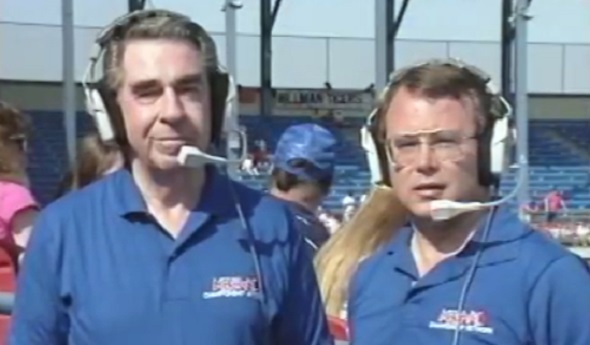
He spent high school games over the years sitting next to legends like the Free Press’ Hal Schram and remembers when current Free Press longtime scribe Mick McCabe was just a rookie. One of Carey's final broadcasts was a 1992 Baseball Final with his nephew Mike Carey, who continues to broadcast MHSAA championship games to this day.
“I am eternally grateful to Paul Carey. His contribution to high school sports in Michigan has been great and significant,” Atkins said.
“We are lucky to have him.”
PHOTO: Paul Carey (left) and nephew Mike Carey broadcast the MHSAA 1992 Class D Baseball Final between Hillman and Athens for PASS.

Hartland Ices Rematch To Finish Repeat
March 9, 2019
Second Half reports
PLYMOUTH — When Adam Pietila won a national championship with his travel hockey team last April, nobody in Hartland outside of his family knew about it.
When he won an MHSAA Division 2 championship with Hartland on Saturday at USA Hockey Arena, he did so in front of a large student section and with his best friends at the school.
“This is better,” said the Hartland sophomore, who scored the Eagles’ third goal in a 4-0 shutout of Trenton. “Going to school with everybody every day is just a great time.”
It’s the experience of playing for one’s school, in front of kids that players see every day in class, that coach Rick Gadwa pitches to talented players at Hartland who are on the fence about playing high school hockey.
The scene at USA Hockey Arena, with players jumping up against the glass to celebrate with the student section, could be Exhibit A in that sales pitch.
“You want to have a place where guys can come play where they’re feeling the love, where maybe sometimes they weren’t or it’s a different look or another stop for them,” said Gadwa, who played for Hartland 16 years ago. “More important, the pride of high school hockey, the pride of playing for your school, that stuff you don’t get in AAA or AA hockey. It’s a real special thing when you can come play for your school.”
Two of the newcomers to the Eagles in their quest to repeat were the Pietila brothers, Adam and Owen. Owen, a senior, scored two goals eight seconds apart to break a scoreless deadlock late in the first period after Hartland failed to cash in on a long five-on-three power play.
Owen Pietila made up his mind to play for Hartland after watching the Eagles beat Trenton in last year’s championship game.
“It looked like fun,” he said.
 The Division 2 ranks were dominated all season by four powerhouse programs: Hartland, Trenton, Livonia Stevenson and Birmingham Brother Rice.
In the end, there was no doubt which team was the best in the division. Hartland (27-4) beat Brother Rice, 6-2, in the Semifinals before outshooting the Trojans, 44-13, in a dominant performance in the title game.
“We had a good plan here to start the playoffs,” Gadwa said. “We kept building and building and building. We got to the top at the end. The buy-in and effort as strong as it was is hard to beat, no matter how good you are. We played some good teams. Brother Rice and Trenton are unbelievable programs. Hat’s off to them on another great year.”
Trenton was hoping to avenge a 4-2 loss to the Eagles in last year’s championship game. The Trojans (25-5-1) came in with confidence, having shut out Hartland, 2-0, on Feb. 1. But Hartland was in command from start to finish, getting the first 11 shots of the game and 17 of the first 18.
“The first time we played them, we had a few bounces go our way,” Trenton coach Chad Clements said. “They had a few bounces go their way tonight. They outshot us two-to-one the last time we played them. I kind of expected that, just because of how offensive they were. I was fine with being outshot. As long as we kept the shots from the outside, we were fine with that.
“It’s their night again. We beat them this year, just not when it mattered.”
Adam Pietila’s goal at 13:47 of the second period came on the rebound of a Benny Tervo shot on a breakaway. Gabe Anderson completed the scoring with 4:33 left in the game.
Brett Tome made 13 saves to backstop the Eagles to the Division 2 championship for the second straight time. He had a 12-0 career record as a playoff starter, allowing only seven goals and posting seven shutouts.
“It means a lot to me to not lose a single game in the playoffs,” Tome said.
On the other end of the rink, Joey Cormier made 40 saves to keep the Trojans in the game most of the way.
“Joey’s just a tremendous competitor, the backbone of our team,” Clements said. “Without him, it could have been much worse. He gives us a chance to win every time that he plays.”
PHOTOS: (Top) Hartland players celebrate clinching their second straight Division 2 championship at USA Hockey Arena. (Middle) The Eagles’ Owen Pietila tries to stuff a shot past Trenton goalie Joey Cormier during Saturday’s Final. (Photos by Andrew Knapik.)