

Powerful Voice for High School Sports
December 19, 2014
By Geoff Kimmerly
Second Half editor
Paul Carey was home from the U.S. Army only a few months and just shy of 25 years old when Beal City embarked on its first trip deep into the MHSAA boys basketball tournament.
On the call for local radio station WCEN from gyms at Saginaw Arthur Hill and Lansing Sexton, Carey served as the voice of the previously “laughable” Aggies as they reached the Class D Semifinals before falling just six points short of playing for the title.
“All of Beal City emptied out. They’d never had anything before,” Carey recalled during his annual Thanksgiving weekend visit to the MHSAA Football Finals at Ford Field. “When I got home, within the next two weeks I got a letter from every citizen of Beal City thanking me for broadcasting their games. That’s the kind of appreciation that meant so much.”
During 42 years on the airwaves, Carey was best known as a voice of the Detroit Tigers bounding out of transistor radios all over Michigan, thanks to WJR’s powerful signal.
But for the state’s high school sports community, his legacy is similarly memorable as the voice of the longtime football and basketball scoreboard show and a voter for various all-state teams and wire polls over the decades.
Now 86 and retired since 1991, Carey remains a regular during the first day of the Football Finals, taking in games he broadcast for the MHSAA during the late 1970s and that continue to hold his eye as they have for more than a half-century.
“It was a passion of mine. High school sports always has been,” Carey said. “I think because my dad was a high school coach, and teacher initially, and my brother was a high school coach and teacher, I just grew up in families that appreciated coaching and athletics. I was not a great athlete, but it kept my hand in following sports that way.”
Now, the scores
Carey partnered with Ernie Harwell for Tigers radio broadcasts from 1973-91, including during the march to the 1984 World Series championship. He was named Michigan Sportscaster of the Year six times and to the Michigan Sports Hall of Fame in 1992.
But Carey’s early career included sitting on top of a car, plugged into a phone pole, for a Sacred Heart football game at old Fancher Field just a few blocks from his family’s Mount Pleasant home. Among many more accolades are a Distinguished Service Award from the Michigan High School Coaches Association and a place in the Basketball Coaches Association of Michigan Hall of Fame.
In fact, the start of his weekly announcing of statewide football and basketball scores preceded his baseball career by 16 years and ended two months after he announced his final professional out.
The Michigan High School Scoreboard show was a staple of WJR’s late Friday nights from 1957-91. Carey would read every score he could collect from a variety of sources, often organized by league and with state rankings and context mixed in.
His idea came from something similar read by Len Colby for Kalamazoo’s WKZO. Carey’s brother Terry was coaching at Niles during the second half of the 1950s, and he and other coaches would get together to listen to the Friday night scores from the southwestern part of the state.
Carey, who left WKNX in Saginaw for WJR in 1956, explained to then-sports director Bob Reynolds that the station’s strong signal could provide for a truly statewide scoreboard experience.
Carey then connected with Edgar Hayes of the former Detroit Times, who gave the OK for Carey to call the paper on Friday nights to get scores from the Detroit metro area. For the rest, Carey relied on wire services – there were three at the time – who relied on newspapers from all over Michigan to call in scores over the course of an evening.
Before every Friday during high school football season – and later Tuesdays and Fridays during boys basketball season – Carey typed up lists of games based on schedules in the newspaper, with spaces to add scores. More than a few times, Carey raced down a back ramp at Tiger Stadium after a Friday night game, back to the WJR studio, with 15 minutes to prep for the show’s 11:30 p.m. start.
“If the Flint Journal, the Grand Rapids Press, the Traverse City paper didn’t call in scores to the AP, then I was out of luck too. And that happened all the time,” Carey said. “I would call back occasionally, say, ‘Did you get anything more?’ It was a rat race.”
The show originally was set for 10 minutes and then extended to 15. American Airlines sponsored a record show that followed, and Carey’s scoreboard show had a sponsor only once in 35 years. Finishing up on time was expected, even with more than 200 scores to read.
But Carey said he always went 20 minutes, sometimes 25.
“Because I wasn’t done. I just kept right on going,” Carey said. “Jay Roberts did the all-night show most of the time, and he was patient with me. He didn’t say too much on the air about ‘that guy ahead of me took all of my time.’”
Carey continued the “rat race” until his final scoreboard show, Dec. 20, 1991. He retired from WJR at the end of that calendar year. And it's important to note: Carey was never paid a dime extra for doing the program. .
“I think Paul is really just a sports fan, and that came across to the listener on his broadcasts,” MHSAA historian Ron Pesch said. “Paul would gather as much as possible off the wire. He'd interject if scores were missing from sections of the state. Press polls from the Free Press, News, AP and UPI were big, so he could point out close calls and upsets.
“He provided immediacy, or the closest thing to it in the days before cable TV and the Internet, and because of his scoreboard show, you could get the results before the morning paper. For listeners, he brought life to something as simple as game scores.”
First team all the way
Carey, who resides in Rochester, also served as the engineer on Tigers broadcasts for 16 years, through 1990. He broadcast Pistons games on the radio for six seasons and did the first broadcast of a Central Michigan University football game, in 1949.
Harry Atkins, covering Detroit’s teams while with The Associated Press for 29 years including the last 21 as its sports editor for Detroit, took note of his colleague's hard work – and especially that Carey was one of few broadcasters who was a journalist in addition to a voice.
That made Carey's other major role in high school sports a natural fit.
Atkins split The Associated Press all-state selection panels for football and basketball into 11 regions, and Carey represented the Detroit area for a number of years. He also was a longtime voter in those sports' weekly polls.
“Paul is just that kind of guy. He thought it was important and he made time in his busy schedule to do it,” Atkins said “And it had an impact on the other 10 voters on the All-State panels, too.
“Some of them were from small out-state newspapers or radio or TV stations. Yet every one of them knew who Paul Carey was. And when he spoke, of course, with what often is called "The Voice of God," those voters paid attention.”
And he still does, as well.
At the end of each fall, Carey still puts together a compilation of the three high school all-state football teams – Associated Press, Detroit Free Press and Detroit News – and files them with years of research and results.
“It’s important to me. Nobody sees it but me, but I get a certain kick,” Carey said. “Once in a while I’ll see a kid playing at Central, Western or (Michigan) State or Michigan, and they’ll say he came from Clawson. I’ll go into my all-state collections, say that would’ve been 2009 he played, and I find a name.”
In addition to the Football Finals on WJR, Carey was part of the Baseball Finals broadcasts into the early 1990s, continuing to contribute even after his retirement from his fulltime gig.
He spent high school games over the years sitting next to legends like the Free Press’ Hal Schram and remembers when current Free Press longtime scribe Mick McCabe was just a rookie. One of Carey's final broadcasts was a 1992 Baseball Final with his nephew Mike Carey, who continues to broadcast MHSAA championship games to this day.
“I am eternally grateful to Paul Carey. His contribution to high school sports in Michigan has been great and significant,” Atkins said.
“We are lucky to have him.”
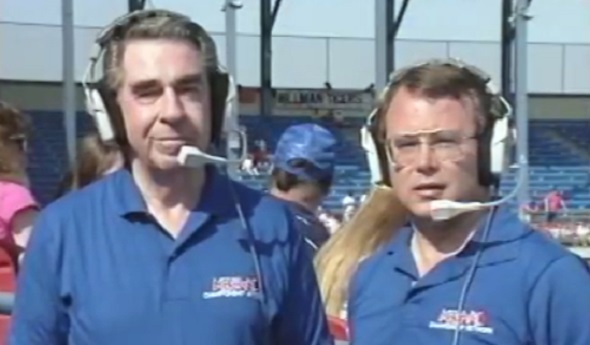
PHOTO: Paul Carey (left) and nephew Mike Carey broadcast the MHSAA 1992 Class D Baseball Final between Hillman and Athens for PASS.
Forsythe Honorees Led with Statewide View
By
Geoff Kimmerly
MHSAA.com senior editor
March 6, 2019
Jim Derocher always tried to listen to everyone before making a decision while serving on the MHSAA's Representative Council. He wanted to best serve not just the stars but all student-athletes, and not just those down the road but all over Michigan.
Longtime Council member Fred Smith always thought back to something Lake Michigan Catholic coach Terry Rose once told him: when making decisions, do what's best for kids first. Smith did so while trying to consider the needs not just of the student-athletes in his community, but in the many communities all over the state.
Both Derocher and Smith served thousands of students locally over decades of service and provided statewide contributions that continue to guide educational athletics in Michigan today. In recognition of their dedication, Derocher and Smith have been named the 2019 recipients of the Michigan High School Athletic Association’s Charles E. Forsythe Award.
The annual award is in its 42nd year and named after former MHSAA Executive Director Charles E. Forsythe, the Association's first full-time and longest-serving chief executive. Forsythe Award recipients are selected each year by the MHSAA Representative Council, based on an individual's outstanding contributions to the interscholastic athletics community. Derocher and Smith will receive their honors during the break after the first quarter of the MHSAA Division 1 Boys Basketball Final on March 16 at the Breslin Student Events Center in East Lansing.
After beginning his career as a teacher and coach at L’Anse, Derocher went on to serve as athletic director and assistant principal at Ishpeming Westwood from 1989-94, then as superintendent at Brimley from 1994-98 and finally Negaunee from 1998-2014. He also represented the Upper Peninsula’s Class C & D schools on the MHSAA Representative Council from 2003-14 and served as its president from 2008-14.
Smith taught, coached and served as athletic director at St. Joseph Lake Michigan Catholic from 1981-91, then served as athletic director at Comstock from 1991-2007, Buchanan from 2007-2015 and Benton Harbor from 2015-17. He represented the Lower Peninsula’s Southwestern Class A & B schools on the MHSAA Representative Council from 2008-17, including serving as vice president his final four years.
“Jim Derocher was an outstanding Council president, always approaching things first as a superintendent and looking at the big picture,” MHSAA Executive Director Mark Uyl said. “He provided a statewide perspective through an Upper Peninsula prism, always considering how decisions would impact schools from Monroe to Menominee.
“Fred Smith is simply one of the best athletic directors I’ve gotten to work with during my career in athletics,” Uyl added. “I met him while he was at Comstock; from Comstock to Buchanan to Benton Harbor he was presented with and led his programs through different challenges. And he always served as a champion for those schools in that part of the state while keeping a statewide perspective when helping shape the Council’s work.”
 Derocher finished his time at L’Anse earning the Copper Country Conference Coach of the Year award for boys basketball in 1989, and he also served as an MHSAA-registered official in football, boys and girls basketball from 1970-90. While on the Representative Council, Derocher served concurrently on the Upper Peninsula Athletic Committee.
He was a member of the Michigan Association of School Administrators from 1994-2014 and selected as its Region 1 Superintendent of the Year in 2013. He also received MASA’s 20-year Distinguished Administrator Award.
“I believe the experiences our student-athletes get in school athletics molds their future, whether they are the stars of the team or the supporting cast that make a team. This experience is no different for students in Brimley, Negaunee or Detroit," Derocher said. "I was always trying to work with other members of the Representative Council to recognize that these student-athletes are the same all over the state. I wanted to provide the best possible experience while also giving equality to all.”
Smith’s impact continues to be far-reaching. He remains active as part of the Michigan Interscholastic Athletic Administrators Association (MIAAA) and National Interscholastic Athletic Administrators Association (NIAAA), having served on the Board of Directors for both and recently named to the Strategic Planning Committee for the latter. He also continues to teach courses for the MHSAA’s Coaches Advancement Program (CAP) and taught the NIAAA’s Leadership Training Course at the national conference and via the internet in 13 states. He has presented at a number of MHSAA New Athletic Administrator In-Service programs and served as the co-chairperson of the MIAAA’s Professional Development Committee.
 Smith has been a registered cross country and track & field official for more than 30 years, and while an athletic director at his various schools hosted a multitude of MHSAA Tournament events in cross country, volleyball, boys and girls tennis, boys and girls basketball, track & field, wrestling, baseball, boys and girls soccer and softball. He received the MHSAA’s Allen W. Bush Award in 2014 for his many contributions behind the scenes, was named the MIAAA’s Athletic Director of the Year in 2000 and George Lovich State Award of Merit winner in 2007, and received the Art Jevert/Bruce Jacobs Distinguished Service Award from the Association of Track Officials of Michigan (ATOM) in 2013. He was named Midwest Athletic Director of the Year in 2000 as well by the National Council of Secondary School Athletic Directors (NCSSAD), and recognized by the NIAAA with a special commendation in 1999, its Distinguished Service Award in 2000, its Thomas Frederick Award of Excellence in 2004 and its Frank Kovaleski Professional Development Award in 2012. Smith also is a member of the Battle Creek St. Philip and Comstock halls of fame.
“Looking back on the service, it goes back to something my mom taught me when I was young and tried to impress on my brothers and sisters – it’s better to serve than to be served,” Smith said. “I’ve always tried to serve. I was very blessed with good high school coaches, and I enjoyed my high school experience at St. Philip. I was wanting to give back and fell into that niche, and I really enjoyed it.”
Derocher graduated from L’Anse High School in 1970 and earned his bachelor’s in secondary education, mathematics and physics in 1975 and master’s in education in 1988, both from Northern Michigan University. He also earned education specialist certification in 2003. He was a member of the Lake Superior Community Partnership from 2003-14 and remains a member of the Negaunee Lions Club. He resides in Ishpeming and works as an account executive for SET SEG, which coordinates benefits for Michigan public schools and their employees.
Smith graduated from Battle Creek St. Philip in 1973 and Western Michigan University with his bachelor’s degree in 1979. He received the Certified Master Athletic Administrator designation from the NIAAA in 2004. He remains active through his church, Our Lady Queen of Peace Catholic Church in Bridgman, and resides in Stevensville.
Past recipients of the Charles E. Forsythe Award
1978 - Brick Fowler, Port Huron; Paul Smarks, Warren
1979 - Earl Messner, Reed City; Howard Beatty, Saginaw
1980 - Max Carey, Freesoil
1981 - Steven Sluka, Grand Haven; Samuel Madden, Detroit
1982 - Ernest Buckholz, Mt. Clemens; T. Arthur Treloar, Petoskey
1983 - Leroy Dues, Detroit; Richard Maher, Sturgis
1984 - William Hart, Marquette; Donald Stamats, Caro
1985 - John Cotton, Farmington; Robert James, Warren
1986 - William Robinson, Detroit; Irving Soderland, Norway
1987 - Jack Streidl, Plainwell; Wayne Hellenga, Decatur
1988 - Jack Johnson, Dearborn; Alan Williams, North Adams
1989 - Walter Bazylewicz, Berkley; Dennis Kiley, Jackson
1990 - Webster Morrison, Pickford; Herbert Quade, Benton Harbor
1991 - Clifford Buckmaster, Petoskey; Donald Domke, Northville
1992 - William Maskill, Kalamazoo; Thomas G. McShannock, Muskegon
1993 - Roy A. Allen Jr., Detroit; John Duncan, Cedarville
1994 - Kermit Ambrose, Royal Oak
1995 - Bob Perry, Lowell
1996 - Charles H. Jones, Royal Oak
1997 - Michael A. Foster, Richland; Robert G. Grimes, Battle Creek
1998 - Lofton C. Greene, River Rouge; Joseph J. Todey, Essexville
1999 - Bernie Larson, Battle Creek
2000 - Blake Hagman, Kalamazoo; Jerry Cvengros, Escanaba
2001 - Norm Johnson, Bangor; George Lovich, Canton
2002 - John Fundukian, Novi
2003 - Ken Semelsberger, Port Huron
2004 - Marco Marcet, Frankenmuth
2005 - Jim Feldkamp, Troy
2006 - Dan McShannock, Midland; Dail Prucka, Monroe
2007 - Keith Eldred, Williamston; Tom Hickman, Spring Lake
2008 - Jamie Gent, Haslett; William Newkirk, Sanford-Meridian
2009 - Paul Ellinger, Cheboygan
2010 - Rudy Godefroidt, Hemlock; Mike Boyd, Waterford
2011 - Eric C. Federico, Trenton
2012 - Bill Mick, Midland
2013 - Jim Gilmore, Tecumseh; Dave Hutton, Grandville
2014 - Dan Flynn, Escanaba
2015 - Hugh Matson, Saginaw
2016 - Gary Hice, Petoskey; Gina Mazzolini, Lansing
2017 - Chuck Nurek, Rochester Hills
2018 - Gary Ellis, Allegan
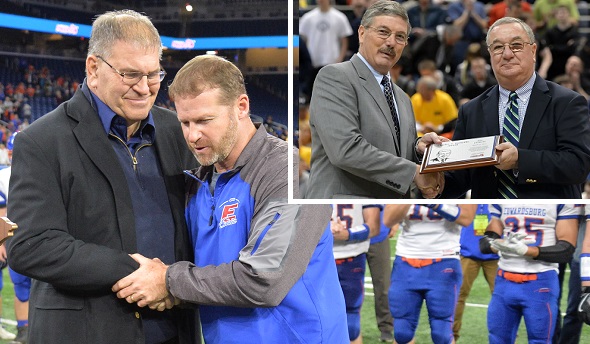
PHOTOS: (Top left) Fred Smith, left, congratulates Edwardsburg football coach Kevin Bartz after the 2017 Division 4 Final at Ford Field. (Top right) Jim Derocher, left, presents Tecumseh's Jim Gilmore with the Forsythe Award in 2013 at the Breslin Center.