

Powerful Voice for High School Sports
December 19, 2014
By Geoff Kimmerly
Second Half editor
Paul Carey was home from the U.S. Army only a few months and just shy of 25 years old when Beal City embarked on its first trip deep into the MHSAA boys basketball tournament.
On the call for local radio station WCEN from gyms at Saginaw Arthur Hill and Lansing Sexton, Carey served as the voice of the previously “laughable” Aggies as they reached the Class D Semifinals before falling just six points short of playing for the title.
“All of Beal City emptied out. They’d never had anything before,” Carey recalled during his annual Thanksgiving weekend visit to the MHSAA Football Finals at Ford Field. “When I got home, within the next two weeks I got a letter from every citizen of Beal City thanking me for broadcasting their games. That’s the kind of appreciation that meant so much.”
During 42 years on the airwaves, Carey was best known as a voice of the Detroit Tigers bounding out of transistor radios all over Michigan, thanks to WJR’s powerful signal.
But for the state’s high school sports community, his legacy is similarly memorable as the voice of the longtime football and basketball scoreboard show and a voter for various all-state teams and wire polls over the decades.
Now 86 and retired since 1991, Carey remains a regular during the first day of the Football Finals, taking in games he broadcast for the MHSAA during the late 1970s and that continue to hold his eye as they have for more than a half-century.
“It was a passion of mine. High school sports always has been,” Carey said. “I think because my dad was a high school coach, and teacher initially, and my brother was a high school coach and teacher, I just grew up in families that appreciated coaching and athletics. I was not a great athlete, but it kept my hand in following sports that way.”
Now, the scores
Carey partnered with Ernie Harwell for Tigers radio broadcasts from 1973-91, including during the march to the 1984 World Series championship. He was named Michigan Sportscaster of the Year six times and to the Michigan Sports Hall of Fame in 1992.
But Carey’s early career included sitting on top of a car, plugged into a phone pole, for a Sacred Heart football game at old Fancher Field just a few blocks from his family’s Mount Pleasant home. Among many more accolades are a Distinguished Service Award from the Michigan High School Coaches Association and a place in the Basketball Coaches Association of Michigan Hall of Fame.
In fact, the start of his weekly announcing of statewide football and basketball scores preceded his baseball career by 16 years and ended two months after he announced his final professional out.
The Michigan High School Scoreboard show was a staple of WJR’s late Friday nights from 1957-91. Carey would read every score he could collect from a variety of sources, often organized by league and with state rankings and context mixed in.
His idea came from something similar read by Len Colby for Kalamazoo’s WKZO. Carey’s brother Terry was coaching at Niles during the second half of the 1950s, and he and other coaches would get together to listen to the Friday night scores from the southwestern part of the state.
Carey, who left WKNX in Saginaw for WJR in 1956, explained to then-sports director Bob Reynolds that the station’s strong signal could provide for a truly statewide scoreboard experience.
Carey then connected with Edgar Hayes of the former Detroit Times, who gave the OK for Carey to call the paper on Friday nights to get scores from the Detroit metro area. For the rest, Carey relied on wire services – there were three at the time – who relied on newspapers from all over Michigan to call in scores over the course of an evening.
Before every Friday during high school football season – and later Tuesdays and Fridays during boys basketball season – Carey typed up lists of games based on schedules in the newspaper, with spaces to add scores. More than a few times, Carey raced down a back ramp at Tiger Stadium after a Friday night game, back to the WJR studio, with 15 minutes to prep for the show’s 11:30 p.m. start.
“If the Flint Journal, the Grand Rapids Press, the Traverse City paper didn’t call in scores to the AP, then I was out of luck too. And that happened all the time,” Carey said. “I would call back occasionally, say, ‘Did you get anything more?’ It was a rat race.”
The show originally was set for 10 minutes and then extended to 15. American Airlines sponsored a record show that followed, and Carey’s scoreboard show had a sponsor only once in 35 years. Finishing up on time was expected, even with more than 200 scores to read.
But Carey said he always went 20 minutes, sometimes 25.
“Because I wasn’t done. I just kept right on going,” Carey said. “Jay Roberts did the all-night show most of the time, and he was patient with me. He didn’t say too much on the air about ‘that guy ahead of me took all of my time.’”
Carey continued the “rat race” until his final scoreboard show, Dec. 20, 1991. He retired from WJR at the end of that calendar year. And it's important to note: Carey was never paid a dime extra for doing the program. .
“I think Paul is really just a sports fan, and that came across to the listener on his broadcasts,” MHSAA historian Ron Pesch said. “Paul would gather as much as possible off the wire. He'd interject if scores were missing from sections of the state. Press polls from the Free Press, News, AP and UPI were big, so he could point out close calls and upsets.
“He provided immediacy, or the closest thing to it in the days before cable TV and the Internet, and because of his scoreboard show, you could get the results before the morning paper. For listeners, he brought life to something as simple as game scores.”
First team all the way
Carey, who resides in Rochester, also served as the engineer on Tigers broadcasts for 16 years, through 1990. He broadcast Pistons games on the radio for six seasons and did the first broadcast of a Central Michigan University football game, in 1949.
Harry Atkins, covering Detroit’s teams while with The Associated Press for 29 years including the last 21 as its sports editor for Detroit, took note of his colleague's hard work – and especially that Carey was one of few broadcasters who was a journalist in addition to a voice.
That made Carey's other major role in high school sports a natural fit.
Atkins split The Associated Press all-state selection panels for football and basketball into 11 regions, and Carey represented the Detroit area for a number of years. He also was a longtime voter in those sports' weekly polls.
“Paul is just that kind of guy. He thought it was important and he made time in his busy schedule to do it,” Atkins said “And it had an impact on the other 10 voters on the All-State panels, too.
“Some of them were from small out-state newspapers or radio or TV stations. Yet every one of them knew who Paul Carey was. And when he spoke, of course, with what often is called "The Voice of God," those voters paid attention.”
And he still does, as well.
At the end of each fall, Carey still puts together a compilation of the three high school all-state football teams – Associated Press, Detroit Free Press and Detroit News – and files them with years of research and results.
“It’s important to me. Nobody sees it but me, but I get a certain kick,” Carey said. “Once in a while I’ll see a kid playing at Central, Western or (Michigan) State or Michigan, and they’ll say he came from Clawson. I’ll go into my all-state collections, say that would’ve been 2009 he played, and I find a name.”
In addition to the Football Finals on WJR, Carey was part of the Baseball Finals broadcasts into the early 1990s, continuing to contribute even after his retirement from his fulltime gig.
He spent high school games over the years sitting next to legends like the Free Press’ Hal Schram and remembers when current Free Press longtime scribe Mick McCabe was just a rookie. One of Carey's final broadcasts was a 1992 Baseball Final with his nephew Mike Carey, who continues to broadcast MHSAA championship games to this day.
“I am eternally grateful to Paul Carey. His contribution to high school sports in Michigan has been great and significant,” Atkins said.
“We are lucky to have him.”
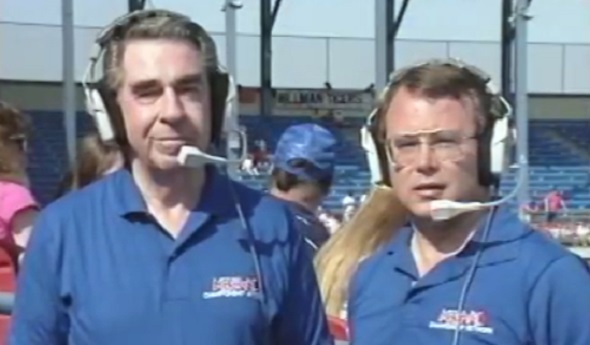
PHOTO: Paul Carey (left) and nephew Mike Carey broadcast the MHSAA 1992 Class D Baseball Final between Hillman and Athens for PASS.

D2 Preview: Red Arrows Target Record
February 22, 2019
By Geoff Kimmerly
Second Half editor
Three wrestling teams in MHSAA history have won five straight Finals championships.
This weekend, Lowell will attempt to become the first to push its winning streak to six.
 There are plenty of upset-minded opponents in the way, however, at Kalamazoo’s Wings Event Center. Five of this weekend’s eight quarterfinalists are seeking their first team title in this sport – with last season’s runner-up Gaylord among the hopefuls.
Below is a look at all eight teams competing in Division 2, listed by seed. Quarterfinal matches begin at 6:45 p.m. Friday, with Semifinals at noon Saturday and the championship match that afternoon at 3:45 p.m. All matches this weekend will be viewable live on a subscription basis on MHSAA.tv. For Friday’s schedule and results throughout, check the MHSAA Wrestling page.
#1 Lowell
Record/rank: 19-3, No. 1
League finish: First in Ottawa-Kent Conference White
Coach: R.J. Boudro, fifth season (105-14)
Championship history: Eight MHSAA championships (most recent 2018), six runner-up finishes.
Individual Finals qualifiers: 103 Ramsy Mutschler (25-8) fr., 112 Nicholas Korhorn (22-8) jr., 125 Zeth Strejc (28-6) soph., 130 Dawson Jankowski (28-6) jr., 135 Jeff Leach (22-9) sr., 135 William Link (36-6) fr., 140 Avry Mutschler (30-2) sr., 145 Doak Dean (34-4) soph., 145 James Fotis (14-3) jr., 152 Austin Boone (26-4) jr., 160 Jacob Lee (27-12) soph., 171 Derek Mohr (20-13) soph., 285 Tyler Deloof (31-5) jr.
Outlook: As noted above, Lowell has a chance to make more history, and has given up just 21 points over four District and Regional matches on the way back to Kalamazoo. Boone is a two-time Individual Finals champion, and Korhorn and Mutschler were runners-up last season. Jankowski, Strejc, Dean, Fotis and Deloof also were placers, and the Red Arrows still will have only three expected senior starters this weekend.
#2 Goodrich
Record/rank: 30-5, No. 3
League finish: First in Genesee Area Conference
Coach: Kenneth Sirignano, 10th season (record N/A)
Championship history: Two MHSAA championships (most recent 2009), two runner-up finishes.
Individual Finals qualifiers: 119 Cameron Macklem (40-10) fr., 125 Carson Richards (41-9) fr., 125 Caleb Teague (39-7) sr., 140 Dominic Edwards (32-5) sr., 160 Juwan Vines (30-6) jr., 171 James Penfold (40-3) sr., 215 Honour Kline (46-1) sr.
Outlook: Goodrich is back at the Quarterfinals for the third time in Division 2 in four seasons, and jumped up four seeds from last year. A crew of talented freshman has joined an otherwise upperclassmen-filled lineup that includes seven seniors. Teague was a Finals runner-up last season, while Vines, Kline and senior Blake Coffell also were placers.
#3 DeWitt
Record/rank: 16-5, No. 4
League finish: First in Capital Area Activities Conference Blue
Coach: Brian Byars, 19th season (449-196)
Championship history: Has not appeared in an MHSAA Final.
Individual Finals qualifiers: 125 Matt Foddrill (26-14) jr., 145 Tyler Brandt (32-12) jr., 152 Quenten Hall (29-4) sr., 171 Jacob Brandt (33-11) jr., 189 Chandler Murton (31-7) soph.
Outlook: DeWitt is back at the Quarterfinals for the second time in three seasons and second time ever, seeking to advance to Saturday for the first time. The Panthers made it to Kalamazoo with a 30-20 Regional Final victory over No. 2 Eaton Rapids after winning a league that included Division 1 No. 10 Holt and formerly-ranked Grand Ledge. Brandt, Hall and Murton were all Finals placers last season.
#4 Gaylord
Record/rank: 27-1, No. 5
League finish: First in Big North Conference
Coach: Jerry LaJoie, 25th season (696-134-2)
Championship history: Division 2 runner-up 2018.
Individual Finals qualifiers: 103 Gabe Thompson (33-14) fr., 119 Will Sides (31-14) jr., 125 Chayse LaJoie (44-0) jr., 130 John Sosa (33-9) jr., 160 Jacob McKnight (37-4) jr., 171 Quinn Schultz (11-4) soph., 189 Cade Foster (21-6) sr., 215 Aurilius Krumholz (37-10) jr.
Outlook: Gaylord emerged as a third seed last season to make an MHSAA championship match for the first time, and the Blue Devils are seeded to return to at least the Semifinals after edging No. 9 St. Johns 36-33 in the Regional Final to reach Kalamazoo. Chayse LaJoie is a two-time individual champion, and McKnight and Foster also were Finals placers in 2018.
#5 Tecumseh
Record/rank: 28-5, No. 8
League finish: First in Southeastern Conference White
Coach: A.J. Marry, fourth season (90-34)
Championship history: Has not appeared in an MHSAA Final.
Individual Finals qualifiers: 112 Joshua Hilton (46-2) sr., 119 Vincent Perez (48-0) sr., 125 Kellen Patton (45-2) sr., 130 Victor Coscarelli (33-14) jr., 135 Lucas Petty (19-21), jr., 189 Clayton Boatright (40-10) sr.
Outlook: Make it eight Quarterfinals in nine seasons for Tecumseh, which moved up three seeds from the eighth spot a year ago. The Indians have one of the most veteran lineups in Kalamazoo this weekend in any division, with all seniors and juniors expected to jump on the mat Friday. Eight starters are back from the team that faced Lowell in last season’s Quarterfinal. Perez was a Finals runner-up in 2018.
#6 Warren Woods-Tower
Record/rank: 20-6, No. 6
League finish: Third in Macomb Area Conference Red
Co-coaches: Greg Mayer and Russell Correll, 19th seasons (372-244)
Championship history: Division 2 runner-up 2017.
Individual Finals qualifiers: 112 Josh Howey (31-10) fr., 119 Joe Haynes (30-7) soph., 125 Chaise Mayer (39-3) sr., 160 Omari Embree (33-4) fr., 215 CJ Sheir (35-11) sr., 285 Joel Radvansky (39-4) sr.
Outlook: Tower reached the Semifinals last season after finishing runner-up in 2017, and the Titans are looking to make another run after emerging from a MAC Red that included Division 1 contender Macomb Dakota. Radvansky was a Finals runner-up last season, while Chaise Mayer was a runner-up in both 2016 and 2017 and took third at his weight a year ago. Haynes, sophomore Dru Wilson and senior David Stepanian also were placers in 2018.
#7 Niles
Record/rank: 22-4, No. 7
League finish: First in Southwestern Michigan Athletic Conference West
Coach: Todd Hesson, 12th season (257-86)
Championship history: Has not appeared in an MHSAA Final.
Individual Finals qualifiers: 103 Jamison Zimmerman (33-6) jr., 130 Bryce Brust (18-3) sr., 135 Javond Ball (33-8) jr., 140 Kade Wagley (36-8) jr., 152 Robert Buckland (34-11) sr., 160 Cole Simpson (33-11) sr., 171 Cade Best (33-7) sr., 285 Brian Soto (30-4) sr.
Outlook: Niles fell short of the Quarterfinals a year ago but has advanced for the fifth time in seven seasons. Eight seniors anchor the lineup, six holding down the weights from 152-285. Zimmerman took fifth last season at 103 and is one of eight on the team with at least 29 wins.
#8 Cedar Springs
Record/rank: 20-9, unranked
League finish: Second in O-K White
Coach: Nicholas Emery, seventh season (131-84)
Championship history: Class B champion 1995, runner-up 1978.
Individual Finals qualifiers: 112 Trevor Marsman (37-9) soph., 135 Aaron Smith (38-11) sr., 145 Lucas Pienton (34-3) sr., 171 Ryan Ringler (43-0) sr., 189 Sage Serbenta (41-1) jr.
Outlook: A 37-36 win over No. 10 Allendale in the Regional Final vaulted Cedar Springs to the Quarterfinals for the first time since 1996. The Red Hawks will be plenty familiar with Friday’s opponent; Lowell is from the same league. Ringler is the reigning individual champion at 171, and Pienton and Serbenta also were Finals placers last season.
PHOTO: Gaylord’s Rico Brown (top), here competing at Grand Ledge this winter, will try to help his team win its first MHSAA wrestling title. (Click for more from HighSchoolSportsScene.com.)