


Powerful Voice for High School Sports
December 19, 2014
By Geoff Kimmerly
Second Half editor
Paul Carey was home from the U.S. Army only a few months and just shy of 25 years old when Beal City embarked on its first trip deep into the MHSAA boys basketball tournament.
On the call for local radio station WCEN from gyms at Saginaw Arthur Hill and Lansing Sexton, Carey served as the voice of the previously “laughable” Aggies as they reached the Class D Semifinals before falling just six points short of playing for the title.
“All of Beal City emptied out. They’d never had anything before,” Carey recalled during his annual Thanksgiving weekend visit to the MHSAA Football Finals at Ford Field. “When I got home, within the next two weeks I got a letter from every citizen of Beal City thanking me for broadcasting their games. That’s the kind of appreciation that meant so much.”
During 42 years on the airwaves, Carey was best known as a voice of the Detroit Tigers bounding out of transistor radios all over Michigan, thanks to WJR’s powerful signal.
But for the state’s high school sports community, his legacy is similarly memorable as the voice of the longtime football and basketball scoreboard show and a voter for various all-state teams and wire polls over the decades.
Now 86 and retired since 1991, Carey remains a regular during the first day of the Football Finals, taking in games he broadcast for the MHSAA during the late 1970s and that continue to hold his eye as they have for more than a half-century.
“It was a passion of mine. High school sports always has been,” Carey said. “I think because my dad was a high school coach, and teacher initially, and my brother was a high school coach and teacher, I just grew up in families that appreciated coaching and athletics. I was not a great athlete, but it kept my hand in following sports that way.”
Now, the scores
Carey partnered with Ernie Harwell for Tigers radio broadcasts from 1973-91, including during the march to the 1984 World Series championship. He was named Michigan Sportscaster of the Year six times and to the Michigan Sports Hall of Fame in 1992.
But Carey’s early career included sitting on top of a car, plugged into a phone pole, for a Sacred Heart football game at old Fancher Field just a few blocks from his family’s Mount Pleasant home. Among many more accolades are a Distinguished Service Award from the Michigan High School Coaches Association and a place in the Basketball Coaches Association of Michigan Hall of Fame.
In fact, the start of his weekly announcing of statewide football and basketball scores preceded his baseball career by 16 years and ended two months after he announced his final professional out.
The Michigan High School Scoreboard show was a staple of WJR’s late Friday nights from 1957-91. Carey would read every score he could collect from a variety of sources, often organized by league and with state rankings and context mixed in.
His idea came from something similar read by Len Colby for Kalamazoo’s WKZO. Carey’s brother Terry was coaching at Niles during the second half of the 1950s, and he and other coaches would get together to listen to the Friday night scores from the southwestern part of the state.
Carey, who left WKNX in Saginaw for WJR in 1956, explained to then-sports director Bob Reynolds that the station’s strong signal could provide for a truly statewide scoreboard experience.
Carey then connected with Edgar Hayes of the former Detroit Times, who gave the OK for Carey to call the paper on Friday nights to get scores from the Detroit metro area. For the rest, Carey relied on wire services – there were three at the time – who relied on newspapers from all over Michigan to call in scores over the course of an evening.
Before every Friday during high school football season – and later Tuesdays and Fridays during boys basketball season – Carey typed up lists of games based on schedules in the newspaper, with spaces to add scores. More than a few times, Carey raced down a back ramp at Tiger Stadium after a Friday night game, back to the WJR studio, with 15 minutes to prep for the show’s 11:30 p.m. start.
“If the Flint Journal, the Grand Rapids Press, the Traverse City paper didn’t call in scores to the AP, then I was out of luck too. And that happened all the time,” Carey said. “I would call back occasionally, say, ‘Did you get anything more?’ It was a rat race.”
The show originally was set for 10 minutes and then extended to 15. American Airlines sponsored a record show that followed, and Carey’s scoreboard show had a sponsor only once in 35 years. Finishing up on time was expected, even with more than 200 scores to read.
But Carey said he always went 20 minutes, sometimes 25.
“Because I wasn’t done. I just kept right on going,” Carey said. “Jay Roberts did the all-night show most of the time, and he was patient with me. He didn’t say too much on the air about ‘that guy ahead of me took all of my time.’”
Carey continued the “rat race” until his final scoreboard show, Dec. 20, 1991. He retired from WJR at the end of that calendar year. And it's important to note: Carey was never paid a dime extra for doing the program. .
“I think Paul is really just a sports fan, and that came across to the listener on his broadcasts,” MHSAA historian Ron Pesch said. “Paul would gather as much as possible off the wire. He'd interject if scores were missing from sections of the state. Press polls from the Free Press, News, AP and UPI were big, so he could point out close calls and upsets.
“He provided immediacy, or the closest thing to it in the days before cable TV and the Internet, and because of his scoreboard show, you could get the results before the morning paper. For listeners, he brought life to something as simple as game scores.”
First team all the way
Carey, who resides in Rochester, also served as the engineer on Tigers broadcasts for 16 years, through 1990. He broadcast Pistons games on the radio for six seasons and did the first broadcast of a Central Michigan University football game, in 1949.
Harry Atkins, covering Detroit’s teams while with The Associated Press for 29 years including the last 21 as its sports editor for Detroit, took note of his colleague's hard work – and especially that Carey was one of few broadcasters who was a journalist in addition to a voice.
That made Carey's other major role in high school sports a natural fit.
Atkins split The Associated Press all-state selection panels for football and basketball into 11 regions, and Carey represented the Detroit area for a number of years. He also was a longtime voter in those sports' weekly polls.
“Paul is just that kind of guy. He thought it was important and he made time in his busy schedule to do it,” Atkins said “And it had an impact on the other 10 voters on the All-State panels, too.
“Some of them were from small out-state newspapers or radio or TV stations. Yet every one of them knew who Paul Carey was. And when he spoke, of course, with what often is called "The Voice of God," those voters paid attention.”
And he still does, as well.
At the end of each fall, Carey still puts together a compilation of the three high school all-state football teams – Associated Press, Detroit Free Press and Detroit News – and files them with years of research and results.
“It’s important to me. Nobody sees it but me, but I get a certain kick,” Carey said. “Once in a while I’ll see a kid playing at Central, Western or (Michigan) State or Michigan, and they’ll say he came from Clawson. I’ll go into my all-state collections, say that would’ve been 2009 he played, and I find a name.”
In addition to the Football Finals on WJR, Carey was part of the Baseball Finals broadcasts into the early 1990s, continuing to contribute even after his retirement from his fulltime gig.
He spent high school games over the years sitting next to legends like the Free Press’ Hal Schram and remembers when current Free Press longtime scribe Mick McCabe was just a rookie. One of Carey's final broadcasts was a 1992 Baseball Final with his nephew Mike Carey, who continues to broadcast MHSAA championship games to this day.
“I am eternally grateful to Paul Carey. His contribution to high school sports in Michigan has been great and significant,” Atkins said.
“We are lucky to have him.”
PHOTO: Paul Carey (left) and nephew Mike Carey broadcast the MHSAA 1992 Class D Baseball Final between Hillman and Athens for PASS.
Adrian Madison's Isom Leads at All Levels
By
Geoff Kimmerly
MHSAA.com senior editor
February 21, 2019
Over more than three decades, Adrian Madison athletic director Kris Isom has taken on responsibilities not only in her league and regionally, but statewide as a member of the MHSAA Representative Council – in addition to her athletic department responsibilities at the high school and junior high.
And yet, she still teaches multiple classes and coaches at least one of the district’s teams every year, serving and building relationships at the most local level of her wide influence on educational athletics.
She’s made those relationships a priority, also serving as class advisor to Madison students through last year when her daughter Rachel graduated. One year during the 1990s, in fact, the graduating class even dedicated its yearbook to her.
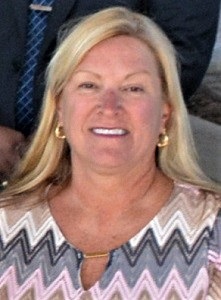 “I like being in the classroom and coaching because I still have a connection with kids, know who they are,” Isom said. “Being at a smaller school, you’re able to know who kids are, but at the middle school especially I don’t know a lot. Getting involved in coaching has helped me put a name with a face so I will know them coming up.”
She continues to impact students at Madison and beyond, and will be recognized for her many contributions with the 32nd Women In Sports Leadership Award during halftime of the Division 3 Girls Basketball Final on March 23 at Calvin College’s Van Noord Arena.
Each year, the Representative Council considers the achievements of women coaches, officials and athletic administrators affiliated with the MHSAA who show exemplary leadership capabilities and positive contributions to athletics.
Isom is in her 33rd year as athletic director at Adrian Madison, taking over athletics for the high school and junior high after serving as a teacher and coach for a year at Clinton. She has served as part of the MHSAA Representative Council since 2008, representing Class C and D schools from the state’s southeastern section.
“I’m very honored by this award, not only because it’s for women in leadership. I’ve been doing this 33 years and I’ve seen more and more women in this profession … that for all things considered is a man’s profession,” Isom said. “Having a daughter, who while she’s not following my footsteps, but getting her in the business world eventually, it’s a good feeling.”
Isom’s contributions to high school sports and its participants are many and at all levels. Within her district, she has coached basketball, volleyball, sideline cheer, track & field and softball – at least one sport every year, including as the eighth grade girls basketball coach this season.
At the league level, Isom has served as president of the Tri-County Conference since 2002 after previously serving as vice president and secretary/treasurer. Serving more of her neighboring districts, Isom has hosted numerous District, Regional and Quarterfinal competitions and MHSAA Coaches Advancement Program (CAP) sessions.
At the statewide level, Isom has provided her expertise as a member of the Representative Council and as a 33-year member of the Michigan Interscholastic Athletic Administrators Association and National Interscholastic Athletic Administrators Association. She also assists MHSAA staff annually in selecting members of the 16-student Student Advisory Council.
She was named the MIAAA’s Region 6 “Athletic Director of the Year” in 2000 and received the MHSAA’s Allen W. Bush Award in 2016 to recognize her many behind-the-scenes contributions.
“Kris Isom continues to provide a steadying presence on our Representative Council. She researches issues and really brings a voice of reason to the discussion – not only to the full Council, but to the Executive Committee as well,” MHSAA Executive Director Mark Uyl said. “She does a great job representing the southeastern corner of the state, bringing a small-school perspective to the table time after time. We’re thankful for her leadership and glad to present her with the Women In Sports Leadership Award.”
Part of leadership is being an example, and Isom has served as one for many. Of course that growing group included her daughter who this year left home to study in the dental hygiene program at Jackson College but has frequently been by Mom’s side for the many activities.
“Hopefully, (she learned) to be assertive, that she needs to be a good listener, and obviously you have to be a mediator,” Kris Isom said. “Hopefully seeing all those aspects, and dealing with situations and different issues, she’ll be a better problem solver, be more open (to the idea) that there is more than one side of a story.”
A graduate of Clinton High School, Isom received her bachelor’s degree in science and teaching certification in physical education and health in 1984 from Michigan State University. She earned her master’s in elementary education in 1986 from Eastern Michigan University and also has completed graduate courses from Fresno Pacific University.
In addition to the MIAAA and NIAAA, Isom is a member of the Michigan Association for Health, Physical Education, Recreation and Dance (MAHPERD) and the Michigan State University Alumni Association. She’s active with The Clinton United Church of Christ in various service projects, including an annual fundraiser for cancer research, and also participates in local Meals on Wheels, American Red Cross and Habitat for Humanity projects.
The first Women In Sports Leadership Award was presented in 1990.
Past recipients
1990 – Carol Seavoy, L’Anse
1991 – Diane Laffey, Harper Woods
1992 – Patricia Ashby, Scotts
1993 – Jo Lake, Grosse Pointe
1994 – Brenda Gatlin, Detroit
1995 – Jane Bennett, Ann Arbor
1996 – Cheryl Amos-Helmicki, Huntington Woods
1997 – Delores L. Elswick, Detroit
1998 – Karen S. Leinaar, Delton
1999 – Kathy McGee, Flint
2000 – Pat Richardson, Grass Lake
2001 – Suzanne Martin, East Lansing
2002 – Susan Barthold, Kentwood
2003 – Nancy Clark, Flint
2004 – Kathy Vruggink Westdorp, Grand Rapids
2005 – Barbara Redding, Capac
2006 – Melanie Miller, Lansing
2007 – Jan Sander, Warren Woods
2008 – Jane Bos, Grand Rapids
2009 – Gail Ganakas, Flint; Deb VanKuiken, Holly
2010 – Gina Mazzolini, Lansing
2011 – Ellen Pugh, West Branch; Patti Tibaldi, Traverse City
2012 – Janet Gillette, Comstock Park
2013 – Barbara Beckett, Traverse City
2014 – Teri Reyburn, DeWitt
2015 – Jean LaClair, Bronson
2016 – Betty Wroubel, Pontiac Notre Dame Prep
2017 – Dottie Davis, Ann Arbor Huron
2018 – Meg Seng, Ann Arbor Greenhills
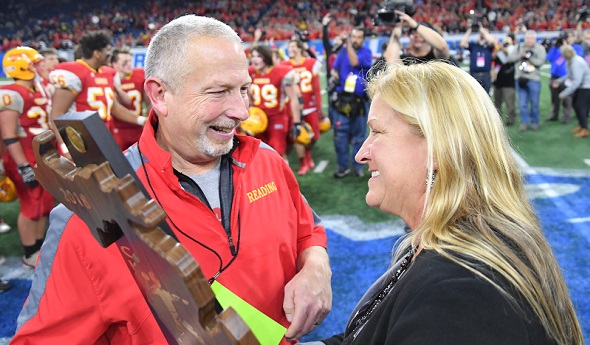
PHOTO: Adrian Madison athletic director Kris Isom, right, presents the Division 8 football championship trophy to Reading coach Rick Bailey in November at Ford Field.