


Powerful Voice for High School Sports
December 19, 2014
By Geoff Kimmerly
Second Half editor
Paul Carey was home from the U.S. Army only a few months and just shy of 25 years old when Beal City embarked on its first trip deep into the MHSAA boys basketball tournament.
On the call for local radio station WCEN from gyms at Saginaw Arthur Hill and Lansing Sexton, Carey served as the voice of the previously “laughable” Aggies as they reached the Class D Semifinals before falling just six points short of playing for the title.
“All of Beal City emptied out. They’d never had anything before,” Carey recalled during his annual Thanksgiving weekend visit to the MHSAA Football Finals at Ford Field. “When I got home, within the next two weeks I got a letter from every citizen of Beal City thanking me for broadcasting their games. That’s the kind of appreciation that meant so much.”
During 42 years on the airwaves, Carey was best known as a voice of the Detroit Tigers bounding out of transistor radios all over Michigan, thanks to WJR’s powerful signal.
But for the state’s high school sports community, his legacy is similarly memorable as the voice of the longtime football and basketball scoreboard show and a voter for various all-state teams and wire polls over the decades.
Now 86 and retired since 1991, Carey remains a regular during the first day of the Football Finals, taking in games he broadcast for the MHSAA during the late 1970s and that continue to hold his eye as they have for more than a half-century.
“It was a passion of mine. High school sports always has been,” Carey said. “I think because my dad was a high school coach, and teacher initially, and my brother was a high school coach and teacher, I just grew up in families that appreciated coaching and athletics. I was not a great athlete, but it kept my hand in following sports that way.”
Now, the scores
Carey partnered with Ernie Harwell for Tigers radio broadcasts from 1973-91, including during the march to the 1984 World Series championship. He was named Michigan Sportscaster of the Year six times and to the Michigan Sports Hall of Fame in 1992.
But Carey’s early career included sitting on top of a car, plugged into a phone pole, for a Sacred Heart football game at old Fancher Field just a few blocks from his family’s Mount Pleasant home. Among many more accolades are a Distinguished Service Award from the Michigan High School Coaches Association and a place in the Basketball Coaches Association of Michigan Hall of Fame.
In fact, the start of his weekly announcing of statewide football and basketball scores preceded his baseball career by 16 years and ended two months after he announced his final professional out.
The Michigan High School Scoreboard show was a staple of WJR’s late Friday nights from 1957-91. Carey would read every score he could collect from a variety of sources, often organized by league and with state rankings and context mixed in.
His idea came from something similar read by Len Colby for Kalamazoo’s WKZO. Carey’s brother Terry was coaching at Niles during the second half of the 1950s, and he and other coaches would get together to listen to the Friday night scores from the southwestern part of the state.
Carey, who left WKNX in Saginaw for WJR in 1956, explained to then-sports director Bob Reynolds that the station’s strong signal could provide for a truly statewide scoreboard experience.
Carey then connected with Edgar Hayes of the former Detroit Times, who gave the OK for Carey to call the paper on Friday nights to get scores from the Detroit metro area. For the rest, Carey relied on wire services – there were three at the time – who relied on newspapers from all over Michigan to call in scores over the course of an evening.
Before every Friday during high school football season – and later Tuesdays and Fridays during boys basketball season – Carey typed up lists of games based on schedules in the newspaper, with spaces to add scores. More than a few times, Carey raced down a back ramp at Tiger Stadium after a Friday night game, back to the WJR studio, with 15 minutes to prep for the show’s 11:30 p.m. start.
“If the Flint Journal, the Grand Rapids Press, the Traverse City paper didn’t call in scores to the AP, then I was out of luck too. And that happened all the time,” Carey said. “I would call back occasionally, say, ‘Did you get anything more?’ It was a rat race.”
The show originally was set for 10 minutes and then extended to 15. American Airlines sponsored a record show that followed, and Carey’s scoreboard show had a sponsor only once in 35 years. Finishing up on time was expected, even with more than 200 scores to read.
But Carey said he always went 20 minutes, sometimes 25.
“Because I wasn’t done. I just kept right on going,” Carey said. “Jay Roberts did the all-night show most of the time, and he was patient with me. He didn’t say too much on the air about ‘that guy ahead of me took all of my time.’”
Carey continued the “rat race” until his final scoreboard show, Dec. 20, 1991. He retired from WJR at the end of that calendar year. And it's important to note: Carey was never paid a dime extra for doing the program. .
“I think Paul is really just a sports fan, and that came across to the listener on his broadcasts,” MHSAA historian Ron Pesch said. “Paul would gather as much as possible off the wire. He'd interject if scores were missing from sections of the state. Press polls from the Free Press, News, AP and UPI were big, so he could point out close calls and upsets.
“He provided immediacy, or the closest thing to it in the days before cable TV and the Internet, and because of his scoreboard show, you could get the results before the morning paper. For listeners, he brought life to something as simple as game scores.”
First team all the way
Carey, who resides in Rochester, also served as the engineer on Tigers broadcasts for 16 years, through 1990. He broadcast Pistons games on the radio for six seasons and did the first broadcast of a Central Michigan University football game, in 1949.
Harry Atkins, covering Detroit’s teams while with The Associated Press for 29 years including the last 21 as its sports editor for Detroit, took note of his colleague's hard work – and especially that Carey was one of few broadcasters who was a journalist in addition to a voice.
That made Carey's other major role in high school sports a natural fit.
Atkins split The Associated Press all-state selection panels for football and basketball into 11 regions, and Carey represented the Detroit area for a number of years. He also was a longtime voter in those sports' weekly polls.
“Paul is just that kind of guy. He thought it was important and he made time in his busy schedule to do it,” Atkins said “And it had an impact on the other 10 voters on the All-State panels, too.
“Some of them were from small out-state newspapers or radio or TV stations. Yet every one of them knew who Paul Carey was. And when he spoke, of course, with what often is called "The Voice of God," those voters paid attention.”
And he still does, as well.
At the end of each fall, Carey still puts together a compilation of the three high school all-state football teams – Associated Press, Detroit Free Press and Detroit News – and files them with years of research and results.
“It’s important to me. Nobody sees it but me, but I get a certain kick,” Carey said. “Once in a while I’ll see a kid playing at Central, Western or (Michigan) State or Michigan, and they’ll say he came from Clawson. I’ll go into my all-state collections, say that would’ve been 2009 he played, and I find a name.”
In addition to the Football Finals on WJR, Carey was part of the Baseball Finals broadcasts into the early 1990s, continuing to contribute even after his retirement from his fulltime gig.
He spent high school games over the years sitting next to legends like the Free Press’ Hal Schram and remembers when current Free Press longtime scribe Mick McCabe was just a rookie. One of Carey's final broadcasts was a 1992 Baseball Final with his nephew Mike Carey, who continues to broadcast MHSAA championship games to this day.
“I am eternally grateful to Paul Carey. His contribution to high school sports in Michigan has been great and significant,” Atkins said.
“We are lucky to have him.”
PHOTO: Paul Carey (left) and nephew Mike Carey broadcast the MHSAA 1992 Class D Baseball Final between Hillman and Athens for PASS.
Erie Mason Climbs to Championship Level
February 15, 2019
By Doug Donnelly
Special for Second Half
ERIE – When Kevin Skaggs was named the boys varsity basketball coach at Erie Mason, he immediately got on the phone and started asking questions.
 After more than two decades coaching basketball, Skaggs was about to embark on something new – high school basketball.
“All of my 22 years was in college coaching,” he said. “I reached out to a lot of different high school coaches, coaches that I had known over the years. … It’s mind-boggling how you have to fit all of the pieces together to build a program.”
Whatever those coaches told Skaggs, he should box it up and sell it.
Skaggs took over an Erie Mason program that occasionally had success but was often the team on the schedule other schools wanted to face. Those days are just a memory now. In his eighth season, Skaggs has become the school’s all-time winningest coach, recently leading the team to its first-ever outright Lenawee County Athletic Association championship. His team also is in the midst of a 13-game winning streak, the longest in school history.
What’s more is the success doesn’t appear to be a blip on the screen. Mason has had five consecutive winning seasons for the first time in school history and its top scorer – the top scorer in Monroe County – is just a junior.
“I think we are starting to make (other schools) believe,” Skaggs said. “We want to be one of those opponents that when we walk into the gym, other teams say, ‘oh, no,’ instead of ‘oh, boy.’”
Those days are here. Earlier this week, Mason knocked off Petersburg-Summerfield, 64-44, in a non-league game. The Bulldogs came into Erie with a 15-0 record and a top 10 ranking in the Associated Press poll but were handled by the Eagles.
Mason followed that win with an 89-50 victory Thursday over Hudson to clinch the outright LCAA championship, the first since they joined the LCAA in 1988.
Erie Mason has a Saturday date this week with LCAA rival Dundee with a chance to improve to 15-2 on the season. Mason hasn’t won 15 games in a season since 2003-04 and has done so only three times since the school debuted in 1961-62.
All of the wins, high-powered offenses (Mason averages 67 points a game and has made 126 3-pointers as a team) can be traced back to when Skaggs first got to Mason and, on the advice of coaching friends, started a youth basketball program, the Junior Eagles. Those first-year kids eight years ago are now the ones Skaggs sees in the huddle during timeouts.
“They are from that first group of our youth program, and you can get a sense of that,” he said. “They love basketball. That was a big step for us.”
Skaggs, 63, brought together others in the community to put together the youth program for boys and girls. While Mason has had success in other sports – the football team won the Class C championship in 1987 – basketball had lagged behind. Now, he said, that culture has changed. It happened, he said, because student-athletes started loving the game of basketball.
“What you want to teach is to teach them to have fun with the game,” he said. “If you get the kids to fall in love with the sport, they will pursue it. You want to be able to keep kids interested and with a ball in their hands.”
The program aims at teaching the game, making sure kids have fun and, then, around the fifth- and sixth-grade level, increase the competitiveness. By middle school, the basketball players are able to compete with other teams on the Mason schedule. By high school, they are used to success and hungry for more.
“Our eight-grade team had a tremendous year, and our seventh-grade team was pretty good,” Skaggs said. “It’s starting to cycle through, which is wonderful to watch.”
Skaggs also said he’s noticed that athletes aren’t leaving the district to go play for other schools like was once the case.
“We’re keeping our players in our school,” he said.
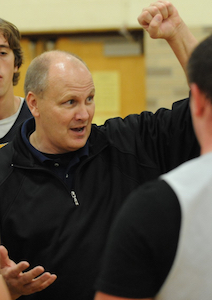 Skaggs earned his master’s degree in sports administration and bachelor’s degree in social work at Western Michigan University, where he met coach Dick Shilts. He was directing Christian-based basketball camps in Michigan and Ohio before becoming an assistant coach at Kalamazoo Valley Community College under Shilts and enjoying monumental success. After six years there, he became head coach at Alma College from 1995 to 2001, going 53-98. His second Alma team went 14-12 and won a Michigan Intercollegiate Athletic Association tournament game for the first time in school history. After moving to Erie, Skaggs got an assistant coaching job at Owens Community College in northwest Ohio. He was an assistant five years with the Express, including three years as a volunteer coach, before becoming the head coach.
In 2011, he was named the head coach at Erie Mason, a school just north of the Ohio border that had just a handful of winning seasons in its history.
“Mason was a no-brainer. I was 55 and getting a little tired of getting on a bus and going three to four hours away for a game,” he said. “Plus, my son was playing and I was missing watching him.”
His family has been a major part of his run at Mason. Sons Isaac and Jacob have both either played or coached with him his entire time at Mason.
“What’s a better place to start than with your family?” he said.
He also found community members Tom Banachowski and Brad Liedel to serve as assistant coaches. He delegates what he calls “meaningful responsibility” to his assistants to help the workload and to build continuity in the program. One thing he doesn’t delegate is the Eagles’ offense.
“I’m greedy when it comes to offense,” he said. “That’s mine. There’s nothing like watching an offense that moves the ball and goes. It’s exciting and fun to watch.”
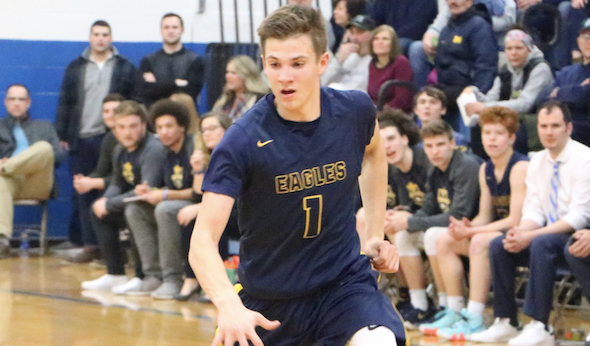
For the past couple of seasons, the Eagle most fun to watch has been Joe Liedel. The 5-foot-11 junior recently moved into second place on the school’s all-time scoring list. With 1,229 points through 16 games this season, he’s well within reach of the school’s career leader, J.P. Horne (1,455 points).
“If Joe Liedel was 6-foot-3, every Division I school would be calling on him,” Skaggs said. “He’s one of the most complete kids I’ve coached in 35 years – and I don’t say that easily.”
Liedel has been sensational this season. He’s the top scorer in the LCAA, and has had games of 41, 37, 37, 34 and 31 while shooting 51.4 percent from the floor, 86.9 percent from the free throw line and leading the team in assists and steals.
“He’s really a complete player, offense and defense,” Skaggs said. “When he thinks there is a weakness in his game, he identifies it and works on it. He’s always been good at shooting, but now he can get to the basket. It adds to his game.”
Liedel isn’t a one-man show, however. Senior Jake Trainor averages 13.6 points a game, while senior brothers Bryan Sweeney (10.6 points a game) and John Sweeney (8.3 points, 6.3 rebounds a game) have played major roles as well.
When they get to the postseason, Erie Mason will be trying to win its first District championship in 46 years. The 1972-73 team won District and Regional championships. It won’t be easy as the Division 3 District at Blissfield is loaded with talented teams, including Summerfield (15-1), perennial power Monroe St. Mary Catholic Central (11-3) and Clinton, which just knocked off 10th-ranked Quincy.
Skaggs is drawing on his college coaching days to keep his players focused on next-level goals.
“Our first goal was to win the LCAA, and we’ve done that,” he said. “Next, it’s the District. Every game we play in now is a test to get ready for the state tournament. You have to keep the focus on one game at a time. We’ve been able to do that. We’re still having fun.”
 Doug Donnelly has served as a sports and news reporter and city editor over 25 years, writing for the Daily Chief-Union in Upper Sandusky, Ohio from 1992-1995, the Monroe Evening News from 1995-2012 and the Adrian Daily Telegram since 2013. He's also written a book on high school basketball in Monroe County and compiles record books for various schools in southeast Michigan. E-mail him at [email protected] with story ideas for Jackson, Washtenaw, Hillsdale, Lenawee and Monroe counties.
PHOTOS: (Top) Joe Liedel moved into second place on the Erie Mason all-time scoring list this season. (Middle) Coach Kevin Skaggs has led the Eagles to rare success including an outright league title this season. (Top photo by Vanessa Ray.)