


Powerful Voice for High School Sports
December 19, 2014
By Geoff Kimmerly
Second Half editor
Paul Carey was home from the U.S. Army only a few months and just shy of 25 years old when Beal City embarked on its first trip deep into the MHSAA boys basketball tournament.
On the call for local radio station WCEN from gyms at Saginaw Arthur Hill and Lansing Sexton, Carey served as the voice of the previously “laughable” Aggies as they reached the Class D Semifinals before falling just six points short of playing for the title.
“All of Beal City emptied out. They’d never had anything before,” Carey recalled during his annual Thanksgiving weekend visit to the MHSAA Football Finals at Ford Field. “When I got home, within the next two weeks I got a letter from every citizen of Beal City thanking me for broadcasting their games. That’s the kind of appreciation that meant so much.”
During 42 years on the airwaves, Carey was best known as a voice of the Detroit Tigers bounding out of transistor radios all over Michigan, thanks to WJR’s powerful signal.
But for the state’s high school sports community, his legacy is similarly memorable as the voice of the longtime football and basketball scoreboard show and a voter for various all-state teams and wire polls over the decades.
Now 86 and retired since 1991, Carey remains a regular during the first day of the Football Finals, taking in games he broadcast for the MHSAA during the late 1970s and that continue to hold his eye as they have for more than a half-century.
“It was a passion of mine. High school sports always has been,” Carey said. “I think because my dad was a high school coach, and teacher initially, and my brother was a high school coach and teacher, I just grew up in families that appreciated coaching and athletics. I was not a great athlete, but it kept my hand in following sports that way.”
Now, the scores
Carey partnered with Ernie Harwell for Tigers radio broadcasts from 1973-91, including during the march to the 1984 World Series championship. He was named Michigan Sportscaster of the Year six times and to the Michigan Sports Hall of Fame in 1992.
But Carey’s early career included sitting on top of a car, plugged into a phone pole, for a Sacred Heart football game at old Fancher Field just a few blocks from his family’s Mount Pleasant home. Among many more accolades are a Distinguished Service Award from the Michigan High School Coaches Association and a place in the Basketball Coaches Association of Michigan Hall of Fame.
In fact, the start of his weekly announcing of statewide football and basketball scores preceded his baseball career by 16 years and ended two months after he announced his final professional out.
The Michigan High School Scoreboard show was a staple of WJR’s late Friday nights from 1957-91. Carey would read every score he could collect from a variety of sources, often organized by league and with state rankings and context mixed in.
His idea came from something similar read by Len Colby for Kalamazoo’s WKZO. Carey’s brother Terry was coaching at Niles during the second half of the 1950s, and he and other coaches would get together to listen to the Friday night scores from the southwestern part of the state.
Carey, who left WKNX in Saginaw for WJR in 1956, explained to then-sports director Bob Reynolds that the station’s strong signal could provide for a truly statewide scoreboard experience.
Carey then connected with Edgar Hayes of the former Detroit Times, who gave the OK for Carey to call the paper on Friday nights to get scores from the Detroit metro area. For the rest, Carey relied on wire services – there were three at the time – who relied on newspapers from all over Michigan to call in scores over the course of an evening.
Before every Friday during high school football season – and later Tuesdays and Fridays during boys basketball season – Carey typed up lists of games based on schedules in the newspaper, with spaces to add scores. More than a few times, Carey raced down a back ramp at Tiger Stadium after a Friday night game, back to the WJR studio, with 15 minutes to prep for the show’s 11:30 p.m. start.
“If the Flint Journal, the Grand Rapids Press, the Traverse City paper didn’t call in scores to the AP, then I was out of luck too. And that happened all the time,” Carey said. “I would call back occasionally, say, ‘Did you get anything more?’ It was a rat race.”
The show originally was set for 10 minutes and then extended to 15. American Airlines sponsored a record show that followed, and Carey’s scoreboard show had a sponsor only once in 35 years. Finishing up on time was expected, even with more than 200 scores to read.
But Carey said he always went 20 minutes, sometimes 25.
“Because I wasn’t done. I just kept right on going,” Carey said. “Jay Roberts did the all-night show most of the time, and he was patient with me. He didn’t say too much on the air about ‘that guy ahead of me took all of my time.’”
Carey continued the “rat race” until his final scoreboard show, Dec. 20, 1991. He retired from WJR at the end of that calendar year. And it's important to note: Carey was never paid a dime extra for doing the program. .
“I think Paul is really just a sports fan, and that came across to the listener on his broadcasts,” MHSAA historian Ron Pesch said. “Paul would gather as much as possible off the wire. He'd interject if scores were missing from sections of the state. Press polls from the Free Press, News, AP and UPI were big, so he could point out close calls and upsets.
“He provided immediacy, or the closest thing to it in the days before cable TV and the Internet, and because of his scoreboard show, you could get the results before the morning paper. For listeners, he brought life to something as simple as game scores.”
First team all the way
Carey, who resides in Rochester, also served as the engineer on Tigers broadcasts for 16 years, through 1990. He broadcast Pistons games on the radio for six seasons and did the first broadcast of a Central Michigan University football game, in 1949.
Harry Atkins, covering Detroit’s teams while with The Associated Press for 29 years including the last 21 as its sports editor for Detroit, took note of his colleague's hard work – and especially that Carey was one of few broadcasters who was a journalist in addition to a voice.
That made Carey's other major role in high school sports a natural fit.
Atkins split The Associated Press all-state selection panels for football and basketball into 11 regions, and Carey represented the Detroit area for a number of years. He also was a longtime voter in those sports' weekly polls.
“Paul is just that kind of guy. He thought it was important and he made time in his busy schedule to do it,” Atkins said “And it had an impact on the other 10 voters on the All-State panels, too.
“Some of them were from small out-state newspapers or radio or TV stations. Yet every one of them knew who Paul Carey was. And when he spoke, of course, with what often is called "The Voice of God," those voters paid attention.”
And he still does, as well.
At the end of each fall, Carey still puts together a compilation of the three high school all-state football teams – Associated Press, Detroit Free Press and Detroit News – and files them with years of research and results.
“It’s important to me. Nobody sees it but me, but I get a certain kick,” Carey said. “Once in a while I’ll see a kid playing at Central, Western or (Michigan) State or Michigan, and they’ll say he came from Clawson. I’ll go into my all-state collections, say that would’ve been 2009 he played, and I find a name.”
In addition to the Football Finals on WJR, Carey was part of the Baseball Finals broadcasts into the early 1990s, continuing to contribute even after his retirement from his fulltime gig.
He spent high school games over the years sitting next to legends like the Free Press’ Hal Schram and remembers when current Free Press longtime scribe Mick McCabe was just a rookie. One of Carey's final broadcasts was a 1992 Baseball Final with his nephew Mike Carey, who continues to broadcast MHSAA championship games to this day.
“I am eternally grateful to Paul Carey. His contribution to high school sports in Michigan has been great and significant,” Atkins said.
“We are lucky to have him.”
PHOTO: Paul Carey (left) and nephew Mike Carey broadcast the MHSAA 1992 Class D Baseball Final between Hillman and Athens for PASS.
Southfield A&T Aiming for Highest Goal
By
Tom Markowski
Special for Second Half
February 14, 2019
SOUTHFIELD – This is season three since the merger combining Southfield’s two former public high schools, Southfield High and Southfield-Lathrup. And the shining star through all of the hubbub, at least athletically, is the girls basketball program.
 The result of the merger is Southfield High School for the Arts and Technology, commonly known as Southfield A&T. The school is located at the former Southfield High, at the corner of 10 Mile Road and Lahser Road. While the boys track & field and football teams have been competitive since the merger, the success of coach Michele Marshall’s girls basketball team has gained statewide attention.
This season the Warriors could have the best team in Southfield history, whether at Southfield High, Southfield-Lathrup or A&T.
No, we’re not forgetting the 2005 Southfield-Lathrup team, also coached by Marshall (her name was Michele Jackson then), which won the Class A title. There are similarities between that team and this year’s squad, which we will address later.
This season the Warriors are 14-1 and ranked No. 2 in Division 1 in the latest Associated Press poll. Their only loss came in the second game to 2018 Class A champion Saginaw Heritage, 45-43, at Ypsilanti Arbor Prep as part of the Icebreaker Challenge. Southfield A&T is 7-0 in the Oakland Activities Association Red, a half-game ahead of Royal Oak (14-1, 7-1) after the Warriors won 60-47 at Royal Oak on Feb. 5.
The teams will complete the regular season against each other Feb. 28 at Southfield A&T.
“It was (a big victory),” Marshall said. “I watched the Royal Oak program grow even when I was coaching at Lathrup. They play very hard. Anytime you walk into a gym where there’s a hostile crowd, it’s going to be a challenge. It was for first place. They were undefeated. We need all the competition we can get to get ready for the state tournament.”
Southfield A&T will host Bloomfield Hills tonight, and barring a major upset in the next two weeks the Warriors will win the Red. It’s no slight to any of the teams in the division, but Southfield has bigger goals – notably, the Division 1 championship.
“That’s a lofty expectation,” Marshall said. “We hope to win a state championship. That’s our goal. If that isn’t (your goal), you have to ask yourself, why are you coaching?
“(But) having won a state title, I know you have to have a lot of things go your way.”
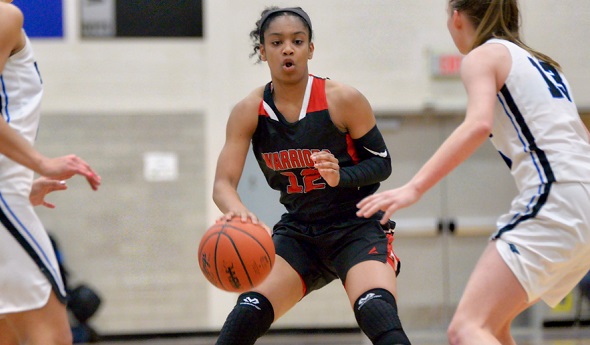
This team has experience with three starters returning led by senior Alexis Johnson and junior Cheyenne McEvans. They are both 5-foot-10 and two of the state’s top players in their respective classes, and both started on the 2016-17 team that reached a Class A Semifinal before losing to East Kentwood, 55-51.
Johnson, who surpassed 1,000 career points and averages 20 per game, is a four-year varsity player and has signed with Marshall University. McEvans averages 18 points and, although she spends much of her time at the guard position, grabbed 22 rebounds in the victory over Royal Oak.
The third returning starter is sophomore Kayiona Willis, who took over at the point guard spot last season and is averaging eight points per game. The other two starters are Soleil Barnes, a 5-8 senior who averaged 16 points last season while attending Nordonia High in Macedonia, Ohio, near Cleveland, and is contributing 10 per game this winter; and Jasmine Worthy, a 6-3 junior who attended nearby Birmingham Groves last season and is averaging eight points and eight rebounds. Her presence inside has allowed Johnson, a post player her first three seasons, to play on the perimeter or wherever Marshall sees fit.
 Few teams can match the versatility, experience and talent of Marshall’s starting five. What can’t be measured is the commitment of this group. It’s not a stretch to make comparisons with the 2005 Southfield-Lathrup team. That team returned all five starters from the 2004 team that reached the Semifinal round before losing a heartbreaker to Lansing Waverly, 50-49.
Waverly, which would go on to defeat Detroit Martin Luther King, 33-32, for the Class A title, trailed Southfield-Lathrup after each of the first three quarters before pulling out the victory. And those 2004 Chargers learned their lessons well as they, too, won a close Semifinal (62-58 over Grandville in overtime) a year later before defeating King, 48-36, for the school’s only MHSAA Finals title.
Talent and experience are just two reasons why this season’s Warriors are such legitimate contenders. Look at the teams that win state titles. Normally you find an experienced coach on the bench. And that’s why this program is so highly respected.
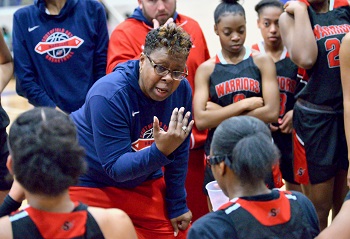
Marshall has coached girls basketball for 27 years, the last 25 as a head coach, the first 22 at Southfield-Lathrup. She’s also taught English during this period all within the Southfield school system. When the two high schools merged, decisions had to be made on who would be the head coach of each of the athletic programs. After some debate, Marshall was named head coach at A&T.
Looking back it would appear the school district made the right choice. Above all else, Marshall has provided stability for a situation that could have turned ugly. Coaching a team where many players were rivals the season before had it challenges. There were jealousies and selfish tendencies with which to contend. That 2016-17 season challenged Marshall as a coach, and as a teacher and mentor away from the court.
Most of the players had played for Southfield High the previous season and she, of course, had coached against them. Known as a strict but fair coach, one who allows her players to be creative, Marshall dug deep to find the courage and patience to win her players over.
“They were our rivals,” said Johnson – the only remaining player from the pre-merger days – of her new teammates who came over from Southfield-Lathrup. “There was tension at first. … Coach said if we want to win, we had to work together. We connected after the King game.”
Showing how difficult that process was and how long it took, that game against King was the Regional Final.
“Nothing was easy,” Marshall said. “I took the most prominent leader from Lathrup and the most prominent leader from Southfield to help lead us. By the end of the season the kids all came together. We got to the semis. It was fun.”
And Johnson said that 2017 Semifinal loss to East Kentwood continues to provide motivation. And there’s an air of confidence that exuberates throughout.
“When we lost to East Kentwood, we were hungry to win a state title,” she said. “This team’s work ethic is different than any team I’ve been on. We all just want to win. We’re all on the same page.”
 Tom Markowski is a correspondent for the State Champs! Sports Network and previously directed its web coverage. He also covered primarily high school sports for the The Detroit News from 1984-2014, focusing on the Detroit area and contributing to statewide coverage of football and basketball. Contact him at [email protected] with story ideas for Oakland, Macomb and Wayne counties.
PHOTOS: (Top) Southfield Arts & Technology’s Cheyenne McEvans looks to make her move during her team’s win over Royal Oak on Feb. 5. (Middle) Warriors coach Michele Marshall talks things over with her players. (Photos courtesy of C&G Newspapers.)