

Powerful Voice for High School Sports
December 19, 2014
By Geoff Kimmerly
Second Half editor
Paul Carey was home from the U.S. Army only a few months and just shy of 25 years old when Beal City embarked on its first trip deep into the MHSAA boys basketball tournament.
On the call for local radio station WCEN from gyms at Saginaw Arthur Hill and Lansing Sexton, Carey served as the voice of the previously “laughable” Aggies as they reached the Class D Semifinals before falling just six points short of playing for the title.
“All of Beal City emptied out. They’d never had anything before,” Carey recalled during his annual Thanksgiving weekend visit to the MHSAA Football Finals at Ford Field. “When I got home, within the next two weeks I got a letter from every citizen of Beal City thanking me for broadcasting their games. That’s the kind of appreciation that meant so much.”
During 42 years on the airwaves, Carey was best known as a voice of the Detroit Tigers bounding out of transistor radios all over Michigan, thanks to WJR’s powerful signal.
But for the state’s high school sports community, his legacy is similarly memorable as the voice of the longtime football and basketball scoreboard show and a voter for various all-state teams and wire polls over the decades.
Now 86 and retired since 1991, Carey remains a regular during the first day of the Football Finals, taking in games he broadcast for the MHSAA during the late 1970s and that continue to hold his eye as they have for more than a half-century.
“It was a passion of mine. High school sports always has been,” Carey said. “I think because my dad was a high school coach, and teacher initially, and my brother was a high school coach and teacher, I just grew up in families that appreciated coaching and athletics. I was not a great athlete, but it kept my hand in following sports that way.”
Now, the scores
Carey partnered with Ernie Harwell for Tigers radio broadcasts from 1973-91, including during the march to the 1984 World Series championship. He was named Michigan Sportscaster of the Year six times and to the Michigan Sports Hall of Fame in 1992.
But Carey’s early career included sitting on top of a car, plugged into a phone pole, for a Sacred Heart football game at old Fancher Field just a few blocks from his family’s Mount Pleasant home. Among many more accolades are a Distinguished Service Award from the Michigan High School Coaches Association and a place in the Basketball Coaches Association of Michigan Hall of Fame.
In fact, the start of his weekly announcing of statewide football and basketball scores preceded his baseball career by 16 years and ended two months after he announced his final professional out.
The Michigan High School Scoreboard show was a staple of WJR’s late Friday nights from 1957-91. Carey would read every score he could collect from a variety of sources, often organized by league and with state rankings and context mixed in.
His idea came from something similar read by Len Colby for Kalamazoo’s WKZO. Carey’s brother Terry was coaching at Niles during the second half of the 1950s, and he and other coaches would get together to listen to the Friday night scores from the southwestern part of the state.
Carey, who left WKNX in Saginaw for WJR in 1956, explained to then-sports director Bob Reynolds that the station’s strong signal could provide for a truly statewide scoreboard experience.
Carey then connected with Edgar Hayes of the former Detroit Times, who gave the OK for Carey to call the paper on Friday nights to get scores from the Detroit metro area. For the rest, Carey relied on wire services – there were three at the time – who relied on newspapers from all over Michigan to call in scores over the course of an evening.
Before every Friday during high school football season – and later Tuesdays and Fridays during boys basketball season – Carey typed up lists of games based on schedules in the newspaper, with spaces to add scores. More than a few times, Carey raced down a back ramp at Tiger Stadium after a Friday night game, back to the WJR studio, with 15 minutes to prep for the show’s 11:30 p.m. start.
“If the Flint Journal, the Grand Rapids Press, the Traverse City paper didn’t call in scores to the AP, then I was out of luck too. And that happened all the time,” Carey said. “I would call back occasionally, say, ‘Did you get anything more?’ It was a rat race.”
The show originally was set for 10 minutes and then extended to 15. American Airlines sponsored a record show that followed, and Carey’s scoreboard show had a sponsor only once in 35 years. Finishing up on time was expected, even with more than 200 scores to read.
But Carey said he always went 20 minutes, sometimes 25.
“Because I wasn’t done. I just kept right on going,” Carey said. “Jay Roberts did the all-night show most of the time, and he was patient with me. He didn’t say too much on the air about ‘that guy ahead of me took all of my time.’”
Carey continued the “rat race” until his final scoreboard show, Dec. 20, 1991. He retired from WJR at the end of that calendar year. And it's important to note: Carey was never paid a dime extra for doing the program. .
“I think Paul is really just a sports fan, and that came across to the listener on his broadcasts,” MHSAA historian Ron Pesch said. “Paul would gather as much as possible off the wire. He'd interject if scores were missing from sections of the state. Press polls from the Free Press, News, AP and UPI were big, so he could point out close calls and upsets.
“He provided immediacy, or the closest thing to it in the days before cable TV and the Internet, and because of his scoreboard show, you could get the results before the morning paper. For listeners, he brought life to something as simple as game scores.”
First team all the way
Carey, who resides in Rochester, also served as the engineer on Tigers broadcasts for 16 years, through 1990. He broadcast Pistons games on the radio for six seasons and did the first broadcast of a Central Michigan University football game, in 1949.
Harry Atkins, covering Detroit’s teams while with The Associated Press for 29 years including the last 21 as its sports editor for Detroit, took note of his colleague's hard work – and especially that Carey was one of few broadcasters who was a journalist in addition to a voice.
That made Carey's other major role in high school sports a natural fit.
Atkins split The Associated Press all-state selection panels for football and basketball into 11 regions, and Carey represented the Detroit area for a number of years. He also was a longtime voter in those sports' weekly polls.
“Paul is just that kind of guy. He thought it was important and he made time in his busy schedule to do it,” Atkins said “And it had an impact on the other 10 voters on the All-State panels, too.
“Some of them were from small out-state newspapers or radio or TV stations. Yet every one of them knew who Paul Carey was. And when he spoke, of course, with what often is called "The Voice of God," those voters paid attention.”
And he still does, as well.
At the end of each fall, Carey still puts together a compilation of the three high school all-state football teams – Associated Press, Detroit Free Press and Detroit News – and files them with years of research and results.
“It’s important to me. Nobody sees it but me, but I get a certain kick,” Carey said. “Once in a while I’ll see a kid playing at Central, Western or (Michigan) State or Michigan, and they’ll say he came from Clawson. I’ll go into my all-state collections, say that would’ve been 2009 he played, and I find a name.”
In addition to the Football Finals on WJR, Carey was part of the Baseball Finals broadcasts into the early 1990s, continuing to contribute even after his retirement from his fulltime gig.
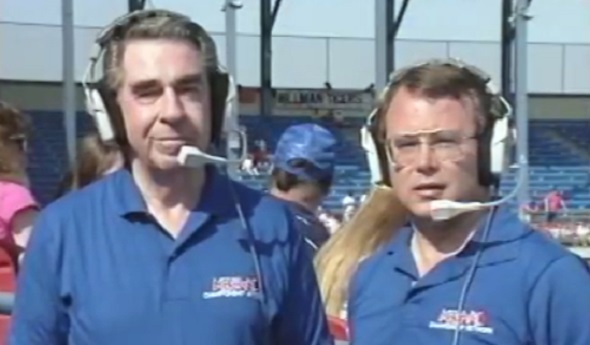
He spent high school games over the years sitting next to legends like the Free Press’ Hal Schram and remembers when current Free Press longtime scribe Mick McCabe was just a rookie. One of Carey's final broadcasts was a 1992 Baseball Final with his nephew Mike Carey, who continues to broadcast MHSAA championship games to this day.
“I am eternally grateful to Paul Carey. His contribution to high school sports in Michigan has been great and significant,” Atkins said.
“We are lucky to have him.”
PHOTO: Paul Carey (left) and nephew Mike Carey broadcast the MHSAA 1992 Class D Baseball Final between Hillman and Athens for PASS.
As Soules Guided, East Catholic Reigned
January 31, 2019
By Ron Pesch
Special for Second Half
“I’m surprised to be this far. Some nights we play very good and some nights we play very bad. I just didn’t think we’d be consistent enough to get this far.”
The words were spoken by varsity basketball coach Dave Soules of Detroit East Catholic back in 1973, but, no doubt, could have come from any number of coaches who have found themselves, unexpectedly, somewhere deep into the MHSAA postseason.
It was Soules’ first season in charge of Detroit East Catholic’s varsity, but far from his first year in the building the school occupied.
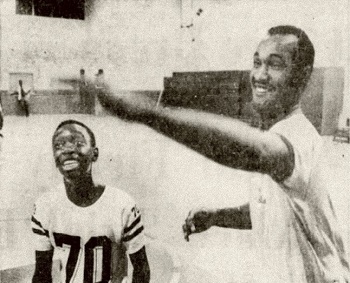
The Chargers had advanced to the Class B Quarterfinals the previous year, falling to perennial powerhouse River Rouge, 65-64. That East Catholic team was coached by Eugene Dennis Alexander. An all-city player at Detroit Northeastern, Denny Alexander played college ball at Aquinas in Grand Rapids and became only the fourth player in Michigan collegiate history to surpass 2,000 points in a career, joining John Bradley of Lawrence Tech, Dave DeBusschere of the University of Detroit and the University of Michigan’s Cazzie Russell on the list. In May of 1969, at age 23, he was named head coach at East Catholic.
 Denny’s brother, Darryl Alexander, was East Catholic’s best ballplayer in 1972. The team streaked to 11 straight victories during the regular season, then squared off in a series of late February games against larger Detroit Public School League teams. The scheduling was designed to ready the squad for the postseason. Losses to Detroit Southeastern (68-47), Detroit Kettering (80-71) and Detroit Northern (59-58) were a means to that end. While the Chargers did not make the Detroit Catholic League tournament, they were ready to do some damage in the Class B MHSAA tournament.
Only a field goal by River Rouge’s Byron Wilson with 26 seconds remaining prevented the Chargers from doing more. East Catholic trailed in the Quarterfinal by as many as 14 points, and made valiant runs to pull within a point on two occasions, but couldn’t upset coach Lofton Greene’s Panthers. Alexander finished with 19 to again lead the Chargers but was lost to fouls with 1:37 remaining in the third period. Trailing 61-53, East Catholic cut it to 61-60 with 1:35 left to play on a Phil Young field goal. Larry Merchant’s pair of free throws again brought the margin to a single point, 65-64 – but with only five seconds left, the Chargers were out of miracles.
River Rouge, on the other hand, was not. The Panthers would advance through the Semifinals and then survive another thriller, escaping with another one-point victory in the title game against Muskegon Heights. That win marked their 12th Class B title in 19 years.
The Chargers finished the season with a 16-7 record. Alexander earned Associated Press Class B all-state honors that season as a senior, averaging 20 points, 13 rebounds and six assists per game. Come the fall, the brothers headed north to Central Michigan University, where Darryl became a prized recruit. In mid-September, CMU president William Boyd announced Denny had been hired as an assistant coach.
In 1977, Denny was interviewed for the head coaching vacancy at Wayne State, and then was named head coach at Xavier University in New Orleans in 1978.
In 1966, with shrinking enrollments driven by flight of parishioners to the suburbs and rapidly changing neighborhood demographics, the Roman Catholic Archdiocese of Detroit directed that four Catholic high schools on Detroit’s east side – St. Catherine, St. Rose, Annunciation, and St. Charles – consolidate into the old St. Catherine building at 4130 Maxwell Street.
The amalgamation was christened Detroit East Catholic, and it opened its doors in the fall of 1967.
But the mergers were simply not enough. Needs for new equipment, combined with increased costs for teacher salaries and legislative changes to funding meant a need to increase tuition to cover expenses. That, in turn, led to even more departures.
 “The East Side Catholic schools ran up a total deficit of over $1 million last year,” said Bishop Thomas J. Gumbleton, vicar general of the archdiocese, announcing additional closings and mergers of high schools and elementary schools planned with the conclusion of the 1968-69 school year.
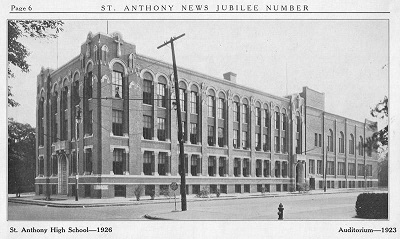
Detroit St. Anthony and Detroit Elizabeth were merged into East Catholic to help address the deficit and exodus. With the changes in the fall of 1969, East Catholic High School was relocated from St. Catherine’s to the St. Anthony building a mile away at the corner of Field and Frederick streets.
Soules had graduated from Dearborn Sacred Heart in 1957 and then the University of Detroit. He was hired as an English teacher at St. Anthony and became the school’s JV basketball coach in 1962. In 1964, he took charge of the varsity team.
“When we merged (into East Catholic) they divvied up the jobs and Dennis got the basketball job,” said Soules in 2005 to Mick McCabe, Detroit Free Press sportswriter. “If I’d have got the job, I’d have lost my mind. I mean literally. The merger was painful. Everybody hated everybody else …”
In May 1972, the Free Press had interviewed Soules about the challenges and the future of the school located at 5206 Field. As an assistant principal, he spoke for those who remained.
“From here, there isn’t any place to go. You close up, and you go out of business. If we keep working at it and keep believing in it, it’s gonna keep going. It has so far. If we close, there’s no inner city Catholic school on the lower east side,” he said.
Raffles, paper drives, lollipop and baked good sales, car washes, fish dinners and dances all contributed to keeping the doors open.
Making a new school community from all of the former had not come easily.
“It was hell. I lost 25 pounds last year. We lost a lot of good staff people. But we came back this year, and, all of a sudden, people could smile at each other in the halls. That’s important. As people got to know each other, they did become friends,” Soules added
With Alexander’s late departure, Soules became the school’s newest varsity basketball coach. At the time, no one knew that he would also be the school’s last.
With the graduation of Darryl Alexander, the expectations of the team, loaded with juniors and sophomores, were limited. Smaller enrollment meant the team had fallen a classification come tournament time. With a 5-3 mark, the Chargers were No. 5 in Hal Schram’s weekly Free Press Class C Top Ten in early January, but had fallen well out of the United Press International’s Top 20 Class C rankings by mid-February with a 12-4 record. The team was quickly eliminated in the annual Detroit Catholic League tournament and, unranked in the final state polls, carried a 12-6 record into the MHSAA postseason. Following District wins over Hamtramck St. Florian – ranked eighth by AP – and Hamtramck St. Ladislaus, Soule’s crew quickly changed the landscape in the opening round of the Class C Regionals.
 “Just two days into regional play, the tourney is starting to live up to its Pseudonym – ‘March Madness’”, wrote Harry Atkins for The Associated Press.
“The Chargers were given hardly a chance against a talent-rich Dearborn St. Alphonsus team in Class C action,” continued Atkins, “but East Catholic didn’t let Dearborn’s No. 2 ranking scare them as they matched the Arrows basket for basket.” Trailing by six with 1:46 left to play, Larry Merchant’s field goal with 46 seconds left tied the score. “Then Mike Walton hit a free throw with one second on the clock to give East Catholic its upset.”
Mike Woods led the team with 21 points. St. Alphonsus exited the tournament with a 22-2 mark.
On a very snowy evening across Michigan, East Catholic took advantage of its height and survived a 27-point performance by New Haven’s Don Sims to win their Regional and advance to the Quarterfinals of the MHSAA tournament. Merchant scored 10 of the Chargers’ 11 points in the final four minutes to seal the 68-63 win.
Merchant showed off his ball-handling skills dishing out 12 assists in the 71-48 Quarterfinal win over Erie-Mason. Sophomores Greg Guye, a 6-foot-6 center, and Walton, a 6-2 sophomore guard, each pumped in seven field goals, both finishing with 14 points, to lead the Chargers in scoring.
Merchant scored 26, while Walton added 23 – 18 points over his season average – as East Catholic rolled to a 66-55 Semifinal victory over Battle Creek St. Philip to earn a trip to the championship game.
“We had accurate scouting reports on East Catholic,” said St. Philip coach Tom Miller following the game. “They were quick. I knew we were in trouble when we had a fast break – and they had two guys at the other end waiting for us,” Miller told UPI’s Richard Shook, laughing. “At least we got beat by a team that was better than we were.”
The state’s scribes had a week to contemplate the upcoming Final matchups as Michigan’s tournament format of the time injected seven days between the Semifinal and Final rounds. Soules had never won a tournament game as a coach at St. Anthony, and noted his club’s strengths and challenges to the media during the time.
“This is a young team which makes mistakes,” he told Atkins of the AP, “but we don’t quit and we’ve won some games on hustle in the last few minutes. It is difficult to key on one player and beat us, because we have excellent balance.”
In a conversation with Schram he noted that his team had a tendency to work out big leads, then start to get sloppy.
“We’ve never put anyone away yet,” he added. Schram noted that Soules took only half of the 700 tickets allotted East Catholic at the state association. “I won’t sell all that I have. These kids simply don’t have the bread to go running all over the state.”
“I don’t believe many of our students or fans have a great amount of confidence in us,” declared the coach, but emphasized that was not the view of the team. “They want this state title and will fight all the way to win it Saturday.”
By most, if not all accounts, not many others had faith in the Chargers’ chances in the championship matchup.
“St. Stephen lost in the ‘C’ finals in 1972 to Shelby and have their key players returning,” wrote Fred Stabley Jr. in the Lansing State Journal. “Led by 6-5 Elijah Coates and 6-2 Jimmy Beavers, St. Stephen has the size and speed to win it all this year.”
“Every game is a home game for Saginaw St. Stephens,” noted Atkins in his pregame AP write-up. “The Titans have a frenzied following of nearly 1,500 fans at every tournament game and you can bet your last lottery ticket they’ll all be in Ann Arbor for Saturday’s showdown.
 “On paper there’s no way you can pick a favorite … but neither St. Stephens nor East Catholic has been winning on paper … Saginaw, however, has done a slightly better job of it and who can measure how much their loyal throng of well-wishers has contributed to that record.”
“East Catholic won’t make the trip to Ann Arbor for nothing,” wrote Schram, as his alter ego, “The Swami,” on the Saturday of the game. “There’s a trophy for the runnerup.”
Saginaw coach Sam Franz, celebrating his 25th year as a coach, may have been the only skeptic.
“Any team that comes this far has to have something more than luck going for them,” said Franz to Schram.
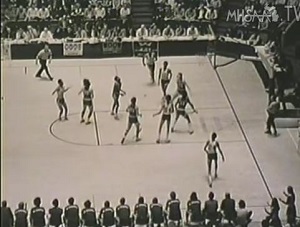
The story of the Final can still be seen in silence today.
“From the late 1940’s to the mid 1970’s the Michigan High School Athletic Association shot portions of the action at its basketball finals on 16mm film,” notes John Johnson, communications director for the MHSAA. “Some of the films only have portions of the second half and the postgame awards; some have most of the action. None of the films have sound.”
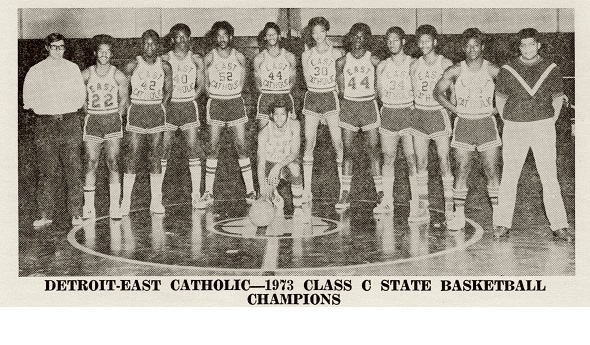
One of the surviving films is the 1973 Class C classic. The Chargers blew a 10-point lead late in the third quarter. With 2:29 remaining, the game was tied, 46-46. A free throw gave St. Stephen the lead 47-46 with 2:16 to play.
The final two minutes of film spools out the story, in thrilling – and heartbreaking – detail.
In the days before the possession arrow, jumps for possession could mean the difference between victory and defeat. East Catholic won a possession on a jump ball, but a miss by the Chargers and a defensive rebound by St. Stephen sent the Titans into stall mode. However, a turnover grabbed and converted by Merchant gave the Chargers a 48-47 lead with just over a minute to play.
A pair of free throws by Elijah Coates pushed St. Stephen out front 49-48 with 45 seconds left. Yet with four seconds remaining on the clock, Merchant's 18-foot jumper from left of the key gave the Chargers a 50-49 victory.
The front page of the Free Press shouted the headline, “A Chance to Be Somebody,” with a story representative of the time. Focused on the players and their struggles, the title could have easily applied to the re-start of a coaching career, and a life, which ultimately would become legendary at least on Detroit’s east side.
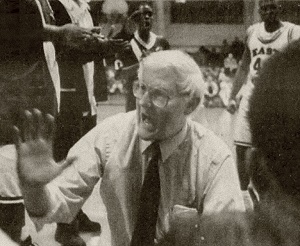 To students, he became famous for a rope of keys around his neck, his pad of detention slips and the substitution of “Hot Dog” or “Baby” for names when trying to keep the halls clear during the school week. Saturday mornings for many included time in “The Jug” serving detention.
“He’s more to East Catholic than just the basketball coach,” Lou Miramonti told Jo-Ann Barnas of the Free Press in 1996. Miramonti, the athletic director at Royal Oak Shrine, knew of whom he spoke. “It’s the most visible thing he does, but it may well be the least important thing that he does at that school and for those kids.”
Soules was assistant principal, disciplinarian, tuition collector, the giver of rides, and one who called students just to make sure homework was getting done. And, of course, the coach that guided the talent that came through the halls of a building that today no longer stands.
Playing witness in 2005 to another sweeping closure of schools by the Detroit archdiocese – one that included the shuttering of East Catholic – Soules discussed a career he never could have predicted.
“I was the right guy who just happened to be in the right place at the right time,” he explained to McCabe as he tried to come to grips with the announced closing. Soules’ coaching career at East Catholic featured 544 wins against 250 defeats over 33 seasons. The Chargers’ athletic cases included eight MHSAA Finals championship trophies won by his teams. To this day, only Greene at River Rouge won more.
An honest, humble and caring individual with a “self-deprecating sense of humor,” he discussed those earliest of days:
“The saddest part is, I was so dumb at the time, we didn’t win it again (over the next two years) … I didn’t know how to deal with the 2-2-1 three-quarter court press (in 1974) … in the semis (in 1975) … we just weren’t ready to play.”
“With some of the kids I had, you didn’t have to be a genius,” he stated. “I’m a lot better coach now than I was then.”
In 2009, Soules passed away after a three-year battle with cancer. His extended family numbered thousands.
The many condolences that followed, and that continue today, are a heartfelt testament to the difference one man can make in a life, both on the court and in the hallways, of an ancient building built with the lofty purpose of education.
 Ron Pesch has taken an active role in researching the history of MHSAA events since 1985 and began writing for MHSAA Finals programs in 1986, adding additional features and "flashbacks" in 1992. He inherited the title of MHSAA historian from the late Dick Kishpaugh following the 1993-94 school year, and resides in Muskegon. Contact him at [email protected] with ideas for historical articles.
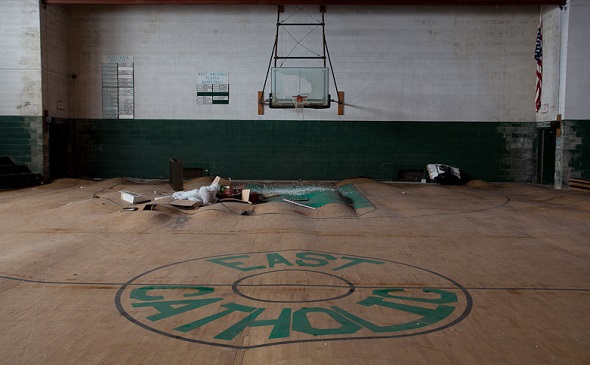
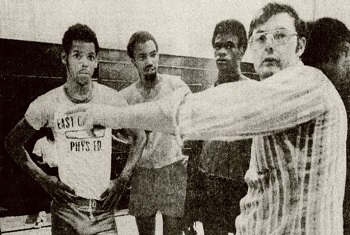
PHOTOS: (Top) The Detroit East Catholic 1973 Class C championship team. (2) Denny Alexander was hired as East Catholic boys basketball coach in 1969. (3) The former Detroit St. Anthony High School. (4) Dave Soules coaches his East Catholic players during the 1973 season. (5) Film survives from the Chargers’ 1973 championship game win over Saginaw St. Stephen. (6) Soules instructs his team during a 1996 game. (7) The Detroit East Catholic gymnasium, after the school’s closure. (Photos gathered by Ron Pesch.)