


Powerful Voice for High School Sports
December 19, 2014
By Geoff Kimmerly
Second Half editor
Paul Carey was home from the U.S. Army only a few months and just shy of 25 years old when Beal City embarked on its first trip deep into the MHSAA boys basketball tournament.
On the call for local radio station WCEN from gyms at Saginaw Arthur Hill and Lansing Sexton, Carey served as the voice of the previously “laughable” Aggies as they reached the Class D Semifinals before falling just six points short of playing for the title.
“All of Beal City emptied out. They’d never had anything before,” Carey recalled during his annual Thanksgiving weekend visit to the MHSAA Football Finals at Ford Field. “When I got home, within the next two weeks I got a letter from every citizen of Beal City thanking me for broadcasting their games. That’s the kind of appreciation that meant so much.”
During 42 years on the airwaves, Carey was best known as a voice of the Detroit Tigers bounding out of transistor radios all over Michigan, thanks to WJR’s powerful signal.
But for the state’s high school sports community, his legacy is similarly memorable as the voice of the longtime football and basketball scoreboard show and a voter for various all-state teams and wire polls over the decades.
Now 86 and retired since 1991, Carey remains a regular during the first day of the Football Finals, taking in games he broadcast for the MHSAA during the late 1970s and that continue to hold his eye as they have for more than a half-century.
“It was a passion of mine. High school sports always has been,” Carey said. “I think because my dad was a high school coach, and teacher initially, and my brother was a high school coach and teacher, I just grew up in families that appreciated coaching and athletics. I was not a great athlete, but it kept my hand in following sports that way.”
Now, the scores
Carey partnered with Ernie Harwell for Tigers radio broadcasts from 1973-91, including during the march to the 1984 World Series championship. He was named Michigan Sportscaster of the Year six times and to the Michigan Sports Hall of Fame in 1992.
But Carey’s early career included sitting on top of a car, plugged into a phone pole, for a Sacred Heart football game at old Fancher Field just a few blocks from his family’s Mount Pleasant home. Among many more accolades are a Distinguished Service Award from the Michigan High School Coaches Association and a place in the Basketball Coaches Association of Michigan Hall of Fame.
In fact, the start of his weekly announcing of statewide football and basketball scores preceded his baseball career by 16 years and ended two months after he announced his final professional out.
The Michigan High School Scoreboard show was a staple of WJR’s late Friday nights from 1957-91. Carey would read every score he could collect from a variety of sources, often organized by league and with state rankings and context mixed in.
His idea came from something similar read by Len Colby for Kalamazoo’s WKZO. Carey’s brother Terry was coaching at Niles during the second half of the 1950s, and he and other coaches would get together to listen to the Friday night scores from the southwestern part of the state.
Carey, who left WKNX in Saginaw for WJR in 1956, explained to then-sports director Bob Reynolds that the station’s strong signal could provide for a truly statewide scoreboard experience.
Carey then connected with Edgar Hayes of the former Detroit Times, who gave the OK for Carey to call the paper on Friday nights to get scores from the Detroit metro area. For the rest, Carey relied on wire services – there were three at the time – who relied on newspapers from all over Michigan to call in scores over the course of an evening.
Before every Friday during high school football season – and later Tuesdays and Fridays during boys basketball season – Carey typed up lists of games based on schedules in the newspaper, with spaces to add scores. More than a few times, Carey raced down a back ramp at Tiger Stadium after a Friday night game, back to the WJR studio, with 15 minutes to prep for the show’s 11:30 p.m. start.
“If the Flint Journal, the Grand Rapids Press, the Traverse City paper didn’t call in scores to the AP, then I was out of luck too. And that happened all the time,” Carey said. “I would call back occasionally, say, ‘Did you get anything more?’ It was a rat race.”
The show originally was set for 10 minutes and then extended to 15. American Airlines sponsored a record show that followed, and Carey’s scoreboard show had a sponsor only once in 35 years. Finishing up on time was expected, even with more than 200 scores to read.
But Carey said he always went 20 minutes, sometimes 25.
“Because I wasn’t done. I just kept right on going,” Carey said. “Jay Roberts did the all-night show most of the time, and he was patient with me. He didn’t say too much on the air about ‘that guy ahead of me took all of my time.’”
Carey continued the “rat race” until his final scoreboard show, Dec. 20, 1991. He retired from WJR at the end of that calendar year. And it's important to note: Carey was never paid a dime extra for doing the program. .
“I think Paul is really just a sports fan, and that came across to the listener on his broadcasts,” MHSAA historian Ron Pesch said. “Paul would gather as much as possible off the wire. He'd interject if scores were missing from sections of the state. Press polls from the Free Press, News, AP and UPI were big, so he could point out close calls and upsets.
“He provided immediacy, or the closest thing to it in the days before cable TV and the Internet, and because of his scoreboard show, you could get the results before the morning paper. For listeners, he brought life to something as simple as game scores.”
First team all the way
Carey, who resides in Rochester, also served as the engineer on Tigers broadcasts for 16 years, through 1990. He broadcast Pistons games on the radio for six seasons and did the first broadcast of a Central Michigan University football game, in 1949.
Harry Atkins, covering Detroit’s teams while with The Associated Press for 29 years including the last 21 as its sports editor for Detroit, took note of his colleague's hard work – and especially that Carey was one of few broadcasters who was a journalist in addition to a voice.
That made Carey's other major role in high school sports a natural fit.
Atkins split The Associated Press all-state selection panels for football and basketball into 11 regions, and Carey represented the Detroit area for a number of years. He also was a longtime voter in those sports' weekly polls.
“Paul is just that kind of guy. He thought it was important and he made time in his busy schedule to do it,” Atkins said “And it had an impact on the other 10 voters on the All-State panels, too.
“Some of them were from small out-state newspapers or radio or TV stations. Yet every one of them knew who Paul Carey was. And when he spoke, of course, with what often is called "The Voice of God," those voters paid attention.”
And he still does, as well.
At the end of each fall, Carey still puts together a compilation of the three high school all-state football teams – Associated Press, Detroit Free Press and Detroit News – and files them with years of research and results.
“It’s important to me. Nobody sees it but me, but I get a certain kick,” Carey said. “Once in a while I’ll see a kid playing at Central, Western or (Michigan) State or Michigan, and they’ll say he came from Clawson. I’ll go into my all-state collections, say that would’ve been 2009 he played, and I find a name.”
In addition to the Football Finals on WJR, Carey was part of the Baseball Finals broadcasts into the early 1990s, continuing to contribute even after his retirement from his fulltime gig.
He spent high school games over the years sitting next to legends like the Free Press’ Hal Schram and remembers when current Free Press longtime scribe Mick McCabe was just a rookie. One of Carey's final broadcasts was a 1992 Baseball Final with his nephew Mike Carey, who continues to broadcast MHSAA championship games to this day.
“I am eternally grateful to Paul Carey. His contribution to high school sports in Michigan has been great and significant,” Atkins said.
“We are lucky to have him.”
PHOTO: Paul Carey (left) and nephew Mike Carey broadcast the MHSAA 1992 Class D Baseball Final between Hillman and Athens for PASS.
'Outside Shot' Becomes Adams' Historic Win
November 17, 2018
By Keith Dunlap
Special for Second Half
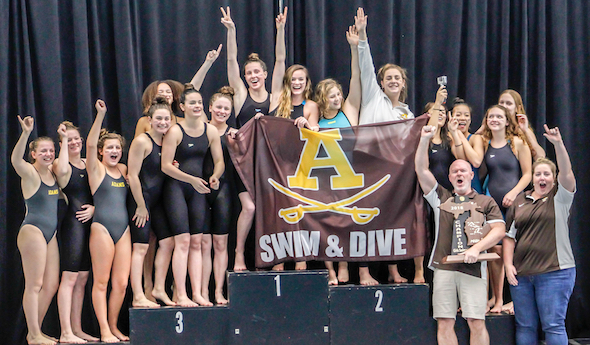
ROCHESTER – In his more than two decades as the face of the Rochester Adams swimming & diving program, Tim Hickey has seen his share of great swimmers in his school’s pool, including former Olympian Peter Vanderkaay.
But Vanderkaay and those other standout swimmers weren’t able to achieve what the current Adams girls team accomplished at Saturday’s Lower Peninsula Division 2 Finals at Oakland University.
For the first time in school history, girls or boys, an Adams swim team was crowned state champion in swimming after the Highlanders finished off a dream season by collecting a meet-best 250 points.
Adams outlasted Oakland Activities Association Red rival Birmingham Seaholm, which was runner-up with 220 points.
Grosse Pointe South was third with 214 points.
“You can’t even really put it into words,” Hickey said. “Early in the season, we thought we had an outside shot. As the season progressed and as the kids started performing the way we needed them to, we knew we had a shot. We had some off swims in prelims that made it a little closer than we wanted. But this team came from behind after prelims to win our league meet, and came from behind to win this. It’s just amazing for these girls to come together like they have.”
Helping Adams’ cause was one of the state’s best overall swimmers in senior Lisa Lohner, who will continue her career next season at University of Toledo.
She won both the 200-yard freestyle (1:51.49) and 500 freestyle (4:58.17), and anchored the winning Adams 200 freestyle relay (1:36.76).
Lohner was indeed fighting off tears when the meet ended, although it actually didn’t have anything to do with helping Adams to historic success.
“I’m really sad because I’m done with high school swimming right now,” Lohner said. “It’s a lot right now. This is my family.”
 Lohner entered as the heavy favorite in the 200 and 500 freestyle events going in, but admitted there were still a lot of nerves.
“Going into finals, I was really nervous because I knew a lot of people dropped a lot of times in prelims,” Lohner said. “I didn’t know what to expect. I was really nervous going in. (Coach Hickey) talked about it before today that we could be the first team to do it. We decided to not think about it today, but now it’s all coming down.”
While not having as much of a reason to celebrate as Adams, Seaholm head coach Karl Hodgson said his team had plenty to feel good about with its runner-up finish.
“We thought this was going to be a rebuilding year for us,” Hodgson said. “I would have been happy with a top-five. Somebody had us ranked second throughout the season, and I was like, ‘No, we’re not that good.’ But the girls swam great (Friday). Today, we just ran out of gas a bit.”
Having seen Adams up close throughout the season in league action, Hodgson said it was the Highlanders’ depth that separated them.
“When we swam against them in a dual meet, we swam head-to-head against them and almost pulled it off,” Hodgson said. “But they took all the fifth places, and we took the sixth places. That’s the main difference, their depth. They just keep coming at you."
The other individual star besides Lohner was Midland Dow junior Claire Newman, who won the 50 (23.08) and 100 freestyles (51.19).
Fenton freshman Gracie Olsen won the 200 individual medley in a time of 2:03.19, Walled Lake Western sophomore Kamila Podsiadlo won the diving title with 414.60 points, Grosse Pointe South senior Claire Fisher won the 100 butterfly in a time of 54.86, Grosse Pointe South senior Renee Liu won the 100 backstroke with a time of 55.88, and Grand Rapids Forest Hills Central senior Jessica Schellenboom won the 100 breaststroke in a time of 1:03.88.
Grosse Pointe South’s team of Liu, Fisher, Olivia You and Hannah Blanzy won the 200 medley relay in a time of 1:46.61, while the Portage Central team of Sydney Sonday, Maggie Farrell, Audrey Vermeulen and Julia Semler won the 400 freestyle relay in 3:31.51.
PHOTOS: (Top) Rochester Adams celebrates its first MHSAA Finals title in girls swimming & diving. (Middle) Freshman Kate Stanley helped Birmingham Seaholm to a second-place finish. (Click to see more from HighSchoolSportsScene.com.)