

Powerful Voice for High School Sports
December 19, 2014
By Geoff Kimmerly
Second Half editor
Paul Carey was home from the U.S. Army only a few months and just shy of 25 years old when Beal City embarked on its first trip deep into the MHSAA boys basketball tournament.
On the call for local radio station WCEN from gyms at Saginaw Arthur Hill and Lansing Sexton, Carey served as the voice of the previously “laughable” Aggies as they reached the Class D Semifinals before falling just six points short of playing for the title.
“All of Beal City emptied out. They’d never had anything before,” Carey recalled during his annual Thanksgiving weekend visit to the MHSAA Football Finals at Ford Field. “When I got home, within the next two weeks I got a letter from every citizen of Beal City thanking me for broadcasting their games. That’s the kind of appreciation that meant so much.”
During 42 years on the airwaves, Carey was best known as a voice of the Detroit Tigers bounding out of transistor radios all over Michigan, thanks to WJR’s powerful signal.
But for the state’s high school sports community, his legacy is similarly memorable as the voice of the longtime football and basketball scoreboard show and a voter for various all-state teams and wire polls over the decades.
Now 86 and retired since 1991, Carey remains a regular during the first day of the Football Finals, taking in games he broadcast for the MHSAA during the late 1970s and that continue to hold his eye as they have for more than a half-century.
“It was a passion of mine. High school sports always has been,” Carey said. “I think because my dad was a high school coach, and teacher initially, and my brother was a high school coach and teacher, I just grew up in families that appreciated coaching and athletics. I was not a great athlete, but it kept my hand in following sports that way.”
Now, the scores
Carey partnered with Ernie Harwell for Tigers radio broadcasts from 1973-91, including during the march to the 1984 World Series championship. He was named Michigan Sportscaster of the Year six times and to the Michigan Sports Hall of Fame in 1992.
But Carey’s early career included sitting on top of a car, plugged into a phone pole, for a Sacred Heart football game at old Fancher Field just a few blocks from his family’s Mount Pleasant home. Among many more accolades are a Distinguished Service Award from the Michigan High School Coaches Association and a place in the Basketball Coaches Association of Michigan Hall of Fame.
In fact, the start of his weekly announcing of statewide football and basketball scores preceded his baseball career by 16 years and ended two months after he announced his final professional out.
The Michigan High School Scoreboard show was a staple of WJR’s late Friday nights from 1957-91. Carey would read every score he could collect from a variety of sources, often organized by league and with state rankings and context mixed in.
His idea came from something similar read by Len Colby for Kalamazoo’s WKZO. Carey’s brother Terry was coaching at Niles during the second half of the 1950s, and he and other coaches would get together to listen to the Friday night scores from the southwestern part of the state.
Carey, who left WKNX in Saginaw for WJR in 1956, explained to then-sports director Bob Reynolds that the station’s strong signal could provide for a truly statewide scoreboard experience.
Carey then connected with Edgar Hayes of the former Detroit Times, who gave the OK for Carey to call the paper on Friday nights to get scores from the Detroit metro area. For the rest, Carey relied on wire services – there were three at the time – who relied on newspapers from all over Michigan to call in scores over the course of an evening.
Before every Friday during high school football season – and later Tuesdays and Fridays during boys basketball season – Carey typed up lists of games based on schedules in the newspaper, with spaces to add scores. More than a few times, Carey raced down a back ramp at Tiger Stadium after a Friday night game, back to the WJR studio, with 15 minutes to prep for the show’s 11:30 p.m. start.
“If the Flint Journal, the Grand Rapids Press, the Traverse City paper didn’t call in scores to the AP, then I was out of luck too. And that happened all the time,” Carey said. “I would call back occasionally, say, ‘Did you get anything more?’ It was a rat race.”
The show originally was set for 10 minutes and then extended to 15. American Airlines sponsored a record show that followed, and Carey’s scoreboard show had a sponsor only once in 35 years. Finishing up on time was expected, even with more than 200 scores to read.
But Carey said he always went 20 minutes, sometimes 25.
“Because I wasn’t done. I just kept right on going,” Carey said. “Jay Roberts did the all-night show most of the time, and he was patient with me. He didn’t say too much on the air about ‘that guy ahead of me took all of my time.’”
Carey continued the “rat race” until his final scoreboard show, Dec. 20, 1991. He retired from WJR at the end of that calendar year. And it's important to note: Carey was never paid a dime extra for doing the program. .
“I think Paul is really just a sports fan, and that came across to the listener on his broadcasts,” MHSAA historian Ron Pesch said. “Paul would gather as much as possible off the wire. He'd interject if scores were missing from sections of the state. Press polls from the Free Press, News, AP and UPI were big, so he could point out close calls and upsets.
“He provided immediacy, or the closest thing to it in the days before cable TV and the Internet, and because of his scoreboard show, you could get the results before the morning paper. For listeners, he brought life to something as simple as game scores.”
First team all the way
Carey, who resides in Rochester, also served as the engineer on Tigers broadcasts for 16 years, through 1990. He broadcast Pistons games on the radio for six seasons and did the first broadcast of a Central Michigan University football game, in 1949.
Harry Atkins, covering Detroit’s teams while with The Associated Press for 29 years including the last 21 as its sports editor for Detroit, took note of his colleague's hard work – and especially that Carey was one of few broadcasters who was a journalist in addition to a voice.
That made Carey's other major role in high school sports a natural fit.
Atkins split The Associated Press all-state selection panels for football and basketball into 11 regions, and Carey represented the Detroit area for a number of years. He also was a longtime voter in those sports' weekly polls.
“Paul is just that kind of guy. He thought it was important and he made time in his busy schedule to do it,” Atkins said “And it had an impact on the other 10 voters on the All-State panels, too.
“Some of them were from small out-state newspapers or radio or TV stations. Yet every one of them knew who Paul Carey was. And when he spoke, of course, with what often is called "The Voice of God," those voters paid attention.”
And he still does, as well.
At the end of each fall, Carey still puts together a compilation of the three high school all-state football teams – Associated Press, Detroit Free Press and Detroit News – and files them with years of research and results.
“It’s important to me. Nobody sees it but me, but I get a certain kick,” Carey said. “Once in a while I’ll see a kid playing at Central, Western or (Michigan) State or Michigan, and they’ll say he came from Clawson. I’ll go into my all-state collections, say that would’ve been 2009 he played, and I find a name.”
In addition to the Football Finals on WJR, Carey was part of the Baseball Finals broadcasts into the early 1990s, continuing to contribute even after his retirement from his fulltime gig.
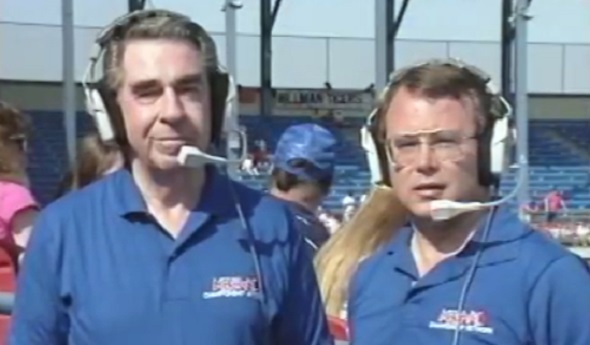
He spent high school games over the years sitting next to legends like the Free Press’ Hal Schram and remembers when current Free Press longtime scribe Mick McCabe was just a rookie. One of Carey's final broadcasts was a 1992 Baseball Final with his nephew Mike Carey, who continues to broadcast MHSAA championship games to this day.
“I am eternally grateful to Paul Carey. His contribution to high school sports in Michigan has been great and significant,” Atkins said.
“We are lucky to have him.”
PHOTO: Paul Carey (left) and nephew Mike Carey broadcast the MHSAA 1992 Class D Baseball Final between Hillman and Athens for PASS.
Understudy Shines as Shores' Lead Receiver
By
Tom Kendra
Special for MHSAA.com
October 31, 2018
The understudy has become the star for the Muskegon Mona Shores football team.
 James Gilbert was supposed to be “the other guy” this season, the receiver on the opposite side from Division I recruit Damari Roberson, who has committed to Western Michigan University.
But the cast list changed in June when Roberson, a 3.6 GPA student who at one time had more than 17 college football scholarship offers, tore the ACL in his left knee for the second time in nine months during a non-contact drill.
“That’s when everything changed,” explained Gilbert, who always had considered himself a basketball player on the football field. “The coaches and Damari sat me down and told me that I had to be the man, that I was the only one with the same type of ability that could take his place. They basically challenged me.”
Shores coach Matt Koziak said Gilbert, a 6-foot-2, 181-pound senior, has always had the physical skills. But since Roberson went down this summer, he has been focused, motivated and driven like never before.
The result has been an incredible senior season for Gilbert, who has 51 catches for 1,172 yards and 10 touchdowns. His emergence as one of the top receivers in the state enabled the Sailors to climb all the way to No. 1 in Division 2 in the final Associated Press state rankings.
Mona Shores (9-1) will put its top ranking to the test Friday night in the MHSAA District championship game against visiting Ottawa-Kent Conference Black rival Jenison (7-3). The two teams engaged in a shootout just three weeks ago, with the visiting Sailors escaping with a 49-42 victory.
Gilbert played a huge role in that win, with six catches for 93 yards and a touchdown, coming up big once again when his team needed it most.
“JG has been unbelievable all year,” said Koziak, who has a 60-26 record in eight years as the Sailors’ coach, highlighted by a run to the Division 2 title game in 2014. “With all of the injuries we’ve had, he’s kind of been the one constant. When we’re scratching our heads, we can always throw it up to James.”
Coming into the season, Koziak knew he had senior battering ram running back Sincere Dent (5-11, 217), who has delivered with 118 carries for 1,082 yards and 20 touchdowns. The problem is that Dent has played in only seven games and his playing time was reduced in several others due to shoulder and ankle injuries.
Junior quarterback Caden Broersma (6-3, 206) also has been outstanding, completing 81-of-112 passes (72 percent) for 1,547 yard and 13 touchdowns, with just one interception. He also has rushed for 621 yards and 12 touchdowns.
The most surprising statistic for Mona Shores is that Gilbert has accounted for 76 percent of the Sailors’ receiving yards.
 “I’m not surprised, because he’s always had it in him,” said Roberson, who has remained a key part of the team, attending every practice and serving as another assistant coach for Koziak. “I always learned from him in basketball, and I taught him everything he knows about football. With me being out, he’s had more of a chance to show what he can do.”
Gilbert is starting to garner more and more interest from college football programs, with Saginaw Valley State, Ferris, Davenport and Mount Union (Ohio) showing the most thus far.
Gilbert wasted no time proving he would be “the man,” showing his big-play ability with five catches for 159 yards (32 yards per catch) and a touchdown in a big 48-38 win over East Kentwood in the season-opening Gridiron Classic at Grand Valley State University. East Kentwood hasn’t lost a game since.
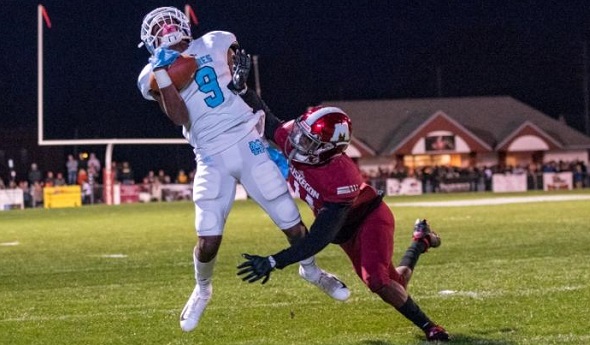
He also came up big in the cross-town showdown Oct. 12 against unbeaten Muskegon, which is ranked No. 1 in Division 3. Gilbert caught six passes for 118 yards, including a one-handed, 28-yard touchdown grab. He also threw a 31-yard touchdown pass to Andrew Swick on a trick play in that 55-35 loss.
And Gilbert was at it again in last week’s narrow 34-28 District win over Grand Rapids Forest Hills Central, catching five passes for 120 yards and a touchdown. He sealed the win with an interception as the Rangers were driving for a potential game-winning score in the final minute.
“It’s been fun, but we know we still have a lot of work to do,” said Gilbert, who has impressed opposing coaches with his ability to come down with big catches in traffic. “Damari and I have been playing with each other and against each other since Little League, so I kind of feel that I’m playing for him this season.”
As for Roberson, he still believes that a season that began with a nightmare injury could have a storybook ending – both for the team and himself.
Roberson (6-2, 194) said his rehabilitation is going great and his possible return date from the injury is during the week of the MHSAA Semifinals. So there remains the possibility, if the team keeps winning, that Roberson and Gilbert could line up as opposite wideouts, like the original plan.
“Stay tuned,” said Roberson, who is on pace to graduate early in December and then enroll at WMU in January. “After all that this team has been through, with all of the injuries, that would be the perfect ending.”
 Tom Kendra worked 23 years at The Muskegon Chronicle, including five as assistant sports editor and the final six as sports editor through 2011. E-mail him at [email protected] with story ideas for Muskegon, Oceana, Mason, Lake, Oceola, Mecosta and Newaygo counties.
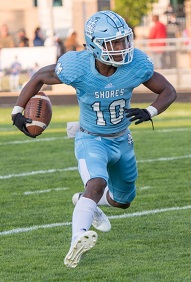
PHOTOS: (Top) Mona Shores senior James Gilbert makes a one-handed catch for a 28-yard touchdown on a pass from Caden Broersma early in the second quarter Oct. 12 at Muskegon. (Middle) Damari Roberson returns a punt last year as a junior against Reeths-Puffer. Roberson has not played this season due to a knee injury. (Photos by Eric Sturr.)