

Powerful Voice for High School Sports
December 19, 2014
By Geoff Kimmerly
Second Half editor
Paul Carey was home from the U.S. Army only a few months and just shy of 25 years old when Beal City embarked on its first trip deep into the MHSAA boys basketball tournament.
On the call for local radio station WCEN from gyms at Saginaw Arthur Hill and Lansing Sexton, Carey served as the voice of the previously “laughable” Aggies as they reached the Class D Semifinals before falling just six points short of playing for the title.
“All of Beal City emptied out. They’d never had anything before,” Carey recalled during his annual Thanksgiving weekend visit to the MHSAA Football Finals at Ford Field. “When I got home, within the next two weeks I got a letter from every citizen of Beal City thanking me for broadcasting their games. That’s the kind of appreciation that meant so much.”
During 42 years on the airwaves, Carey was best known as a voice of the Detroit Tigers bounding out of transistor radios all over Michigan, thanks to WJR’s powerful signal.
But for the state’s high school sports community, his legacy is similarly memorable as the voice of the longtime football and basketball scoreboard show and a voter for various all-state teams and wire polls over the decades.
Now 86 and retired since 1991, Carey remains a regular during the first day of the Football Finals, taking in games he broadcast for the MHSAA during the late 1970s and that continue to hold his eye as they have for more than a half-century.
“It was a passion of mine. High school sports always has been,” Carey said. “I think because my dad was a high school coach, and teacher initially, and my brother was a high school coach and teacher, I just grew up in families that appreciated coaching and athletics. I was not a great athlete, but it kept my hand in following sports that way.”
Now, the scores
Carey partnered with Ernie Harwell for Tigers radio broadcasts from 1973-91, including during the march to the 1984 World Series championship. He was named Michigan Sportscaster of the Year six times and to the Michigan Sports Hall of Fame in 1992.
But Carey’s early career included sitting on top of a car, plugged into a phone pole, for a Sacred Heart football game at old Fancher Field just a few blocks from his family’s Mount Pleasant home. Among many more accolades are a Distinguished Service Award from the Michigan High School Coaches Association and a place in the Basketball Coaches Association of Michigan Hall of Fame.
In fact, the start of his weekly announcing of statewide football and basketball scores preceded his baseball career by 16 years and ended two months after he announced his final professional out.
The Michigan High School Scoreboard show was a staple of WJR’s late Friday nights from 1957-91. Carey would read every score he could collect from a variety of sources, often organized by league and with state rankings and context mixed in.
His idea came from something similar read by Len Colby for Kalamazoo’s WKZO. Carey’s brother Terry was coaching at Niles during the second half of the 1950s, and he and other coaches would get together to listen to the Friday night scores from the southwestern part of the state.
Carey, who left WKNX in Saginaw for WJR in 1956, explained to then-sports director Bob Reynolds that the station’s strong signal could provide for a truly statewide scoreboard experience.
Carey then connected with Edgar Hayes of the former Detroit Times, who gave the OK for Carey to call the paper on Friday nights to get scores from the Detroit metro area. For the rest, Carey relied on wire services – there were three at the time – who relied on newspapers from all over Michigan to call in scores over the course of an evening.
Before every Friday during high school football season – and later Tuesdays and Fridays during boys basketball season – Carey typed up lists of games based on schedules in the newspaper, with spaces to add scores. More than a few times, Carey raced down a back ramp at Tiger Stadium after a Friday night game, back to the WJR studio, with 15 minutes to prep for the show’s 11:30 p.m. start.
“If the Flint Journal, the Grand Rapids Press, the Traverse City paper didn’t call in scores to the AP, then I was out of luck too. And that happened all the time,” Carey said. “I would call back occasionally, say, ‘Did you get anything more?’ It was a rat race.”
The show originally was set for 10 minutes and then extended to 15. American Airlines sponsored a record show that followed, and Carey’s scoreboard show had a sponsor only once in 35 years. Finishing up on time was expected, even with more than 200 scores to read.
But Carey said he always went 20 minutes, sometimes 25.
“Because I wasn’t done. I just kept right on going,” Carey said. “Jay Roberts did the all-night show most of the time, and he was patient with me. He didn’t say too much on the air about ‘that guy ahead of me took all of my time.’”
Carey continued the “rat race” until his final scoreboard show, Dec. 20, 1991. He retired from WJR at the end of that calendar year. And it's important to note: Carey was never paid a dime extra for doing the program. .
“I think Paul is really just a sports fan, and that came across to the listener on his broadcasts,” MHSAA historian Ron Pesch said. “Paul would gather as much as possible off the wire. He'd interject if scores were missing from sections of the state. Press polls from the Free Press, News, AP and UPI were big, so he could point out close calls and upsets.
“He provided immediacy, or the closest thing to it in the days before cable TV and the Internet, and because of his scoreboard show, you could get the results before the morning paper. For listeners, he brought life to something as simple as game scores.”
First team all the way
Carey, who resides in Rochester, also served as the engineer on Tigers broadcasts for 16 years, through 1990. He broadcast Pistons games on the radio for six seasons and did the first broadcast of a Central Michigan University football game, in 1949.
Harry Atkins, covering Detroit’s teams while with The Associated Press for 29 years including the last 21 as its sports editor for Detroit, took note of his colleague's hard work – and especially that Carey was one of few broadcasters who was a journalist in addition to a voice.
That made Carey's other major role in high school sports a natural fit.
Atkins split The Associated Press all-state selection panels for football and basketball into 11 regions, and Carey represented the Detroit area for a number of years. He also was a longtime voter in those sports' weekly polls.
“Paul is just that kind of guy. He thought it was important and he made time in his busy schedule to do it,” Atkins said “And it had an impact on the other 10 voters on the All-State panels, too.
“Some of them were from small out-state newspapers or radio or TV stations. Yet every one of them knew who Paul Carey was. And when he spoke, of course, with what often is called "The Voice of God," those voters paid attention.”
And he still does, as well.
At the end of each fall, Carey still puts together a compilation of the three high school all-state football teams – Associated Press, Detroit Free Press and Detroit News – and files them with years of research and results.
“It’s important to me. Nobody sees it but me, but I get a certain kick,” Carey said. “Once in a while I’ll see a kid playing at Central, Western or (Michigan) State or Michigan, and they’ll say he came from Clawson. I’ll go into my all-state collections, say that would’ve been 2009 he played, and I find a name.”
In addition to the Football Finals on WJR, Carey was part of the Baseball Finals broadcasts into the early 1990s, continuing to contribute even after his retirement from his fulltime gig.
He spent high school games over the years sitting next to legends like the Free Press’ Hal Schram and remembers when current Free Press longtime scribe Mick McCabe was just a rookie. One of Carey's final broadcasts was a 1992 Baseball Final with his nephew Mike Carey, who continues to broadcast MHSAA championship games to this day.
“I am eternally grateful to Paul Carey. His contribution to high school sports in Michigan has been great and significant,” Atkins said.
“We are lucky to have him.”
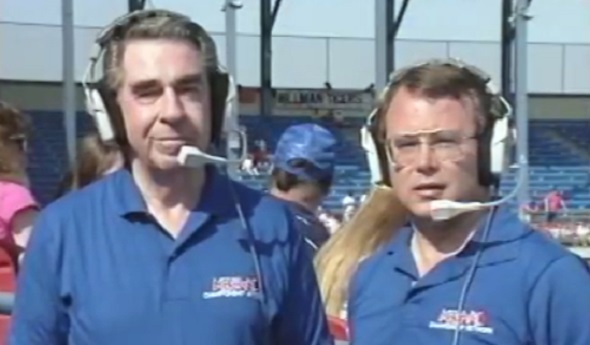
PHOTO: Paul Carey (left) and nephew Mike Carey broadcast the MHSAA 1992 Class D Baseball Final between Hillman and Athens for PASS.
2008 Muskegon's Lesson: Keep the Faith
October 26, 2018
By Ron Pesch
Special for Second Half
Faith.
The word has always been a complex recipe of conviction, trust, belief and loyalty. Sometimes it brings ecstasy, while other times it brings heartbreak. Sometimes it carries surprise.
On a beautiful autumn day 10 seasons ago, Muskegon Big Reds football players, coaches, and fans found their faith tested to the extreme.
Some fans simply couldn’t stand to watch, and departed early, heading to the parking lots surrounding Michigan State University’s Spartan Stadium in East Lansing to get a jump on west-bound traffic. A colossal upset, it seemed, was no longer in the making. Rather, the outcome appeared obvious.
The 2007 regular season was an impressive one for Muskegon. For the first time the Big Reds were competing in the Red division of the Ottawa-Kent Conference, comprised of the largest league schools based on enrollment and considered by many the toughest football league in the state. The reigning MHSAA Division 2 champion, Muskegon rolled to eight straight victories, earning the No. 1 ranking in the Detroit Free Press. Most of the wins were in dominating fashion, included a stunning 52-0 win over No. 2-ranked Hudsonville in the seventh game of the season.
The streak set the stage for a battle with once-beaten Rockford at historic Hackley Stadium in the final game of the regular season before the cameras of NFL Films. It ended in shattering disappointment as the favored Big Reds lost a lead and fell, 28-21, to the Rams. The following week, Muskegon barely slipped past unranked Grand Rapids Ottawa Hills in the final seconds, 38-35, in the opening round of the MHSAA Playoffs, then melted down in a rematch with Hudsonville as the Eagles thumped the Big Reds, 41-7, in the postseason’s second round.
With 18 graduating starters, many questions hovered as the team hung up the pads and headed into basketball and the winter sports schedule. Among those who would graduate were a pair of Associated Press all-state selections, quarterback Chris Crawford, a three-year starter who had guided the Big Reds to the 2006 title, and offensive lineman Carlin Landingham. The Free Press had named Landingham to its statewide Dream Team, and added line mate Mac Parker to its Division 2 selections.
In February, an even bigger question surfaced: “Who will coach the Big Reds?” Coach Tony Annese announced his decision to resign as head coach, noting his desire to spend more time with his family.
But when possible replacements turned down the job, Annese decided to return. Writing in the Free Press prior to the start of the season under his alias, the ‘Son of Swami’, veteran sports writer Mick McCabe joked that “when Annese’s family found out, they huddled and told him they liked him better when he was bugging other people’s kids and made him return to coaching.” In his preseason announcement of the state’s top 25 prep teams, McCabe recognized that 2008 would be a rebuilding year, ranking the Big Reds No. 22. “Although inexperienced, this is a bright group that has run the system at lower levels.”
Muskegon kicked off the new season with a pair of nonconference contests against top-tier schools. The opener, played at Eastern Michigan University as part of the Big Day Prep Showdown, pitted Muskegon against Detroit Martin Luther King, the 2007 Division 2 champ. A dream matchup based on past performances, in reality, the game featured two teams in the throes of renewal. King, like Muskegon, had been hit hard by graduation. Among the departures were defensive standout Nick Perry, a future No. 1 pick of the Green Bay Packers, and Darrin Williams, who had rushed for more 5,600 yards during his days at King. The Crusaders had failed to make McCabe’s preseason rankings.
 Still, the Big Reds were impressive. Led by quarterback Elan Banks, who was starting his first varsity game, and the one-two punch of Jason Hannett and Anthony Davis in the backfield, the Big Reds rolled to an impressive 35-0 win. The Crusaders had difficulty adjusting to Muskegon’s quick no-huddle option offense. Will Gardner highlighted the day with a 91-yard touchdown on a kickoff return.
Week 2 of the season brought perennial state powerhouse Birmingham Brother Rice to Muskegon for a Saturday afternoon contest. Playing in the always-tough Detroit Catholic League, the Warriors had advanced to the MHSAA Division 2 championship contest in five of the previous 10 seasons. Coached by the legendary Al Fracassa, Brother Rice had won six state titles, earning two since 1999. McCabe had the Warriors ranked No. 3 in the preseason. Victorious in Week 1, Brother Rice was favored to win, but once again, the Big Reds cruised to victory, 42-27.
With the wins, Muskegon quickly jumped in the weekly polls to No. 4 in Division 2 and No. 7 in McCabe’s Super 10 – a ranking of all schools, regardless of enrollment classification. Next up was the second year of conference play against O-K Red opponents. Holland West Ottawa (49-14) and Grand Haven (43-6) both were defeated easily. Grandville was defeated 28-14.
All eyes quickly focused on the team’s game with Hudsonville. Led by powerful running back and linebacker Jordan Jonker, the Eagles had a single loss to Rockford, 15-12 in Week 4, then rolled to a 44-17 win over East Kentwood. Jonker had 323 yards in the contest against the Falcons.
The Big Reds didn’t make it easy on themselves, turning over the ball four times in the first half. But Banks was spectacular at quarterback, throwing for a school record 318 yards (the total still stands today) and a pair of touchdowns. He finished with 22 completions on 31 attempts without throwing an interception in the 29-26 win.
“Defensively, the Big Reds did an exceptional job against Hudsonville’s Jonker,” wrote McCabe in Sunday’s Free Press, “but not until after he scored on a 67-yard run on the team’s first possession. Jonker finished with 95 yards on 12 carries and added a touchdown on a 72-yard fumble recovery.”
East Kentwood was next on the Muskegon schedule, and was defeated 42-0. Week 7 brought the top-ranked team in Division 1, the Rockford Rams, with the contest to be played at Rockford. For the state’s game of the week, a crowd of 13,657 packed Ted Carlson Memorial Stadium.
“(Muskegon’s 34-6) victory over Rockford wasn’t a stunning upset because the Big Reds were also 7-0 and ranked No. 2 in Division 2,” wrote McCabe in his Free Press coverage of the game. “But what was stunning was Rockford’s minus-44 yards rushing. Nobody does that to Rockford. It is a victory that will catapult the Big Reds to the No. 1 spot in both our Super 10 and Division 2 rankings this week.”
Muskegon’s 64-22 win over Jenison boosted the team’s record to 9-0, earning the Big Reds outright possession of the O-K Red title in only their second year of competition in the league. It also gave the subs the opportunity to gain additional game experience before the postseason.
Holland, earning a spot in the playoffs for the first time in school history, was Muskegon’s first-round postseason opponent and was quickly disposed of, 49-13. That set the stage for a rematch with Hudsonville.
Played on a muddy, rain-soaked Hackley Field, the first half of the game saw the Big Reds score twice by converting a pair of Hudsonville interceptions into touchdowns. Just before the half, the Eagles recovered a Muskegon fumble at the Big Reds 9-yard line and threatened to put points on the board, but a Hudsonville fumble on the 2-yard line with 28 seconds left to play was snagged by Muskegon’s Carleton Johnson. The Big Reds ran out the clock, and the teams headed to the locker room with Muskegon up 12-0.
 Hudsonville regrouped and responded with an 84-yard, 12-play drive. A 49-yard screen pass from QB Casey Blackport to tight end Christian Prince set up a two-yard romp into the end zone by Jonker late in the third quarter to pull the Eagles within a touchdown, 12-6. Hudsonville’s defense provided the opportunity for a win by shutting down the Big Reds offense on fourth down in each of Muskegon’s next four possessions. Following a huge stop of Hannett on a 4th-and-inches play at the Hudsonville 19, the Eagles gained control of the ball with 3:18 to play.
Blackport again went to work, throwing a 17-yard strike to Jordan Keur, then finding Prince, who broke a tackle and dashed down the right sideline for a 50-yard gain to the Muskegon 11. Still, the Big Reds defense held steady, and facing fourth down with 1:14 remaining, Hudsonville lined up for a final shot at the end zone. Blackport’s pass deep in the corner went through the hands of Keur and fell incomplete. Muskegon took over on downs and ran out the clock to advance with a second close win over the Eagles.
The third week of postseason play brought the undefeated Red Arrows of Lowell. While the Free Press had Muskegon at No. 1 at the end of the regular season, the final Associated Press poll showed Lowell at No. 1 in Division 2 with the Big Reds second in the rankings. Based on strength of schedule, Muskegon edged out the Red Arrows in MHSAA playoff points; hence, the Big Reds held home field advantage. Since Hackley Field was in rough shape after the Hudsonville game, Muskegon officials chose to move the contest to the field turf of Grand Haven’s Buccaneer Stadium. Although Big Reds fans were not pleased with giving up home field advantage, Muskegon excelled on the artificial surface, and at halftime held an overwhelming 27-point lead. At game’s end, the Big Reds had scored a 49-14 victory over Lowell before a crowd of 8,500.
Jason Hannett had a career game, running for 183 yards on 15 carries. Defensively, he set the tone with a 4th-and-1 stop of Lowell quarterback Kyle Nichol at the 43 late in the first half.
“Muskegon (12-0) dominated in every facet of the game,” wrote McCabe, “except punting, because the Big Reds didn’t have to punt. They scored the first six times they had the ball …
“’I just know what our kids have done to some other teams this year,’ added Lowell coach Noel Dean. ‘And to be on the other end of that tells you how good (the Big Reds) really are.’”
With the District trophy in hand, Muskegon prepared for Davison in the Regional title game to be played as part of a doubleheader at Michigan State University’s Spartan Stadium. A 25-19 winner over Midland, Davison arguably had played the toughest non-conference schedule in the state, beating Orchard Lake St. Mary’s and Holt late in the year, but losing to Lowell in Week 1, Rockford in the second week and Lansing Sexton in Week 5.
Muskegon was still the overwhelming favorite entering the game. Two years previous, Muskegon had soundly defeated the Cardinals 43-21 in a Semifinal contest at Midland on the way to an undefeated season and the 2006 championship.
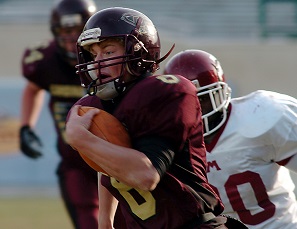
Indeed, the Big Reds opened the contest strong, scoring on a 49-yard run by Banks for a 7-0 lead with just under two minutes gone in the first quarter. Following a stop by the defense, it looked like Muskegon would go up 14-0, but a fumble by Banks at the goal line on Muskegon’s second possession halted the drive. The Cardinals took advantage of the miscue when sophomore QB Jake Thompson connected with Ron Silver on a 70-yard touchdown pass to tie the game at 7-7 with 2:25 left in the first quarter. On Muskegon’s next possession, Davison’s Adam Green picked off a pass and returned it 69 yards to the Muskegon 1, setting up a one-yard TD run by the Cardinals’ Oliver Saylor. Suddenly, Davison held a surprising 14-7 lead with 1:57 to play in the first.
The Cardinals capitalized on another Muskegon fumble late in the second quarter, scoring on a 27-yard toss by Thompson to Dan Thwing, increasing the lead to 21-7 with 1:09 to play in the half. This time, however, the Big Reds responded immediately, showing their explosiveness with a 15-yard TD toss from Banks to Karey Webb as time expired in the first half. The kick failed but, to the relief of Big Reds fans, Muskegon had pulled within eight, 21-13. After a disastrous first half, the Big Reds entered the locker room with some momentum.
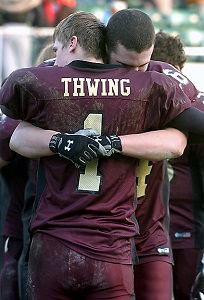 But that energy was quickly lost. Two muffed punts by Muskegon in the third quarter led to a 35-13 Cardinals lead with 4:45 to play in the third quarter. Following a 55-yard dash by Hannett, Anthony Davis scored from a yard out for the Big Reds with 1:54 left in the quarter, but the extra point attempt again failed and Muskegon trailed, 35-19.
Time rapidly became Muskegon’s biggest enemy when Davison’s Kevin Yoesting stopped Davis on a 4th-and-1 with less than nine minutes to play in the fourth quarter. A time-consuming Cardinals drive, highlighted by a pair of long runs by Saylor, set up a Davison first down at the Muskegon 20 with just over five minutes to play, Many Big Reds fans headed for the exits, shaking their heads in disbelief. Cardinals fans celebrated during a timeout in what appeared to be certain victory.
But a huge stop by the Muskegon defense began a comeback unseen in MHSAA playoff history.
“It started after Banks and Karey Webb hooked up on a 77-yard TD pass to pull Muskegon within 35-25 (with 4:31 remaining),” wrote Mike Mattson in the Muskegon Chronicle. Yet on the 2-point conversion attempt, Yoesting again came up big for Davison, tackling Banks just short of the end zone and the Big Reds still trailed by 10 points, needing two possessions for victory.
Jubenal Rodriguez, who had never played football until the third game of the 2007 season, laid down a successful onside kick that was recovered by Dominique Maybanks.
“Seven plays later,” continued Mattson, “Banks and Maybanks connected on a 27-yard TD pass to trim the deficit to 35-31 at the 2:33 mark.”
“The next onside kick didn't travel 10 yards, but hit a Davison player,” wrote Bill Khan of the Flint Journal. “Maybanks again recovered, this time at the 46-yard line. The winning drive was a six-play, 54-yard march, all on the ground. On the winning touchdown, (slot receiver Greg) Wickliffe took a pitch from Banks on the left side, got some blocks and went into the end zone untouched with 42 seconds on the clock. Rodriguez made the extra point to make it a three-point game.”
Davison drove to the Muskegon 32 with 11 seconds remaining, but a pass to the middle of the end zone was picked off by Banks, sealing the astonishing 38-35 comeback win and starting a wild celebration by the players, coaches and the Big Reds fans who had remained to the end.
"I was running as fast as I could,'' Wickliffe said to Mattson during the postgame on-field party. "I saw daylight and just took off as fast as I could. This is amazing.''
“I always say one of the five have to be a fortunate victory,” Annese said to McCabe about the five-game path to a state title. “You’re going to have one of those games – it happens every year. In 2006 it was the final game. In 2004 it was Bay City Western.”
The trip to Ford Field came next.
“Muskegon's (34-14) rout of (Warren DeLaSalle) looked similar to its season-opening 35-0 whitewash of Detroit Martin Luther King back in August,” wrote Shawn Liverance in the Chronicle’s coverage of the Division 2 title game. “A tough-as-nails defense and an offense filled with playmakers was too much for DeLaSalle as it was for Muskegon's 13 other opponents this year.”
Ten years later, Muskegon and Davison again line up for another shot at glory in the 2018 edition of the MHSAA playoffs. There is no chance for a rematch, as the Cardinals compete in Division 1 and Muskegon plays in Division 3.
Only one sure thing has been revealed in more than 100 years of prep football in Michigan. The game’s not over until it’s over. Who knows what twists and turns the 2018 postseason might bring?
 Ron Pesch has taken an active role in researching the history of MHSAA events since 1985 and began writing for MHSAA Finals programs in 1986, adding additional features and "flashbacks" in 1992. He inherited the title of MHSAA historian from the late Dick Kishpaugh following the 1993-94 school year, and resides in Muskegon. Contact him at [email protected] with ideas for historical articles.
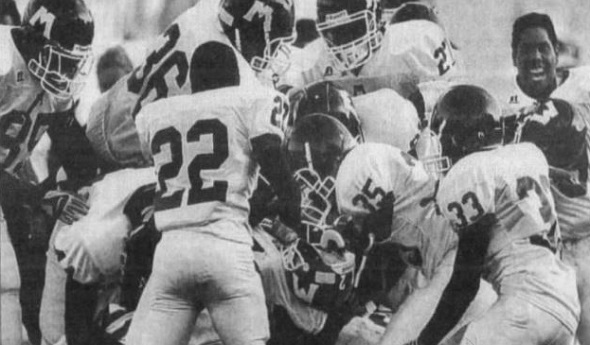
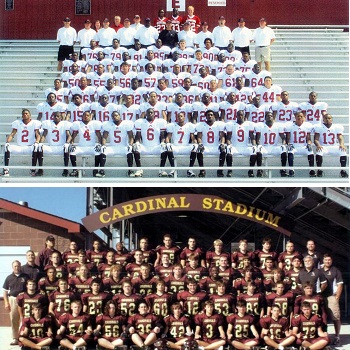
PHOTOS: (Top) The Detroit Free Press captured the postgame celebration by Muskegon’s players after their comeback win over Davison in 2008. (Middle top) The 2008 Muskegon team, top, and the 2008 Davison team. (Middle) The Flint Journal captured the action, including Jake Thompson’s run, as Davison jumped out to a big lead. (Middle below) Davison players suddenly saw their season come to a close at Spartan Stadium.