

Powerful Voice for High School Sports
December 19, 2014
By Geoff Kimmerly
Second Half editor
Paul Carey was home from the U.S. Army only a few months and just shy of 25 years old when Beal City embarked on its first trip deep into the MHSAA boys basketball tournament.
On the call for local radio station WCEN from gyms at Saginaw Arthur Hill and Lansing Sexton, Carey served as the voice of the previously “laughable” Aggies as they reached the Class D Semifinals before falling just six points short of playing for the title.
“All of Beal City emptied out. They’d never had anything before,” Carey recalled during his annual Thanksgiving weekend visit to the MHSAA Football Finals at Ford Field. “When I got home, within the next two weeks I got a letter from every citizen of Beal City thanking me for broadcasting their games. That’s the kind of appreciation that meant so much.”
During 42 years on the airwaves, Carey was best known as a voice of the Detroit Tigers bounding out of transistor radios all over Michigan, thanks to WJR’s powerful signal.
But for the state’s high school sports community, his legacy is similarly memorable as the voice of the longtime football and basketball scoreboard show and a voter for various all-state teams and wire polls over the decades.
Now 86 and retired since 1991, Carey remains a regular during the first day of the Football Finals, taking in games he broadcast for the MHSAA during the late 1970s and that continue to hold his eye as they have for more than a half-century.
“It was a passion of mine. High school sports always has been,” Carey said. “I think because my dad was a high school coach, and teacher initially, and my brother was a high school coach and teacher, I just grew up in families that appreciated coaching and athletics. I was not a great athlete, but it kept my hand in following sports that way.”
Now, the scores
Carey partnered with Ernie Harwell for Tigers radio broadcasts from 1973-91, including during the march to the 1984 World Series championship. He was named Michigan Sportscaster of the Year six times and to the Michigan Sports Hall of Fame in 1992.
But Carey’s early career included sitting on top of a car, plugged into a phone pole, for a Sacred Heart football game at old Fancher Field just a few blocks from his family’s Mount Pleasant home. Among many more accolades are a Distinguished Service Award from the Michigan High School Coaches Association and a place in the Basketball Coaches Association of Michigan Hall of Fame.
In fact, the start of his weekly announcing of statewide football and basketball scores preceded his baseball career by 16 years and ended two months after he announced his final professional out.
The Michigan High School Scoreboard show was a staple of WJR’s late Friday nights from 1957-91. Carey would read every score he could collect from a variety of sources, often organized by league and with state rankings and context mixed in.
His idea came from something similar read by Len Colby for Kalamazoo’s WKZO. Carey’s brother Terry was coaching at Niles during the second half of the 1950s, and he and other coaches would get together to listen to the Friday night scores from the southwestern part of the state.
Carey, who left WKNX in Saginaw for WJR in 1956, explained to then-sports director Bob Reynolds that the station’s strong signal could provide for a truly statewide scoreboard experience.
Carey then connected with Edgar Hayes of the former Detroit Times, who gave the OK for Carey to call the paper on Friday nights to get scores from the Detroit metro area. For the rest, Carey relied on wire services – there were three at the time – who relied on newspapers from all over Michigan to call in scores over the course of an evening.
Before every Friday during high school football season – and later Tuesdays and Fridays during boys basketball season – Carey typed up lists of games based on schedules in the newspaper, with spaces to add scores. More than a few times, Carey raced down a back ramp at Tiger Stadium after a Friday night game, back to the WJR studio, with 15 minutes to prep for the show’s 11:30 p.m. start.
“If the Flint Journal, the Grand Rapids Press, the Traverse City paper didn’t call in scores to the AP, then I was out of luck too. And that happened all the time,” Carey said. “I would call back occasionally, say, ‘Did you get anything more?’ It was a rat race.”
The show originally was set for 10 minutes and then extended to 15. American Airlines sponsored a record show that followed, and Carey’s scoreboard show had a sponsor only once in 35 years. Finishing up on time was expected, even with more than 200 scores to read.
But Carey said he always went 20 minutes, sometimes 25.
“Because I wasn’t done. I just kept right on going,” Carey said. “Jay Roberts did the all-night show most of the time, and he was patient with me. He didn’t say too much on the air about ‘that guy ahead of me took all of my time.’”
Carey continued the “rat race” until his final scoreboard show, Dec. 20, 1991. He retired from WJR at the end of that calendar year. And it's important to note: Carey was never paid a dime extra for doing the program. .
“I think Paul is really just a sports fan, and that came across to the listener on his broadcasts,” MHSAA historian Ron Pesch said. “Paul would gather as much as possible off the wire. He'd interject if scores were missing from sections of the state. Press polls from the Free Press, News, AP and UPI were big, so he could point out close calls and upsets.
“He provided immediacy, or the closest thing to it in the days before cable TV and the Internet, and because of his scoreboard show, you could get the results before the morning paper. For listeners, he brought life to something as simple as game scores.”
First team all the way
Carey, who resides in Rochester, also served as the engineer on Tigers broadcasts for 16 years, through 1990. He broadcast Pistons games on the radio for six seasons and did the first broadcast of a Central Michigan University football game, in 1949.
Harry Atkins, covering Detroit’s teams while with The Associated Press for 29 years including the last 21 as its sports editor for Detroit, took note of his colleague's hard work – and especially that Carey was one of few broadcasters who was a journalist in addition to a voice.
That made Carey's other major role in high school sports a natural fit.
Atkins split The Associated Press all-state selection panels for football and basketball into 11 regions, and Carey represented the Detroit area for a number of years. He also was a longtime voter in those sports' weekly polls.
“Paul is just that kind of guy. He thought it was important and he made time in his busy schedule to do it,” Atkins said “And it had an impact on the other 10 voters on the All-State panels, too.
“Some of them were from small out-state newspapers or radio or TV stations. Yet every one of them knew who Paul Carey was. And when he spoke, of course, with what often is called "The Voice of God," those voters paid attention.”
And he still does, as well.
At the end of each fall, Carey still puts together a compilation of the three high school all-state football teams – Associated Press, Detroit Free Press and Detroit News – and files them with years of research and results.
“It’s important to me. Nobody sees it but me, but I get a certain kick,” Carey said. “Once in a while I’ll see a kid playing at Central, Western or (Michigan) State or Michigan, and they’ll say he came from Clawson. I’ll go into my all-state collections, say that would’ve been 2009 he played, and I find a name.”
In addition to the Football Finals on WJR, Carey was part of the Baseball Finals broadcasts into the early 1990s, continuing to contribute even after his retirement from his fulltime gig.
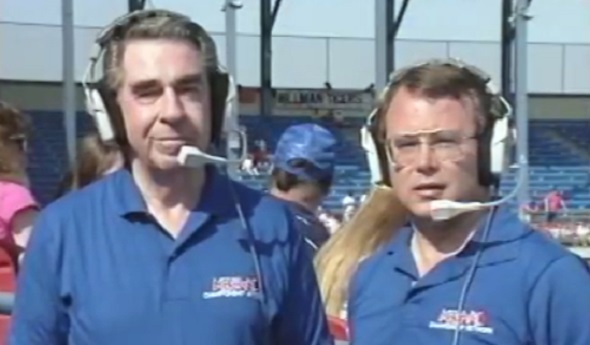
He spent high school games over the years sitting next to legends like the Free Press’ Hal Schram and remembers when current Free Press longtime scribe Mick McCabe was just a rookie. One of Carey's final broadcasts was a 1992 Baseball Final with his nephew Mike Carey, who continues to broadcast MHSAA championship games to this day.
“I am eternally grateful to Paul Carey. His contribution to high school sports in Michigan has been great and significant,” Atkins said.
“We are lucky to have him.”
PHOTO: Paul Carey (left) and nephew Mike Carey broadcast the MHSAA 1992 Class D Baseball Final between Hillman and Athens for PASS.
TC West Ace Finishing Dy-namite Finals Run
October 19, 2018
By Chris Dobrowolski
Special for Second Half
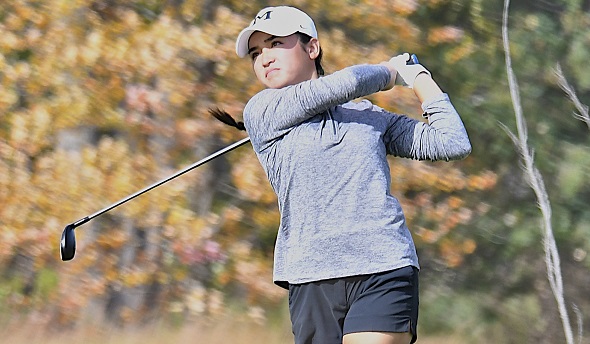
TRAVERSE CITY — Anika Dy already has cemented her legacy as one of the greatest female high school golfers in state history.
Still, she continues to add to that decorated career as she winds down her senior season at Traverse City West.
 Dy, the winner of the state coaches association’s Miss Golf Award the last two years, is the two-time reigning MHSAA Lower Peninsula Division 1 medalist and has been the Titans’ top performer on two team state title runs. She caps off her last season for West this weekend at Bedford Valley Golf Course in Battle Creek when she and the Titans look to sweep the team and individual championships for the second straight year.
“I don’t think it’s quite hit me yet. It doesn’t feel like it’s ending, that’s for sure,” said Dy. ““I think I’ll be on a high of emotions. I’m going to come home and probably realize that it’s all over and start reflecting on these four years.”
What a four years it’s been, too.
Dy announced her arrival on a statewide level her freshman year when she was one of only three golfers to break 80 on the first day of action at the 2015 Lower Peninsula Division 1 Final at The Meadows at Grand Valley State. But her chance to finish first was dashed when she three-putted the last hole and closed with a two-day total of 156 — one shot behind Brighton’s Julia Dean, who came from five strokes back over the last 18 holes.
“That really, really stung,” said Dy. “I came back that next year wanting it really bad.”
Since then she’s been unbeatable on the state’s biggest stage, shooting a 143 (72-71) to redeem herself and card the low score by two strokes over Clarkston’s Meghan Deardorff at the 2016 Final at Forest Akers East. She repeated in resounding fashion last year at The Meadows course when her 141 (69-72) put her eight shots in front of Rochester’s Savannah Haque.
As satisfying as those individual victories have been, Dy has been more fulfilled by the team success the Titans have enjoyed. She calls West’s championship her freshman year her most vivid memory from the past four.
“Just because it was so unexpected,” she said of a title the Titans won over Rochester that came down to a fifth counter tiebreaker. “There is a difference for me (between individual and team success). It’s so much more fun when it’s with the team.”
Dy started playing golf at age 6 and surged to an elite level as a model of consistency and with an unequivocal work ethic.
“She has a love for the game and works very hard,” said Scott Wilson, the club pro at Bay Meadows Golf Course in Traverse City who has coached Dy for the past eight years. “She’s always been very consistent. She’s been consistent in her ball striking, and she has a great short game.”
Dy honed her game through Wilson’s junior elite program, first at Crystal Mountain and then at Bay Meadows. She’s maintained a challenging summer tournament schedule as well, taking part in a number of high-caliber events, including the Michigan Women’s Amateur, the Michigan Women’s Open and several USGA qualifiers.
 “We’ve always tried to set her up in tournaments that would be challenging to her, almost a little over her head even,” said Wilson. “She’s excelled at every level.”
Dy also has helped spur increased interest in the sport within her school as the Titans’ roster ballooned to 17 players this year on the heels of last year’s Division 1 title.
“She’s put Traverse City West on the map,” said West head coach Karl Gagnon. “She’s helped influence a lot of kids to take up golf. Success breeds success. Kids want to be around programs that are successful.”
Dy has emerged as one of the leaders of that squad, along with fellow seniors Jillian Ellul, Hope Aspenleiter and Evelyn Krueger.
“This year it’s definitely been a challenge to be that leader,” she said. “I’ve had great seniors to look up to my past three years. It was a little tricky at first because we doubled the size of our team from last year. There were a lot more new girls who needed a lot of direction, but it’s been fun getting to know them and watching them grow into better players.”
Those new responsibilities haven’t had a negative affect on Dy’s game. She’s been regularly shooting in the upper 60s and near 70 and has finished as the medalist at every meet this season except one — when her younger sister Anci, a sophomore, beat her at an invitational in Alpena. Anci Dy, a tremendous golfer in her own right, was the Regional runner-up last week after finishing seven strokes behind her sister.
Anci admits it’s bittersweet to see her sister finishing out her high school career.
“It’s going to be our last high school tournament together, and I really want all of us to succeed,” Anci said. “I’m really excited to play on the team with her one last time.”
Next year Anika Dy will head to the University of Michigan for the next stage of her playing career.
“She’s going to a great school,” said Gagnon. “The coaches at Michigan are excited to have her. She’s going to be an asset for them from the very beginning. It’s a progression. She’s accomplished everything she’s going to accomplish in high school. It’s time to see what she can do at a different level.”
As for where golf could take Dy into the future, Wilson said the sky is the limit for his star pupil.
“She’s going to continue to try and put her skills to the test and see where it goes from there,” said Wilson. “It’s all up to her how far she wants to take it.”
 Chris Dobrowolski has covered northern Lower Peninsula sports since 1999 at the Ogemaw County Herald, Alpena News, Traverse City Record-Eagle and currently as sports editor at the Antrim Kalkaska Review since 2016. He can be reached at [email protected] with story ideas for Manistee, Wexford, Missaukee, Roscommon, Ogemaw, Iosco, Alcona, Oscoda, Crawford, Kalkaska, Grand Traverse, Benzie, Leelanau, Antrim, Otsego, Montmorency, Alpena, Presque Isle, Cheboygan, Charlevoix and Emmet counties.
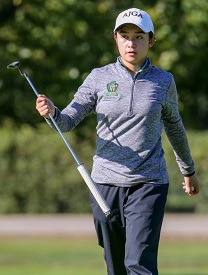
PHOTOS: (Top) Traverse City West’s Anika Dy watches a drive during last season’s Lower Peninsula Division 1 Finals. (Middle) Dy leaves the green after finishing a hole during her 2016 championship run. (Click to see more from HighSchoolSportsScene.com.)