

Powerful Voice for High School Sports
December 19, 2014
By Geoff Kimmerly
Second Half editor
Paul Carey was home from the U.S. Army only a few months and just shy of 25 years old when Beal City embarked on its first trip deep into the MHSAA boys basketball tournament.
On the call for local radio station WCEN from gyms at Saginaw Arthur Hill and Lansing Sexton, Carey served as the voice of the previously “laughable” Aggies as they reached the Class D Semifinals before falling just six points short of playing for the title.
“All of Beal City emptied out. They’d never had anything before,” Carey recalled during his annual Thanksgiving weekend visit to the MHSAA Football Finals at Ford Field. “When I got home, within the next two weeks I got a letter from every citizen of Beal City thanking me for broadcasting their games. That’s the kind of appreciation that meant so much.”
During 42 years on the airwaves, Carey was best known as a voice of the Detroit Tigers bounding out of transistor radios all over Michigan, thanks to WJR’s powerful signal.
But for the state’s high school sports community, his legacy is similarly memorable as the voice of the longtime football and basketball scoreboard show and a voter for various all-state teams and wire polls over the decades.
Now 86 and retired since 1991, Carey remains a regular during the first day of the Football Finals, taking in games he broadcast for the MHSAA during the late 1970s and that continue to hold his eye as they have for more than a half-century.
“It was a passion of mine. High school sports always has been,” Carey said. “I think because my dad was a high school coach, and teacher initially, and my brother was a high school coach and teacher, I just grew up in families that appreciated coaching and athletics. I was not a great athlete, but it kept my hand in following sports that way.”
Now, the scores
Carey partnered with Ernie Harwell for Tigers radio broadcasts from 1973-91, including during the march to the 1984 World Series championship. He was named Michigan Sportscaster of the Year six times and to the Michigan Sports Hall of Fame in 1992.
But Carey’s early career included sitting on top of a car, plugged into a phone pole, for a Sacred Heart football game at old Fancher Field just a few blocks from his family’s Mount Pleasant home. Among many more accolades are a Distinguished Service Award from the Michigan High School Coaches Association and a place in the Basketball Coaches Association of Michigan Hall of Fame.
In fact, the start of his weekly announcing of statewide football and basketball scores preceded his baseball career by 16 years and ended two months after he announced his final professional out.
The Michigan High School Scoreboard show was a staple of WJR’s late Friday nights from 1957-91. Carey would read every score he could collect from a variety of sources, often organized by league and with state rankings and context mixed in.
His idea came from something similar read by Len Colby for Kalamazoo’s WKZO. Carey’s brother Terry was coaching at Niles during the second half of the 1950s, and he and other coaches would get together to listen to the Friday night scores from the southwestern part of the state.
Carey, who left WKNX in Saginaw for WJR in 1956, explained to then-sports director Bob Reynolds that the station’s strong signal could provide for a truly statewide scoreboard experience.
Carey then connected with Edgar Hayes of the former Detroit Times, who gave the OK for Carey to call the paper on Friday nights to get scores from the Detroit metro area. For the rest, Carey relied on wire services – there were three at the time – who relied on newspapers from all over Michigan to call in scores over the course of an evening.
Before every Friday during high school football season – and later Tuesdays and Fridays during boys basketball season – Carey typed up lists of games based on schedules in the newspaper, with spaces to add scores. More than a few times, Carey raced down a back ramp at Tiger Stadium after a Friday night game, back to the WJR studio, with 15 minutes to prep for the show’s 11:30 p.m. start.
“If the Flint Journal, the Grand Rapids Press, the Traverse City paper didn’t call in scores to the AP, then I was out of luck too. And that happened all the time,” Carey said. “I would call back occasionally, say, ‘Did you get anything more?’ It was a rat race.”
The show originally was set for 10 minutes and then extended to 15. American Airlines sponsored a record show that followed, and Carey’s scoreboard show had a sponsor only once in 35 years. Finishing up on time was expected, even with more than 200 scores to read.
But Carey said he always went 20 minutes, sometimes 25.
“Because I wasn’t done. I just kept right on going,” Carey said. “Jay Roberts did the all-night show most of the time, and he was patient with me. He didn’t say too much on the air about ‘that guy ahead of me took all of my time.’”
Carey continued the “rat race” until his final scoreboard show, Dec. 20, 1991. He retired from WJR at the end of that calendar year. And it's important to note: Carey was never paid a dime extra for doing the program. .
“I think Paul is really just a sports fan, and that came across to the listener on his broadcasts,” MHSAA historian Ron Pesch said. “Paul would gather as much as possible off the wire. He'd interject if scores were missing from sections of the state. Press polls from the Free Press, News, AP and UPI were big, so he could point out close calls and upsets.
“He provided immediacy, or the closest thing to it in the days before cable TV and the Internet, and because of his scoreboard show, you could get the results before the morning paper. For listeners, he brought life to something as simple as game scores.”
First team all the way
Carey, who resides in Rochester, also served as the engineer on Tigers broadcasts for 16 years, through 1990. He broadcast Pistons games on the radio for six seasons and did the first broadcast of a Central Michigan University football game, in 1949.
Harry Atkins, covering Detroit’s teams while with The Associated Press for 29 years including the last 21 as its sports editor for Detroit, took note of his colleague's hard work – and especially that Carey was one of few broadcasters who was a journalist in addition to a voice.
That made Carey's other major role in high school sports a natural fit.
Atkins split The Associated Press all-state selection panels for football and basketball into 11 regions, and Carey represented the Detroit area for a number of years. He also was a longtime voter in those sports' weekly polls.
“Paul is just that kind of guy. He thought it was important and he made time in his busy schedule to do it,” Atkins said “And it had an impact on the other 10 voters on the All-State panels, too.
“Some of them were from small out-state newspapers or radio or TV stations. Yet every one of them knew who Paul Carey was. And when he spoke, of course, with what often is called "The Voice of God," those voters paid attention.”
And he still does, as well.
At the end of each fall, Carey still puts together a compilation of the three high school all-state football teams – Associated Press, Detroit Free Press and Detroit News – and files them with years of research and results.
“It’s important to me. Nobody sees it but me, but I get a certain kick,” Carey said. “Once in a while I’ll see a kid playing at Central, Western or (Michigan) State or Michigan, and they’ll say he came from Clawson. I’ll go into my all-state collections, say that would’ve been 2009 he played, and I find a name.”
In addition to the Football Finals on WJR, Carey was part of the Baseball Finals broadcasts into the early 1990s, continuing to contribute even after his retirement from his fulltime gig.
He spent high school games over the years sitting next to legends like the Free Press’ Hal Schram and remembers when current Free Press longtime scribe Mick McCabe was just a rookie. One of Carey's final broadcasts was a 1992 Baseball Final with his nephew Mike Carey, who continues to broadcast MHSAA championship games to this day.
“I am eternally grateful to Paul Carey. His contribution to high school sports in Michigan has been great and significant,” Atkins said.
“We are lucky to have him.”
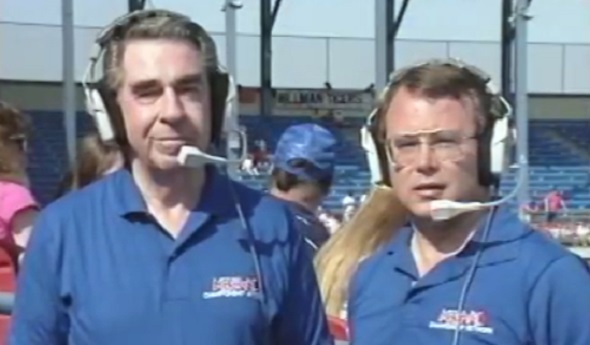
PHOTO: Paul Carey (left) and nephew Mike Carey broadcast the MHSAA 1992 Class D Baseball Final between Hillman and Athens for PASS.
Flashback: Midland Makes '68 Title Play
August 26, 2018
By Ron Pesch
Special for Second Half
It was a sunny, cool late August morning as high school football practice kicked off around the state. The Detroit Tigers were in the midst of a four-game losing streak, their longest to date that World Series-winning season. With 32 games to go, their lead over the Baltimore Orioles was cut to five in the race for the 1968 American League pennant.
Hal Schram, Michigan’s revered prep sports writer, kicked off the start of the season with a trip north. He was on a mission designed to tie up loose ends.
Schram had been covering high school sports in the Great Lakes State since 1941 and began his days at the Detroit Free Press in January of 1945. He had named the 1967 Bay City Central team Michigan’s top Class A squad the previous November. After posting a 9-0-0 season, the school was scheduled to receive a trophy from the newspaper signifying the achievement. However, in mid-November, Detroit’s newspapers began a 267-day strike – the longest in history at the time – that interrupted a planned presentation.
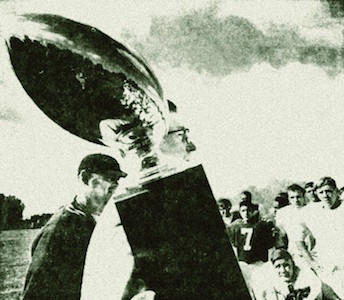
So on Monday, August 25, 16 days after the end of the strike, Schram headed to Bay City. There, he visited with coach Elmer Engel and his staff, then handed off the impressive award before a group of 220 football hopefuls who reported for practice.
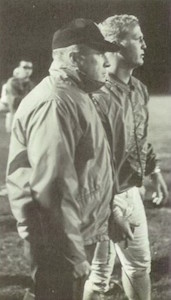
 “It should give us added impetus in the weeks ahead,” said the veteran coach, accepting the trophy. This wasn’t a first for Engel and his squads. Entering his 19th year as head coach at Bay City, he had turned the Wolves into a state powerhouse. Back in the days before a postseason tournament, Central had edged unbeaten Battle Creek Central and seven other unbeaten and untied teams in the annual Free Press poll for the 1965 gridiron championship. In 1958, The Associated Press had named his squad the mythical state titlist. His teams had posted 129 wins against only 29 defeats and four ties since his arrival in 1950.
At age 25, Engel had enlisted in the Marines. As a 25-year-old second lieutenant he led his troops “in one of the most desperate, and bloody, battles of World War II – Iwo Jima.” Previously, he had earned three football letters at the University of Illinois and was the team’s MVP in 1942.
In baseball circles, 1968 has been called “The Year of the Pitcher.” On September 14, Detroit’s Denny McLain became the first hurler to win 30 games since Dizzy Dean in 1938. Bob Gibson, star of the St. Louis Cardinals rotation, turned in a 1.12 earned run average, the lowest in the Major Leagues since 1914.
The year 1968 also has been called “The Year that Shattered America.” With the assassination of Dr. Martin Luther King Jr. in April in Memphis, riots broke out in more than 100 cities across the United States. Protests continued to rage across the country over the war in Vietnam. Demonstrations, peaceful and violent, were raised around the world in support of civil rights.
The world was changing; by year’s end, Shirley Chisholm had become the first black woman elected to U.S. Congress. At Yale, moves were made to finally admit female undergraduates. In December, three astronauts aboard Apollo 8 became the first humans to orbit the moon.
High School football season began tragically in Michigan. Only a day before prep season openers, 17-year-old senior Jerry Knight died from a brain injury suffered in a scrimmage. Jerry and his twin brother, Pat, were scheduled to start in the backfield for Grand Rapids Catholic Central. It was reported that this was the first reported football death in the city of Grand Rapids since 1926. In total, 26 football players in middle school or high school across the nation would die that season, a peak that would spur slow changes within the sport.
The reigning Class A champs began the 1968 season at No. 1 in the state’s three prep football polls, published by Schram in the Free Press and the state’s wire services, The Associated Press (AP) and United Press International (UPI) following the second game of the season.
Only days before, the Tigers had clinched the pennant. Three weeks into the high school season, Bay City Central, with victories over a pair of Flint area schools and Saginaw Arthur Hill, remained firmly planted at the top. Battle Creek Central, winner in 32 of its last 33 games, was ranked No. 2, while Detroit Denby, the 1963 Free Press champion, was ranked third.
While the Tigers and St. Louis, the National League pennant winner, were preparing for their World Series opener, Schram was dealing with an overzealous fan as prep teams readied themselves for the fourth week of the season.
“This is the week we make your ratings look sick,” said a long-distance caller from Midland. “I’m telling you we’re going to run down your No. 1 team at Bay City Central. We’ve run three-straight and you’ve never even given us a courtesy call.”
 “The man’s right about one thing,” said Schram in his weekly column highlighting the top contests from around the state. “The Midland-Bay City Central game Friday night certainly rates a top berth among Top Ten Games of the Week. … While Friday’s game with the defending state champions is of primary importance, the Midland team can’t be blamed for taking a quick peak on their TV sets at the World Series. One of their former All-State quarterbacks, Larry Jaster, just might be pitching for St. Louis against the Tigers.”
No doubt to the joy of the caller, Midland ruined Bay City’s homecoming with a 12-7 win before a crowd of 7,000. With the loss, the Wolves fell to seventh in Schram’s rankings while Midland’s Chemics made their first appearance, entering the Free Press list at No. 4. With Bay City’s loss, Battle Creek Central, the 1966 Class A champ, moved to the top spot across the state’s three polls.
Just a year before, Battle Creek had been in the same position. Like Bay City, the Bearcats had followed their 1966 title by opening the next season ranked No. 1. Riding a 27-game win streak dating back to November of 1964, Battle Creek saw the run end in the eighth week of the 1967 season when 6-A Conference rival Kalamazoo Central nipped the Bearcats, 7-6, on a rainy, windy night at Kalamazoo College’s Angel Field.
“We’re not a holler team,” Battle Creek Central coach Jack Finn said to the Free Press sports editor, Joe Falls, prior to that Kalamazoo game. “We try to keep our kids at an even keel. No, we try to keep the emotion out of it.”
Following the contest, “Finn was pacing the room like a grizzly bear,” wrote Falls.
“‘That’s part of growing up’ he said.
“’Look at these kids – they never lost before. They don’t know how to take it.’”
“Finn consoled one player, then walked back across the room. ‘A test for the kids?’ he said, finally managing a weak smile. ‘This is a test for me. The last time we lost I woke up in the morning and vowed I’d never coach again.’”
Both Finn and Falls knew that defeat was an integral part of kids growing up.
But with Battle Creek’s loss, Bay City moved to the top spot. A week later, the Wolves picked up their ninth win, and with it, the 1967 mythical state crown.
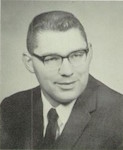 Finn’s 1968 Bearcats had started the season slowly, downing Benton Harbor 14-0 in the season opener and then surviving an early-season scare on the road with Ann Arbor Huron, 6-0, before knocking off conference foe Lansing Eastern in the season’s third week, 27-6. Grinding out 455 yards on the ground, the Bearcats mauled East Lansing, 41-0, in Week 4.
“We were a very balanced team with lots of very good players, but no great ones,” recalled Terry Newton, a first team all-state choice at center in 1968. “We were kind of unheralded with a very tough defense.”
“This is perhaps the best balance squad (Coach) Finn has ever led into a season,” wrote Schram at the time, announcing the change at the top of his Class A poll. “Against East Lansing, Battle Creek used eight running backs almost of equal stature. John Simms, a junior who doesn’t even start, has rushed for 233 yards in 21 carries in his last two games. He’s one of southern Michigan’s foremost breakaway runners.”
On Thursday, October 10, the Detroit Tigers clinched Game 7, 4-1, to win the World Series. The following evening beneath the lights of Memorial Stadium, the Bearcats had their hands full in a game played in Lansing.
“For at least one night, Sexton was the equal of Michigan’s No. 1 prep football team, Battle Creek Central,” wrote Dave Matthews in the Lansing State Journal. “It didn’t work out quite that way on the scoreboard, Battle Creek rallying for a 14-13 decision … but the final tally could not erase a stirring upset attempt by the Big Reds.”
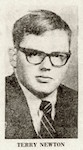 Late in the contest, Battle Creek took advantage of an injury to Lansing Sexton’s all-city tackle, Tom Bush. According to the Journal, the Bearcats pounded the left side on nine out of 10 plays, driving 65 yards, with Simms scoring from two yards out with 2:01 remaining in the contest to knot the score. Ernest English kicked the extra point to give Battle Creek its first lead of the game. Prior to Bush’s departure, the Bearcats had been held to a single first down in the second half.
Midland, with a convincing 48-6 triumph over Saginaw Arthur Hill, was now entrenched at No. 2 and nipping at the heels of the Bearcats in the Associated Press and United Press polls. The AP rankings were based on a “10 points for first, nine for second, eight for third, and so on” voting system by state sportswriters and sportscasters. The UPI rankings were compiled based on the votes of a panel of 17 football coaches from across the state. Schram still ranked Midland at No. 4, trailing Battle Creek, but noted that the Chemics and their coach Bob Stoppert had an outside chance at their second state title in 11 years.
“That would be nice, but we’re not ready to debate such matters,” the 51-year old Stoppert said to Schram as teams headed to Week 6 of the season. “I’m too old to be impressed by the polls. I know the fans and the kids like them, but they’re a nuisance as far as a coach is concerned. If you fellows would wait until the end of the season to rate your teams, I wouldn’t have any objections. But I know you’re not going to listen to that.”
No changes occurred that week, as the Bearcats trounced 6-A conference foe, Jackson, 56-0 and Midland rolled over Saginaw Valley Conference opponent Alpena, 38-0. A loss by Grand Rapids Union boosted the Chemics to third in Schram’s rankings.
Battle Creek squared off against Ann Arbor Pioneer, ranked No.5 in the polls by both AP and UPI in Week 7.
With Battle Creek trailing the Pioneers 7-0 at the half, Jim Roebuck nailed a 34-yard field goal in the third quarter to make it 7-3. A huge goal-line stand late in the fourth quarter by Pioneer appeared to seal an upset, but three successive stops by the Bearcats’ defense prevented Ann Arbor from running out the clock. Following the punt, Battle Creek took over on the Pioneers’ 42 with 2:30 to play. A touchdown by Simms with 1:18 left gave the Bearcats a 9-7 victory.
United Press voters were impressed with the comeback and kept Battle Creek at No. 1, rewarding the Bearcats with a widening point gap between first and second place in their poll. Midland had downed league opponent Flint Northern, 28-12, and, in the eyes of AP voters, the Bearcats and Chemics were now tied for No. 1 as the season headed for the finish line.
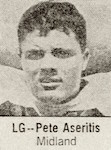
 “In those days, the Saginaw Valley was considered perhaps the toughest conference in the state,” said Peter Aseritis, who captained the Chemics in 1968. “Back then, eight of our nine games were against conference opponents.”
The Bearcats avenged the previous year’s loss to Kalamazoo Central, 31-7, while Midland downed Bay City Handy 27-7 in Week 8. While the Free Press and UPI kept Battle Creek on top, AP voters pushed the Chemics to No. 1 in their list by a single poll point.
Prior to season’s end, Schram set the stage for football fans across the state.
“While close to 7,000 fans are expected at Post Field for this (week’s) intra-city showdown (between Battle Creek Central and Battle Creek Lakeview), Midland goes after its first perfect season since 1957 at Saginaw where another crowd of 6,000-plus is anticipated. At stake will be the Saginaw Valley League title. Midland holds the No. 3 rating in the state and Saginaw is ranked No. 4.”
“This is the greatest gang of seniors we ever have had at Central … they never gave up … yes, I definitely feel that we are No. 1 in the state,” said Coach Finn to Bill Frank of the Battle Creek Enquirer “as he came dripping out of the shower, clothes and all” following Central’s 19-7 win over Lakeview. It was the third perfect season for the Bearcats in four years, and only the fourth perfect campaign in school history.
Midland defeated Saginaw 20-13.
“There was some violence after the game,” noted Aseritis. “Some fans were upset. Rocks were thrown at our bus; some windows were broken.”
Both the Detroit Free Press and the United Press International season-ending polls named Battle Creek at No. 1. The Associated Press saw it differently, awarding Class A’s mythical crown to Midland while placing the Bearcats tied for third with Ferndale. Unbeaten in eight games, Detroit Denby finished second in the AP rankings, compiling 131 poll points to Midland’s 135. Midland received seven first place votes to three for Denby. Battle Creek ended with 129 points and five first-place votes.
Without the structure of a playoff system, there was no chance that the two top-ranked teams would meet on the gridiron.
 “There is a certain level of charm to the time of mythical state titles. Winning a conference championship was much more important back before the arrival of the playoffs and today’s focus on six wins,” said Newton, who went on become athletic director at Battle Creek St. Philip, a member of the Battle Creek Parks and Recreation department and the radio voice of prep sports in Battle Creek as host of ‘Coach’s Corner’ on WBCK for more than 25 years.
“It was a great time at Battle Creek Central. We had a lot of winning tradition,” continued Newton. “For five or six years, Bay City and Battle Creek dominated (Class A) football. I think that some voters fell in love with Midland that year, and that split the vote. But we were the champs according to Hal Schram. That was the big one. He really was the state’s top prep sportswriter.”
“On the weekend of October 12th and 13th back in Midland, the team will reunite to celebrate the 50th anniversary of their title. On Friday, the school plans to honor us during the game,” said Aseritis, who also earned first team all-state honors in 1968. “I won’t make it back for that. My son is a senior at Elk Rapids. He has a game and I plan to be there, but I expect to be in Midland on Saturday for our reunion. As players we got a piece of it.
“Back then, it was ground and pound; a real physical game. Today, the game is wide open and space. Of course, back then we only had to play nine games. You got to hand it to those who get to the state title game today. Now, kids have to play 14.
“We had it easy,” he added, laughing.
Fifty years down the road for both men, the camaraderie and chance to learn to work with others toward a common goal still stand out from those days.
“Yes, I recall certain days from my career,” added Aseritis, a former Marine Corps captain who traveled the world as a financial analyst and consultant. “My times playing high school football, college football and my years in the military are the days that mean the most. Those are lifetime memories.”
“Within the football program, the issues of the times never really came up,” said Newton reflecting on his days at Battle Creek Central. “The coaches never talked about it. They were focused on blocking and tackling. The players were focused on school and football. Our team came together from four different junior high schools at Central; it was a mixed community, maybe 50 percent black and 50 white.
“We had to come from behind a few times that season. That’s where you learn to work with other people; how to handle adversity and success, and deal with challenges. We had great camaraderie, and that allowed us to have the success we had.”
After stints at Dansville, Hudson and Coldwater high schools, Finn held the football reigns at Battle Creek Central for 11 years. He stepped aside following the 1968 season to take on the dual role of athletic director and head football coach at Northwood Institute in Midland. At Northwood, he helped found the Great Lakes Intercollegiate Athletic Conference. He retired as the school’s football coach following the 1986 season and as AD in 1989. He died in 2013.
Elmer Engel and his Bay City squad again would grab the Class A title in 1969 and in 1972. He retired after the 1972 season with a 165-34-8 record and five mythical state titles. In 1973, the school chose to rechristen its football stadium in his honor in recognition of his incredible success. The classic concrete structure was built in 1925. Engel died in 2006 at age 86.
Stoppert stepped aside following the 1974 season. A Flint Northern graduate, he had coached briefly at Flint Bendle and Rockford before being named head football coach at Midland in 1953. The Chemics posted 128 victories, 58 losses, six ties and two mythical gridiron championships during that span. He died in 2003.
 Ron Pesch has taken an active role in researching the history of MHSAA events since 1985 and began writing for MHSAA Finals programs in 1986, adding additional features and "flashbacks" in 1992. He inherited the title of MHSAA historian from the late Dick Kishpaugh following the 1993-94 school year, and resides in Muskegon. Contact him at [email protected] with ideas for historical articles.
PHOTOS:
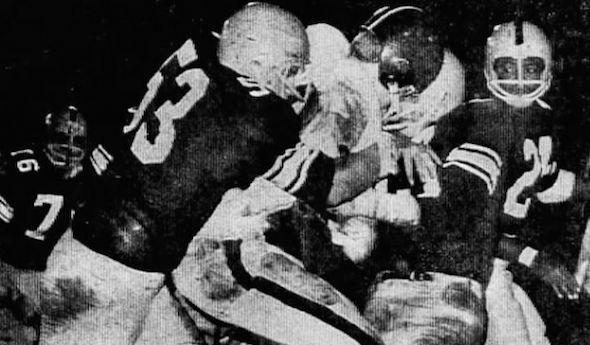
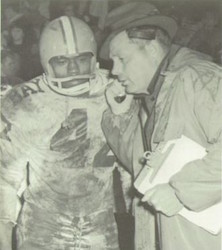
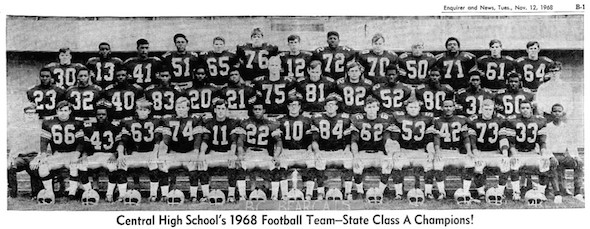
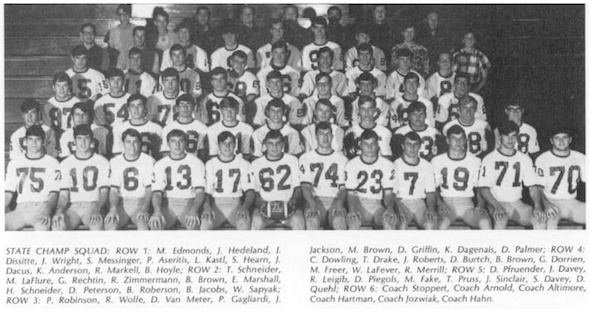
(Top) Battle Creek Central’s Terry Newton (53) and Jim Roebuck tackle Battle Creek Lakeview’s Dave Roberts during their 1968 game. (2) Hal Schram presents Bay City Central with the 1967 Detroit Free Press Class A championship trophy. (3) Bay City Central coach Elmer Engel and a player during the 1967 season. (4) Battle Creek Central coach Jack Finn. (5) Battle Creek Central’s Terry Newton. (6) Midland coach Bob Stoppert. (7) Midland’s Pete Aseritis. (8) Battle Creek Central’s 1968 championship team. (9) Midland’s 1968 championship team. (Photos gathered by Ron Pesch.)