

Powerful Voice for High School Sports
December 19, 2014
By Geoff Kimmerly
Second Half editor
Paul Carey was home from the U.S. Army only a few months and just shy of 25 years old when Beal City embarked on its first trip deep into the MHSAA boys basketball tournament.
On the call for local radio station WCEN from gyms at Saginaw Arthur Hill and Lansing Sexton, Carey served as the voice of the previously “laughable” Aggies as they reached the Class D Semifinals before falling just six points short of playing for the title.
“All of Beal City emptied out. They’d never had anything before,” Carey recalled during his annual Thanksgiving weekend visit to the MHSAA Football Finals at Ford Field. “When I got home, within the next two weeks I got a letter from every citizen of Beal City thanking me for broadcasting their games. That’s the kind of appreciation that meant so much.”
During 42 years on the airwaves, Carey was best known as a voice of the Detroit Tigers bounding out of transistor radios all over Michigan, thanks to WJR’s powerful signal.
But for the state’s high school sports community, his legacy is similarly memorable as the voice of the longtime football and basketball scoreboard show and a voter for various all-state teams and wire polls over the decades.
Now 86 and retired since 1991, Carey remains a regular during the first day of the Football Finals, taking in games he broadcast for the MHSAA during the late 1970s and that continue to hold his eye as they have for more than a half-century.
“It was a passion of mine. High school sports always has been,” Carey said. “I think because my dad was a high school coach, and teacher initially, and my brother was a high school coach and teacher, I just grew up in families that appreciated coaching and athletics. I was not a great athlete, but it kept my hand in following sports that way.”
Now, the scores
Carey partnered with Ernie Harwell for Tigers radio broadcasts from 1973-91, including during the march to the 1984 World Series championship. He was named Michigan Sportscaster of the Year six times and to the Michigan Sports Hall of Fame in 1992.
But Carey’s early career included sitting on top of a car, plugged into a phone pole, for a Sacred Heart football game at old Fancher Field just a few blocks from his family’s Mount Pleasant home. Among many more accolades are a Distinguished Service Award from the Michigan High School Coaches Association and a place in the Basketball Coaches Association of Michigan Hall of Fame.
In fact, the start of his weekly announcing of statewide football and basketball scores preceded his baseball career by 16 years and ended two months after he announced his final professional out.
The Michigan High School Scoreboard show was a staple of WJR’s late Friday nights from 1957-91. Carey would read every score he could collect from a variety of sources, often organized by league and with state rankings and context mixed in.
His idea came from something similar read by Len Colby for Kalamazoo’s WKZO. Carey’s brother Terry was coaching at Niles during the second half of the 1950s, and he and other coaches would get together to listen to the Friday night scores from the southwestern part of the state.
Carey, who left WKNX in Saginaw for WJR in 1956, explained to then-sports director Bob Reynolds that the station’s strong signal could provide for a truly statewide scoreboard experience.
Carey then connected with Edgar Hayes of the former Detroit Times, who gave the OK for Carey to call the paper on Friday nights to get scores from the Detroit metro area. For the rest, Carey relied on wire services – there were three at the time – who relied on newspapers from all over Michigan to call in scores over the course of an evening.
Before every Friday during high school football season – and later Tuesdays and Fridays during boys basketball season – Carey typed up lists of games based on schedules in the newspaper, with spaces to add scores. More than a few times, Carey raced down a back ramp at Tiger Stadium after a Friday night game, back to the WJR studio, with 15 minutes to prep for the show’s 11:30 p.m. start.
“If the Flint Journal, the Grand Rapids Press, the Traverse City paper didn’t call in scores to the AP, then I was out of luck too. And that happened all the time,” Carey said. “I would call back occasionally, say, ‘Did you get anything more?’ It was a rat race.”
The show originally was set for 10 minutes and then extended to 15. American Airlines sponsored a record show that followed, and Carey’s scoreboard show had a sponsor only once in 35 years. Finishing up on time was expected, even with more than 200 scores to read.
But Carey said he always went 20 minutes, sometimes 25.
“Because I wasn’t done. I just kept right on going,” Carey said. “Jay Roberts did the all-night show most of the time, and he was patient with me. He didn’t say too much on the air about ‘that guy ahead of me took all of my time.’”
Carey continued the “rat race” until his final scoreboard show, Dec. 20, 1991. He retired from WJR at the end of that calendar year. And it's important to note: Carey was never paid a dime extra for doing the program. .
“I think Paul is really just a sports fan, and that came across to the listener on his broadcasts,” MHSAA historian Ron Pesch said. “Paul would gather as much as possible off the wire. He'd interject if scores were missing from sections of the state. Press polls from the Free Press, News, AP and UPI were big, so he could point out close calls and upsets.
“He provided immediacy, or the closest thing to it in the days before cable TV and the Internet, and because of his scoreboard show, you could get the results before the morning paper. For listeners, he brought life to something as simple as game scores.”
First team all the way
Carey, who resides in Rochester, also served as the engineer on Tigers broadcasts for 16 years, through 1990. He broadcast Pistons games on the radio for six seasons and did the first broadcast of a Central Michigan University football game, in 1949.
Harry Atkins, covering Detroit’s teams while with The Associated Press for 29 years including the last 21 as its sports editor for Detroit, took note of his colleague's hard work – and especially that Carey was one of few broadcasters who was a journalist in addition to a voice.
That made Carey's other major role in high school sports a natural fit.
Atkins split The Associated Press all-state selection panels for football and basketball into 11 regions, and Carey represented the Detroit area for a number of years. He also was a longtime voter in those sports' weekly polls.
“Paul is just that kind of guy. He thought it was important and he made time in his busy schedule to do it,” Atkins said “And it had an impact on the other 10 voters on the All-State panels, too.
“Some of them were from small out-state newspapers or radio or TV stations. Yet every one of them knew who Paul Carey was. And when he spoke, of course, with what often is called "The Voice of God," those voters paid attention.”
And he still does, as well.
At the end of each fall, Carey still puts together a compilation of the three high school all-state football teams – Associated Press, Detroit Free Press and Detroit News – and files them with years of research and results.
“It’s important to me. Nobody sees it but me, but I get a certain kick,” Carey said. “Once in a while I’ll see a kid playing at Central, Western or (Michigan) State or Michigan, and they’ll say he came from Clawson. I’ll go into my all-state collections, say that would’ve been 2009 he played, and I find a name.”
In addition to the Football Finals on WJR, Carey was part of the Baseball Finals broadcasts into the early 1990s, continuing to contribute even after his retirement from his fulltime gig.
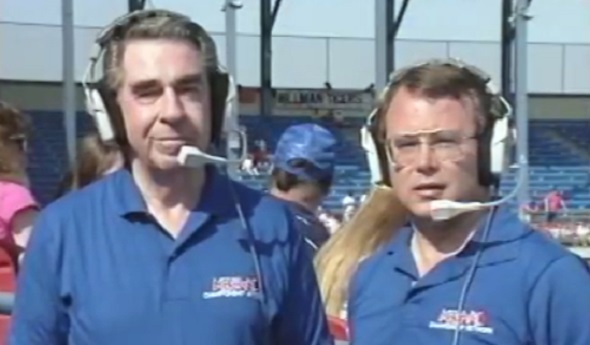
He spent high school games over the years sitting next to legends like the Free Press’ Hal Schram and remembers when current Free Press longtime scribe Mick McCabe was just a rookie. One of Carey's final broadcasts was a 1992 Baseball Final with his nephew Mike Carey, who continues to broadcast MHSAA championship games to this day.
“I am eternally grateful to Paul Carey. His contribution to high school sports in Michigan has been great and significant,” Atkins said.
“We are lucky to have him.”
PHOTO: Paul Carey (left) and nephew Mike Carey broadcast the MHSAA 1992 Class D Baseball Final between Hillman and Athens for PASS.
FHC's Hallock Shines in Green & White
August 22, 2018
By Dean Holzwarth
Special for Second Half
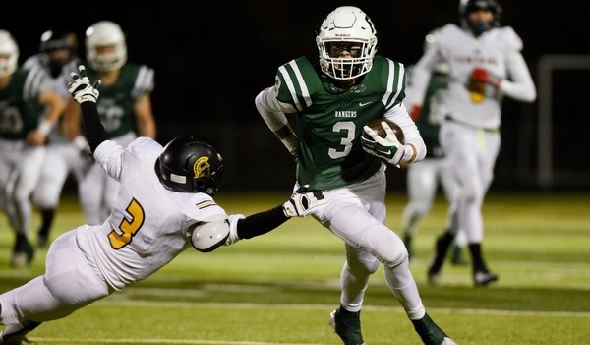
GRAND RAPIDS – It was pretty much a foregone conclusion that Tate Hallock would eventually wind up wearing green and white.
 The Grand Rapids Forest Hills Central senior receiver already has had plenty of success wearing those colors, and he’s always wanted to follow in the footsteps of his family members.
In June, Hallock verbally committed to sign with Michigan State’s football program. He will join his brother Tanner, a second-year walk-on who redshirted last year.
Hallock’s father, Ty, played at MSU from 1989-92 and was drafted by the Detroit Lions in 1993. Ty Hallock played eight seasons in the NFL with three teams (Detroit, Jacksonville and Chicago). Tate’s mother, Jennifer, also graduated from MSU.
“I think my whole life I knew I wanted to go to Michigan State,” said the 6-foot-4, 190-pound Tate, who also was recruited by Notre Dame and several Mid-American Conference schools.
“Obviously my brother plays there, so that was a huge factor, and overall the legacy of my family going to Michigan State played a huge role in that, too. My brother and I had a plan when we were younger that we were going to play together there, so I was able to get that opportunity and commit.”
The Spartans will get a playmaker who produced on both sides of the ball last season as the Rangers turned in one of the best in school history.
Forest Hills Central set a school record for wins, finishing 12-1 with the lone loss a shutout by Livonia Franklin in the Division 2 Semifinals.
 Hallock had 779 receiving yards and 10 touchdowns a year ago, while also recording 81 tackles on defense.
“He is a threat to score on every down on offense,” FHC coach Tim Rogers said. “He has excellent speed and can go up and take the ball away from most defensive backs. We will move him from free safety to strong safety this season. He’s always around the ball, and he’s a violent tackler.”
Tate Hallock is in daily contact with his brother, who played a major role in FHC’s resurgence two years ago as the starting quarterback.
Tanner Hallock helped lead the Rangers to a nine-win season and playoff berth in 2016.
“We are very close, and I talk to him every day,” Tate Hallock said. “We’re always keeping each other in line, and I’ve learned a ton from him. He was a huge leader two years ago, and he really helped put the program back on track.”
Tate Hallock was just born when his father retired from the NFL, but he’s been around football his entire life.
He credits his father for teaching him the game and providing encouragement when needed.
“My dad has really taught me everything, and he just talks to me about being a leader and playing my role,” Tate Hallock said. “He’s my best motivator and the one I really look up to.”
While Tate Hallock waits for his time in East Lansing, he’s excited to play one more high school season and build off last year’s historic run.
“I’m definitely looking forward to next year, but I’m glad I’m finally done with the recruiting process so I can focus on this year and bringing home something for FHC.”
Hallock will benefit from having his longtime friend around to throw him the ball.
Senior dual-threat quarterback Luke Majick returns to engineer a potent Rangers’ offense. He threw for 1,787 yards and 21 touchdowns last season while also rushing for 840 yards and 15 touchdowns.
“I think it’s very important that we’re both back, but definitely Luke, because you need a quarterback and he brought a lot to us last year,” Tate Hallock said. “I think that will be the key to our success this year.”
 Tate Hallock and Majick aren’t just teammates. They’ve known each other since elementary school and have developed a bond on and off the field.
It’s a connection that has enabled both of them to thrive.
“We’ve been best friends since fourth grade,” Tate Hallock said. “I think I’m capable of getting open, and he just knows where I am. We have good chemistry because he’s used to throwing me the ball.”
Majick echoed those sentiments, as both seem to always be in sync.
“We have great chemistry because we’re best buds, and I always know where he is going to be at on the field,” Majick said. “He’s so fast and tall, he makes my job a lot easier.
“Going to Michigan State has always been his dream, and I’ve been to a couple games with him. It seems that’s where his heart’s at, and I’m sure he’ll do great there.”
Tate Hallock hopes to prove last season wasn’t a one-time phenomenon. The Rangers have similar goals in mind, and ending the season at Ford Field instead of watching at home would be at the top of the list.
“I think you should prove something every year, and we definitely showed that last year and the year before,” he said. “The senior class really took a step forward last year, and now we need to take another step forward and show what we are all about.
“We definitely want to go undefeated during the regular season again and get to the state championship, but it’s really a day-by-day process starting with Jenison (on Thursday) and going from there.”
 Dean Holzwarth covered primarily high school sports for the Grand Rapids Press and MLive for 16 years and more recently served as sports editor of the Ionia Sentinel and as a sports photojournalist for WZZM. Contact him at [email protected] with story ideas for Allegan, Kent and Ottawa counties.
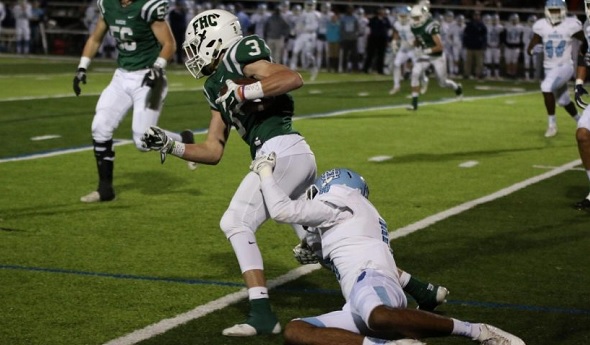
PHOTOS: (Top) Tate Hallock (3) turns up field looking for yardage last season against Traverse City Central. (Middle) Hallock works to pull away from a Muskegon Mona Shores defender. (Action photos courtesy of The Central Trend.)